

If you drink heavily most days and plan to stop, talk to a clinician before you quit, not after symptoms start. Most alcohol withdrawal is mild, but for some people it escalates to seizures or delirium, and the danger comes from stopping suddenly without medical support [NIAAA, 2025].
Up to half of people with alcohol use disorder get some withdrawal symptoms when they stop drinking, and a smaller group needs medical monitoring to get through it safely. NIAAA puts the toll at roughly 260,000 emergency department visits and 850 deaths a year in the U.S. [NIAAA, 2025]. The other side of those numbers is encouraging. Withdrawal responds well to treatment, and even its most severe form is now rarely fatal when it’s recognized and treated promptly [Canver et al., 2024].
Why alcohol withdrawal happens
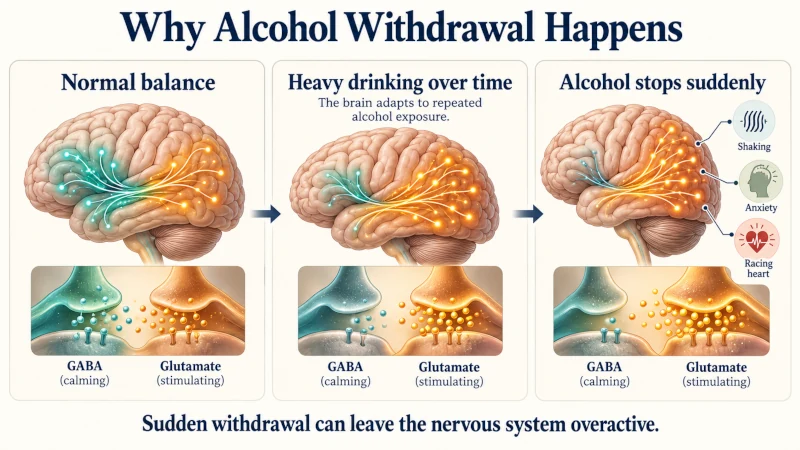
Alcohol slows the brain by boosting GABA, its main calming signal. With steady heavy drinking, the brain compensates: it turns down its own GABA activity and turns up glutamate, an excitatory signal. Take the alcohol away abruptly and the brain is left with too much accelerator and too little brake. The tremor, sweating, racing pulse, and sleeplessness of withdrawal come from that imbalance, and so do its most serious complications [Canver et al., 2024].
You don’t need a formal diagnosis to be at risk. Anyone with a pattern of heavy, regular drinking can go into withdrawal when they cut back sharply, not only when they stop completely [Canver et al., 2024].
Alcohol withdrawal symptoms
Early withdrawal can feel like a hangover that won’t lift, which is one reason people brush it off. The diagnostic criteria clinicians use list these signs [NIAAA, 2025]:
- Tremor – shaky hands, sometimes the whole body (“the shakes”)
- Sweating
- Faster pulse and higher blood pressure
- Insomnia
- Anxiety
- Nausea or vomiting
- Seizures
- Delirium tremens (withdrawal delirium)
Headache and an upset stomach are common in the first hours too [Canver et al., 2024], and many people feel irritable and low as the alcohol wears off [NIAAA, 2025]. If anxiety or low mood is hitting hard, our guide to recognizing anxiety and depression covers when those need care in their own right.
Hallucinations don’t always mean delirium
Some people see, hear, or feel things that aren’t there while still knowing where they are and what’s happening. That’s alcohol hallucinosis. It affects about 2% of people in withdrawal and usually clears within two to three days [Canver et al., 2024]. It still needs medical care. If hallucinations come with confusion or disorientation, treat it as possible delirium, which is an emergency.
Alcohol withdrawal timeline
Withdrawal follows a rough sequence, counted from the last drink. Timing varies from person to person, and clinical references differ slightly on the exact windows, so read this as a guide rather than a schedule.
| Time since last drink | What can happen |
| Within hours | Mild anxiety, headache, stomach upset, insomnia, and tremor can begin [Canver et al., 2024]. |
| 8 to 48 hours | The usual window for withdrawal seizures. A seizure can happen even when other symptoms seem mild [Canver et al., 2024]. |
| Days 1 to 3 | Hallucinosis may appear. Overall symptoms tend to peak around 72 hours [Canver et al., 2024]. |
| About day 3 to day 8 | The risk window for delirium tremens in the small minority who develop it [Canver et al., 2024]. |
| The weeks after | Acute symptoms have usually settled, but some people have a longer tail of anxiety and low mood while the brain’s stress systems recalibrate [NIAAA, 2025]. |
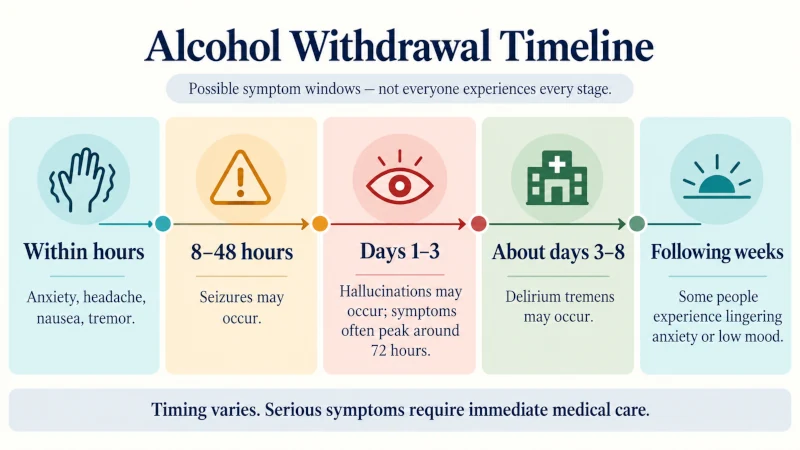
The practical point: feeling okay on day one doesn’t mean you’re through it. The most serious complications usually show up after the first day, which is why monitoring matters.
When alcohol withdrawal becomes an emergency
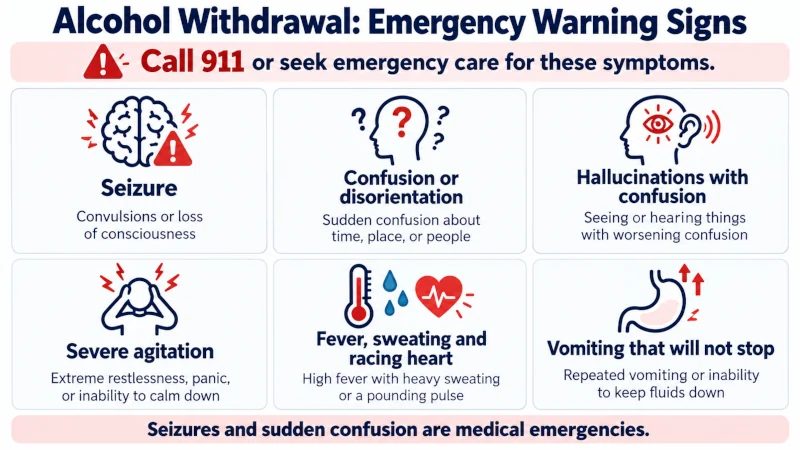
| Call 911 or go to an emergency department for any of these A seizure, even a brief one, even if the person seems fine afterwardConfusion, disorientation, or not knowing where they areHallucinations together with confusionSevere agitationFever with heavy sweating and a racing heartConfusion plus unsteady walking or abnormal eye movements (possible Wernicke’s encephalopathy)Vomiting so persistent that fluids won’t stay down Sources: [Canver et al., 2024]; [Day et al., 2013]. |
Delirium tremens
Alcohol withdrawal delirium, still widely called the DTs, is the severe end of the spectrum: confusion and disorientation, hallucinations, agitation, fever, drenching sweats, a racing heart, and high blood pressure. Only about 3% to 5% of people in withdrawal reach this stage. Historically, up to 20% of them died; with prompt diagnosis and modern intensive care, the figure is now around 1% [Canver et al., 2024]. It’s treated in hospital, often in intensive care. Our article on whether alcohol withdrawal can be fatal looks at those risks in more depth.
Withdrawal seizures
Alcohol-related seizures usually strike 8 to 48 hours after the last drink, sometimes with few other warning signs. They happen in people with no history of epilepsy. Anyone who has one is at risk of further seizures and of delirium, so a withdrawal seizure always needs emergency care [Canver et al., 2024].
Wernicke’s encephalopathy
This is the emergency people miss. Heavy drinking drains thiamine (vitamin B1): 30% to 80% of people who drink heavily show clinical or biochemical signs of deficiency. Severe deficiency can cause Wernicke’s encephalopathy, marked by confusion, unsteady walking, and abnormal eye movements, though not everyone has all three. Untreated, it kills up to 20% of people, and many survivors are left with lasting memory damage known as Korsakoff syndrome [Day et al., 2013].
That’s why clinicians give thiamine early in withdrawal, usually by injection or IV, because absorption from pills is unreliable in this situation [Canver et al., 2024]. One honest caveat: thiamine has been standard care for more than 50 years, but randomized trials are too thin to settle the best dose, route, or duration. Current practice rests on case reports and clinical experience [Day et al., 2013].
Who is at higher risk of severe withdrawal
Clinicians weigh these factors when deciding how closely someone needs to be watched [Canver et al., 2024]:
- A past withdrawal seizure or delirium tremens
- Several previous withdrawals. Each episode tends to be worse than the last, a pattern called kindling.
- Serious medical conditions
- Age over 65
- Dependence on benzodiazepines or other sedatives
- No one who can stay with you and watch your symptoms
Pregnancy also calls for closer care, covered below [NYSDOH AIDS Institute, n.d.].
Before you stop: a safer plan
- Call before you quit. A primary care clinician, urgent care, or addiction specialist can assess your risk in one conversation. If you don’t know where to start, SAMHSA’s National Helpline (1-800-662-4357) is free, confidential, open 24/7 in English and Spanish, and gives treatment referrals [SAMHSA, 2026].
- Be honest about how much you drink. The assessment depends on it, and clinicians have heard it all before.
- Line up a support person. Treating withdrawal outside a hospital works only with someone who can watch your symptoms, help with medication, and call for help [Canver et al., 2024].
- Don’t self-medicate. Leftover sedatives, someone else’s prescription, or a drink “to take the edge off” aren’t a plan. ASAM advises against using alcohol to treat withdrawal [ASAM, 2020].
- Agree in advance who will call 911 if any of the red flags above appear.
How alcohol withdrawal is treated
Treatment starts with assessment: your drinking history, any past withdrawals, other health conditions, vital signs, and a scored symptom checklist such as the CIWA-Ar. The checklist is repeated over time to show whether things are improving or getting worse [Canver et al., 2024].
Outpatient or hospital?
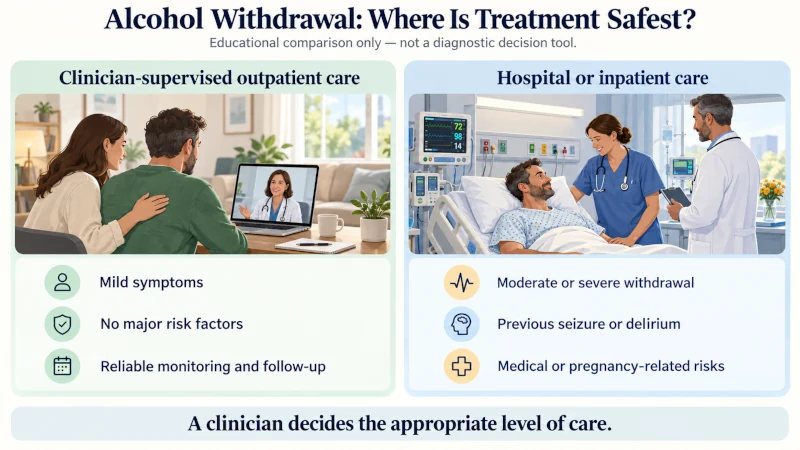
Mild withdrawal in someone without major risk factors can often be managed as an outpatient, with a clinician directing medication and a support person at home. Moderate or severe withdrawal, or a high risk of it, calls for inpatient care with frequent checks [Canver et al., 2024].
Medications
- Benzodiazepines are the standard treatment and have the deepest evidence base [NIAAA, 2025]. Long-acting diazepam is often the first choice; lorazepam is usually used instead when liver damage is a concern. Doses are given on a fixed schedule, in response to symptom scores, or both [Canver et al., 2024].
- Gabapentin is an option for tapering mild withdrawal in outpatient care [Canver et al., 2024].
- Phenobarbital can replace benzodiazepines or serve as rescue therapy in severe withdrawal, in settings experienced with it [Canver et al., 2024]; [ASAM, 2020].
- Clonidine and beta-blockers are add-ons, not stand-alone treatments. ASAM allows them alongside benzodiazepines when blood pressure, heart rate, or anxiety stay high despite treatment, but neither should be used on its own to prevent or treat withdrawal seizures [ASAM, 2020].
- Not recommended: alcohol itself, by mouth or IV; baclofen, which lacks sufficient evidence; and magnesium as a treatment for withdrawal, which has no supporting evidence [ASAM, 2020].
Fluids, vitamins, and electrolytes
People in withdrawal are often depleted. Clinicians typically give thiamine and folate, check electrolytes including magnesium and phosphorus, and replace what’s low. Phosphorus gets particular attention because a malnourished person who starts eating again can develop refeeding syndrome [Canver et al., 2024].
There’s a distinction worth holding onto. Correcting a deficiency that shows up on a blood test is good care; taking magnesium or other supplements to treat withdrawal itself isn’t backed by evidence [ASAM, 2020]. Our guide to supplements for alcohol withdrawal goes through what helps and what doesn’t, and if your magnesium does run low, magnesium-rich foods are the gentlest long-term fix.
Special situations
Pregnancy and breastfeeding
Withdrawal during pregnancy needs specialist care, not home detox. New York State’s clinical guideline recommends inpatient withdrawal management for pregnant patients with, or at risk of, moderate or more severe withdrawal, with an OB-GYN involved [NYSDOH AIDS Institute, n.d.].
On medication, the guidance has a nuance worth seeing plainly. ASAM names benzodiazepines and barbiturates as the medications of choice: there’s a small possible risk to the fetus in the first trimester, but it’s weighed against the harm of continued alcohol exposure and of severe withdrawal for both mother and baby [ASAM, 2020]. The New York guideline adds that benzodiazepines should be prescribed with caution [NYSDOH AIDS Institute, n.d.]. Both point to the same place: this is the treating team’s decision. If withdrawal is treated close to delivery, the newborn should be assessed as well [ASAM, 2020].
If you’re breastfeeding, tell your clinician so it can factor into medication choices.
Older adults
Age over 65 is one of the risk factors for withdrawal turning severe [Canver et al., 2024]. Many older adults also take other medications or live with conditions that complicate treatment, so a monitored setting is often the safer choice.
Liver disease and other medical conditions
Serious medical illness raises the risk of severe withdrawal, and liver disease changes which medication is safest, one reason clinicians may choose lorazepam over diazepam [Canver et al., 2024]. If you have liver, heart, kidney, or lung disease, or diabetes, expect closer monitoring and mention it up front.
Anxiety, depression, and other mental health conditions
Anxiety, depression, and PTSD often travel with alcohol use disorder, and treatment works best when both are addressed together [NIAAA, 2025]. If you’ve had thoughts of harming yourself, say so during the assessment. In a crisis, call or text 988 [SAMHSA, 2026].
After withdrawal: where recovery starts

Detox is a first step, not treatment. Care for alcohol use disorder is measured in months and sometimes years [NIAAA, 2025], and ASAM frames withdrawal management as the start of engaging in treatment rather than a stand-alone service [ASAM, 2020].
The options are broader than many people expect [NIAAA, 2025]:
- Medications. Naltrexone, acamprosate, and disulfiram are FDA-approved for alcohol use disorder, with gabapentin or topiramate as second-line options. They aren’t addictive and can be prescribed in primary care.
- Behavioral therapy. Cognitive-behavioral therapy, motivational enhancement, mindfulness-based approaches, contingency management, and couples or family therapy.
- Mutual support. Alcoholics Anonymous, plus secular groups such as SMART Recovery, LifeRing, and Women for Sobriety. It’s fine to try a few before one fits.
The long view is better than the stereotype. Most people with alcohol use disorder reduce or resolve their drinking problems over time. The first year often mixes gains with setbacks, and a setback doesn’t erase the progress [NIAAA, 2025].
| Health Disclaimer: This article is for general education. It isn’t medical advice, diagnosis, or treatment. Alcohol withdrawal can be life-threatening. Don’t stop drinking suddenly without talking to a qualified healthcare professional if you drink heavily or daily, have had a withdrawal seizure or delirium tremens before, are pregnant, or have liver, heart, or other serious medical conditions. Don’t take medication prescribed for someone else. Call 911 for a seizure, confusion, hallucinations, high fever, or severe agitation. For confidential treatment referrals, call SAMHSA’s National Helpline at 1-800-662-4357. In a mental health crisis, call or text 988. |
Frequently Asked Questions
How long does alcohol withdrawal last?
For most people, symptoms begin within hours of the last drink, peak around the third day, and ease over the following days [Canver et al., 2024]. Delirium tremens, when it happens, can appear several days in, up to about day 8. Some people have lingering anxiety and low mood for weeks afterward [NIAAA, 2025].
When is alcohol withdrawal most dangerous?
Seizures usually occur 8 to 48 hours after the last drink, and delirium tremens a few days in. Both need emergency care [Canver et al., 2024].
Can I detox from alcohol at home?
Sometimes, if withdrawal is mild, you have no major risk factors, a clinician is directing treatment, and someone can stay with you [Canver et al., 2024]. Without those, home detox isn’t safe. Past seizures or DTs, pregnancy, serious illness, or age over 65 point toward a monitored setting.
Do vitamins or supplements help with alcohol withdrawal?
Thiamine matters because it helps prevent Wernicke’s encephalopathy, and clinicians often give it by injection [Day et al., 2013]; [Canver et al., 2024]. Beyond correcting measured deficiencies, supplements don’t treat withdrawal. ASAM finds no supporting evidence for magnesium as a withdrawal treatment [ASAM, 2020].
Are morning shakes a sign of alcohol withdrawal?
They can be. Tremor is a core withdrawal symptom, and drinking to relieve or avoid withdrawal is one of the diagnostic criteria for alcohol use disorder [NIAAA, 2025]. If you need a drink to steady your hands, talk to a clinician before you try to stop.
Does withdrawal get worse each time?
Often, yes. Repeated withdrawals tend to become more severe and make seizures more likely, a pattern called kindling [Canver et al., 2024]. That’s a strong reason to get supported treatment rather than cycling through stop-start attempts alone.
References
- National Institute on Alcohol Abuse and Alcoholism (NIAAA). Alcohol Use Disorder: From Risk to Diagnosis to Recovery. Core Resource on Alcohol. View source
- Canver BR, Newman RK, Gomez AE. Alcohol Withdrawal Syndrome. In: StatPearls [Internet]. Treasure Island (FL): StatPearls Publishing. View source
- Day E, Bentham PW, Callaghan R, Kuruvilla T, George S. Thiamine for prevention and treatment of Wernicke-Korsakoff Syndrome in people who abuse alcohol. View source
- American Society of Addiction Medicine (ASAM). The ASAM Clinical Practice Guideline on Alcohol Withdrawal Management. J Addict Med. View source
- Substance Abuse and Mental Health Services Administration (SAMHSA). National Helpline. View source
- New York State Department of Health AIDS Institute. Substance Use Disorder Treatment in Pregnant Adults: AUD Treatment Recommendations. n.d. View source


