
Ceylon cinnamon is a spice made from the dried inner bark of Cinnamomum verum, a tree native to Sri Lanka. Often called “true cinnamon,” it tastes milder than the cassia cinnamon sold in most U.S. grocery stores, and it contains far less coumarin, a natural compound that can stress the liver in large amounts. Those are differences in flavor and food safety. Whether it improves blood sugar, cholesterol, or weight is a separate question, and that evidence is thin.
At a Glance
- Botanical name: Cinnamomum verum, also written Cinnamomum zeylanicum.
- Origin: Native to Sri Lanka, the island once called Ceylon.
- Flavor: Lighter, sweeter, and less sharp than cassia.
- Coumarin: Low, but not zero. Cassia contains much more.
- Health claims: Human research on Ceylon cinnamon is limited, and no health benefit is established.
What Is Ceylon Cinnamon?
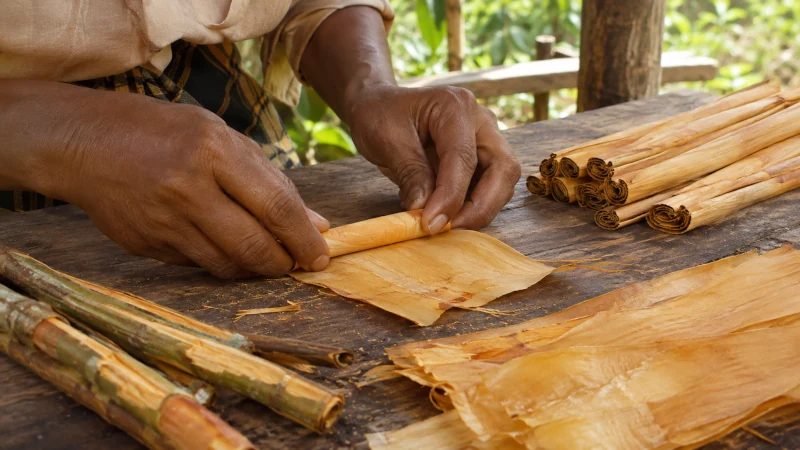
All cinnamon is the dried bark of trees in the genus Cinnamomum. Ceylon cinnamon comes from one species, Cinnamomum verum. You will also see it labeled Cinnamomum zeylanicum, which is another name for the same plant NCCIH, 2024. The botanical database kept by the Royal Botanic Gardens, Kew, lists Sri Lanka as its native range Kew Plants of the World Online, and “Ceylon” is the island’s former name.
Verum is Latin for “true,” and the nickname separates this species from cassia, a group of related trees whose bark is sold under the same everyday name.
Making it is still hand work. According to Sri Lanka’s Export Development Board, growers cut young stems, scrape off the rough outer bark, and peel away the inner layer in thin sheets. The sheets are nested inside one another and dried indoors for several days, curling into the long, layered sticks called quills Sri Lanka Export Development Board, 2015. That labor is part of why it costs more.
Ceylon Cinnamon vs. Regular Cinnamon: What’s the Difference?
In the United States, “regular cinnamon” nearly always means cassia, the most common type sold in North America NCCIH, 2024. When researchers chemically profiled cinnamon bought in U.S. stores, the samples appeared to be Indonesian cassia Journal of Agricultural and Food Chemistry, 2013.
Cassia is not a single plant. The name covers Chinese cassia (C. cassia, also written C. aromaticum), Indonesian or Korintje cinnamon (C. burmannii), and Saigon or Vietnamese cinnamon (C. loureiroi). All are bolder and higher in coumarin than Ceylon, but they are three different species.
| Feature | Ceylon cinnamon | Cassia (“regular”) cinnamon |
| Species | C. verum (C. zeylanicum) | C. cassia, C. burmannii, C. loureiroi |
| Where it grows | Mainly Sri Lanka | China and Southeast Asia, including Indonesia and Vietnam |
| Flavor and aroma | Mild, delicate, lightly sweet | Stronger, hotter, more pungent |
| Stick appearance | Several thin layers rolled together, like a cut cigar | One thick layer curled into a single roll |
| Coumarin | Low: traces to small amounts | Much higher; varies by species and batch |
| Common forms | Quills, powder, capsules | Powder, sticks, capsules, many cinnamon-flavored foods |
| Typical uses | Fruit, tea, custards, lighter dishes | Bold baking and spice blends |
| Price and availability | Costs more; specialty stores, online, some grocers | Inexpensive and sold everywhere |
What Does Ceylon Cinnamon Taste Like?
Ceylon cinnamon is gentle: warm and lightly sweet, without much of cassia’s sharp, peppery heat. If you grew up with cassia, it can seem understated at first.
That mildness shapes how it behaves in food. It blends into oatmeal, tea, baked fruit, custard, and rice dishes without taking over. In cinnamon rolls and other recipes built around a strong cinnamon punch, you may want a little extra, or you may simply prefer cassia.
Potential Health Benefits of Ceylon Cinnamon
Ceylon cinnamon (Cinnamomum verum) contains naturally occurring plant compounds, including polyphenols and cinnamaldehyde, that have attracted scientific interest for their potential effects on blood sugar, inflammation, and cardiovascular health.
However, while some research findings are promising, human studies specifically examining Ceylon cinnamon remain limited, and many commonly cited cinnamon studies involve other varieties.
Blood Sugar and Insulin Sensitivity
Some clinical trials suggest that Ceylon cinnamon extracts may modestly improve fasting blood glucose and certain markers of insulin resistance. However, results are not consistent across studies, and more research is needed to determine whether these effects are clinically meaningful.
Ceylon cinnamon should not replace prescribed diabetes medications or established blood sugar management strategies.
Heart Health and Cholesterol
Researchers have investigated whether Ceylon cinnamon can improve cholesterol levels and other cardiovascular risk factors. Findings remain mixed, and there is insufficient evidence that consuming Ceylon cinnamon prevents heart disease or reliably lowers blood pressure.
Antioxidant and Anti-Inflammatory Properties
Ceylon cinnamon contains compounds that demonstrate antioxidant and anti-inflammatory activity in laboratory studies. These findings are interesting, but laboratory results do not necessarily translate into measurable health benefits in humans.
More well-designed clinical trials are needed to establish whether these properties produce meaningful improvements in health.
What Does the Evidence Really Show?
Ceylon cinnamon can be a flavorful addition to a balanced diet, but its potential medicinal benefits should be viewed cautiously. Studies using concentrated cinnamon extracts also cannot automatically establish the effects of ordinary culinary cinnamon.
For a closer examination of clinical trials, blood sugar findings, cholesterol research, and the limitations of current evidence, read our complete guide to Ceylon cinnamon health benefits.
Why Does Coumarin Matter in Cinnamon?
Coumarin is a natural flavor and fragrance compound found in many plants, including cassia cinnamon, tonka beans, and woodruff. When coumarin was used as a medicine, a small group of sensitive people developed raised liver enzymes or, in severe cases, liver inflammation after a few weeks. The effects usually reversed. Germany’s Federal Institute for Risk Assessment (BfR) sets the tolerable daily intake at 0.1 milligram per kilogram of body weight, about 6 mg a day for a 132-pound adult BfR.
Cassia can reach that limit quickly. By the BfR’s figures, cassia averages roughly 3,000 mg of coumarin per kilogram, so about 2 grams a day reaches the limit for that adult, and about half a gram does for a 33-pound child BfR.
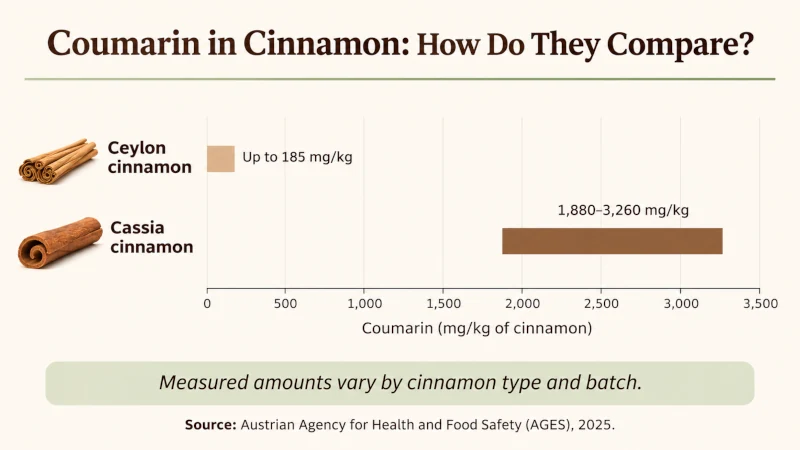
Ceylon contains far less. A U.S. laboratory analysis found only traces in authenticated C. verum bark Journal of Agricultural and Food Chemistry, 2013. Austria’s food safety agency measured a high of 185 mg per kilogram in Ceylon cinnamon, compared with 1,880 to 3,260 in cassia AGES, 2025.
Keep this in proportion. The BfR notes that briefly exceeding the limit is not a health risk and that no liver damage from eating cinnamon had been described in the medical literature. The concern is large amounts every day for a long time, and concentrated supplements. Lower coumarin does not make Ceylon safe in unlimited quantities, either; high doses have not been well studied.
Also, warfarin and similar blood thinners are synthetic derivatives of coumarin, not the same substance AGES, 2025. Cinnamon is not a substitute for anticoagulant medication.
How to Identify Real Ceylon Cinnamon
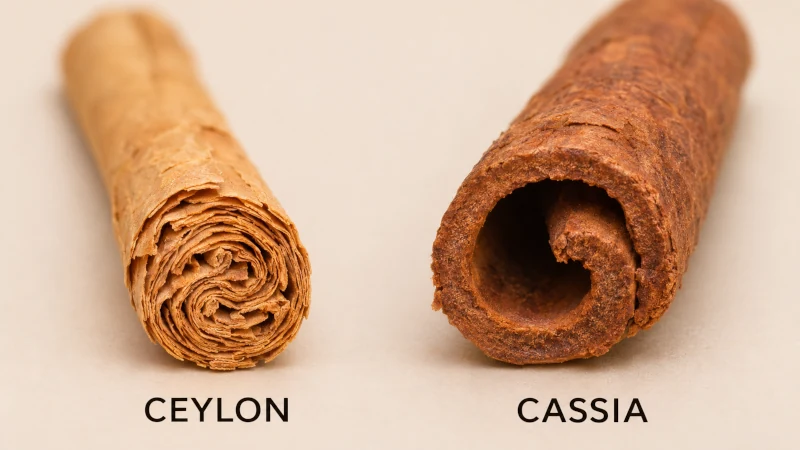
Sticks are the easiest form to check. A Ceylon quill is made of several fine layers rolled together, so the cut end looks like a cigar. A cassia stick is one thick layer of bark curled into a single roll BfR.
For anything in a package, read the label:
- Look for “Ceylon cinnamon,” Cinnamomum verum, or Cinnamomum zeylanicum.
- Check the country of origin. Sri Lanka is a good sign, though not proof.
- Treat a jar labeled only “cinnamon” as probably cassia. Products often do not name the species NCCIH, 2024.
Powder is harder. The BfR says ground Ceylon and cassia are difficult to tell apart, and color or smell will not settle it. You are relying on the label and the seller. Suppliers who name the species and origin and share lab results for coumarin or heavy metals give you more to go on, though paperwork is only as trustworthy as the company behind it. “Organic” describes how a crop was grown, not which species is in the jar.
Since 2024, the FDA has issued alerts about certain ground cinnamon products with elevated lead. The alerts do not sort products by species, so a Ceylon label is no guarantee FDA, 2024.
Ceylon Cinnamon Powder vs. Sticks
Ceylon cinnamon powder is convenient and disperses evenly through batter, oatmeal, yogurt, and spice rubs. Sticks suit liquids: simmer one in tea, cider, rice, or a braise, then lift it out. The thin quills also break down readily in a spice grinder when you want fresh powder.
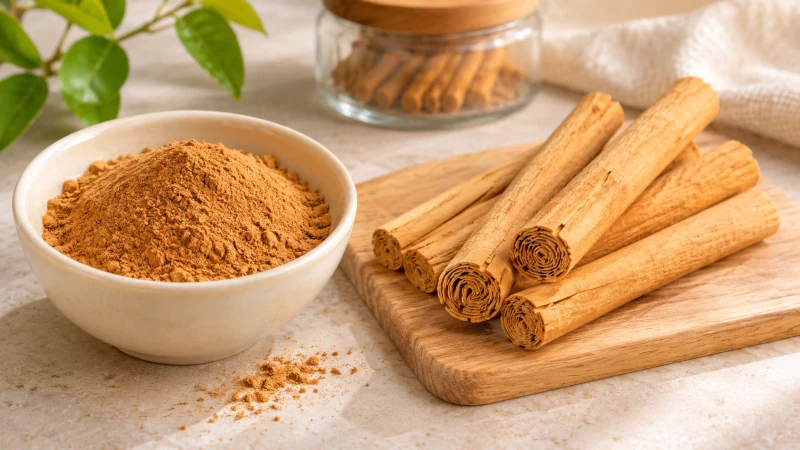
Sticks hold their flavor longer. Penn State Extension advises storing spices in airtight containers away from heat, moisture, and sunlight, checking ground spices after six months, and expecting cinnamon sticks to keep their quality beyond two years. If the aroma has faded, replace it Penn State Extension, 2024.
Extracts are a different product. Capsules and liquids concentrate parts of the bark, their makeup varies from brand to brand, and the FDA does not approve dietary supplements before they are sold NCCIH, 2024. The trials described above tested extracts, not the spice in your pantry. Our supplement guides cover how to weigh such products.
How to Use Ceylon Cinnamon in Everyday Cooking
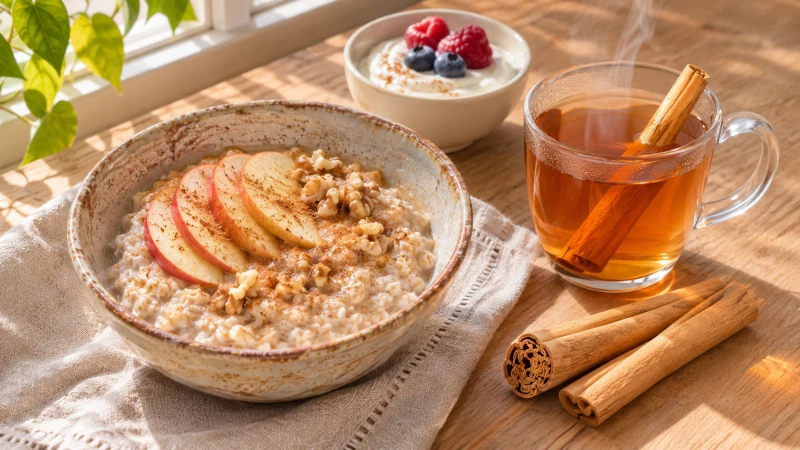
- Stir a pinch into oatmeal or overnight oats.
- Sprinkle it over sliced apples, pears, bananas, or roasted sweet potatoes.
- Mix it into plain yogurt with fruit and nuts.
- Steep a stick in hot water or black tea for several minutes.
- Simmer sticks in warm cider, milk, or homemade chai.
- Add it to curries, chili, lentils, or rice pilaf for background warmth.
These are cooking amounts, a pinch or a sprinkle for flavor. They are not doses and are not comparable to the capsules used in research.
Is Ceylon Cinnamon Safe to Consume Every Day?
For most adults, yes, in the amounts used to season food. NCCIH describes cinnamon as likely safe when used as a spice or flavoring. Larger amounts or long-term use sometimes cause digestive problems or allergic reactions, and swallowing dry cinnamon powder on a dare is unsafe NCCIH, 2024. Cinnamon-flavored gum and toothpaste have caused mouth irritation in some people MSKCC, 2021.
Some people should take more care, especially with supplements:
- Liver disease. Coumarin is the main worry, and cassia is the larger source. Ask your clinician before taking any cinnamon supplement.
- Diabetes medication. Cinnamon can interact with diabetes drugs, so tell your health care provider if you use it, and do not replace treatment with it NCCIH, 2023. See our diabetes and blood sugar resource center.
- Other medications. MSKCC lists cautions with statins and pioglitazone MSKCC, 2021.
- Pregnancy and breastfeeding. Food amounts appear safe. Larger amounts of Ceylon cinnamon are considered unsafe in pregnancy, and little is known about larger amounts while breastfeeding NCCIH, 2024.
Stop taking a cinnamon supplement and call your primary care clinician if you notice yellowing of your skin or eyes or stomach upset that does not settle. Trouble breathing, throat tightness, or swelling of the lips or tongue after eating any food is an emergency. Call 911 MedlinePlus, 2025.
Is Ceylon Cinnamon Better Than Regular Cinnamon?
That depends on how you use it. If you eat cinnamon most days, in oatmeal, coffee, or smoothies, Ceylon is the sensible pick because it keeps coumarin intake low. That is the BfR’s advice for people who often use large amounts at home BfR. If cinnamon shows up in your kitchen a few times a month, cassia in normal recipe amounts is not usually a problem NCCIH, 2024.
There is no good evidence that Ceylon outperforms cassia on health effects; more of the positive trials used cassia Journal of Herbal Medicine, 2020. The extra money buys a different flavor and less coumarin, not proven medical benefits.
| HEALTH DISCLAIMER: This article is for general education and is not medical advice. Talk with a qualified health care professional before using cinnamon supplements, particularly if you are pregnant or breastfeeding, have liver disease, or take prescription medication, and do not stop or change a prescribed treatment without your clinician’s guidance. Read about our editorial and research standards. |
Frequently Asked Questions
Is Ceylon cinnamon the same as regular cinnamon?
No. Regular cinnamon in U.S. stores is usually cassia, from related but different species.
Why is Ceylon cinnamon called true cinnamon?
Its species name, verum, means “true” in Latin. That does not make cassia fake; both are real cinnamon bark.
How can you tell if cinnamon is Ceylon?
Sticks show many thin layers rolled like a cigar. Powder cannot be judged by eye, so rely on a label naming Ceylon or Cinnamomum verum.
Does Ceylon cinnamon contain coumarin?
Yes, in small amounts well below cassia. It is not coumarin-free.
Can you use Ceylon cinnamon every day?
In food amounts, most adults can. Discuss daily capsules or extracts with a clinician first.
Does Ceylon cinnamon lower blood sugar?
Possibly a little, in some extract studies, but results are inconsistent. It should not replace medication, diet changes, or monitoring.
The Bottom Line
Ceylon cinnamon is the bark of Cinnamomum verum, a milder relative of the cassia most Americans know. Its clearest advantage is practical: much less coumarin, which matters if cinnamon is part of your daily routine. Its health reputation runs ahead of the research, so enjoy it for what it reliably offers, which is good flavor in ordinary food amounts. For more, browse our guides to herbs and natural remedies.
References
- National Center for Complementary and Integrative Health. Cinnamon: Usefulness and Safety. View source
- National Center for Complementary and Integrative Health. Diabetes and Dietary Supplements: What You Need To Know. View source
- German Federal Institute for Risk Assessment (BfR). FAQ on coumarin in cinnamon and other foods. View source
- Memorial Sloan Kettering Cancer Center. Cinnamon. View source
- Royal Botanic Gardens, Kew. Cinnamomum verum J.Presl. Plants of the World Online. View source
- Sri Lanka Export Development Board. Processing of Ceylon Cinnamon: Age-old traditions rooted in a colourful history. View source
- Wang YH, Avula B, Nanayakkara NPD, Zhao J, Khan IA. Cassia cinnamon as a source of coumarin in cinnamon-flavored food and food supplements in the United States. Journal of Agricultural and Food Chemistry. View source
- Leach MJ, Kumar S. Cinnamon for diabetes mellitus. View source
- Shinjyo N, Waddell G, Green J. A tale of two cinnamons: a comparative review of the clinical evidence of Cinnamomum verum and C. cassia as diabetes interventions. Journal of Herbal Medicine. View source
- Muthukuda D, de Silva CK, Ajanthan S, Wijesinghe N, Dahanayaka A, Pathmeswaran A. Effects of Cinnamomum zeylanicum (Ceylon cinnamon) extract on lipid profile, glucose levels and its safety in adults: a randomized, double-blind, controlled trial. PLoS One. View source
- Ranasinghe P, Pigera S, Premakumara GAS, Galappaththy P, Constantine GR, Katulanda P. Medicinal properties of ‘true’ cinnamon (Cinnamomum zeylanicum): a systematic review. BMC Complementary and Alternative Medicine. View source
- Ranasinghe P, Jayawardena R, Pigera S, et al. Evaluation of pharmacodynamic properties and safety of Cinnamomum zeylanicum (Ceylon cinnamon) in healthy adults: a phase I clinical trial. View source
- Austrian Agency for Health and Food Safety (AGES). Coumarin. View source
- U.S. Food and Drug Administration. FDA Alert Concerning Certain Cinnamon Products Due to Presence of Elevated Levels of Lead. View source
- Penn State Extension. Storing Staple Ingredients in the Kitchen. View source
- MedlinePlus, National Library of Medicine. Anaphylaxis. View source


