
The best-supported Ceylon cinnamon health benefits are modest and metabolic: in two randomized trials published in 2025, a standardized extract was linked to somewhat lower fasting blood sugar. Claims about cholesterol, blood pressure, inflammation, antioxidants, and weight rest on weaker or mostly laboratory evidence. No human study shows that Ceylon cinnamon treats, cures, or prevents any disease.
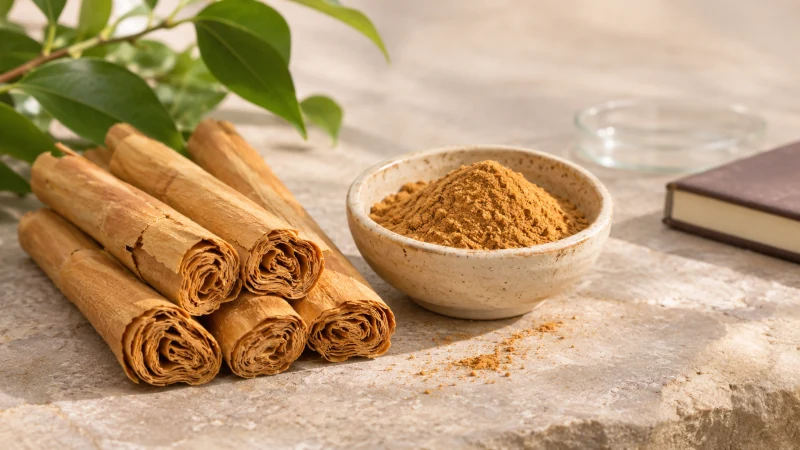
Ceylon cinnamon (Cinnamomum verum, also called C. zeylanicum) keeps attracting researchers because its bark contains biologically active compounds, including cinnamaldehyde, eugenol, and polyphenols called proanthocyanidins. [Ranasinghe et al., systematic review, 2013] Most testing has focused on metabolic outcomes. This article examines that clinical evidence; for background on the spice, see what Ceylon cinnamon is and how it differs from cassia.
What Does Research Say About Ceylon Cinnamon Health Benefits?
The U.S. National Center for Complementary and Integrative Health (NCCIH) puts it plainly: research does not clearly support using cinnamon for any health condition, and many studies never say which species was tested. [NCCIH, 2024]
Ceylon-specific human research is thin. A 2013 systematic review of 70 papers found mostly test-tube and animal work and called the human data sparse. [Ranasinghe et al., systematic review, 2013] Two randomized, placebo-controlled trials followed in 2025. Both tested capsules of concentrated extract, not the ground spice.
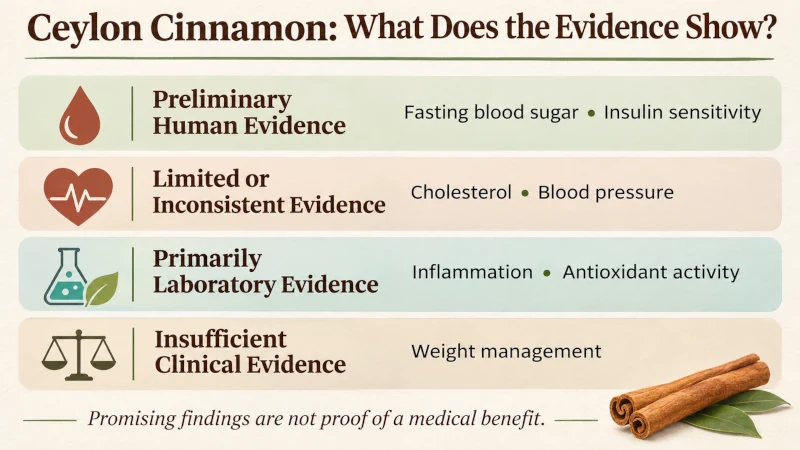
The table uses four ratings:
- Preliminary human evidence: a placebo-controlled Ceylon trial found an effect not yet independently confirmed.
- Limited or inconsistent human evidence: studies are small, uncontrolled, conflicting, or not Ceylon-specific.
- Primarily laboratory evidence: test-tube or animal experiments only.
- Insufficient clinical evidence: human studies have not shown a benefit.
| Health claim | Human evidence | What studies suggest | Key limitation |
| Blood sugar regulation | Preliminary human evidence | Two 2025 extract trials reported lower fasting glucose; one found no change in HbA1c | Extracts only; small effect; funding and patent interests |
| Insulin sensitivity | Preliminary human evidence | One trial in type 2 diabetes reported improved insulin-resistance measures | An estimated marker; size of the difference from placebo not given in the published summary |
| Cholesterol | Limited or inconsistent human evidence | The largest LDL-focused trial found no significant change; a diabetes trial reported lower LDL at its higher dose | Conflicting results; no heart attack or stroke outcomes |
| Blood pressure | Limited or inconsistent human evidence | A drop in an uncontrolled study; no difference in a placebo-controlled trial | Pooled analyses mix cinnamon species |
| Inflammation | Primarily laboratory evidence | Animal and cell findings; a small average CRP reduction in pooled cinnamon trials | Species unclear; a blood marker, not symptoms |
| Antioxidant activity | Primarily laboratory evidence | Strong activity in test-tube assays | Almost no direct human data |
| Weight management | Insufficient clinical evidence | No weight change in the two Ceylon studies that reported it | Short studies not designed around weight |
| Allergic rhinitis (nasal spray) | Preliminary human evidence | One 7-day trial of an extract nasal spray reported symptom improvement | Does not apply to cinnamon that is eaten or swallowed |
Ceylon Cinnamon and Blood Sugar: What Do Human Trials Show?
Blood sugar is the most-studied claim, with the best human evidence. Trials use three measures that answer different questions.
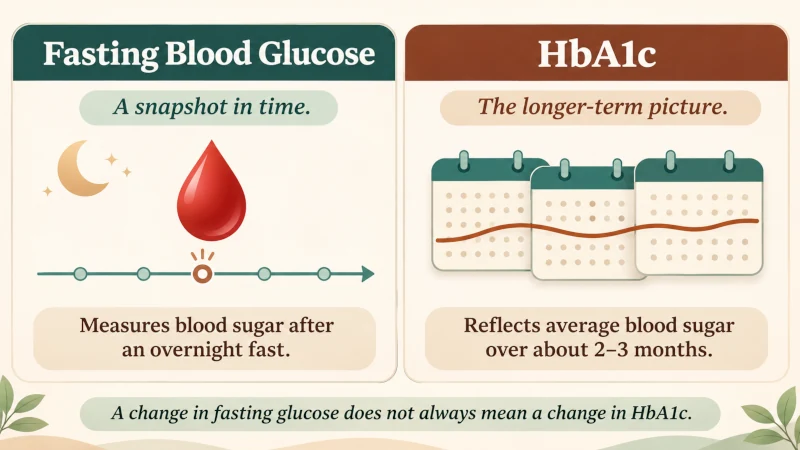
- Fasting blood glucose is a single reading taken after an overnight fast.
- HbA1c (also written A1C) reflects average blood sugar over roughly the previous two to three months.
- Insulin resistance means the body’s cells respond poorly to insulin. Studies usually estimate it from fasting glucose and insulin.
A supplement can nudge a fasting reading without changing HbA1c. Our guide to normal blood sugar ranges explains the numbers themselves.
The 2025 trial in adults with raised LDL cholesterol
Researchers in Sri Lanka randomly assigned 150 adults with LDL cholesterol of 100 to 190 mg/dL to 1,000 mg a day of standardized Ceylon cinnamon bark extract or placebo for 12 weeks; 127 were analyzed. Blood sugar was a secondary outcome, and only 18% of participants had type 2 diabetes. [Muthukuda et al., PLOS ONE, 2025]
After adjustment for starting values, fasting blood sugar ended about 8.6 mg/dL lower with extract than with placebo (95% confidence interval 0.59 to 16.59; p = 0.036). A confidence interval is the range of effects compatible with the data; this one runs from almost nothing to a moderate drop. The unadjusted comparison was not statistically significant, and HbA1c did not differ.
The effect seemed concentrated in participants with type 2 diabetes, whose fasting glucose fell by an average of 78.6 mg/dL on extract and 11.2 mg/dL on placebo. That comparison involved 12 and 15 people and was labeled exploratory: a lead for research, not a finding to act on.
The 2025 trial in people with type 2 diabetes
Another Sri Lankan team randomized 210 adults with type 2 diabetes to 250 mg or 500 mg of extract a day, or placebo, for four months; 186 finished. HbA1c and fasting glucose were the main outcomes. The published abstract reports that both fell significantly from baseline in the extract groups, that insulin resistance and beta-cell function (insulin production) improved, and that regression analyses identified extract treatment as a significant predictor of the glucose changes. [Ranasinghe et al., Diabetes & Metabolic Syndrome, 2025]
Two cautions apply. A drop from baseline is a within-group change, and people in trials often improve whatever they are given; the comparison with placebo is what counts. The abstract does not state how large the difference from placebo was, so the size of the benefit, and whether it matters clinically, cannot be judged from the summary. The authors also disclose holding a patent and call for further study.
Why cassia results do not carry over
Most cinnamon-and-diabetes research used cassia, a different species. Of 25 clinical studies in a 2020 review, 19 tested cassia and six tested Ceylon. Cassia appeared to help at 3 to 6 grams a day, the Ceylon evidence was inconclusive, and the two differ considerably in chemistry. [Shinjyo et al., Journal of Herbal Medicine, 2020] A Cochrane review of 10 mostly cassia trials found cinnamon no better than control for HbA1c and judged the evidence insufficient. [Cochrane review, 2012]
A reasonable reading: Ceylon cinnamon extract may lower fasting glucose slightly over three to four months, mainly in people who already have type 2 diabetes. Nothing here shows that it prevents or reverses diabetes, and it cannot replace prescribed medication, dietary changes, or glucose monitoring.
| Study | Participants | Preparation and duration | Main result | Funding and interests |
| Ranasinghe et al., 2017 (phase I) | 30 healthy adults; 28 completed | Water extract capsules, 85 mg rising to 500 mg a day; 3 months; no control group | Lower blood pressure, total and LDL cholesterol from baseline; no change in fasting glucose or weight | University grant; no competing interests declared |
| Muthukuda et al., 2025 | 150 adults with LDL 100–190 mg/dL; 127 analyzed | Standardized extract, 1,000 mg a day, versus placebo; 12 weeks | LDL: no significant difference. Fasting glucose: about 8.6 mg/dL lower. HbA1c, blood pressure, weight: no difference | Funded by the extract’s manufacturer; two authors reimbursed for their time |
| Ranasinghe et al., 2025 | 210 adults with type 2 diabetes; 186 completed | Extract, 250 mg or 500 mg a day, versus placebo; 4 months | Abstract reports lower fasting glucose and HbA1c from baseline; lower LDL at 500 mg | University funded; authors hold a patent |
Can Ceylon Cinnamon Improve Cholesterol and Heart Health?
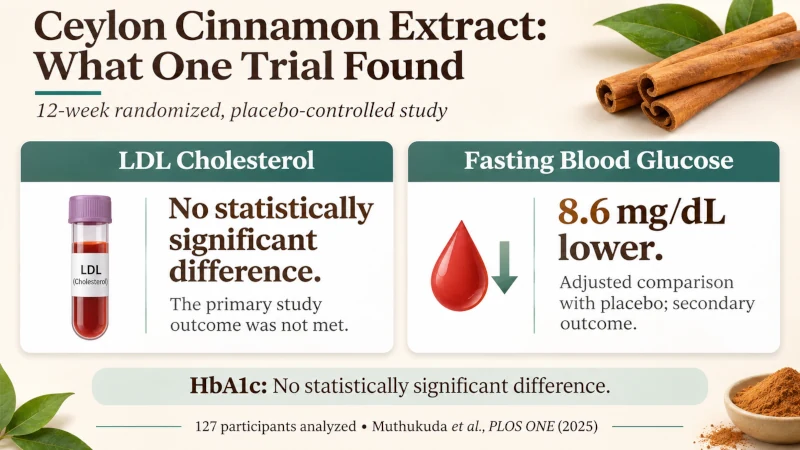
LDL cholesterol was the main target of the 12-week extract trial, and the result was negative. The adjusted difference between extract and placebo was about 6 mg/dL (95% confidence interval −2.43 to 14.52; p = 0.161), so chance could easily explain it. The study had been designed to detect a 10 mg/dL reduction. Total cholesterol, HDL, and triglycerides did not differ significantly either. [Muthukuda et al., PLOS ONE, 2025]
The diabetes trial points the other way: its abstract reports lower total and LDL cholesterol in the 500 mg group. [Ranasinghe et al., Diabetes & Metabolic Syndrome, 2025] In an earlier phase I study of 28 healthy adults, LDL fell from 152.8 to 129.8 mg/dL over three months, but with no control group the change cannot be credited to cinnamon. [Ranasinghe et al., phase I trial, 2017]
Blood pressure follows the same pattern. Systolic pressure dropped from 124.0 to 117.3 mmHg in the uncontrolled phase I study, while the placebo-controlled trial found no significant difference (−1.87 mmHg; 95% confidence interval −5.99 to 2.25). A 2020 meta-analysis of nine cinnamon trials (641 participants) reported average reductions of about 5 mmHg systolic and 3 mmHg diastolic, but its summary does not separate Ceylon from other species, and its authors flagged small trials. [Hadi et al., Clinical Nutrition ESPEN, 2020]
LDL and blood pressure are also only risk markers. A better figure on a cholesterol test is not the same as fewer heart attacks or strokes, and none of these studies measured those events. Our guide to home measures that lower blood pressure covers approaches with stronger evidence.
Does Ceylon Cinnamon Reduce Inflammation?
Inflammation is the immune system’s response to injury or infection. Short term, it is protective; researchers worry about low-grade inflammation that lingers, and track it with blood markers such as C-reactive protein (CRP).
For Ceylon cinnamon, the evidence is mostly preclinical: the 2013 review described anti-inflammatory effects in animal models and a proposed mechanism in cells. [Ranasinghe et al., systematic review, 2013]
Human data are indirect. A 2019 meta-analysis of six randomized cinnamon trials (285 participants) found CRP lower by 0.81 mg/L on average, with results that varied considerably between trials. Although its title names Cinnamomum zeylanicum, the published summary does not confirm that every included trial used that species. [Vallianou et al., Complementary Therapies in Medicine, 2019]
A modest shift in one blood marker is a long way from relief. The analysis measured CRP, not joint pain or disease progression, so it gives no clinical basis for treating arthritis or any other inflammatory disease with Ceylon cinnamon.
Antioxidant Properties of Ceylon Cinnamon: What Do They Mean for Health?
Phenolic compounds in the bark, including eugenol and proanthocyanidins, neutralize free radicals in laboratory tests. The 2013 review catalogued assays such as DPPH and ABTS, which measure how well a substance mops up reactive molecules in a test tube. [Ranasinghe et al., systematic review, 2013]
Those assays cannot show what happens after digestion and metabolism, when a compound may reach tissues in small amounts or an altered form. Direct human evidence is minimal. The review described one 10-day study of 18 operating-room staff in which a marker of fat oxidation in the blood fell, while total antioxidant capacity did not change significantly.
“Rich in antioxidants” describes the bark’s chemistry; it is not evidence of disease prevention. The human research reviewed here offers no support for claims about detoxification, longevity, anti-aging, or cancer prevention.
Can Ceylon Cinnamon Help With Weight Loss?
The Ceylon-specific human data consistently show no effect. In the 12-week placebo-controlled trial, the difference in body weight between extract and placebo was −0.09 kg (95% confidence interval −1.09 to 0.91), with no significant change in BMI or waist size. [Muthukuda et al., PLOS ONE, 2025] In the phase I study, average weight went from 66.5 to 66.4 kg over three months. [Ranasinghe et al., phase I trial, 2017] Across the wider, mixed-species literature, NCCIH says it is unclear whether supplements help with weight loss. [NCCIH, 2024]
A small change in fasting glucose is a biomarker shift, not fat loss, and one does not automatically produce the other. The evidence is insufficient, and Ceylon cinnamon should not be treated as a weight-loss aid.
Other Potential Benefits Under Investigation
Allergic rhinitis (hay fever) is the one other area with a human trial. A 2019 randomized, placebo-controlled study tested a nasal spray containing a standardized Ceylon cinnamon bark extract for seven days. NCCIH calls the results preliminary and says more reliable evidence is needed. [NCCIH, 2024] The trial was registered with a planned enrollment of about 60 people and commercial funding, and employees of the funding company were among its authors. [ANZCTR trial registration, 2018] [Steels et al., Complementary Therapies in Medicine, 2019] A spray applied directly to the nasal lining says nothing about eating cinnamon or swallowing capsules.
Antimicrobial, brain-protective, and anticancer claims rest on test-tube and animal experiments in the 2013 review: activity against bacteria in culture, interference with tau protein clumping (a feature of Alzheimer’s disease), and toxicity to cancer cell lines. They are research leads, not demonstrated human benefits. [Ranasinghe et al., systematic review, 2013]
Why Are Cinnamon Health Studies So Difficult to Interpret?
The species is often unknown. When a pooled analysis reports that “cinnamon” lowers a number, it may be describing cassia. [NCCIH, 2024]
Preparations differ. The phase I study used a hot-water extract; the 12-week trial used a water-and-ethanol extract standardized to at least 30% polyphenols.
Trials are small and short. The studies described here enrolled 30 to 210 people and lasted seven days to four months.
Endpoints are inconsistent. One trial’s positive result was a secondary outcome (fasting glucose); its primary outcome (LDL) and HbA1c did not move.
Populations and medications are mixed. The LDL trial combined people with normal glucose, prediabetes, and diabetes and does not report who was taking glucose-lowering drugs.
Funding and interests matter. The LDL trial was funded by the extract’s manufacturer, which reimbursed two authors for their time and is stated to have had no role in design, analysis, or publication. [Muthukuda et al., PLOS ONE, 2025] The diabetes trial’s authors hold a patent. [Ranasinghe et al., Diabetes & Metabolic Syndrome, 2025] Neither fact invalidates a result; both are reasons to want independent replication.
Reporting is selective. Summaries tend to lead with improvements from baseline and favorable subgroups, and disappointing studies are less likely to be published at all (publication bias).
Statistical and clinical significance are different things. A p-value of 0.036 suggests the fasting glucose difference was unlikely to be chance alone. It does not make 8.6 mg/dL, with a plausible range reaching down to 0.59, important for health.
Counting positive studies therefore misleads. One placebo-controlled trial with a null primary outcome outweighs several uncontrolled studies that agree with each other.
Does Eating Ceylon Cinnamon Provide the Same Benefits as the Extracts Studied in Clinical Trials?
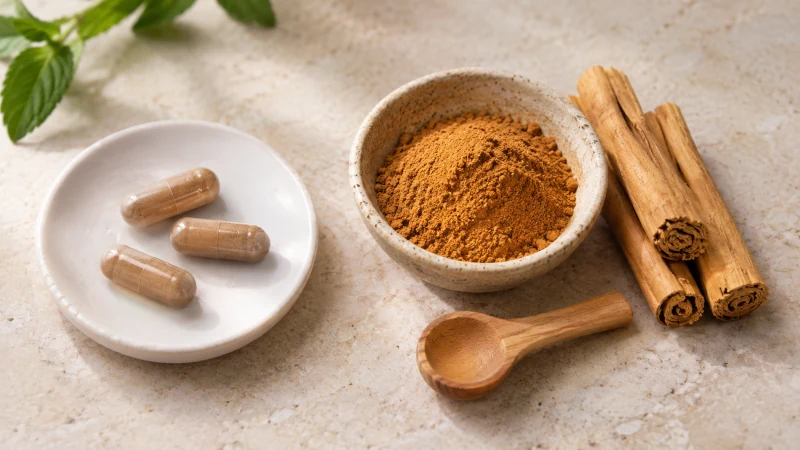
The trials described above cannot say, because every one used a manufactured extract. Ground bark is the whole spice, with an unstandardized mix of compounds. An extract concentrates part of that mix, and different extraction methods deliver different amounts of active constituents. A gram of extract and a gram of powder are not equivalent.
Findings from capsules therefore cannot be applied to cinnamon sprinkled on oatmeal. Nor is a trial dose a recommendation: researchers choose doses to test a hypothesis, and no therapeutic daily amount has been established. For cooking, our guide to choosing authentic Ceylon cinnamon powder covers quality. Buy it as a spice, not as a treatment.
Is Ceylon Cinnamon Safe When Used for Health Purposes?
As a seasoning, cinnamon is likely safe. Concentrated supplements are a different matter. [NCCIH, 2024]
In the trials, the main complaint was digestive: two people left the phase I study because of worsening indigestion. NCCIH also notes allergic reactions with larger amounts or long-term use. Stop using any cinnamon product and call 911 if you develop trouble breathing or swelling of the face or throat.
Talk with a doctor or pharmacist before using an extract if you:
- take diabetes medication, because an added glucose-lowering effect could matter; do not change a prescription on your own
- take any other regular medicine, since interaction data are limited
- have liver disease; the extract trial excluded people with abnormal liver tests
- are pregnant or breastfeeding; NCCIH considers larger-than-food amounts of Ceylon cinnamon unsafe in pregnancy and says little is known about breastfeeding
The longest trial lasted four months, which is not proof of long-term safety. For more, see our overview of Ceylon cinnamon safety considerations.
| HEALTH DISCLAIMER: This article is for general education. It is not medical advice and does not replace care from a qualified healthcare professional. Do not use Ceylon cinnamon or any supplement in place of prescribed treatment, and do not start, stop, or change a medication without talking to your clinician. Call 911 in a medical emergency. |
What Is the Bottom Line on Ceylon Cinnamon Health Benefits?
Fasting blood sugar is the most promising outcome: two placebo-controlled extract trials point to a small reduction, mainly in people with type 2 diabetes. Cholesterol and blood pressure findings conflict. Inflammation and antioxidant claims rest largely on laboratory work, and weight loss has no support from the Ceylon studies that measured it.
Human trials matter because only they can show whether a laboratory effect survives real bodies, diets, and medications. So far they are few, short, and tied to specific extracts.
If you have diabetes, high cholesterol, or high blood pressure, keep to the plan you and your clinician have agreed on, and raise any supplement with them first. If you simply like Ceylon cinnamon in your coffee, that is reason enough to use it. Enjoying a spice and treating a condition are separate questions.
Frequently Asked Questions
Are Ceylon cinnamon health benefits scientifically proven?
No. Two 2025 randomized trials of Ceylon cinnamon extract reported modestly lower fasting blood sugar, but the results have not been independently confirmed. NCCIH states that research does not clearly support cinnamon for any health condition, and other claimed benefits rely mostly on laboratory studies.
Does Ceylon cinnamon lower blood sugar in humans?
Possibly, by a small amount. In a 12-week trial, fasting blood sugar was about 8.6 mg/dL lower with extract than placebo, but HbA1c, the long-term measure, did not change. A four-month diabetes trial reported improvements from baseline. Neither shows cinnamon can replace treatment.
Can Ceylon cinnamon reduce cholesterol?
The evidence conflicts. A 2025 trial designed around LDL cholesterol found no statistically significant difference between extract and placebo after 12 weeks, while a trial in type 2 diabetes reported lower LDL at its higher dose. Neither measured heart attacks or strokes.
Does Ceylon cinnamon help with inflammation?
Not in a demonstrated clinical sense. Anti-inflammatory effects appear in animal and cell experiments. A pooled analysis of six cinnamon trials found a small average drop in C-reactive protein, a blood marker, without confirming each trial’s species or measuring symptoms such as joint pain.
Is there a clinically proven amount of Ceylon cinnamon for health benefits?
No. Trials tested extract capsules of 85 mg to 1,000 mg a day, but those were research doses of specific products, not recommendations. No therapeutic amount has been established, and extract doses cannot be converted into teaspoons of ground cinnamon. Ask a healthcare professional before taking a concentrated product.
References
- National Center for Complementary and Integrative Health (NIH). Cinnamon: Usefulness and Safety. View source
- Muthukuda D, de Silva CK, Ajanthan S, Wijesinghe N, Dahanayaka A, Pathmeswaran A. Effects of Cinnamomum zeylanicum (Ceylon cinnamon) extract on lipid profile, glucose levels and its safety in adults: a randomized, double-blind, controlled trial. View source
- Ranasinghe P, Galappatthy P, Constantine GR, Jayawardena R, Weeratunga HD, Premakumara S, Katulanda P. Efficacy and safety of Cinnamomum zeylanicum (Ceylon cinnamon) for diabetes mellitus: a randomized, double blind, placebo-controlled clinical trial. View source
- Ranasinghe P, Pigera S, Premakumara GAS, Galappaththy P, Constantine GR, Katulanda P. Medicinal properties of ‘true’ cinnamon (Cinnamomum zeylanicum): a systematic review. View source
- Ranasinghe P, Jayawardena R, Pigera S, et al. Evaluation of pharmacodynamic properties and safety of Cinnamomum zeylanicum (Ceylon cinnamon) in healthy adults: a phase I clinical trial. View source
- Shinjyo N, Waddell G, Green J. A tale of two cinnamons: a comparative review of the clinical evidence of Cinnamomum verum and C. cassia as diabetes interventions. Journal of Herbal Medicine. View source
- Leach MJ, Kumar S. Cinnamon for diabetes mellitus. View source
- Hadi A, Campbell MS, Hassani B, Pourmasoumi M, Salehi-Sahlabadi A, Hosseini SA. The effect of cinnamon supplementation on blood pressure in adults: a systematic review and meta-analysis of randomized controlled trials. View source
- Vallianou N, Tsang C, Taghizadeh M, Davoodvandi A, Jafarnejad S. Effect of cinnamon (Cinnamomum zeylanicum) supplementation on serum C-reactive protein concentrations: a meta-analysis and systematic review. View source
- Australian New Zealand Clinical Trials Registry. Pilot experimental study for safety and efficacy of IND02 (standardized hydroalcoholic extract of Cinnamomum zeylanicum bark extract) in reducing symptoms of seasonal allergic rhinitis. View source
- Steels E, Deshpande P, Thakurdesai P, Dighe S, Collet T. A randomized, double-blind placebo-controlled study of intranasal standardized cinnamon bark extract for seasonal allergic rhinitis. Complementary Therapies in Medicine. View source


