
Yes. Alcohol withdrawal can be fatal, mostly through seizures and a severe state of confusion called delirium tremens (DTs). That is the honest answer to “can you die from alcohol withdrawal?” But it isn’t the whole picture. Most people who stop drinking get through withdrawal with symptoms that are miserable rather than dangerous. The serious cases are fairly predictable, and treatment cuts the risk sharply.

About half of people with alcohol use disorder who suddenly stop or cut back develop withdrawal symptoms [Tiglao et al., 2021]. Only about 3% to 5% of people in withdrawal go on to develop delirium tremens [Canver et al., 2024]. That small group is where most of the danger lies, and a clinician can often spot who is in it before the first symptom appears.
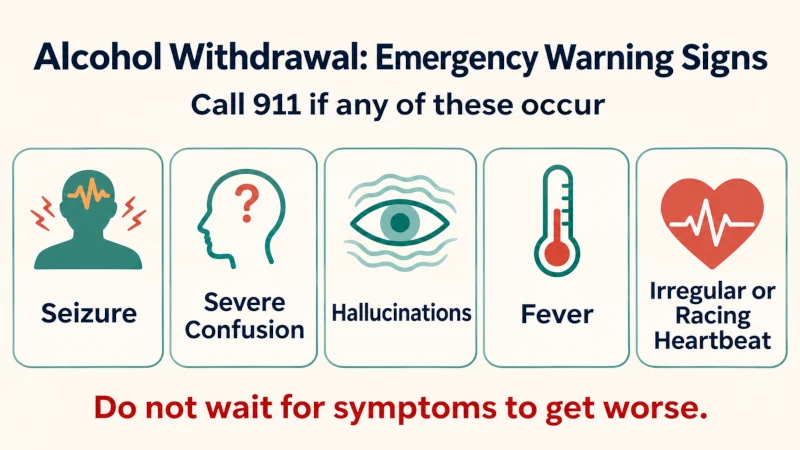
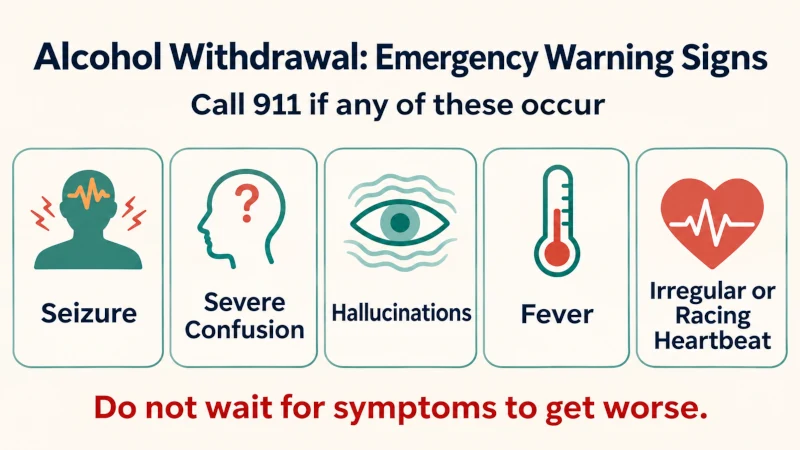
| Call 911 or go to the emergency room now if you or someone else in withdrawal has: A seizure (and call immediately if a seizure lasts longer than five minutes, or a second one starts right after the first) [Mayo Clinic]Severe confusion or not knowing where they areHallucinations (seeing, hearing, or feeling things that aren’t there)A feverAn irregular or racing heartbeat Those warning signs come from [MedlinePlus, 2025]. Do not wait it out at home. |
Why stopping drinking can be dangerous
When you drink heavily day after day, your brain adjusts to having alcohol around. Alcohol slows the nervous system, so the brain compensates by revving itself up. Take the alcohol away suddenly and that revved-up state is left unopposed. Clinicians describe withdrawal as overactivity of the central and autonomic nervous systems, which is why it produces tremors, sweating, a fast pulse, anxiety, insomnia, and in severe cases hallucinations and seizures [Tiglao et al., 2021].
Withdrawal also tends to get worse with repetition. Each episode appears to lower the threshold for the next seizure, a process called kindling, and a history of withdrawal seizures makes another one considerably more likely [Canver et al., 2024]. So someone who has “toughed it out” before is not necessarily safer the next time. They may be at higher risk.
This article focuses on the danger. For the full range of symptoms and how they’re treated, see our guide to alcohol withdrawal symptoms, timeline, and treatment.
Can you die from alcohol withdrawal? How alcohol withdrawal can turn fatal
Withdrawal seizures
Withdrawal seizures are usually generalized tonic-clonic seizures, the kind that cause loss of consciousness and violent muscle contractions [Mayo Clinic]. They typically happen 24 to 48 hours after the last drink, though they have been reported as early as two hours after stopping [Tiglao et al., 2021].
A seizure is an emergency in itself: falls, head injuries, and inhaling vomit are real risks. It is also a sign of a complicated withdrawal. A seizure during the current episode is one of the things that rules out managing withdrawal at home [Tiglao et al., 2021], and prior seizures are a recognized risk factor for delirium tremens [Rahman & Paul, 2023].
Delirium tremens (DTs)
Delirium tremens is the most severe form of alcohol withdrawal. It usually starts 48 to 72 hours after the last drink, and symptoms can peak around day five [Tiglao et al., 2021]. Some sources describe a wider window. One review places the risk anywhere from three to eight days after stopping [Canver et al., 2024].
Someone in DTs is not simply very shaky. They are delirious. Typical features include clouded consciousness, mostly visual hallucinations, disorientation, a fast heart rate, high blood pressure, low-grade fever, agitation, and heavy sweating [Bayard et al., 2004]. Deaths are usually tied to complications rather than to “withdrawal” itself: heart rhythm problems, breathing failure, aspiration pneumonia, seizures, and severe muscle breakdown, often on top of other illnesses such as pneumonia or pancreatitis [Rahman & Paul, 2023].
How often does delirium tremens kill? The numbers vary
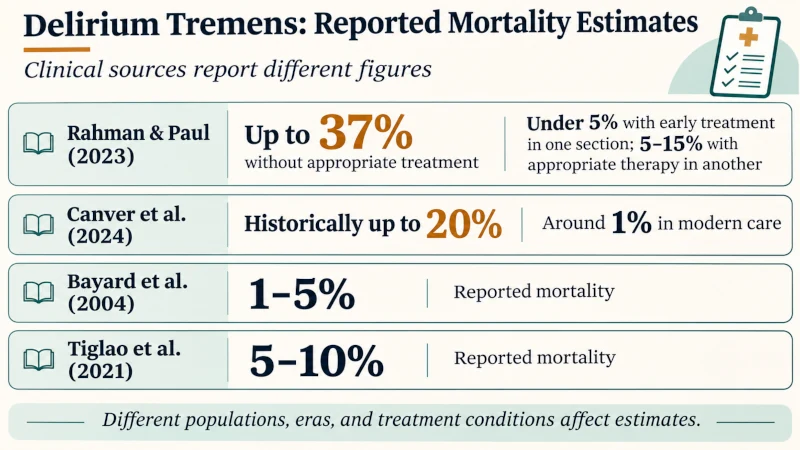
You will see very different death rates quoted online, and the reputable sources don’t fully agree either. Here is what the main clinical references we checked actually say:
| Source | What it reports for delirium tremens |
| [Rahman & Paul, 2023] | Up to 37% without appropriate treatment. With early treatment, under 5% in one section; 5% to 15% “even with appropriate therapy” in another. |
| [Canver et al., 2024] | Historically as high as 20%; now around 1%. |
| [Bayard et al., 2004] | 1% to 5%. |
| [Tiglao et al., 2021] | 5% to 10%. |
The spread reflects different eras, patient groups, and how sick people were to begin with. The consistent message is more useful than any single number. Untreated DTs carries a high risk of death. Treatment brings that risk down a lot, but not to zero, which is why DTs is handled in a hospital. Remember too that these percentages apply only to the small minority who develop DTs, not to everyone who stops drinking.
The problems that ride along: electrolytes and thiamine
Long-term heavy drinking often leaves the body short on things it needs. Magnesium deficiency is common in people with chronic alcohol dependence [NIH Office of Dietary Supplements, 2026], and low potassium is listed among the risk factors for delirium tremens [Rahman & Paul, 2023]. These are found with blood tests and corrected by clinicians during withdrawal. Eating more potassium-rich foods or magnesium-rich foods is good for recovery later. It is not a way to treat withdrawal.
Thiamine (vitamin B1) is the other big one. Clinical reviews recommend giving it routinely during withdrawal, and in hospital it is usually injected because thiamine taken by mouth is unpredictably absorbed [Canver et al., 2024]. Our article on supplements for alcohol withdrawal explains why thiamine matters and why most other supplements do not.
Alcohol withdrawal timeline: when the danger peaks
Timing varies from person to person, but the typical pattern after the last drink looks like this [Tiglao et al., 2021]:
| Time since last drink | What can happen |
| 6–12 hours | Shakiness, sweating, poor sleep, mild anxiety, upset stomach, headache, palpitations, poor appetite |
| 12–24 hours | Alcoholic hallucinosis: hallucinations while otherwise alert. Usually clears within 48 hours |
| 24–48 hours | Withdrawal seizures (reported as early as 2 hours) |
| 48–72 hours | Delirium tremens can begin; symptoms may peak around day 5 |
The point to take from this table: feeling fine on day one does not mean you are through it. The most dangerous complication often starts two or three days in, after many people assume the worst has passed. Milder after-effects can linger much longer. Sleep problems, mood swings, and fatigue may last for months [MedlinePlus, 2025].
Who is most at risk of dangerous withdrawal
Anyone who has been drinking heavily can have a rough withdrawal, but the risk of seizures, DTs, and death clusters in people with certain features. Clinical guidance flags these [Tiglao et al., 2021][Canver et al., 2024]:
- A previous withdrawal seizure or episode of delirium tremens
- Several past withdrawal episodes, or a severe one within the last year
- Age over 65
- Other medical illness, such as pneumonia, pancreatitis, or heart disease
- Long stretches of heavy drinking, or more than eight drinks a day
- Physical dependence on benzodiazepines, other sedatives, or opioids as well as alcohol
- A seizure or a marked racing pulse, high blood pressure, and sweating during the current episode
- Active mental health problems, or no one to stay with you and no reliable way to get help
Pregnancy is another reason clinicians favor inpatient care [Bayard et al., 2004]. If any item on this list applies to you, quitting suddenly on your own is the riskiest way to stop.
Can you detox from alcohol safely at home?
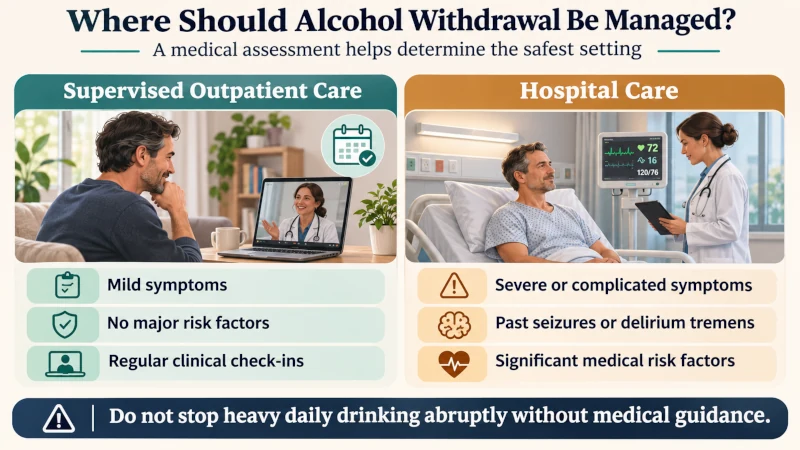
Sometimes, with a doctor involved. Never alone with no plan if you are at higher risk.
People with mild to moderate symptoms and none of the risk factors above can often be treated as outpatients [Tiglao et al., 2021]. Done properly, that means a clinician assesses you first, prescribes medication on a set schedule, checks in with you daily, and makes sure someone at home knows what warning signs to watch for [Bayard et al., 2004]. Severe or complicated withdrawal belongs in the emergency department and hospital [Tiglao et al., 2021].
What “home detox” should not mean is a heavy daily drinker stopping cold with nobody watching. It also should not mean borrowing someone else’s sedatives to take the edge off. Those medicines are dosed against symptoms and monitored for a reason.
What medical withdrawal treatment involves
Clinicians usually score symptoms with a standard checklist called the CIWA-Ar. Scores of 8 or less generally mean mild withdrawal, and scores above 15 mean severe withdrawal [Canver et al., 2024]. Treatment then depends on severity:
- Benzodiazepines are the first-line medicines for moderate to severe withdrawal. Carbamazepine or gabapentin may be used for mild cases, but they do not reliably prevent seizures or DTs [Tiglao et al., 2021].
- Diazepam is commonly used first unless there is significant liver damage, with lorazepam as an alternative and phenobarbital as another option [Canver et al., 2024].
- Thiamine, folate, and a multivitamin are given alongside, with fluids and electrolyte correction as needed [Canver et al., 2024][Tiglao et al., 2021].
Withdrawal treatment gets you through the next week safely. On its own, it is not treatment for alcohol use disorder. The American Society of Addiction Medicine stresses that it should be the start of ongoing care, not a stand-alone service [ASAM, 2020].
Four beliefs about withdrawal that put people at risk
“Only hard-core alcoholics go through withdrawal.” Withdrawal can begin after as little as a couple of weeks of heavy drinking [Tiglao et al., 2021], and the more often someone drinks, the more likely they are to have symptoms [MedlinePlus, 2025]. You don’t need a diagnosis to be at risk.
“If I feel okay after the first day, I’m in the clear.” Seizures cluster at 24 to 48 hours and DTs at 48 to 72 hours or later. The second and third days are exactly when to stay alert.
“Withdrawal is mostly in your head.” Anxiety is part of it, but so are seizures, fever, and heart rhythm problems. Those are physical events, and they can kill.
“I got through it last time, so I’ll be fine.” Because of kindling, past withdrawals can make the next one worse, not easier [Canver et al., 2024].
If you are ready to stop: a safer plan

- Talk to a doctor before your last drink. Be honest about how much and how often you drink. That number decides whether home treatment is reasonable.
- Ask what level of care fits you. Outpatient treatment with daily check-ins, a supervised withdrawal program, or a hospital stay. The risk factors above guide that choice.
- Line up a support person. Someone who can stay with you for the first several days, knows the 911 signs, and can drive you if needed.
- Keep the red-flag list handy. Seizure, severe confusion, hallucinations, fever, or an irregular heartbeat means emergency care [MedlinePlus, 2025].
- Plan what comes next. Ask about longer-term treatment, including medication for alcohol use disorder, which family physicians are encouraged to offer alongside withdrawal care [Tiglao et al., 2021].
If you don’t know where to start, these free services can help:
- SAMHSA National Helpline: 1-800-662-4357. Free, confidential treatment referral, 24/7, in English and Spanish [SAMHSA].
- NIAAA Alcohol Treatment Navigator: a government tool for finding evidence-based programs, therapists, and doctors [NIAAA].
- 988 Suicide & Crisis Lifeline: call or text 988 any time, including for alcohol or drug concerns [988 Lifeline].
- Peer support: Alcoholics Anonymous has a meeting finder, and SMART Recovery runs free, non-religious meetings in person and online.
After withdrawal
There is good news here, and it is not wishful thinking. Most people make a full recovery from alcohol withdrawal [MedlinePlus, 2025]. Expect some rough edges for a while. Sleep may be off, moods may swing, and energy can stay low for weeks or months. That is normal and not a sign that something has gone wrong. Staying away from alcohol is both the safest long-term choice and the best protection against going through withdrawal again [MedlinePlus, 2025].
| HEALTH DISCLAIMER: This article is for general education and is not a substitute for medical advice, diagnosis, or treatment. Alcohol withdrawal can be life-threatening. Please talk to a doctor before you stop drinking if you drink heavily or daily, and do not change or start any medication without professional guidance. If you or someone else has a seizure, severe confusion, hallucinations, fever, or an irregular heartbeat during withdrawal, call 911 or go to the nearest emergency room. |
Frequently Asked Questions
When is alcohol withdrawal most dangerous?
Usually between about 24 hours and five days after the last drink. Seizures most often occur at 24 to 48 hours, and delirium tremens typically begins at 48 to 72 hours, sometimes later [Tiglao et al., 2021][Canver et al., 2024].
How likely is death from alcohol withdrawal?
For most people, low. Only about 3% to 5% of people in withdrawal develop delirium tremens [Canver et al., 2024]. Among those who do, reported death rates range from around 1% to 15% with treatment and up to 37% without it, depending on the source and the patients studied [Rahman & Paul, 2023][Tiglao et al., 2021].
Should I go to the ER for alcohol withdrawal?
Yes, if there is a seizure, severe confusion, hallucinations, fever, or an irregular heartbeat. MedlinePlus also advises contacting a provider right away, or going to the emergency room, if you think you may be in withdrawal after heavy, frequent drinking [MedlinePlus, 2025].
How long do alcohol withdrawal symptoms last?
Symptoms usually start within about eight hours of the last drink and peak at 24 to 72 hours. Sleep changes, mood swings, and fatigue can last for months [MedlinePlus, 2025].
Can supplements make withdrawal safer?
Thiamine is the one with a clear clinical role, and in severe withdrawal it is given by injection [Canver et al., 2024]. Other supplements do not prevent seizures or DTs. See our breakdown of which supplements help and which don’t.
References
- American Society of Addiction Medicine. (2020). The ASAM clinical practice guideline on alcohol withdrawal management. View source
- Bayard, M., McIntyre, J., Hill, K. R., & Woodside, J., Jr. (2004). Alcohol withdrawal syndrome. View source
- Canver, B. R., Newman, R. K., & Gomez, A. E. (2024, updated Feb 14). Alcohol withdrawal syndrome. View source
- Mayo Clinic. Tonic-clonic (grand mal) seizure: Symptoms and causes. View source
- MedlinePlus Medical Encyclopedia. Alcohol withdrawal. U.S. National Library of Medicine. View source
- National Institute on Alcohol Abuse and Alcoholism. NIAAA Alcohol Treatment Navigator. View source
- NIH Office of Dietary Supplements. Magnesium: Fact sheet for health professionals. View source
- Rahman, A., & Paul, M. Delirium tremens. In StatPearls. StatPearls Publishing. View source
- Substance Abuse and Mental Health Services Administration. SAMHSA’s National Helpline. View source.
- Tiglao, S. M., Meisenheimer, E. S., & Oh, R. C. (2021). Alcohol withdrawal syndrome: Outpatient management. View source
- 988 Suicide & Crisis Lifeline. View source
- Alcoholics Anonymous. View source
- SMART Recovery. View source


