
There is no single best cortisol supplement for everyone. Ashwagandha has the most human evidence among supplements marketed for stress and cortisol: several randomized trials and meta-analyses report lower measured cortisol in stressed adults. Results vary by extract and dose, safety beyond about three months is unknown, and some people should avoid it. Evidence for magnesium, phosphatidylserine, L-theanine, rhodiola, and omega-3s is thinner or narrower.
The more useful question is what you want a supplement to do. Feeling less stressed, sleeping better, and lowering a cortisol number on a lab report are three different goals, and the research supports them unevenly. Each ingredient below is graded on the exact claim being made, not on how often it appears on a label.
What Cortisol Does, and Why Lower Is Not Always Better
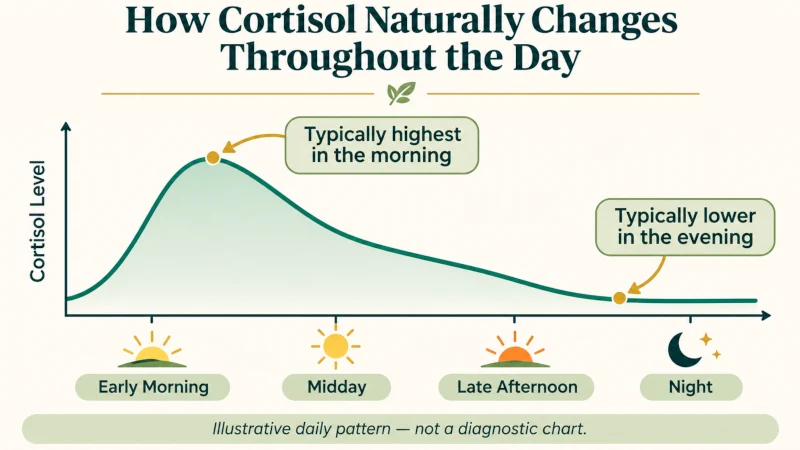
Cortisol is a hormone made by your adrenal glands. It helps your body respond to stress, regulate blood sugar and metabolism, control blood pressure, and limit inflammation. Levels move through the day: blood cortisol is usually highest in the morning and much lower by late afternoon, and it rises for a while with stress, exercise, illness, and even hot or cold temperatures. MedlinePlus, 2024
Those temporary rises are the system working as designed. Cortisol is essential for life, and having too little of it is a medical condition called adrenal insufficiency. NIDDK, adrenal insufficiency Having far too much for a long time is a different condition, Cushing syndrome, which is rare and is usually caused by long-term, high-dose steroid medicines or by a tumor. NIDDK, Cushing’s syndrome
Neither condition can be diagnosed from tiredness, poor sleep, cravings, or weight gain, and neither is treated with a supplement. The popular idea of “adrenal fatigue” does not fill the gap: the Endocrine Society says no scientific proof supports it as a medical condition. Endocrine Society, 2022 For most people shopping for supplements to lower cortisol, the real target is everyday stress and the way it feels, which is a reasonable thing to want help with.
The Best Cortisol Supplements at a Glance
Grades use four levels: Strong, Moderate, Limited, and Insufficient. No ingredient earns a Strong grade for lowering cortisol.
| Ingredient | Evidence for cortisol | Evidence for perceived stress | Overall strength | Main safety concern | Bottom line |
| Ashwagandha | Moderate: several meta-analyses show lower cortisol in stressed adults; trials vary | Moderate but inconsistent across meta-analyses | Moderate | Liver injury (uncommon), thyroid effects, pregnancy, drug interactions | Best-supported option; not for everyone |
| Phosphatidylserine | Limited: blunted cortisol during exercise or a lab stress test only | Limited | Limited | Only short trials (days to weeks) | Acute-stress findings; not shown to lower all-day cortisol |
| L-theanine | Limited and mixed: one acute effect; no change over 4 weeks | Limited: may ease stress under pressure | Limited | Long-term use not well studied | Possible calm aid, not a cortisol reducer |
| Omega-3s | Limited: one trial, during a lab stressor, at 2.5 g/day | Insufficient | Limited | Warfarin interaction; atrial fibrillation at high doses | Not a cortisol product |
| Magnesium | Insufficient | Limited: anxiety studies of poor quality | Limited | Diarrhea; kidney disease; drug binding | Useful if intake is low; cortisol claim unproven |
| Rhodiola | Limited: one small 28-day trial | Limited | Limited | Insomnia, dizziness; losartan interaction | “Adaptogen” is a label, not evidence |
| Holy basil | Limited: one manufacturer-funded trial | Limited | Limited | Tolerated in one 8-week trial; little else known | Promising; needs confirmation |
Lowering Stress Is Not the Same as Lowering Cortisol
Supplement studies measure very different things, and labels tend to blur them together. When you read that an ingredient “lowers cortisol,” it helps to know which of these was actually measured:
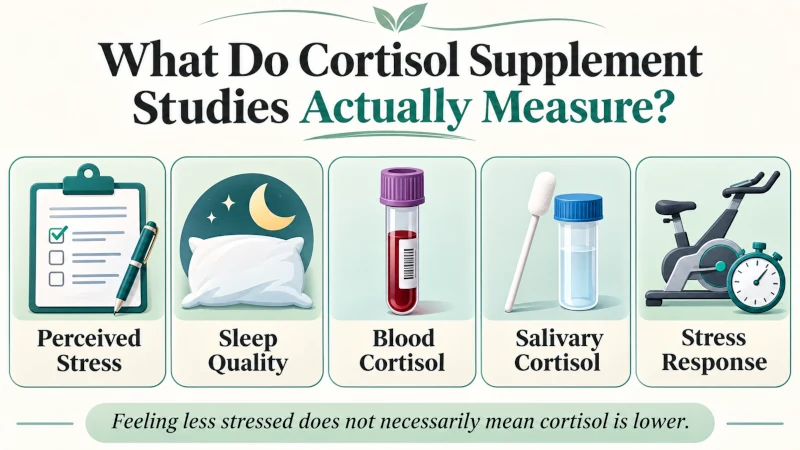
- Perceived stress and anxiety scores. Questionnaires about how you feel. Meaningful, but not a hormone measurement.
- Sleep. Usually self-rated sleep quality, sometimes a wearable tracker.
- Morning blood (serum) cortisol. A single snapshot, taken at the time of day when cortisol is naturally highest.
- Salivary cortisol and the cortisol awakening response. Saliva samples that track the rise in the first minutes after waking or across a day.
- Cortisol during a stress test or hard exercise. How high cortisol climbs in response to a staged challenge, which says little about the rest of the day.
These outcomes do not always move together. One 2025 meta-analysis of ashwagandha found a significant drop in cortisol and no significant change in perceived stress in the same pool of trials. Albalawi, Nutrition and Health, 2025 The reverse also happens: in a four-week trial, L-theanine improved some sleep measures while blood and saliva cortisol did not change. Hidese et al., Nutrients, 2019 A supplement that helps you feel calmer has not necessarily changed your cortisol, and a lower lab value does not guarantee you will feel different.
Which Cortisol Supplements Have the Best Evidence?
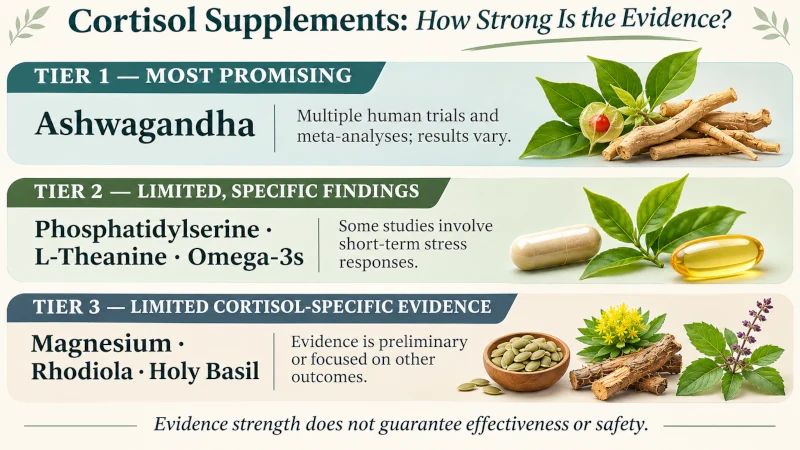
Sorting by the quality of human evidence for cortisol specifically, the ingredients fall into three tiers.
| Tier | Ingredients | Why |
| Tier 1: Most promising human evidence | Ashwagandha | Multiple randomized trials and meta-analyses report lower cortisol in stressed adults. Limits: varied extracts, short trials, real safety cautions. |
| Tier 2: Some evidence, important limitations | Phosphatidylserine, L-theanine, omega-3s | Controlled trials show a smaller cortisol response to an acute stressor. No good evidence of lower day-to-day cortisol. |
| Tier 3: Popular, limited cortisol-specific evidence | Magnesium, rhodiola, holy basil, and most other blend ingredients | A single small trial, or evidence for anxiety or fatigue only. |
Ashwagandha
Ashwagandha (Withania somnifera) is the only ingredient here with several meta-analyses that pooled cortisol results. A 2025 analysis of seven randomized trials with 488 participants found cortisol was lower with ashwagandha than with placebo by an average of 1.16 µg/dL. Albalawi, Nutrition and Health, 2025 A review of nine trials with 558 participants reported lower serum cortisol along with better stress and anxiety scores. Arumugam et al., Explore, 2024 A 2026 meta-analysis of 23 placebo-controlled trials with 1,706 participants again found a significant reduction, and its authors cautioned that the trials varied considerably. Fornalik et al., Planta Medica, 2026
The stress findings are less tidy. The 2025 analysis found no significant effect on perceived stress, while a 2022 meta-analysis of 12 trials did find lower stress and anxiety but rated the certainty of that evidence as low because results differed so widely between studies. Akhgarjand et al., Phytotherapy Research, 2022 The NIH Office of Dietary Supplements lands in the middle: ashwagandha may reduce stress and anxiety and may modestly help sleep, particularly in people with insomnia, but the trials are small, short, mostly conducted in India, and use different preparations. NIH Office of Dietary Supplements, 2025
That last point matters when you shop. Trials in the NIH summary used about 240 to 1,250 mg a day of extract for six to eight weeks, and several saw more benefit at 500 to 600 mg a day. A 12-week trial of 400 mg a day in overweight adults found no reduction in perceived stress. Extracts differ in which part of the plant is used, how it is extracted, and how much of the marker compounds called withanolides they contain, so two products with the same milligram amount are not equivalent. These are research doses, not personal dosing advice.
Safety is the other half of the picture. Ashwagandha appears to be tolerated for up to about three months; safety over longer periods is unknown. Common side effects are stomach upset, loose stools, nausea, and drowsiness. NIH Office of Dietary Supplements, 2025 Liver injury is uncommon but documented. The NIH LiverTox database rates ashwagandha a likely cause of liver injury, typically appearing 2 to 12 weeks after starting, with jaundice and itching; most cases resolve after stopping, though rare cases of liver failure have been reported, mainly in people with existing liver disease. NIH LiverTox, 2024
Ashwagandha can also raise thyroid hormone levels, and case reports describe an overactive thyroid state in people taking it. NIH Office of Dietary Supplements, 2025 NIH’s complementary health center advises against it during pregnancy and breastfeeding, before surgery, and for people with autoimmune or thyroid disorders or hormone-sensitive prostate cancer. It may interact with thyroid, diabetes, and blood pressure medicines, immunosuppressants, sedatives, and anti-seizure drugs. NCCIH, 2023 For more detail on pairing it with the next ingredient, see our guide to combining ashwagandha and magnesium.
Magnesium
Magnesium is an essential mineral, and nearly half of Americans get less from food and drinks than their estimated requirement. NIH Office of Dietary Supplements, 2026 Closing that gap with leafy greens, legumes, nuts, seeds, and whole grains, or with a modest supplement, is sound nutrition. It is a different claim from “magnesium lowers cortisol,” and the second claim is not established.
The stress-related research mostly concerns anxiety. A systematic review of 18 studies found that about half reported less self-rated anxiety with magnesium in people already prone to it. The reviewers judged the overall quality poor, noted strong placebo responses, and found that no study used a validated measure of stress. Boyle et al., Nutrients, 2017 That supports a Limited grade for anxiety and an Insufficient grade for cortisol.
If you take magnesium, the adult upper limit from supplements and medicines is 350 mg a day (food does not count toward it). Higher doses commonly cause diarrhea, nausea, and cramping, especially the carbonate, chloride, gluconate, and oxide forms. People with reduced kidney function can accumulate magnesium to toxic levels and should not supplement without medical guidance. Magnesium also binds certain antibiotics and osteoporosis drugs, so doses need to be separated by at least two hours. NIH Office of Dietary Supplements, 2026
Phosphatidylserine
Phosphatidylserine is a fat-like compound found in cell membranes, usually sold as a soy or sunflower extract. Its cortisol reputation comes from short studies of acute stress. In one crossover trial, 10 healthy men took 600 mg a day for 10 days; peak cortisol during a 15-minute cycling test was roughly 39% lower than with placebo. Starks et al., JISSN, 2008 In another, 80 people took a phosphatidylserine and phosphatidic acid complex for three weeks before a public-speaking stress test. The 400 mg dose blunted the cortisol response; the 600 mg and 800 mg doses did not. Hellhammer et al., Stress, 2004
Both findings describe how high cortisol rises during a staged challenge, in small groups, over days to weeks. They do not show that phosphatidylserine lowers cortisol across an ordinary day or eases chronic stress, and the lack of effect at higher doses in the second trial is a reason for caution about dose claims on labels.
L-Theanine
L-theanine is an amino acid from tea. A systematic review of nine randomized trials concluded that 200 to 400 mg a day may help reduce stress and anxiety in people facing stressful conditions, and called for longer and larger studies. Williams et al., Plant Foods for Human Nutrition, 2020
Its cortisol evidence is mixed. In a crossover study of 34 adults, an L-theanine drink lowered self-rated stress one hour after a demanding mental task and reduced the salivary cortisol response at three hours. White et al., Nutrients, 2016 But when 30 adults took 200 mg nightly for four weeks, serum and salivary cortisol did not change, even though some sleep measures improved; that trial was funded by the ingredient’s manufacturer. Hidese et al., Nutrients, 2019 L-theanine is better described as a possible aid for feeling calmer under pressure than as a cortisol-lowering supplement.
Rhodiola
Rhodiola is sold as an adaptogen, a term for herbs said to help the body resist stress. The word describes a marketing and traditional-use category. It is not proof that a product regulates cortisol.
One trial does bear on cortisol: 60 adults with stress-related fatigue took 576 mg a day of a specific extract (SHR-5) or placebo for 28 days. Fatigue and attention improved more with rhodiola, and the cortisol response after waking changed relative to placebo. Olsson et al., Planta Medica, 2009
A single small study of one extract is thin support, and NIH’s complementary health center concludes there is not enough reliable evidence to say rhodiola is useful for any health purpose, with most human studies of low to moderate quality. It lists dizziness, headache, and insomnia as side effects, describes use as possibly safe for up to 12 weeks, and notes a reported interaction with the blood pressure drug losartan. NCCIH, 2025
Omega-3 Fatty Acids
Fish oil is not a cortisol product, but one well-designed trial is often cited. In 138 sedentary, overweight, middle-aged adults, four months of 2.5 g a day of omega-3s was associated with about 19% lower cortisol during a laboratory speech stressor than placebo. Madison et al., Molecular Psychiatry, 2021 This was a secondary analysis of a larger trial and measured cortisol only during the stress test, so it suggests a blunted stress response at a fairly high dose, not lower cortisol day to day.
Side effects are usually mild (fishy aftertaste, heartburn, nausea, loose stools). The FDA considers up to 5 g a day of EPA and DHA from supplements safe when used as recommended. High doses can prolong clotting time in people taking warfarin, and trials using 4 g a day for several years found a slightly higher risk of atrial fibrillation in people with or at high risk of heart disease. NIH Office of Dietary Supplements
Holy Basil and Other Popular Cortisol Ingredients With Limited Evidence
Holy basil (tulsi) has one notable trial. Among 100 stressed adults, 250 mg a day of a branded extract for eight weeks improved perceived stress and insomnia scores more than placebo, and hair and salivary cortisol were lower in the holy basil group at week eight. Cortisol was measured only at the end, with no baseline for comparison, and the study was funded by the extract’s manufacturer. Lopresti et al., Frontiers in Nutrition, 2022 That is a promising first result that needs independent confirmation.
Lemon balm, GABA, magnolia bark, medicinal mushrooms, vitamin C, and B vitamins also appear in cortisol formulas and are not graded here. Hold a cortisol claim for any of them to the same standard as the ingredients above: which human trial measured cortisol, in whom, at what dose, and for how long.
Will Cortisol Supplements Reduce Belly Fat?
Probably not in the way the ads suggest. The trials described above measured stress scores, sleep, or cortisol; none was designed to show that a supplement shrinks abdominal fat by lowering cortisol. Abdominal fat has many contributors beyond any single hormone.
The weight gain of true cortisol excess is a different matter. In Cushing syndrome, fat tends to collect in the trunk, face, and upper back while arms and legs stay thin, usually alongside signs such as easy bruising, wide purple stretch marks, and weak muscles. It is rare, affecting roughly 40 to 70 people per million. NIDDK, Cushing’s syndrome Ordinary weight gain around the middle is not evidence of it.
How to Choose a Cortisol Supplement
Supplements are regulated differently from medicines. The FDA does not approve them for safety or effectiveness, or approve their labels, before they are sold; the company is responsible for both. FDA, 2022 “Cortisol support” on a label is a marketing phrase that no regulator has checked. A few habits make a real difference.
Read the Supplement Facts panel, not the front of the bottle
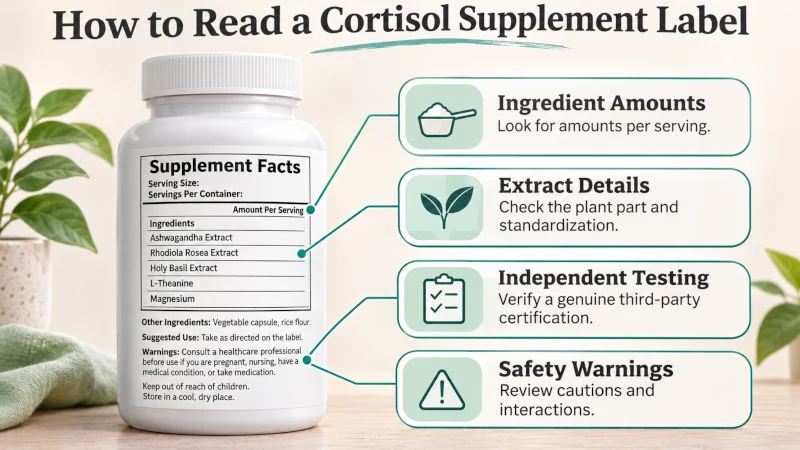
- Look for exact amounts of each ingredient. You cannot compare a product to the research without them.
- Check the extract. For ashwagandha, the label should state the plant part and the withanolide standardization. Even then, a “standardized” label does not by itself guarantee quality or consistency. NCCIH, Using Dietary Supplements Wisely
- Prefer simple formulas. One ingredient at a studied amount is easier to judge, and easier to stop if it disagrees with you, than a long list.
- Expect warnings. A responsible ashwagandha label mentions pregnancy, thyroid conditions, and medication interactions.
Third-party testing
What is on a label does not always match what is in the bottle. Independent programs such as U.S. Pharmacopeia (USP), NSF, and ConsumerLab test products and allow those that pass to carry a seal. NIH Office of Dietary Supplements, 2023 The USP Verified mark, for example, indicates that a product contains the listed ingredients in the stated amounts, is free of harmful levels of contaminants such as heavy metals and microbes, breaks down properly, and was made under good manufacturing practices. USP A seal speaks to quality. It does not show that the product is effective or safe for you.
Proprietary blends
A proprietary blend lists its ingredients but gives only a combined weight. If a 600 mg blend contains ashwagandha, rhodiola, L-theanine, and four other things, you cannot tell whether any of them reaches an amount used in a trial. A formula with ten promising ingredients is not better than a simpler one with a single ingredient at a studied amount, and each addition is another possible side effect or interaction.
Claims that deserve skepticism
Be wary of products that promise to “block cortisol,” “flush stress hormones,” “reset your hormones,” “melt cortisol belly,” or lower cortisol rapidly. Supplement labels may describe support for normal body functions, but they may not claim to diagnose, treat, cure, or prevent a disease, and a product marketed to treat a disease is legally a drug. NIH Office of Dietary Supplements, 2023 Beyond the legal line, these phrases promise something the research has not shown: the best-supported ingredient produced modest average changes in stressed adults over several weeks, with wide variation between studies.
A supplement also works at the margins of habits that matter more. Caffeine, alcohol, sleep, and eating patterns all influence how stressed you feel; our article on foods that affect cortisol covers what is and is not supported.
Who Should Be Careful With Cortisol Supplements?
“Natural” does not mean safe, and supplements can interact with prescription and over-the-counter medicines. NCCIH, Using Dietary Supplements Wisely Talk with a physician or pharmacist before starting if any of these apply to you:

- Pregnancy or breastfeeding. Avoid ashwagandha. Little is known about rhodiola’s safety, and many supplements have not been tested in these groups.
- Thyroid disease or thyroid medication. Ashwagandha can raise thyroid hormone levels.
- Liver disease. Ashwagandha has been linked to liver injury, with the greatest risk in people who already have liver disease.
- Kidney disease. Supplemental magnesium can build up to toxic levels.
- Autoimmune conditions or immunosuppressant drugs. Ashwagandha is not recommended.
- Diabetes or blood pressure medicines. Ashwagandha may interact with them, and rhodiola has a reported interaction with losartan.
- Sedatives, sleep aids, or anti-seizure medicines. Ashwagandha can cause drowsiness and may interact.
- Warfarin or other anticoagulants. High-dose omega-3s may prolong clotting time.
- Hormone-sensitive prostate cancer. Ashwagandha may raise testosterone.
- Upcoming surgery. Some supplements affect bleeding or anesthesia; tell your surgical team about everything you take.
- Several supplements at once. Combining products raises the chance of side effects and makes it hard to tell which one caused a problem.
Do not stop or change a prescribed medicine in order to take a supplement. If you develop yellowing of the skin or eyes or unexplained itching after starting ashwagandha, stop taking it and contact your doctor promptly. You can also report a suspected reaction to the FDA. FDA, 2022
Do You Need a Cortisol Test Before Taking a Supplement?
Usually not. Most people considering a stress supplement have no reason to suspect a cortisol disorder, and common symptoms such as fatigue or poor sleep do not point to one. A single reading is also easy to misread: stress, exercise, pregnancy, and medicines such as birth control pills and steroids all shift results, and a cortisol test alone cannot identify the cause of an abnormal value. MedlinePlus, 2024
A mail-order saliva result should not be used to justify taking more of a supplement or stacking several. If you have reason to think your cortisol is truly abnormal, a clinician can order the right test at the right time of day and interpret it. Our guide to how cortisol levels are checked explains the options.
When to See a Healthcare Professional
A supplement trial is reasonable for everyday stress. It is the wrong tool when something more specific may be going on. Make an appointment with your primary care clinician if you notice:
- weight gain concentrated in the trunk and face with thin arms and legs, easy bruising, wide purple stretch marks, or weak muscles;
- high blood pressure or high blood sugar without a clear explanation;
- long-lasting fatigue with muscle weakness, loss of appetite, unintended weight loss, abdominal pain, or dizziness on standing;
- stress, anxiety, low mood, or poor sleep that persists or worsens despite your own efforts.
The first two can accompany Cushing syndrome and the third can accompany adrenal insufficiency, though both sets of symptoms have many other causes, which is why they need an evaluation and not a guess. NIDDK, Cushing’s syndrome NIDDK, adrenal insufficiency Tell your clinician if you take or recently stopped steroid medicines, the most common cause of abnormal cortisol results. MedlinePlus, 2024
Sudden or severe symptoms such as fainting, confusion, chest pain, or trouble breathing call for the emergency room or 911, not a change in supplements.
Which Cortisol Supplement Makes the Most Sense?
Match the choice to the problem you are trying to solve.
- Mainly stress. Ashwagandha has the most evidence, provided none of the cautions above apply to you. Choose a single-ingredient, standardized, third-party-tested product, use it for a defined period such as eight weeks, and reassess. L-theanine is an alternative with weaker evidence.
- Mainly poor sleep. Judge products on sleep evidence, not cortisol claims. Ashwagandha has a small demonstrated effect on sleep, strongest in people with insomnia. Sleep that stays poor deserves a medical conversation.
- A diet low in magnesium. Improving intake is worthwhile for its own sake. Do not expect it to lower cortisol.
- You think your cortisol is medically high or low. See a clinician first. No supplement here treats a cortisol disorder.
- You take prescription medicines or have a chronic condition. Check interactions with a pharmacist before you buy anything.
Whatever you choose, change one thing at a time and give it several weeks; most ashwagandha trials ran four to twelve. If nothing is noticeably different by then, stopping is a sound decision. More of our ingredient guides are collected under supplements and reviews.
| HEALTH DISCLAIMER: This article is for general education and is not medical advice. Dietary supplements are not approved by the FDA to diagnose, treat, cure, or prevent any disease, and they are not a substitute for evaluation or treatment of a suspected cortisol disorder, anxiety, depression, or sleep disorder. Talk with your doctor or pharmacist before starting any supplement, particularly if you are pregnant or breastfeeding, have a medical condition, or take medication. Do not stop or change a prescribed medicine without your clinician’s guidance. In an emergency, call 911. |
Frequently Asked Questions
Does ashwagandha lower cortisol?
In stressed adults, on average, yes. Several meta-analyses of randomized trials have found lower cortisol with ashwagandha than with placebo over roughly six to eight weeks. The size of the effect varies by study and extract, and it has not been tested as a treatment for cortisol disorders. Albalawi, 2025
Does magnesium lower cortisol?
That has not been established. Magnesium’s stress-related research mostly concerns anxiety, and reviewers rated its quality as poor. Getting enough magnesium is worthwhile for general health. Boyle et al., 2017
How quickly do cortisol supplements work?
Most ashwagandha trials measured results after 30 to 90 days, commonly six to eight weeks. Phosphatidylserine and L-theanine studies looked at responses to a single stressful event after days to weeks of use. Expect weeks, not days, and reassess if nothing has changed. NIH Office of Dietary Supplements, 2025
Can supplements lower cortisol too much?
The trials reviewed here did not report cortisol falling to harmful levels, but they were short and enrolled mostly healthy adults. Because cortisol is essential, symptoms such as lasting fatigue, weakness, weight loss, or dizziness on standing should be evaluated by a clinician. NIDDK
Are cortisol supplements safe long term?
Long-term safety is largely unstudied. NIH sources describe ashwagandha as tolerated for up to about three months and rhodiola as possibly safe for up to 12 weeks, with no reliable data beyond that. NCCIH, 2023
References
- NIH Office of Dietary Supplements. Ashwagandha: Is it helpful for stress, anxiety, or sleep? Fact Sheet for Health Professionals. View source
- National Center for Complementary and Integrative Health. Ashwagandha. View source
- LiverTox: Clinical and Research Information on Drug-Induced Liver Injury. Ashwagandha. National Institute of Diabetes and Digestive and Kidney Diseases. View source
- Albalawi AA. Dual impact of Ashwagandha: Significant cortisol reduction but no effects on perceived stress – A systematic review and meta-analysis. View source
- Arumugam V, et al. Effects of Ashwagandha (Withania somnifera) on stress and anxiety: A systematic review and meta-analysis. View source
- Fornalik M, Malkiewicz A, Adamczak D, Nawrocki F, Zielinska A, Mondal SA. Hormonal Modulation with Withania somnifera: Systematic Review and Meta-Analysis of Randomized-controlled Trials. View source
- Akhgarjand C, Asoudeh F, Bagheri A, Kalantar Z, Vahabi Z, Shab-Bidar S, Rezvani H, Djafarian K. View source
- NIH Office of Dietary Supplements. Magnesium: Fact Sheet for Health Professionals. View source
- Boyle NB, Lawton C, Dye L. The Effects of Magnesium Supplementation on Subjective Anxiety and Stress—A Systematic Review. View source
- Starks MA, Starks SL, Kingsley M, Purpura M, Jäger R. The effects of phosphatidylserine on endocrine response to moderate intensity exercise. View source
- Hellhammer J, Fries E, Buss C, Engert V, Tuch A, Rutenberg D, Hellhammer D. Effects of soy lecithin phosphatidic acid and phosphatidylserine complex (PAS) on the endocrine and psychological responses to mental stress. Stress. View source
- Hidese S, Ogawa S, Ota M, Ishida I, Yasukawa Z, Ozeki M, Kunugi H. View source
- Williams JL, Everett JM, D’Cunha NM, et al. The Effects of Green Tea Amino Acid L-Theanine Consumption on the Ability to Manage Stress and Anxiety Levels: a Systematic Review. Plant Foods for Human Nutrition. View source
- White DJ, de Klerk S, Woods W, Gondalia S, Noonan C, Scholey AB. View source
- National Center for Complementary and Integrative Health. Rhodiola. View source
- Olsson EMG, von Schéele B, Panossian AG. A randomised, double-blind, placebo-controlled, parallel-group study of the standardised extract SHR-5 of the roots of Rhodiola rosea in the treatment of subjects with stress-related fatigue. View source
- Madison AA, Belury MA, Andridge R, Renna ME, Shrout MR, Malarkey WB, Lin J, Epel ES, Kiecolt-Glaser JK. Omega-3 supplementation and stress reactivity of cellular aging biomarkers: an ancillary substudy of a randomized, controlled trial in midlife adults. View source
- NIH Office of Dietary Supplements. Omega-3 Fatty Acids: View source
- Lopresti AL, Smith SJ, Metse AP, Drummond PD. A randomized, double-blind, placebo-controlled trial investigating the effects of an Ocimum tenuiflorum (Holy Basil) extract (Holixer) on stress, mood, and sleep in adults experiencing stress. Frontiers in Nutrition. View source
- U.S. Food and Drug Administration. FDA 101: Dietary Supplements. View source
- NIH Office of Dietary Supplements. Dietary Supplements: What You Need to Know. View source
- U.S. Pharmacopeia. View source
- National Center for Complementary and Integrative Health. Using Dietary Supplements Wisely. View source
- National Institute of Diabetes and Digestive and Kidney Diseases. Cushing’s Syndrome. View source
- National Institute of Diabetes and Digestive and Kidney Diseases. Symptoms & Causes of Adrenal Insufficiency & Addison’s Disease. View source
- Endocrine Society. Adrenal Fatigue. View source
- MedlinePlus, National Library of Medicine. Cortisol Test. View source


