
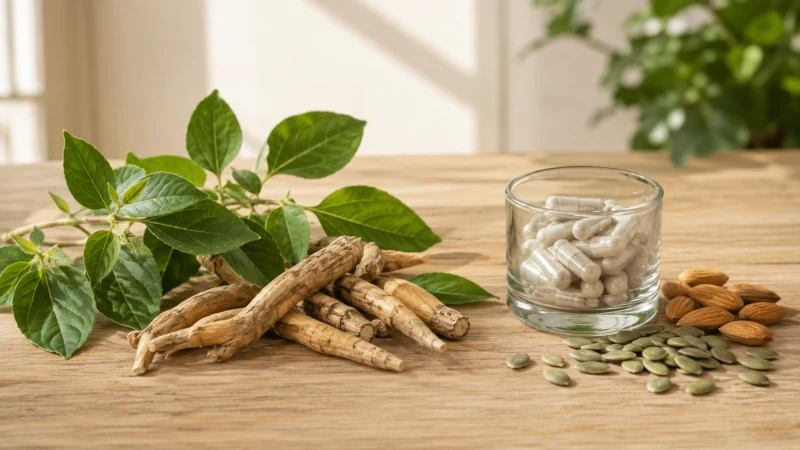
Ashwagandha and magnesium are two of the most talked-about natural options for stress and sleep — but the research behind them is narrower than most blog posts admit. Ashwagandha is an adaptogenic herb from Ayurveda with a small but growing body of short-term human trials.
Magnesium is an essential mineral where the strongest evidence applies to people who are actually deficient. Taken together, they can be reasonable to try for short periods in healthy adults, but they are not a cure, and they are not right for everyone.
This guide walks through what each one does, what the evidence shows, safe dose ranges, who should avoid them, and when to see a doctor instead.
For a deeper look at the mineral on its own, see our full guide to magnesium benefits, functions, and dosage, or the ultimate guide to magnesium glycinate powder if you want the gentlest form for sleep and calm.
Key Takeaways
- Short-term, moderate evidence: Small randomized trials suggest standardized ashwagandha root extract can reduce perceived stress and cortisol in healthy adults over 6–8 weeks.
- Deficiency matters most: Magnesium supplementation helps the most when someone is actually low — which is common, but not universal.
- They work differently: Ashwagandha targets the stress-hormone axis; magnesium supports nerve and muscle relaxation.
- Not for everyone: Pregnancy, thyroid disorders, liver disease, kidney disease, and many common prescriptions are reasons to talk to a clinician before starting either one.
- They are not a cure: These supplements do not treat anxiety disorders, insomnia, or any disease. They can be part of a plan — not the whole plan.
What Is Ashwagandha and What Does the Evidence Show?

Ashwagandha (Withania somnifera) is a small shrub native to India, the Middle East, and parts of Africa. It has been used in Ayurvedic medicine for centuries and is classified as an adaptogen — a loose category of plants thought to help the body respond to physical and psychological stress. Most commercial products use a standardized extract of the root, sometimes combined with leaf. See our full overview of ashwagandha benefits for context on how the herb has been used historically.
Stress and cortisol
A 60-day randomized, double-blind, placebo-controlled trial in 60 stressed-but-healthy adults found that 240 mg/day of a standardized ashwagandha extract significantly reduced scores on the Hamilton Anxiety Rating Scale and lowered morning cortisol compared with placebo [Lopresti et al., 2019]. The NIH Office of Dietary Supplements fact sheet summarizes multiple similar trials and notes that most participants tolerated ashwagandha well for up to about three months [NIH ODS, 2025].
Anxiety and sleep
The evidence here is promising but limited. A 2023 narrative review in Pharmaceutics concluded that while several small trials report improvements in perceived stress, sleep quality, and anxiety symptoms, trial sizes are small, durations are short, and the specific extracts and doses vary widely [Mikulska et al., 2023]. The Cleveland Clinic notes that the U.S. National Center for Complementary and Integrative Health considers ashwagandha possibly effective for short-term stress and insomnia, while evidence for anxiety specifically is unclear [Cleveland Clinic, 2025].
What ashwagandha is NOT proven to do
Ashwagandha has not been shown to cure anxiety disorders, insomnia, depression, infertility, or any diagnosed disease. Most trials run 8–12 weeks in a few dozen people. Long-term safety over months to years has not been well studied. Marketing claims that go beyond “may help with short-term stress” usually outrun the evidence.
What Magnesium Does and Why Deficiency Matters

Magnesium is an essential mineral — your body cannot make it, so you have to get it from food or supplements. It acts as a cofactor in more than 300 enzyme systems that support muscle and nerve function, blood sugar control, blood pressure regulation, protein synthesis, and energy production [NIH ODS, 2022].
Surveys suggest many adults in Western countries do not consistently meet the Recommended Dietary Allowance of 310–420 mg/day. When someone is actually low, correcting the deficiency can improve symptoms such as muscle cramps, fatigue, irritability, and poor sleep. The harder question is how much magnesium helps people who are already getting enough.
Magnesium, stress, and sleep
A systematic review of 18 studies found that magnesium supplementation may modestly reduce subjective anxiety in specific vulnerable groups — such as people with mild anxiety, premenstrual syndrome, or hypertension — but the authors concluded that the overall evidence quality was low and more rigorous trials are needed [Boyle, Lawton & Dye, 2017]. In other words: magnesium is not a sedative. It may help if you’re low. It is not guaranteed to help if you’re not.
Food first, then supplements
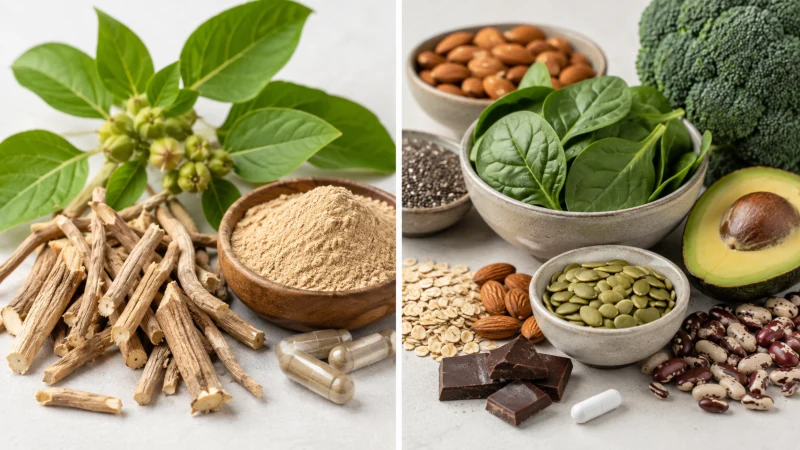
Magnesium-rich foods include pumpkin seeds, almonds, cashews, spinach, Swiss chard, black beans, edamame, whole grains, avocado, and dark chocolate. Getting magnesium from food is safer than supplementing because the kidneys efficiently excrete excess from diet. Supplement magnesium can push past the Tolerable Upper Intake Level of 350 mg/day from supplements alone, which is the main reason high-dose products can cause diarrhea [NIH ODS, 2022].
Why People Combine Ashwagandha and Magnesium

The theory behind stacking them is straightforward: they work through different pathways. Ashwagandha appears to act on the hypothalamic-pituitary-adrenal axis, potentially dampening the cortisol response to stress. Magnesium is directly involved in the calming GABA system, nerve-impulse regulation, and muscle relaxation. On paper, that is complementary. In practice, there are no large, rigorous trials of the combination — most claims about synergy are extrapolated from single-ingredient studies.
That does not make the combination unreasonable for a healthy adult looking for short-term stress or sleep support. It just means expectations should be modest, and the decision should be based on your own health picture. If ashwagandha is part of a broader approach to stress, our guide to adaptogenic herbs covers the wider category, and best herbs for high blood pressure is worth reading if stress-related blood pressure is part of why you’re looking into these supplements.
Ashwagandha vs. Magnesium at a Glance
| Feature | Ashwagandha | Magnesium |
| Type | Adaptogenic herb (Withania somnifera) | Essential mineral |
| Main mechanism | Modulates the HPA axis; may lower cortisol | Cofactor in 300+ enzymatic reactions; supports nerve and muscle relaxation |
| Best-studied uses | Perceived stress, anxiety, sleep quality (short-term) | Correcting deficiency; some evidence for sleep and mild anxiety |
| Typical trial dose | 240–600 mg/day standardized root extract for 6–8 weeks | 200–400 mg/day elemental magnesium (glycinate is gentle on the gut) |
| Strength of evidence | Small RCTs and meta-analyses — promising but short-term | Strong for deficiency correction; limited for anxiety and sleep in well-nourished adults |
| Key cautions | Thyroid conditions, pregnancy, liver disease, autoimmune disease, sedatives | Severe kidney disease; high doses can cause diarrhea; interacts with some antibiotics |
How Much, and How to Take Them

These ranges reflect what clinical studies have used — they are not personal recommendations. Always match doses to a specific, reputable product and talk to your healthcare provider before starting.
| Supplement | Common research range | Notes |
| Ashwagandha (standardized root extract) | 240–600 mg once or twice daily | Most studies ran 6–8 weeks. Long-term safety beyond 3 months is not well established. |
| Magnesium (elemental) | 310–420 mg/day (RDA); up to 350 mg/day from supplements above food | The Tolerable Upper Intake Level from supplements is 350 mg/day for adults, separate from food magnesium. |
Timing: Magnesium glycinate is often taken in the evening because of its gentle calming profile. Ashwagandha can be taken in the morning or evening depending on the product — some people find it mildly sedating, others find it neutral. Start at the lower end, track how you feel for a couple of weeks, and reassess.
Form matters for magnesium: Magnesium glycinate and citrate are generally better absorbed and more tolerable than magnesium oxide, which is cheap but poorly bioavailable and more likely to cause loose stools.
Side Effects, Interactions, and Who Should Avoid These Supplements

Common side effects
- Ashwagandha: Upset stomach, nausea, loose stools, and drowsiness are the most common reports. Rare but serious cases of liver injury have been reported, which is why some countries have issued advisories.
- Magnesium: Diarrhea, nausea, and abdominal cramping — especially with oxide, citrate, or doses above 350 mg/day from supplements.
Medication interactions to watch for
- Ashwagandha: Thyroid hormone, immunosuppressants, sedatives and benzodiazepines, anti-seizure medicines, diabetes and blood pressure drugs, and anything metabolized through the liver in sensitive people.
- Magnesium: Certain antibiotics (tetracyclines, quinolones) — take at least 2–4 hours apart. Bisphosphonates for osteoporosis, some diuretics, and proton pump inhibitors can also interact or affect magnesium levels.
Who should avoid ashwagandha or use it only under medical supervision
- People who are pregnant or trying to become pregnant — some authorities caution about possible effects on pregnancy.
- People who are breastfeeding (safety data are lacking).
- People with autoimmune conditions such as lupus, rheumatoid arthritis, or multiple sclerosis, because ashwagandha may stimulate immune activity.
- People with thyroid disease, especially hyperthyroidism, since ashwagandha can raise thyroid hormone levels.
- People with liver disease or a history of liver injury.
- Anyone scheduled for surgery within two weeks, due to possible effects on sedation and blood sugar.
Who should avoid high-dose magnesium supplements
- People with severe kidney disease or kidney failure, unless a doctor specifically recommends it.
- People with heart block or certain cardiac conduction problems.
- People who are already getting magnesium from multiple sources — laxatives, antacids, and multivitamins can add up quickly.
Realistic Expectations

If either supplement is going to help, most trials show effects building over 4 to 8 weeks, not days. A reasonable plan is to try one change at a time, keep a brief journal of sleep, stress, and mood, and reassess after two months. If nothing has changed, it probably isn’t working for you — and stacking more supplements on top rarely fixes that.
It’s also worth naming what these supplements cannot replace: sleep hygiene, regular movement, meaningful time off screens, therapy when it’s indicated, and treatment of any underlying medical issue. Supplements are the smallest lever in the stress-and-sleep toolkit.
When to See a Doctor Instead of Reaching for a Supplement
Talk to a healthcare provider — don’t self-treat with supplements — if any of the following apply:
- Sleep problems or anxiety have lasted more than a few weeks and are interfering with work, relationships, or daily life.
- You have panic attacks, intrusive thoughts, or thoughts of self-harm.
- You feel persistent sadness, hopelessness, or loss of interest in things you used to enjoy.
- You experience new muscle weakness, irregular heartbeat, severe cramps, or unexplained fatigue (possible signs of a mineral imbalance that needs testing).
- You notice yellowing of the skin or eyes, dark urine, upper-right abdominal pain, or unusual tiredness while taking ashwagandha — stop and seek care.
- You have a diagnosed thyroid, liver, kidney, autoimmune, or cardiac condition.
- You are pregnant, breastfeeding, or trying to conceive.
| Health Disclaimer: The information in this article is for educational purposes only and is not a substitute for advice, diagnosis, or treatment from a qualified healthcare professional. Ashwagandha and magnesium are dietary supplements, not medications, and the U.S. FDA does not approve supplements for treating, curing, or preventing disease. Individual responses vary. If you are pregnant or breastfeeding, have a thyroid condition, kidney disease, liver disease, an autoimmune condition, take prescription medications (including sedatives, thyroid hormone, antibiotics, diabetes drugs, or blood pressure drugs), or have surgery scheduled, talk to your doctor or pharmacist before starting either supplement. Stop use and seek care if you notice jaundice, unusual fatigue, dark urine, rash, or other symptoms of a bad reaction. |
Frequently Asked Questions
Can I take ashwagandha and magnesium together?
For most healthy adults, taking them together is generally considered safe, and there are no major known direct interactions between the two. That said, there are no large human trials of the combination specifically, and both have their own cautions. Check with your doctor or pharmacist first, especially if you take any prescription medication.
How long until I notice a difference?
Clinical studies typically run 6–8 weeks. Some people feel a calming effect from magnesium glycinate within a few days, especially if they were low. Ashwagandha’s effects on perceived stress tend to build more gradually over several weeks. If nothing has changed by the two-month mark, the combination probably isn’t doing much for you.
Which form of magnesium is best for sleep?
Magnesium glycinate is generally the preferred form for sleep and calm because it is well absorbed and gentle on the gut. Magnesium citrate is also well absorbed but more likely to loosen stools. Magnesium oxide is cheap and poorly absorbed and is often used as a stool softener rather than for sleep.
Is ashwagandha safe during pregnancy?
No — most authoritative sources advise against ashwagandha during pregnancy because of possible effects on the uterus and a lack of safety data. If you are pregnant, trying to conceive, or breastfeeding, don’t take it without explicit guidance from your obstetric provider.
Can ashwagandha cause liver problems?
Rare cases of liver injury have been reported in people taking ashwagandha supplements. Most resolved after stopping the supplement, but the risk is real enough that regulators in some countries have issued advisories. Stop use and see a doctor if you develop jaundice, dark urine, nausea, or upper-right belly pain.
References
- National Institutes of Health, Office of Dietary Supplements. Ashwagandha: Is it helpful for stress, anxiety, or sleep? Health Professional Fact Sheet (updated 2025). → View source
- National Institutes of Health, Office of Dietary Supplements. Magnesium: Fact Sheet for Health Professionals (updated 2022). → View source
- Lopresti AL, Smith SJ, Malvi H, Kodgule R. An investigation into the stress-relieving and pharmacological actions of an ashwagandha (Withania somnifera) extract: A randomized, double-blind, placebo-controlled study. Medicine (Baltimore). 2019;98(37):e17186. → View source (DOI)
- Boyle NB, Lawton C, Dye L. The effects of magnesium supplementation on subjective anxiety and stress — a systematic review. Nutrients. 2017;9(5):429. → View source (DOI)
- Mikulska P, Malinowska M, Ignacyk M, et al. Ashwagandha (Withania somnifera) — current research on the health-promoting activities: A narrative review. Pharmaceutics. 2023;15(4):1057. → View source (DOI)
- Cleveland Clinic. Ashwagandha: Uses and Side Effects. Cleveland Clinic health library (2025). → View source
