
If you want a pill that turns a healthy brain into a sharper one, the honest answer is that no nootropic supplement reliably does that. The evidence is real but modest. A few ingredients have decent support for short-term focus, several show small or mixed effects, and some of the most heavily marketed ones barely beat a placebo in healthy people.
That doesn’t make nootropic supplements useless. Used well, they can smooth the jittery edge of caffeine, nudge memory over a span of weeks, or help you hold attention under real stress. But they work at the margins, and only on top of sleep, food, and movement that are already in reasonable shape. This guide walks through the ingredients people actually reach for, grades how strong the evidence is for each, and is honest about the safety details that marketing tends to skip.
What counts as a nootropic
“Nootropic” is a broad umbrella. It covers everyday compounds like caffeine, amino acids such as L-theanine and L-tyrosine, herbs like bacopa and rhodiola, functional mushrooms, phospholipids such as phosphatidylserine, and, at the far end, prescription “smart drugs” that are a different category entirely. A 2022 review in the journal Nutrients groups them by how they act and reminds readers that most improve thinking most clearly when a function is impaired, not in people who are already well [Malík & Tlustoš, 2022].
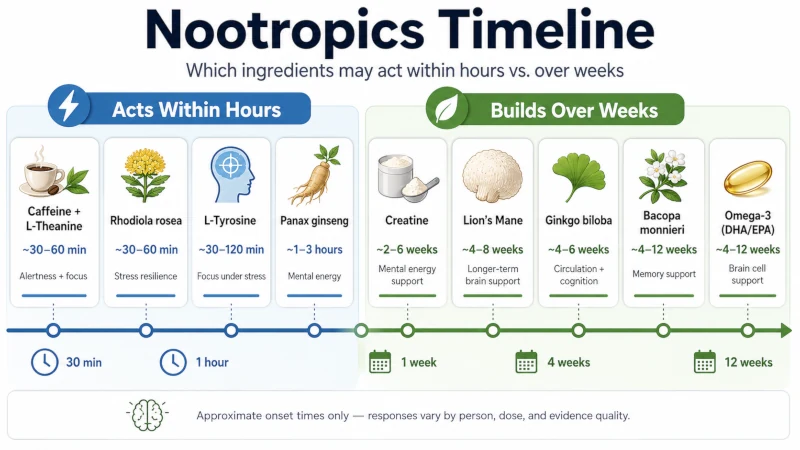
One split matters more than any other when you shop: acute versus chronic. Acute ingredients (caffeine, L-theanine, L-tyrosine) can shift how you feel the same day. Chronic ones (bacopa, phosphatidylserine, omega-3s) do little in a single dose and are studied over 8 to 12 weeks or longer. Expecting a same-afternoon jolt from a slow-building ingredient is the most common way people end up disappointed.
A quick reality check before you buy
Two facts set realistic expectations. First, much of the research on brain supplements in healthy people is low quality. Reviewing ginkgo—one of the most-studied brain herbs—the U.S. National Center for Complementary and Integrative Health notes it is “uncertain whether they actually influence cognitive performance in healthy people” and that “much of the research on this topic is of low quality” [NCCIH, 2025]. That caution applies to the category, not just one herb.
Second, supplements are lightly regulated. Unlike drugs, dietary supplements are not approved by the FDA before they are sold, and manufacturers are responsible for their own safety and labeling [NCCIH, 2025]. What’s on the label isn’t always what’s in the bottle, which is why third-party testing (USP, NSF, or ConsumerLab) is worth looking for.
The evidence at a glance
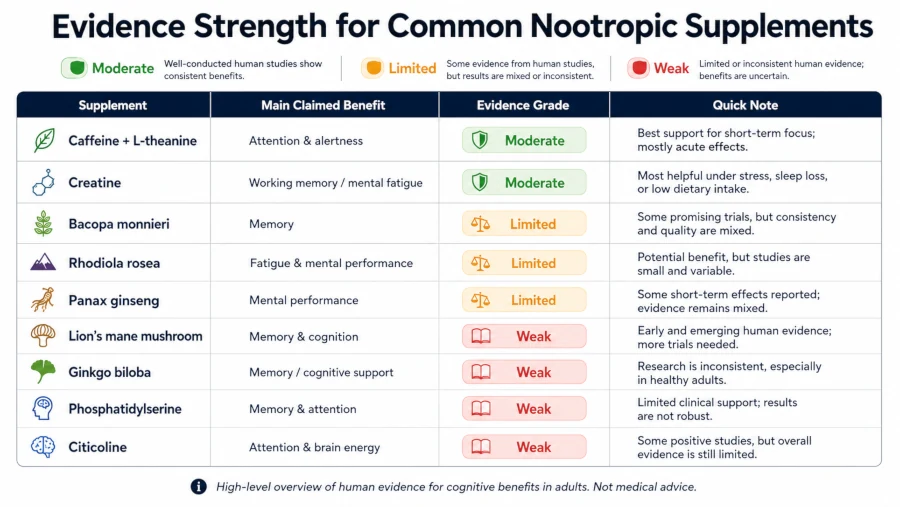
Here’s how the popular options stack up. “Evidence strength” reflects human research quality, not how loudly a product is marketed.
| Ingredient | Mainly used for | Evidence in healthy people | How fast |
| Caffeine + L-theanine | Alert, calm focus | Moderate (small effects) | Same day |
| Citicoline | Memory, attention | Limited / promising | Weeks |
| Bacopa monnieri | Memory, recall | Limited (modest) | 8–12 weeks |
| L-tyrosine | Focus under stress | Mixed / situational | Same day |
| Rhodiola rosea | Fatigue, burnout | Weak / inconsistent | Days–weeks |
| Lion’s mane | Clarity, mood | Early / mixed | Unclear |
| Phosphatidylserine | Working memory | Limited (older adults) | Weeks |
| Ginkgo biloba | Memory, blood flow | Weak / mostly negative | Weeks |
| Omega-3 (EPA/DHA) | Long-term brain health | Foundational, not a focus fix | Months |
Caffeine paired with L-theanine: the best-supported combo
L-theanine is an amino acid found in green tea that promotes a calm, focused state. Pair it with caffeine and you get what people describe as “relaxed alertness”—caffeine’s lift without as much of the jitter. This is the pairing with the most credible short-term evidence. A 2021 systematic review of caffeine and L-theanine found the combination produces small-to-moderate improvements in attention, mostly in the second hour after a dose—though the confidence intervals often overlap with no effect, so the benefit is genuine but modest and not guaranteed [caffeine and L-theanine review, 2021].
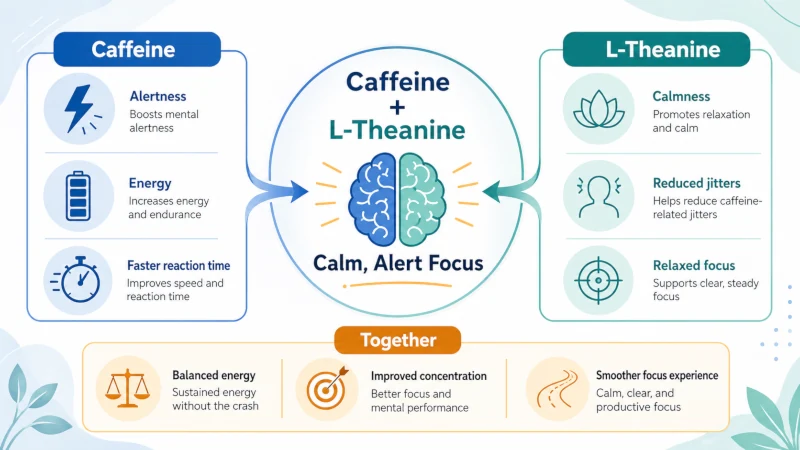
A commonly used ratio in research and products is roughly 100 mg of caffeine to 200 mg of L-theanine, though that’s a typical pairing rather than a clinical prescription. The catch is caffeine itself: taken too late it erodes the sleep that does far more for your focus than any capsule, and daily use builds tolerance.
Citicoline: promising for memory, still limited
Citicoline (CDP-choline) supplies choline, a building block for acetylcholine, a neurotransmitter central to learning and memory, and it supports brain-cell membranes. A randomized controlled trial in healthy older adults with age-related memory complaints reported modest memory improvements over about 12 weeks [citicoline and memory trial, 2021]. Evidence in young, healthy people is thinner, so treat citicoline as promising rather than proven. It tends to sharpen concentration without acting like a stimulant, which is why it’s a common base ingredient in stacks.
Bacopa monnieri: modest memory help, but you have to wait
Bacopa is an herb long used in Ayurvedic medicine for memory. Modern trials give it partial support: a systematic review of randomized human trials found bacopa can improve memory—particularly free recall—after around 12 weeks of daily use, at roughly 300 mg a day of standardized extract [Bacopa systematic review, 2012]. It is not a same-day ingredient, and its most reliable effect is on memory rather than on-the-spot alertness. The most common side effect is stomach upset or cramping, which taking it with food usually eases. For context on where bacopa sits among traditional botanicals, see this overview of herbs that support the nervous system.
L-tyrosine: situational, for stress and sleep loss
L-tyrosine is a precursor to dopamine and norepinephrine—neurotransmitters that demanding tasks burn through quickly. A 2015 review of tyrosine supplementation concluded it may help cognition specifically under stress, cold, or sleep deprivation, while noting that results vary considerably and it does little for people who are already rested [Jongkees et al., 2015]. Think of it as a tool for a hard, high-pressure stretch—an all-nighter or an exam week—rather than a daily focus aid.
Rhodiola rosea: for fatigue, with shaky evidence
Rhodiola is an adaptogen with a long history of use for fatigue and burnout in cold, demanding climates. The trial record is weaker than the marketing suggests. A 2012 systematic review identified 11 trials of rhodiola for physical and mental fatigue and found inconsistent results with a high risk of bias, leaving the evidence inconclusive [Ishaque et al., 2012]. Some people find it helps with an afternoon slump; just keep expectations measured. For a realistic look at adaptogens alongside the habits that move the needle more, see this guide on boosting your energy levels naturally.
Lion’s mane: early and mixed
Lion’s mane is a functional mushroom studied for its effects on nerve growth factor and brain plasticity. Human research is still early and inconsistent: small, short trials show a scatter of results—some quicker performance on specific tasks, some no measurable benefit. A 2023 pilot study in young adults is typical of this picture, with modest and mixed findings [lion’s mane pilot study, 2023]. It’s a reasonable ingredient to be curious about, not one to bank on.
Phosphatidylserine: limited, mostly in older adults
Phosphatidylserine (PS) is a phospholipid in brain-cell membranes involved in cell signaling. The strongest signal comes from older adults with memory complaints: a study of soybean-derived PS reported improved memory scores over several months in that group, especially in people who started with lower scores [soy phosphatidylserine trial, 2010]. Evidence in healthy younger people is limited. PS often gets paired with omega-3s, since both support the structural side of brain-cell health.
Ginkgo biloba: popular, but weak in healthy people
Ginkgo is one of the most recognizable brain herbs, and the honest read on it is sobering. The National Center for Complementary and Integrative Health states plainly that ginkgo “has not been shown to be effective for any of the conditions for which it has been studied.” In the large Ginkgo Evaluation of Memory study—more than 3,000 adults aged 75 and older, followed for a median of six years—ginkgo did not reduce the rate of dementia compared with placebo [NCCIH on ginkgo, 2025].
For healthy people hoping for a focus boost, the evidence is weak. If you want the fuller picture, this deeper look at what the evidence actually shows for ginkgo covers doses, interactions, and who should avoid it. On safety, ginkgo can raise bleeding risk with anticoagulants such as warfarin and may be unsafe in pregnancy [NCCIH, 2025].
Omega-3s (EPA and DHA): a foundation, not a focus pill
DHA is a structural component of the brain, and omega-3s keep cell membranes working the way they should. But they aren’t a same-day focus enhancer. The NIH Office of Dietary Supplements is careful here: “some—but not all—research” links higher omega-3 intake from food to a lower risk of cognitive decline, and “more study of the effects of omega-3s on the brain is needed” [NIH Office of Dietary Supplements, 2022]. Treat omega-3s as long-term brain maintenance—ideally from fish first—rather than something you feel before a study session.
Multi-ingredient stacks and student formulas: read the label
All-in-one “brain” formulas combine several of the ingredients above, which can be more convenient than juggling bottles. Two cautions matter. Proprietary blends often hide the dose of each ingredient behind a single total, so you can’t tell whether the bacopa or citicoline inside matches the amounts that were actually studied—underdosing is common. And no combination product has strong trial evidence as a whole; the research is on individual ingredients. Favor formulas that list exact amounts per ingredient and carry third-party testing, and judge them by whether the doses match what the studies used.
Safety, interactions, and who should be careful
This is the part worth slowing down for. “Natural” does not mean risk-free.
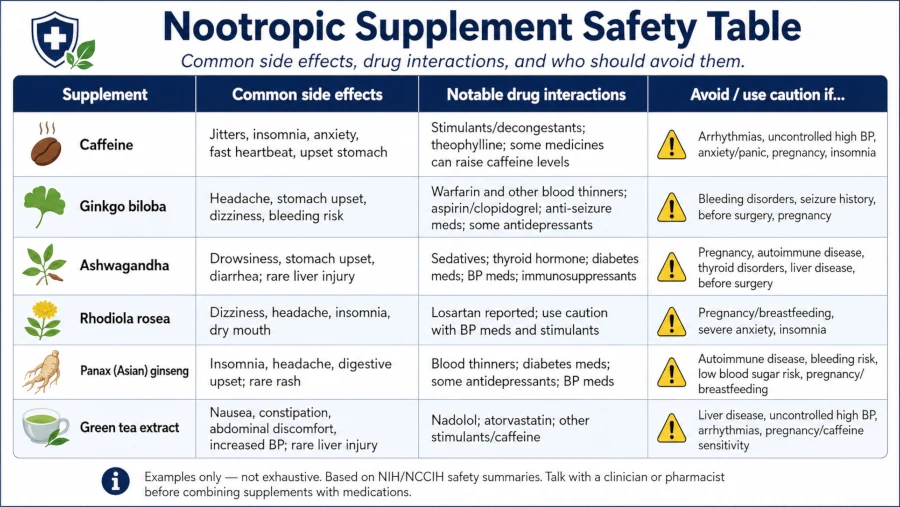
Common side effects
- Caffeine-based products: anxiety, a racing heart, disrupted sleep, and a crash if overused.
- Bacopa: stomach upset and cramping; take it with food.
- Ginkgo: dizziness, gastrointestinal upset, and headache are the most common [NCCIH, 2025].
- Omega-3s: usually mild—fishy aftertaste, heartburn, or loose stools [NIH ODS, 2022].
Drug interactions
The real hazard is interactions with prescription medicines. Both ginkgo and high-dose omega-3s can increase bleeding risk when combined with anticoagulants like warfarin [NCCIH, 2025; NIH ODS, 2022]. Stacking stimulant-type ingredients can strain the heart, and some herbs affect blood sugar or blood pressure, which matters if you take medication for either. Run any supplement past a pharmacist or physician if you’re on prescription drugs—they can check for conflicts you won’t find on the label. This evidence-based look at supplements for stress and anxiety covers similar cautions for the calming herbs people often add to a stack.
Pregnancy, breastfeeding, and who should avoid these
If you are pregnant or breastfeeding, be conservative. Ginkgo may be unsafe in pregnancy—it could contribute to early labor or extra bleeding around delivery [NCCIH, 2025]—and safety data for most nootropic herbs in pregnancy are thin, so the default should be to avoid them unless a clinician says otherwise. Others who should check with a professional first: anyone on prescription medication, people with heart, liver, or thyroid conditions, those with bleeding disorders or surgery coming up (stop herbal supplements about two weeks beforehand), and anyone under 18.
When “brain fog” is actually something else
Reaching for a nootropic makes sense only after you’ve ruled out the ordinary causes of poor focus—because a supplement won’t fix them. Persistent trouble concentrating or remembering can stem from short sleep or sleep apnea, thyroid problems, low iron or B12, depression, or a medication’s side effects. In older adults it can signal mild cognitive impairment. This overview of memory health and cognitive decline walks through what’s normal aging and what isn’t.
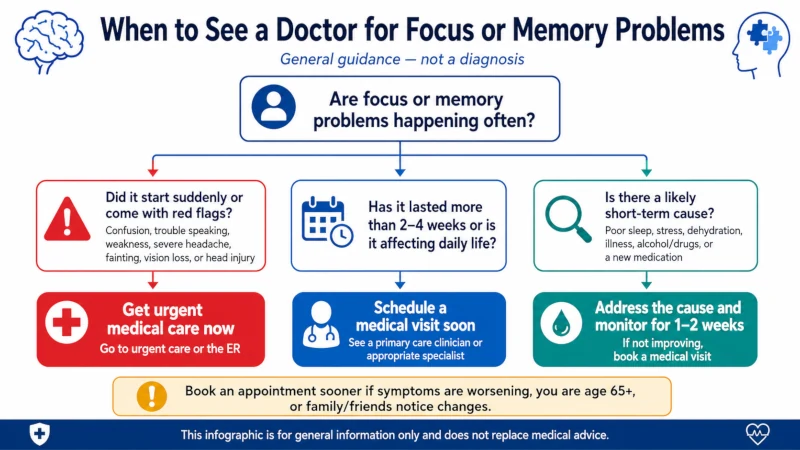
Talk to a healthcare professional if focus or memory problems interfere with daily life, are noticed by people around you, or come with low mood and loss of interest. Warning signs that deserve prompt attention include getting lost in familiar places, repeating the same questions, and persistent trouble finding words.
Seek emergency care for the sudden onset of confusion, weakness on one side of the body, trouble speaking, or a severe unexplained headache. Those can signal a stroke—call 911 rather than waiting.
How to use nootropics sensibly
- Build the foundation first. Sleep, movement, and steady meals do more for focus than any capsule; see these evidence-based ways to boost energy. Supplements build on that base—they don’t replace it.
- Change one thing at a time. Adding several ingredients at once makes it impossible to tell what helped or what upset your stomach.
- Give the slow ones time. Bacopa, phosphatidylserine, and omega-3s need 8 to 12 weeks. Track how you actually feel and function, and drop anything that isn’t earning its place.
- Expect margins, not miracles. The realistic upside is a small, useful edge on top of good habits—not a transformation.
| Health Disclaimer This article is for general education and is not medical advice. It is not a substitute for diagnosis or treatment from a qualified clinician. Nootropic supplements are not intended to diagnose, treat, cure, or prevent any disease. Talk to your doctor or pharmacist before starting any supplement—especially if you are pregnant or breastfeeding, manage a chronic condition, take prescription medication, or are under 18. If your symptoms are severe or persistent, seek care promptly. |
Frequently Asked Questions
Do nootropic supplements actually work?
Some do, modestly. Caffeine with L-theanine has the best short-term evidence for attention; citicoline, bacopa, and phosphatidylserine show limited but real effects on memory in specific groups. Many popular options, including ginkgo, show weak or mixed results in healthy people [NCCIH, 2025]. Expect a small edge, not a transformation.
What’s a sensible one to start with?
For most people, a modest dose of caffeine paired with L-theanine is the best-studied, lowest-friction place to begin—provided caffeine agrees with you and you keep it to the morning. Build the sleep and movement habits underneath it first.
How long do they take to work?
It depends on the type. Caffeine, L-theanine, and L-tyrosine act within an hour. Bacopa, phosphatidylserine, and omega-3s usually need 8 to 12 weeks of consistent use before any effect shows up.
Are nootropic supplements the same as prescription smart drugs?
No. The supplements in this article are over-the-counter herbs, amino acids, and nutrients. Prescription stimulants used off-label for focus are controlled medications with stronger effects, real risks, and legal implications. They aren’t interchangeable.
Is “natural” safer than synthetic?
Not automatically. Herbal nootropics can cause side effects and interact with medications—ginkgo and warfarin is a clear example [NCCIH, 2025]. Judge any ingredient by its evidence and its safety profile, not by whether it came from a plant.
Can I take them while pregnant or breastfeeding?
Default to no unless your clinician clears a specific product. Ginkgo may be unsafe in pregnancy, and safety data for most nootropic herbs during pregnancy and breastfeeding are limited [NCCIH, 2025].
References
- Malík M, Tlustoš P. Nootropics as Cognitive Enhancers: Types, Dosage and Side Effects of Smart Drugs. Nutrients. 2022;14(16):3367. View source
- National Center for Complementary and Integrative Health (NCCIH). Ginkgo: Usefulness and Safety. Updated February 2025. View source
- NIH Office of Dietary Supplements. Omega-3 Fatty Acids: Fact Sheet for Consumers. 2022. View source
- The Cognitive-Enhancing Outcomes of Caffeine and L-theanine: A Systematic Review. 2021. (PMC8794723) View source
- Citicoline and Memory Function in Healthy Older Adults: A Randomized, Double-Blind, Placebo-Controlled Clinical Trial. 2021. (PMC8349115) View source
- The cognitive-enhancing effects of Bacopa monnieri: a systematic review of randomized, controlled human clinical trials. J Altern Complement Med. 2012. (PMID 22747190) View source
- Ishaque S, Shamseer L, Bukutu C, Vohra S. Rhodiola rosea for physical and mental fatigue: a systematic review. BMC Complement Altern Med. 2012;12:70. View source
- Jongkees BJ, Hommel B, Kühn S, Colzato LS. Effect of tyrosine supplementation on clinical and healthy populations under stress or cognitive demands—A review. J Psychiatr Res. 2015. (PMID 26424423) View source
- The Acute and Chronic Effects of Lion’s Mane Mushroom Supplementation on Cognitive Function, Stress and Mood in Young Adults: A Pilot Study. 2023. (PMC10675414) View source
- Kato-Kataoka A, et al. Soybean-Derived Phosphatidylserine Improves Memory Function of the Elderly Japanese Subjects with Memory Complaints. 2010. (PMC2966935) View source
