
Most disagreements at work can be settled with one calm, private, specific conversation, held early, before resentment sets in. You do not have to like the other person. You need to cool down, talk about the problem rather than their character, agree on what you are both trying to get done, and know when to bring someone else in. Handled that way, most workplace conflicts stay small.

It is worth getting right for more than the sake of your projects. In a meta-analysis of 79 studies, conflict with coworkers was one of the two job stressors most strongly tied to physical symptoms, a link that held up over time [Nixon et al., 2011]. Here is how to handle conflict at work in a way that protects your job and your health, and how to tell when it has become something you should not handle alone.
What workplace conflict is, and why the type matters
Researchers usually split conflict inside teams into three kinds [de Wit et al., 2012]:
- Task conflict: disagreement about the work itself: the right approach, the right answer, what matters most.
- Process conflict: disagreement about logistics: who does what, by when, and who decides.
- Relationship conflict: personal friction: clashing personalities, values or styles, and the irritation that builds up.
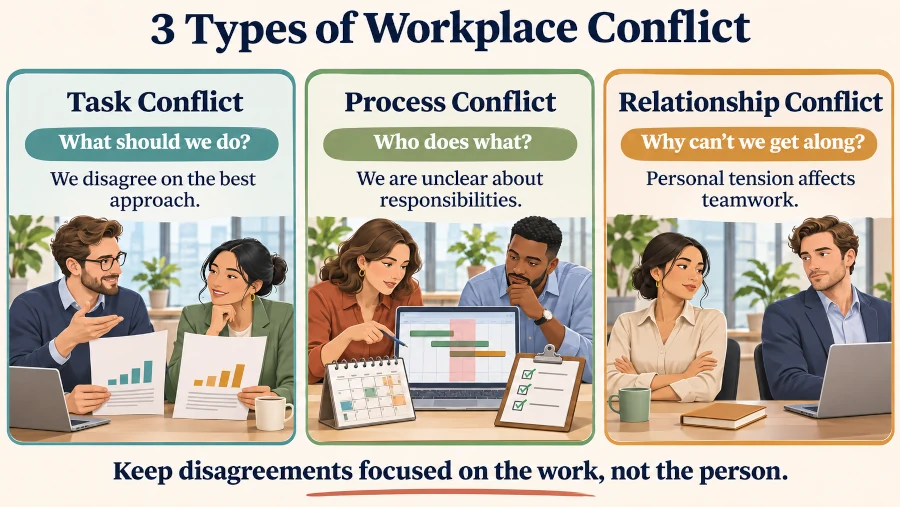
The distinction matters because the types behave differently. Relationship and process conflict are consistently linked to worse team outcomes. Task conflict is a mixed picture. An early meta-analysis found it was also tied to poorer team performance and satisfaction [De Dreu & Weingart, 2003], while a larger update of 116 studies found no strong negative link, and some benefit when the disagreement stayed about the work and did not spill into personal friction [de Wit et al., 2012].
The practical lesson: disagreeing about the work is normal and can even sharpen decisions. Your job is to keep it from turning personal.
How workplace conflicts affect your health
Ongoing friction at work does not stay at work. The research here is observational, so it shows strong, consistent associations rather than proof that conflict causes illness, but the pattern is hard to ignore.
| What the research found | Type of evidence | How much weight to give it |
| Interpersonal conflict and organizational constraints had the strongest links with physical symptoms of seven job stressors studied. Stomach problems and poor sleep were tied to more stressors than other symptoms. [Nixon et al., 2011] | Meta-analysis of 79 studies, cross-sectional and longitudinal | Moderate. Consistent over time, but mostly self-reported symptoms. |
| Workplace bullying was associated with depressive symptoms, anxiety and stress-related complaints, with the strongest link for stress complaints. The link ran both ways: bullying predicted later mental health problems, and existing problems predicted later bullying. [Verkuil et al., 2015] | Meta-analysis, including longitudinal data from more than 54,000 people | Moderate. Large samples; self-reported data; describes bullying, not everyday disagreement. |
| 19% of U.S. workers called their workplace very or somewhat toxic. Of those, 52% said work had harmed their mental health, compared with 15% in healthy workplaces. [APA, 2023] | National survey of 2,515 employed adults | Descriptive. Shows how common the problem is; cannot show cause. |
| Violence, harassment and bullying, an organizational culture that enables negative behaviour, and an unclear job role are among the recognized risks to mental health at work. [WHO, 2026] | International health agency guidance | Expert consensus. |
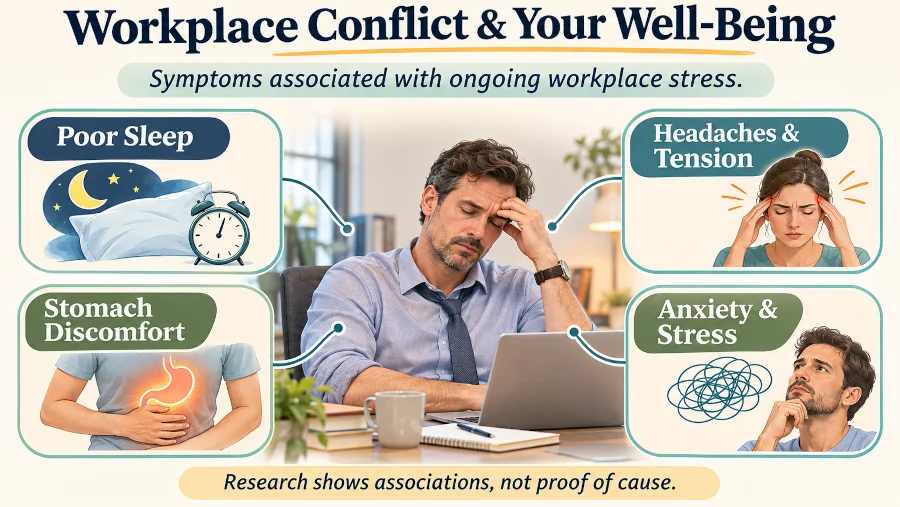
If a conflict is keeping you up at night, tightening your stomach before meetings, or making you dread Sunday evenings, that is a real stress response and worth dealing with, not something to push through.
How to handle workplace conflicts, step by step
These steps come from communication and stress-management guidance rather than clinical trials. They are not a script that guarantees a result. They do give you the best chance of being heard, and most of them cost nothing to try.
1. Cool down before you respond
Nothing good gets typed in the first ten minutes after a provoking email. If you are agitated, wait if you can, breathe slowly, and keep your voice even and firm when you do speak [Mayo Clinic, 2024]. Waiting an hour, or until the next morning, is not avoidance. It is how you make sure the conversation is about the problem and not about how angry you were.
2. Do not take it personally
Work is work. A coworker who snaps at you may be dealing with a deadline you cannot see, a manager leaning on them, or trouble at home. If the negative behaviour comes from something outside your control, it is easier not to answer it in kind, and a little empathy often lowers the temperature faster than a rebuttal.
Empathy is not the same as accepting mistreatment. If the behaviour is aimed at you, repeated, or demeaning, skip ahead to escalation.
3. Talk privately, and talk early
Small problems are far easier to fix than resentments that have had months to grow. Ask for a few minutes one on one, in person or on a video call. Avoid group chats, email threads and meetings with an audience, where people defend their position instead of listening.
An opener can be as simple as: “Do you have 15 minutes this week? I think we’re seeing the launch timeline differently and I’d like to sort it out.”
4. Describe the problem, not the person
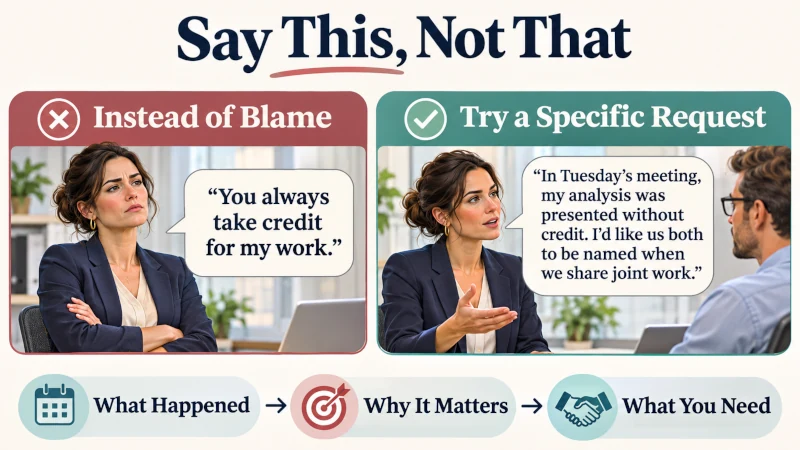
Frame your concern with “I” statements, which say what you think or feel without sounding like an accusation: “I disagree” rather than “You’re wrong” [Mayo Clinic, 2024]. Then be specific. Name the behaviour, its effect, and what you would like instead:
| Instead of: “You always take credit for my work.” Try: “In Tuesday’s meeting the analysis was presented without mentioning that I built it. I’d like us both to be named when we share joint work.” |
If confrontation makes you freeze, rehearse. Write out what you want to say, say it aloud, or practise with a friend [Mayo Clinic, 2024].
5. Listen until you can repeat their side
After you have made your point, stop and ask how they see it. Then summarize their view back to them until they agree you have it right. You do not have to agree with it. People who feel understood become far less defensive, and you may learn the conflict is about something else entirely, such as a workload problem or an unclear instruction from above.

You and your coworker are on the same payroll for the same reason: to get the work done and help the company do well. Pull the conversation back to that. “We both want this shipped by the 30th. What would make that work for you?” moves things from who is right to what happens next.
End with something concrete: who will do what, by when. A two-line follow-up email (“Thanks for talking. To confirm, I’ll send the draft Thursday and you’ll review by Monday”) prevents the same argument from coming back next month.
7. Clear up roles and expectations
A lot of friction is process conflict in disguise: two people who each think a task belongs to them, or to the other person, or a deadline nobody actually agreed to. When people work without clear expectations, conflict follows. An unclear job role is one of the workplace risks to mental health the World Health Organization lists [WHO, 2026]. If you suspect this is the root problem, ask your manager to spell out who owns what. That is a reasonable request, not a complaint.
8. Recognize the good in the person who annoys you
Nobody enjoys a difficult colleague, but most people bring something useful: they catch errors, they know the client, they get things over the line. Deliberately noticing that is within your control, and it changes how you read their behaviour. It will not fix a genuine problem, but it makes the conversation in steps 3 to 6 easier to have.
9. Escalate when required
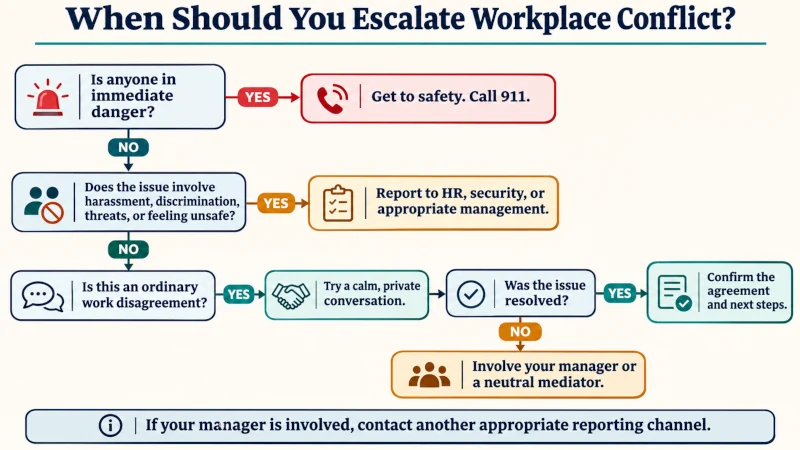
It is usually best to resolve a problem between the two of you. But if you have tried in good faith and the other person will not engage, or the conflict is affecting your work or your well-being, it is time to bring someone in.
- Start with your manager, or the next level up if your manager is part of the problem.
- Keep simple notes: dates, what was said or done, who was present, and how it affected the work. Facts carry more weight than feelings in these conversations.
- Ask about mediation if your employer offers it, or a neutral third party from HR.
- Use your Employee Assistance Program (EAP) if you have one. These programs typically offer confidential short-term counselling.
Go straight to HR, without trying to settle it yourself first, if the behaviour involves harassment, discrimination, threats or anything that makes you feel unsafe. See the section on harassment, bullying and threats below.
What managers can do
Any workplace should be built on fairness, trust and mutual respect. Conflict will still happen, but people bring problems forward when they trust management to handle them fairly. A few habits make the biggest difference:
- Act early. Do not wait for a formal complaint. Raise it privately as soon as you notice tension.
- Make roles explicit. Written owners and deadlines prevent a large share of process conflict.
- Hear both sides separately, then together, and follow up a week or two later.
- Build the skills. WHO recommends training managers to recognize and respond to distress in the people they supervise, and to use open communication and active listening [WHO, 2026].
When conflict follows you home
Replaying an argument at 2 a.m., snapping at your family, tension headaches, a churning stomach before work: these are common signs that a workplace conflict has turned into chronic stress. While you work on the conflict itself, look after the basics:
- Protect your sleep. Short or broken sleep keeps your stress response switched on, which is part of how poor sleep affects blood pressure.
- Move. A walk at lunch or after work gives you a break from the loop and burns off some of the tension.
- Eat regular meals. Skipping lunch to stew over a conflict makes everything feel worse. If you want ideas, see foods that may help with stress.
- Talk to someone outside work such as a friend, partner or counsellor, so the conflict is not the only voice in your head.
Some people look to supplements for stress. They cannot fix a workplace problem, and several interact with prescription medicines or are not advised in pregnancy. If you are considering one, read our guide to supplements for anxiety and stress and check with a pharmacist or doctor first.
When it is more than conflict: harassment, bullying and threats
Ordinary conflict is two people disagreeing. Some behaviour is something else, and the advice above about talking it out does not apply.
Harassment. Under U.S. federal law, harassment is unwelcome conduct based on a protected characteristic such as race, color, religion, sex (including sexual orientation, transgender status or pregnancy), national origin, age 40 or older, disability or genetic information. Petty slights and isolated incidents usually do not meet the legal bar unless they are extremely serious. The EEOC advises reporting harassment to management early, before it escalates [EEOC, n.d.].
Bullying. Repeated, targeted mistreatment such as humiliation, exclusion, or constant unfair criticism is linked to depression, anxiety and stress-related complaints [Verkuil et al., 2015]. Bullying that is not tied to a protected characteristic may not be illegal under federal harassment law, but it is still a reason to go to HR and to document what is happening.
Threats and violence. OSHA defines workplace violence as any act or threat of physical violence, harassment, intimidation or other threatening behaviour at the work site, ranging from threats and verbal abuse to physical assault [OSHA, n.d.]. If someone threatens you, report it to security or management right away. If you are in immediate danger, call 911.
When to get help
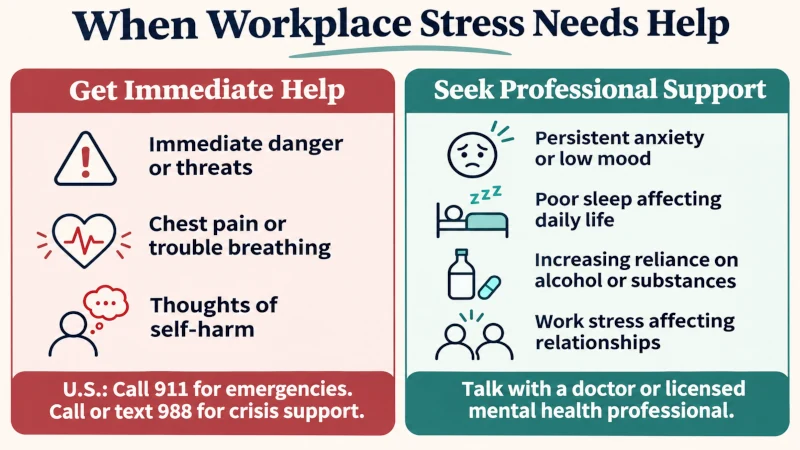
| Red flags Get help right away if: • You are having thoughts of harming yourself or that life is not worth living. Call or text 988, or chat at 988lifeline.org, any time. It is free and confidential [988 Lifeline, n.d.]. • You have chest pain, trouble breathing, or feel faint during or after a confrontation. Call 911. Do not assume it is “just stress.” • Someone has threatened or hurt you, or you feel unsafe at work. Call 911 if the danger is immediate; otherwise report it to security, management or HR. |
See your doctor or a mental health professional soon if:
- Low mood, anxiety, poor sleep or loss of interest last most days for more than two weeks. Our guide to anxiety and depression symptoms explains what to watch for.
- You are drinking more, or relying on other substances, to unwind after work.
- Dread of work is affecting your relationships, appetite or ability to function.
- Anger, anxiety or fear keeps you from speaking up even after practice. Mayo Clinic suggests a mental health professional or formal assertiveness training in that situation [Mayo Clinic, 2024].
| HEALTH DISCLAIMER: This article is for general education. It is not medical, psychological or legal advice, and it does not replace care from a qualified professional. If workplace stress is affecting your physical or mental health, talk with your doctor or a licensed mental health professional. For questions about harassment, discrimination or your rights at work, contact your HR department, an employment attorney, or the U.S. Equal Employment Opportunity Commission. If you are in crisis, call or text 988 in the U.S., or call 911 in an emergency. |
Frequently Asked Questions
What are the most common causes of workplace conflict?
Unclear roles and deadlines, heavy workloads, different communication styles, and clashing personalities or values account for most of it. Many conflicts that look personal start as process problems, such as two people who each believe a task is theirs, so clarifying ownership often solves more than a heart-to-heart.
Is conflict at work ever a good thing?
Disagreement about the work itself can improve decisions, especially when it stays respectful and does not turn personal. A meta-analysis of 116 studies found task conflict was not reliably harmful, while personal and process conflict consistently were [de Wit et al., 2012]. The goal is not zero conflict. It is conflict about ideas, not people.
Should I go to my manager or HR first?
For an ordinary disagreement, try a private conversation first, then your manager. Go to HR directly if the behaviour involves harassment, discrimination, threats or retaliation, or if your manager is the problem and there is no one else to go to.
How do I handle a conflict with my boss?
Use the same steps, with more preparation. Ask for a private meeting, focus on the work (“I want to make sure I’m hitting what you need on the report”), bring specifics, and propose a solution. If the problem is mistreatment rather than disagreement, document it and go to HR or your boss’s manager.
Can workplace conflict make you physically sick?
It is strongly associated with physical symptoms. Interpersonal conflict was one of the two job stressors most tied to symptoms in a meta-analysis of 79 studies, and stomach problems and poor sleep were linked to more stressors than other symptoms [Nixon et al., 2011]. The studies are observational, so they cannot prove cause. If you have physical symptoms, see a doctor rather than assuming stress is the explanation.
References
- De Dreu, C. K. W., & Weingart, L. R. (2003). Task versus relationship conflict, team performance, and team member satisfaction: View source
- de Wit, F. R. C., Greer, L. L., & Jehn, K. A. (2012). The paradox of intragroup conflict: A meta-analysis. View source
- Nixon, A. E., Mazzola, J. J., Bauer, J., Krueger, J. R., & Spector, P. E. (2011). Can work make you sick? A meta-analysis of the relationships between job stressors and physical symptoms. View source
- Verkuil, B., Atasayi, S., & Molendijk, M. L. (2015). Workplace bullying and mental health: View source
- American Psychological Association. APA poll reveals toxic workplaces, other significant workplace mental health challenges View source
- World Health Organization. Mental health at work. View source
- Mayo Clinic Staff. (2024, January 20). Being assertive: Reduce stress, communicate better. View source
- U.S. Equal Employment Opportunity Commission. Harassment. View source
- Occupational Safety and Health Administration. Workplace violence. View source
- 988 Suicide & Crisis Lifeline. View source


