
If you have seen claims that “high cortisol” explains belly fat, restless sleep, or constant tiredness, you may want to find out where your own levels stand. A cortisol test can answer certain medical questions very well. It cannot measure how stressed you are, and one result on its own rarely settles anything.
How is cortisol tested?
| Quick answer Cortisol can be measured in blood, saliva, or urine, and the right cortisol test depends on what a clinician is trying to find out. Because cortisol rises and falls across the day, timing matters. Doctors may use a morning blood draw, late-night saliva samples, a 24-hour urine collection, or a suppression or stimulation test. |
A provider may order more than one MedlinePlus cortisol test guide, 2024, depending on whether the concern is too much cortisol, too little, or a medicine that changes cortisol levels.
Evidence at a glance
| Claim | Evidence | What that rating means here |
| Cortisol normally changes throughout the day | Strong | Well-established physiology described in clinical guidelines and NIH resources. |
| Blood, saliva, and urine can all be used to measure cortisol | Strong | All three are standard, laboratory-validated specimen types. |
| A random cortisol test can show whether everyday stress has made your cortisol “chronically high” | Insufficient | No validated test does this; guidelines advise against random blood cortisol for detecting cortisol excess. |
| Late-night saliva and 24-hour urine cortisol are useful in carefully selected people being checked for cortisol excess | Moderate | Recommended first-line tests, but the guideline rates the underlying evidence quality as low, and accuracy depends on the lab method and who is tested. |
| A direct-to-consumer cortisol test can identify the cause of vague symptoms by itself | Insufficient | A cortisol result alone cannot diagnose the cause of an abnormal level. |
Sources for this table: Endocrine Society Cushing’s diagnosis guideline, 2008; MedlinePlus cortisol test guide, 2024.
What cortisol is, and why timing changes the result
Cortisol is a glucocorticoid hormone made by the adrenal glands, two small glands that sit on top of the kidneys NIDDK on adrenal crisis. Its output is controlled by a chain of signals known as the hypothalamic-pituitary-adrenal (HPA) axis: a part of the brain called the hypothalamus releases corticotropin-releasing hormone (CRH), which tells the pituitary gland to release adrenocorticotropic hormone (ACTH), which in turn tells the adrenal glands to make cortisol NIDDK on adrenal crisis.
Cortisol is often called the “stress hormone,” but it does far more than respond to stress. It helps control blood sugar and metabolism, dampen inflammation, and maintain blood pressure MedlinePlus cortisol test guide, 2024.
Cortisol’s daily rhythm
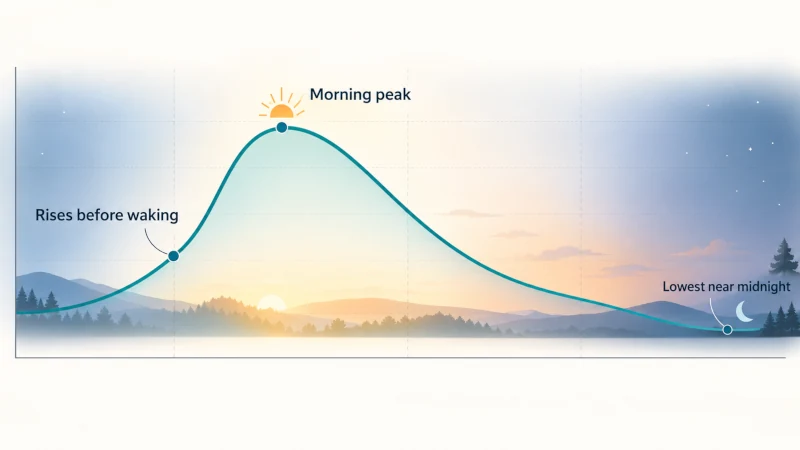
With a regular sleep schedule, blood cortisol starts climbing around 3 to 4 a.m., peaks roughly between 7 and 9 a.m., and then drifts down for the rest of the day, reaching very low levels around midnight in someone who is relaxed and asleep Endocrine Society Cushing’s diagnosis guideline, 2008. That morning pulse is one of several reasons blood pressure climbs after you wake, a pattern explained in our guide to the morning blood pressure surge.
So a cortisol number only means something alongside its collection time: a level normal at 8 a.m. could be abnormal at 11 p.m. Reference ranges also differ substantially by laboratory method, so a value has to be read against the range printed on your own report, not a number found online Endocrine Society Cushing’s diagnosis guideline, 2008.
The main types of cortisol tests
Blood (serum) cortisol test
A blood cortisol test uses a sample drawn from a vein in your arm, which usually takes less than five minutes. Samples are often taken in the morning, when levels are normally highest, and sometimes again around 4 p.m., when they are usually much lower MedlinePlus cortisol test guide, 2024. A morning sample is especially useful when the question is whether the body is making too little cortisol.
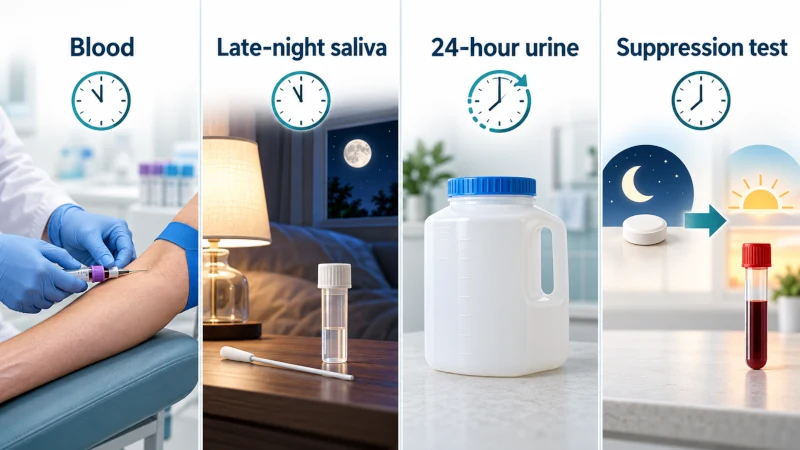
Its limitation is that it captures a single moment. Standard blood assays also measure total cortisol, including the portion carried by a binding protein called cortisol-binding globulin. Oral estrogen, such as birth control pills, raises that protein and can push serum cortisol up, while severe illness can lower it Endocrine Society Cushing’s diagnosis guideline, 2008. Stress and exercise beforehand can also raise the result, which is why you may be asked to rest first MedlinePlus cortisol test guide, 2024.
Salivary cortisol test, including late-night saliva
Saliva can be collected at a provider’s office or at home with a kit, either with a swab or by spitting into a tube. Typical instructions include not eating, drinking, brushing, or flossing for 30 minutes beforehand, then holding or rolling the swab in your mouth for about two minutes and labeling the tube with the collection time MedlinePlus cortisol test guide, 2024.
The best-known use is the late-night salivary cortisol test. Cortisol normally falls to a low point around bedtime, and in Cushing’s syndrome, a disorder of long-term cortisol excess, that nighttime dip does not happen NIDDK on Cushing’s syndrome. Most clinicians ask for samples on two separate evenings, usually between 11 p.m. and midnight, with timing adjusted for people who reliably go to bed much later Endocrine Society Cushing’s diagnosis guideline, 2008. Depending on the question being asked, a provider may instead request several samples at different times of day MedlinePlus cortisol test guide, 2024.

Because the test assumes a normal nighttime low, it may not suit shift workers, people with variable bedtimes, or recent long-distance travelers, and several products can falsely raise it (see the factors table below) Endocrine Society Cushing’s diagnosis guideline, 2008.
24-hour urinary free cortisol test
For this test, you collect all of your urine for a full day. You usually skip the first morning urination and note the time, collect every void for the next 24 hours, keep the container refrigerated or on ice, and finish with one last void at the 24-hour mark MedlinePlus cortisol test guide, 2024.
The test measures “free” cortisol, the unbound fraction that the kidneys filter into urine, so it reflects total cortisol output across the whole day rather than one moment. Because it measures unbound hormone, it is not distorted by estrogen-related changes in binding protein Endocrine Society Cushing’s diagnosis guideline, 2008.
Its weak point is collection. A missed void makes the total falsely low, which is why labs check urine volume and creatinine to judge completeness. Very high fluid intake (about 5 liters a day or more) can raise the result, moderate to severe kidney disease can lower it, and steroid creams should not be used during collection unless your clinician says otherwise. Because cortisol excess can come and go, the Endocrine Society recommends at least two collections Endocrine Society Cushing’s diagnosis guideline, 2008.
Dexamethasone suppression test
Dexamethasone is a prescription synthetic glucocorticoid, a lab-made relative of cortisol. In a healthy HPA axis, taking a dose of it signals the brain that there is plenty of glucocorticoid around, so ACTH and cortisol output drop. In endogenous Cushing’s syndrome, meaning cortisol excess produced by the body itself, that suppression fails Endocrine Society Cushing’s diagnosis guideline, 2008.
In the common overnight version, a clinician prescribes a low dose to be taken late in the evening, usually around 11 p.m., and blood is drawn the next morning, usually around 8 a.m. A longer version spreads doses over 48 hours NIDDK on Cushing’s syndrome. Your clinician sets the dose and timing; this is not a test to run on your own.
A random level shows what cortisol was doing at one moment; a suppression test checks whether the body’s feedback control works. It has limits too: oral estrogen causes false-positive results in about half of women taking birth control pills, and the test is not recommended for initial screening in pregnancy Endocrine Society Cushing’s diagnosis guideline, 2008.
Cortisol tests compared
| Test | Sample | Common clinical use | Timing | Main limitation |
| Blood (serum) cortisol | Blood from an arm vein | Morning sample as a starting point when low cortisol is suspected; monitoring | Usually morning, sometimes also afternoon | Captures one moment; affected by estrogen, illness, and stress; not recommended to screen for cortisol excess |
| Late-night salivary cortisol | Saliva (swab or tube) | First-line screening for suspected cortisol excess | Usually 11 p.m.–midnight on two evenings | Unreliable with shift work or irregular sleep; licorice, tobacco, and steroid creams interfere |
| 24-hour urinary free cortisol | All urine for 24 hours | First-line screening for suspected cortisol excess; preferred initial test in pregnancy | Full day; at least two collections | Incomplete collection, heavy fluid intake, and kidney disease distort results |
| Dexamethasone suppression test | Blood after a prescribed dexamethasone dose | First-line screening for suspected cortisol excess | Dose late evening, blood next morning (or a 48-hour version) | False positives with oral estrogen and some medicines; avoided for initial testing in pregnancy |
Sources: Endocrine Society Cushing’s diagnosis guideline, 2008; MedlinePlus cortisol test guide, 2024; NIDDK on Cushing’s syndrome.
How can I check my cortisol levels?
The most reliable route runs through a clinician, because the right test depends on the question. A practical sequence looks like this:
- Start with a conversation. See your primary care clinician if your symptoms, history, or medicines make a cortisol problem plausible, and say how long symptoms have lasted and whether they are worsening.
- Name the question. Is the concern too much cortisol, too little, or the effect of a steroid medicine? Each points to different tests.
- Match the test and timing. Suspected excess usually starts with late-night saliva, 24-hour urine, or a dexamethasone suppression test; suspected deficiency usually involves morning blood tests and ACTH stimulation testing Endocrine Society Cushing’s diagnosis guideline, 2008; NIDDK on diagnosing adrenal insufficiency.
- Follow collection instructions exactly. Ask about timing, food, exercise, and medicines. Do not stop any medicine unless your provider tells you to MedlinePlus cortisol test guide, 2024.
- Read results in context. Compare the value with your lab’s reference range and the collection time, and go over it with the clinician who ordered it.
- Expect follow-up. A cortisol test alone can’t diagnose the cause of an abnormal level, so more tests usually follow an abnormal result MedlinePlus cortisol test guide, 2024.
How doctors look for high cortisol
The first step is a careful medication history, because glucocorticoid medicines, including pills, inhalers, skin creams, joint injections, and some herbal “tonics,” are the most common cause of Cushing’s syndrome Endocrine Society Cushing’s diagnosis guideline, 2008. Doctors also try to rule out conditions with overlapping signs, such as polycystic ovary syndrome or metabolic syndrome NIDDK on Cushing’s syndrome.
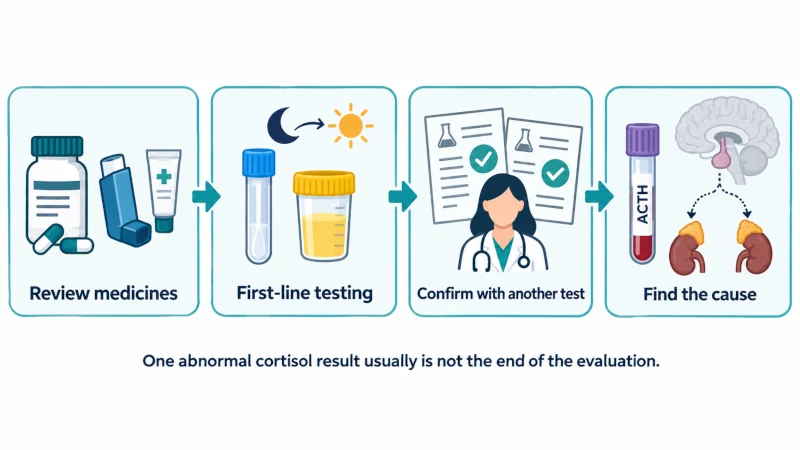
Testing is aimed at people with a real chance of having the condition. The Endocrine Society recommends testing people with several features that are worsening over time, especially the ones that best separate Cushing’s syndrome from common conditions: easy bruising, a flushed and full face, weakness in the hip and shoulder muscles, and reddish-purple stretch marks wider than about 1 centimeter. It also recommends testing people with features unusual for their age, such as osteoporosis or high blood pressure in a young adult, and people with an adrenal mass found on imaging. It advises against widespread testing in everyone else Endocrine Society Cushing’s diagnosis guideline, 2008.
The caution is deliberate. Endogenous Cushing’s syndrome is rare, with estimates around 40 to 70 people per million NIDDK on Cushing’s syndrome, while obesity, depression, and diabetes are common, so broad testing produces many false positives and the harms of follow-up testing and labeling that come with them Endocrine Society Cushing’s diagnosis guideline, 2008.
For initial testing, the guideline recommends one of four options: 24-hour urinary free cortisol (at least two collections), late-night salivary cortisol (two samples), the 1-mg overnight dexamethasone suppression test, or the longer 48-hour low-dose version. It specifically recommends against using a random blood cortisol level Endocrine Society Cushing’s diagnosis guideline, 2008. No test is perfect, so doctors usually use two different tests to confirm a diagnosis NIDDK on Cushing’s syndrome. An abnormal first result leads to an endocrinologist and a second test; two concordant abnormal results lead to tests for the cause, such as ACTH levels and imaging Endocrine Society Cushing’s diagnosis guideline, 2008.
How doctors look for low cortisol
Adrenal insufficiency, the medical term for not making enough cortisol, tends to develop slowly. Common symptoms are long-lasting fatigue, muscle weakness, loss of appetite, weight loss, and abdominal pain; people with Addison’s disease may also notice darkening skin NIDDK on causes of adrenal insufficiency.
The ACTH stimulation test (also called a corticotropin stimulation test) is the test used most often. A clinician injects synthetic ACTH into a vein and measures blood cortisol before and 30 or 60 minutes afterward. A normal adrenal gland responds with a rise in cortisol; damaged glands show little or no rise NIDDK on diagnosing adrenal insufficiency. The Endocrine Society calls the short corticotropin test the “gold standard” for diagnosing primary adrenal insufficiency, and when it is not immediately possible, recommends starting with morning ACTH and cortisol levels Endocrine Society adrenal insufficiency guideline, 2016.
Measuring ACTH alongside cortisol helps locate the problem: high ACTH with low cortisol points to the adrenal glands themselves, while low or normal ACTH with low cortisol points toward the pituitary gland MedlinePlus ACTH test guide, 2023. The stimulation test can miss pituitary-related deficiency that began recently, because the adrenal glands have not yet lost their ability to respond, so doctors sometimes add a CRH stimulation test or a supervised insulin tolerance test NIDDK on diagnosing adrenal insufficiency.
Interpretation depends on timing, the assay, and how sick the person is, so there is no safe do-it-yourself cutoff. In acutely ill patients, the Endocrine Society advises a low threshold for both testing and treatment Endocrine Society adrenal insufficiency guideline, 2016.
Can stress cause a high cortisol test?
Yes, and that is part of why a single high result can mislead. Physical and emotional stress raise cortisol as a normal response MedlinePlus cortisol test guide, 2024. Hospitalization, surgery, pain, malnutrition, and intense ongoing exercise can all raise cortisol without any adrenal or pituitary disease Endocrine Society Cushing’s diagnosis guideline, 2008.
A second group of conditions can keep cortisol mildly elevated for longer: depression, anxiety, alcohol use disorder, poorly controlled diabetes, and obesity. This pattern is sometimes called pseudo-Cushing’s syndrome or non-neoplastic hypercortisolism, and it can produce test results that look like Cushing’s syndrome MedlinePlus cortisol test guide, 2024; Endocrine Society Cushing’s diagnosis guideline, 2008. Pregnancy also raises cortisol Endocrine Society Cushing’s diagnosis guideline, 2008.
Neither is the same as Cushing’s syndrome, where cortisol stays inappropriately high for a long period and causes progressive physical changes NIDDK on Cushing’s syndrome. Feeling stressed does not mean your cortisol is medically abnormal, and no validated test turns cortisol into a stress score. The same goes for “adrenal fatigue”: the Endocrine Society states that there is no scientific proof it is a real medical condition and no test that can detect it Endocrine Society on adrenal fatigue, 2022.
What about “cortisol belly”?
Weight gain and obesity appear in the Endocrine Society’s list of features that are common in the general population and do little to distinguish Cushing’s syndrome from other causes Endocrine Society Cushing’s diagnosis guideline, 2008. When Cushing’s syndrome does cause weight gain, it tends to come with other changes, such as thin arms and legs, a rounder face, extra fat at the base of the neck, easy bruising, wide purple stretch marks, and muscle weakness NIDDK on Cushing’s syndrome. Extra weight around the middle on its own is not evidence of a cortisol disorder, and it is not a reason to treat an unvalidated home result as a diagnosis.
At-home cortisol tests: what they can and cannot tell you
Some samples really can be collected at home. Late-night saliva samples for a clinician-ordered Cushing’s evaluation are usually collected that way, as is a 24-hour urine collection NIDDK on Cushing’s syndrome. Home collection is not the problem.
What differs is who chose the test, why, and how it is interpreted. A clinician-ordered collection follows a validated protocol, goes to a lab whose method has known cutoffs, and is read alongside your history. Cortisol assays differ widely in accuracy, and results near a cutoff can reflect assay variation Endocrine Society Cushing’s diagnosis guideline, 2008. A direct-to-consumer kit may differ on any of those points, and its timing or number of samples may not match the question you actually have.
Be especially cautious with multi-sample saliva “stress panels” or “adrenal fatigue” curves. The Endocrine Society notes that blood or saliva tests offered for adrenal fatigue are not supported by good scientific studies, so their results and interpretation may not be correct Endocrine Society on adrenal fatigue, 2022. If a home result worries you, bring the full report, with lab name and collection times, to your clinician.
An unusual home result also should not lead straight to self-treatment. The Endocrine Society warns that many supplements sold for adrenal health have not been tested for safety, and that taking adrenal hormone products you don’t need can switch off your own adrenal glands for months, raising the risk of adrenal crisis when they are stopped Endocrine Society on adrenal fatigue, 2022. If you are considering supplements commonly marketed for stress, our review of ashwagandha and magnesium covers what the evidence shows and who should avoid them.
What can affect cortisol test results
Not every factor affects every test equally. The table below shows where each one matters most.
| Factor | Tests most affected | Why |
| Time of day, shift work, irregular sleep, jet lag | Late-night saliva; single blood samples | The normal day-night rhythm is blunted or shifted Endocrine Society Cushing’s diagnosis guideline, 2008 |
| Acute illness, surgery, pain | Blood, saliva, and urine | Physical stress raises cortisol physiologically Endocrine Society Cushing’s diagnosis guideline, 2008 |
| Emotional stress or exercise just before testing | Blood and saliva | Both raise cortisol, so resting first may be advised MedlinePlus cortisol test guide, 2024 |
| Pregnancy | All; dexamethasone testing especially | Urine cortisol rises up to threefold by term, and dexamethasone suppression is blunted Endocrine Society Cushing’s diagnosis guideline, 2008 |
| Oral estrogen (birth control pills, hormone therapy) | Blood cortisol and dexamethasone tests | Raises binding protein and total serum cortisol; urine free cortisol stays normal Endocrine Society Cushing’s diagnosis guideline, 2008 |
| Glucocorticoid medicines, including creams, inhalers, and injections | All | Can cause cortisol excess, interfere with some assays, or suppress the body’s own production Endocrine Society Cushing’s diagnosis guideline, 2008; MedlinePlus cortisol test guide, 2024 |
| Certain anti-seizure medicines; rifampin | Dexamethasone tests | Speed up dexamethasone clearance, causing false positives Endocrine Society Cushing’s diagnosis guideline, 2008 |
| Licorice, chewing tobacco, smoking | Late-night saliva | Can falsely raise salivary cortisol Endocrine Society Cushing’s diagnosis guideline, 2008 |
| Collection errors | Urine (missed voids); saliva (eating or brushing beforehand) | Under-collection or contamination Endocrine Society Cushing’s diagnosis guideline, 2008; MedlinePlus cortisol test guide, 2024 |
| Kidney disease; very high fluid intake | 24-hour urine | Kidney impairment lowers urine cortisol; heavy fluid intake raises it Endocrine Society Cushing’s diagnosis guideline, 2008 |
Tell the clinician ordering your test about every medicine and product you use, including skin creams, and do not stop any of them unless your provider tells you to MedlinePlus cortisol test guide, 2024. If irregular sleep is part of your picture, it affects more than hormone tests; our guide to how sleep affects blood pressure explains the overnight side of that rhythm.
What abnormal cortisol test results may mean
If a result is high
A high result can reflect Cushing’s syndrome. The most common cause is long-term, high-dose glucocorticoid medicine. When the body itself is overproducing cortisol, the usual source is a noncancerous pituitary tumor that makes too much ACTH (Cushing’s disease), which accounts for about 8 in 10 such cases; less often, it is an ACTH-producing tumor elsewhere, often in the lungs, or a tumor of the adrenal gland NIDDK on Cushing’s syndrome.
A high value also often has a non-Cushing explanation, such as the stress-related causes above, estrogen, or a collection problem. An abnormal result does not always mean a condition that needs treatment, and the most common cause of abnormal cortisol levels is long-term steroid use or stopping it suddenly MedlinePlus cortisol test guide, 2024. Confirmation requires repeat or different tests, usually guided by an endocrinologist Endocrine Society Cushing’s diagnosis guideline, 2008.
If a result is low
A low result can point to Addison’s disease (damage to the adrenal glands, most often autoimmune in developed countries), to a pituitary problem that limits ACTH, or to a hypothalamic problem. The most common cause of adrenal insufficiency overall is suddenly stopping corticosteroids after taking them for a long time NIDDK on causes of adrenal insufficiency. This is why steroid doses are tapered gradually under medical supervision, and why you should never stop a prescribed steroid on your own NIDDK on causes of adrenal insufficiency.
A single low value, especially one drawn at the wrong time of day, does not establish the diagnosis. Stimulation testing and ACTH measurement are what confirm it and find the cause NIDDK on diagnosing adrenal insufficiency; MedlinePlus ACTH test guide, 2023.
When to see a healthcare professional
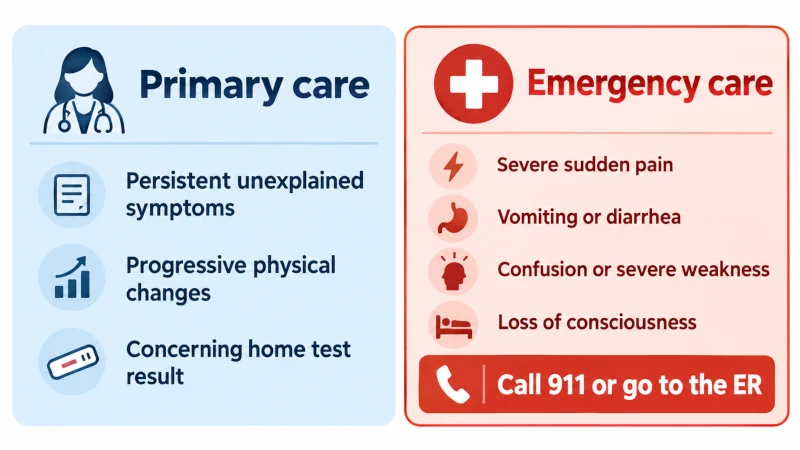
Make an appointment with your primary care clinician if you notice:
- Long-lasting fatigue or weakness together with weight loss, poor appetite, abdominal pain, dizziness or fainting when you stand, salt cravings, or darkening skin NIDDK on causes of adrenal insufficiency
- Several physical changes developing together, such as easy bruising, wide reddish-purple stretch marks, weakness in the thighs or upper arms, or a rounder, flushed face Endocrine Society Cushing’s diagnosis guideline, 2008
- High blood pressure or bone loss that seems unusual for your age, or type 2 diabetes with blood sugar and blood pressure that stay high despite treatment Endocrine Society Cushing’s diagnosis guideline, 2008; NIDDK on Cushing’s syndrome
- Long-term use of a steroid medicine you want to reduce or stop (your prescriber will need to plan a taper)
- An abnormal home or wellness cortisol result you are unsure how to interpret
Fatigue, poor sleep, or stress on their own still deserve a visit, since they have many treatable causes such as depression and sleep apnea Endocrine Society on adrenal fatigue, 2022; they just don’t point to a cortisol test by default.
| Call 911 or go to the nearest emergency room for signs of adrenal crisis, especially if you have adrenal insufficiency or recently stopped long-term steroids: sudden, severe pain in the lower back, abdomen, or legs; vomiting and diarrhea; weakness; confusion; or loss of consciousness. Adrenal crisis can be fatal without prompt treatment NIDDK on adrenal crisis. |
Before any cortisol test, bring a written list of everything you take, including birth control, inhalers, skin creams, recent joint injections, and supplements. That list often answers the most important question before any sample is collected.
| HEALTH DISCLAIMER: This article is for general education and is not medical advice, diagnosis, or treatment. Cortisol results depend on timing, the type of sample, the laboratory method, your medicines, and your overall health, and they need to be interpreted by a qualified healthcare professional. Do not start, stop, or change any prescription medicine, including corticosteroids, birth control, or anti-seizure medicines, without your prescriber’s guidance, and never take dexamethasone or another prescription drug except as directed. If you are pregnant, have a known adrenal or pituitary condition, or take long-term steroid medicine, ask your clinician how testing applies to you. If you have symptoms of adrenal crisis, call 911. |
Frequently Asked Questions
What is the most accurate test for cortisol?
There is no single most accurate cortisol test for everyone. For suspected cortisol excess, late-night salivary cortisol, 24-hour urinary free cortisol, and dexamethasone suppression testing are all recommended first-line options, chosen to suit the person; for example, urine testing is preferred initially in pregnancy Endocrine Society Cushing’s diagnosis guideline, 2008. For suspected deficiency, the ACTH stimulation test is the test used most often NIDDK on diagnosing adrenal insufficiency.
Can I test my cortisol levels at home?
You can collect some samples at home, such as late-night saliva or a 24-hour urine collection, and clinicians often order them that way NIDDK on Cushing’s syndrome. Collecting a sample at home is different from diagnosing yourself. Results depend on the lab method, timing, and the question being asked, and tests marketed for “adrenal fatigue” are not supported by good evidence Endocrine Society on adrenal fatigue, 2022.
What time of day should cortisol be tested?
It depends on the purpose. Morning blood samples are used because cortisol is normally highest then, which is helpful when low cortisol is suspected MedlinePlus cortisol test guide, 2024. When cortisol excess is suspected, the late-night window, usually 11 p.m. to midnight, is more informative because levels should be at their lowest Endocrine Society Cushing’s diagnosis guideline, 2008.
Is a cortisol blood test enough to diagnose high cortisol?
No. The Endocrine Society recommends against using a random blood cortisol level to test for Cushing’s syndrome, and doctors usually need two different abnormal tests before looking for a cause Endocrine Society Cushing’s diagnosis guideline, 2008; NIDDK on Cushing’s syndrome.
Can you have high cortisol without Cushing’s syndrome?
Yes. Illness, surgery, pain, pregnancy, intense exercise, depression, anxiety, alcohol use disorder, poorly controlled diabetes, and obesity can all raise cortisol without Cushing’s syndrome Endocrine Society Cushing’s diagnosis guideline, 2008; MedlinePlus cortisol test guide, 2024.
How long does a cortisol test take, and how should I prepare?
A blood draw usually takes less than five minutes, a saliva swab about two minutes, and a urine collection a full 24 hours. For saliva, avoid eating, drinking, brushing, or flossing for 30 minutes beforehand; you may be asked to rest before a blood test; and you should tell your provider about every medicine, including skin creams, without stopping any on your own MedlinePlus cortisol test guide, 2024. For late-night saliva, avoiding licorice, tobacco, and smoking on the collection day helps prevent falsely high results Endocrine Society Cushing’s diagnosis guideline, 2008.
References
- National Library of Medicine (MedlinePlus). Cortisol Test. MedlinePlus Medical Tests. View source
- National Library of Medicine (MedlinePlus). Adrenocorticotropic Hormone (ACTH). MedlinePlus Medical Tests. View source
- National Institute of Diabetes and Digestive and Kidney Diseases. Cushing’s Syndrome. NIDDK. View source
- National Institute of Diabetes and Digestive and Kidney Diseases. Diagnosis of Adrenal Insufficiency & Addison’s Disease. NIDDK. View source
- National Institute of Diabetes and Digestive and Kidney Diseases. Symptoms & Causes of Adrenal Insufficiency & Addison’s Disease. NIDDK. View source
- National Institute of Diabetes and Digestive and Kidney Diseases. Definition & Facts of Adrenal Insufficiency & Addison’s Disease. NIDDK. View source
- Nieman LK, Biller BMK, Findling JW, Newell-Price J, Savage MO, Stewart PM, Montori VM. The Diagnosis of Cushing’s Syndrome: An Endocrine Society Clinical Practice Guideline. Journal of Clinical Endocrinology & Metabolism. View source
- Endocrine Society. Diagnosis of Cushing’s Syndrome Guideline Resources. View source
- Endocrine Society (Bornstein SR, et al.). Diagnosis and Treatment of Primary Adrenal Insufficiency: An Endocrine Society Clinical Practice Guideline. Journal of Clinical Endocrinology & Metabolism. View source
- Endocrine Society. Adrenal Fatigue. Endocrine Library (patient resource). View source


