

The lifestyle habits that support nitric oxide are almost embarrassingly ordinary: move your body most days, get some daylight, sleep enough, eat vegetables, and stop doing the handful of things that quietly burn nitric oxide off. No capsule outperforms that list. Your arteries make nitric oxide (NO) on their own — the small “relax” signal the vessel lining sends to widen the pipe and ease blood flow [Carlström, 2024]. The useful question isn’t how to buy more of it. It’s how to keep the two systems that produce it running, and how to stop sabotaging them.
That’s what this page is for. If you want the grocery list, that lives on the nitric oxide foods guide; if you’re weighing capsules, start with nitric oxide supplements for blood pressure. Here we’re talking about behavior — and grading it honestly, because some of these habits rest on solid trials and others on small, promising ones.
How your body actually makes nitric oxide
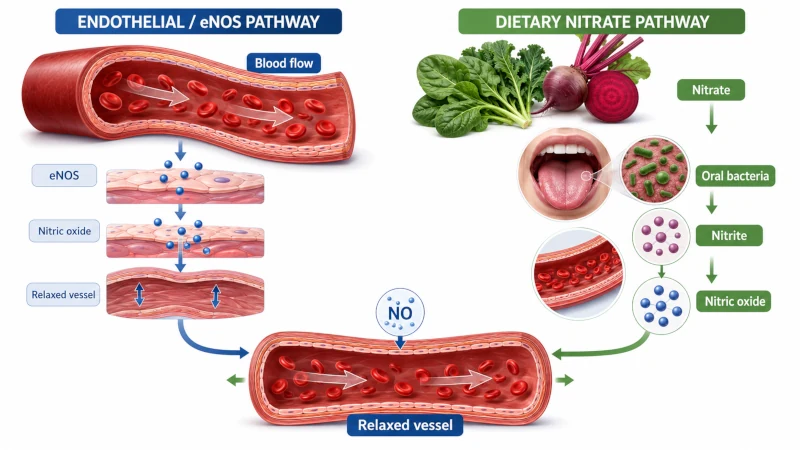
There are two routes, and every habit below plugs into one of them. The first is the enzyme route: an enzyme called endothelial nitric oxide synthase (eNOS), sitting in your artery lining, builds NO on demand. Blood flowing past the vessel wall is one of its main triggers, which is why movement matters so much.
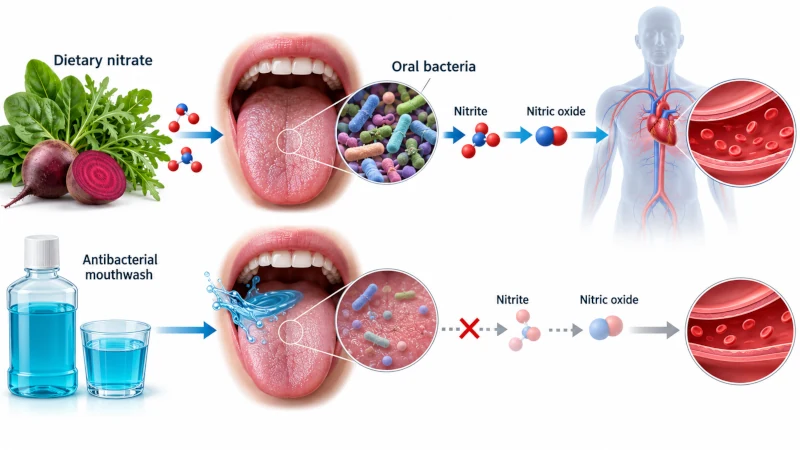
The second is the dietary route — the nitrate–nitrite–nitric oxide pathway — where nitrate from vegetables is converted, starting with bacteria in your mouth, into signaling your body can use as NO [Carlström, 2024]. Two things dull both routes: oxidative stress, which chemically “mops up” NO before it can act, and the ordinary decline that comes with disease and aging [Carlström, 2024]. Keep that frame in mind and the rest of this page stops being a list and starts being a strategy.
The habit that does the most: move most days
If you change one thing, change this. When you move, blood flow rises, the vessel wall feels the drag of that flow, and eNOS responds — the enzyme pathway gets its main cue from motion.
What the evidence shows (reasonably strong)
A 2024 systematic review and meta-analysis pooled 37 studies and 2,801 people with high blood pressure and found that exercise raised endogenous nitric oxide (a standardized mean difference of 0.89, 95% CI 0.48–1.30), improved flow-mediated dilation, and lowered endothelin-1, the signal that tightens vessels [Liang, 2024]. Aerobic exercise moved the NO needle most. In that analysis, the biggest effect came from higher-intensity aerobic sessions of roughly 35–50 minutes, three to four times a week — but that’s where the data peaked, not where you have to begin.
A beginner routine you can keep
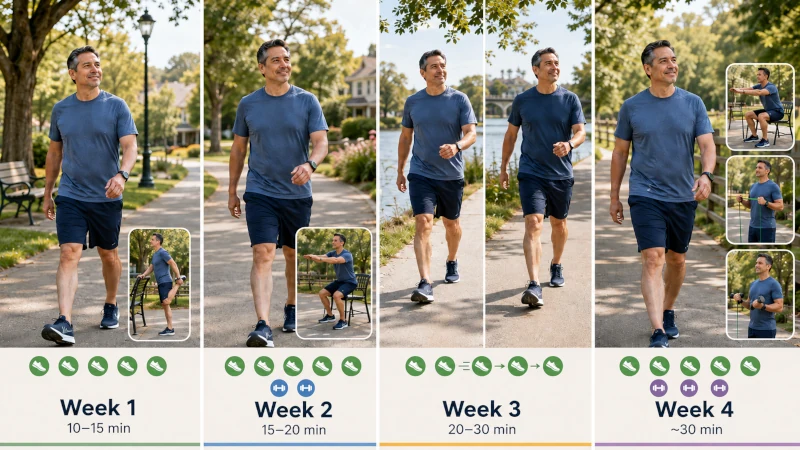
The best routine is the one you’ll still be doing in a month. Walking plus a little strength work is plenty to start.
| Week | Walking goal | Optional add-on | What to track |
| 1 | 10–15 min, 5 days | 1 easy stretch session | Minutes walked, BP trend |
| 2 | 15–20 min, 5 days | 2 short strength sessions (10 min) | Minutes, sleep rating |
| 3 | 20–30 min, 5 days | Brisk pace 2 days | Symptoms, recovery |
| 4 | 30 min, 5 days | Strength 2–3×/week | Weekly totals |
What about harder exercise?
It can help, and the meta-analysis suggests higher-intensity aerobic work has the largest effect on NO [Liang, 2024]. But intensity is where you graduate to, not where you sign up. Build the habit first. And if you have known heart disease, chest symptoms, or you’ve been sedentary for years, get your clinician’s clearance before intense training — that caution matters more than any extra minute of NO.
Stop scavenging the nitric oxide you already make
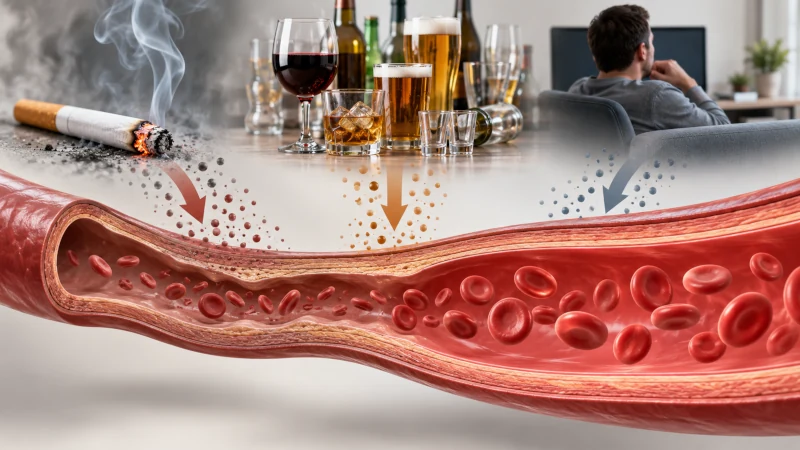
Producing NO is only half the equation; the other half is not destroying it. Oxidative stress scavenges nitric oxide, which is one reason NO tends to run low in cardiovascular disease [Carlström, 2024]. The everyday behaviors that drive that oxidative burden are the familiar ones. Smoking is the clearest: it’s a direct hit to endothelial function, and stopping is the single most valuable vascular decision most smokers can make.
Heavy alcohol use and a life spent sitting pull in the same wrong direction, which is why the current blood-pressure guideline builds lifestyle change — activity, moderating alcohol, weight, not smoking — into the foundation of care rather than treating it as optional [AHA/ACC, 2025]. You don’t need a special “NO diet” to benefit here. You need to remove the things working against the pathway.
Get some daylight on your skin (the underrated, and misunderstood, lever)
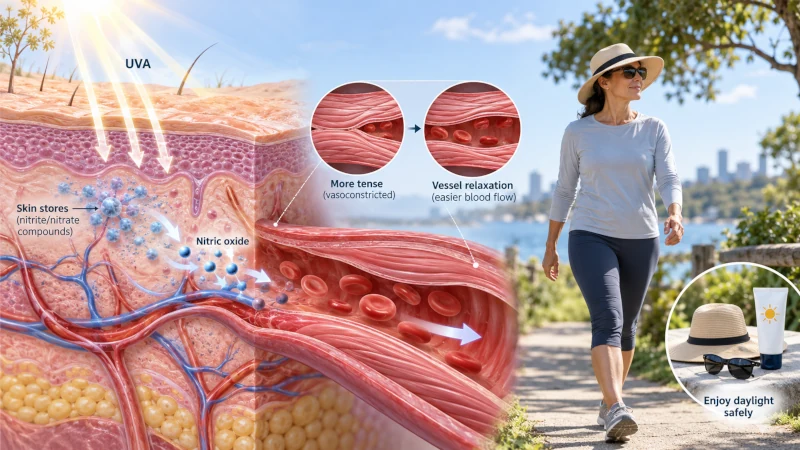
Here’s the one most articles miss. Your skin holds a store of nitrogen-oxide compounds, and ultraviolet A light can release some of that as nitric oxide into the circulation. In a controlled study of 24 people with normal blood pressure, a UVA dose equivalent to about 30 minutes of midday summer sun widened arteries and produced a small, temporary drop in blood pressure — and, importantly, it happened independently of vitamin D [Liu, 2014]. That’s a genuinely different mechanism from the vitamin-D story most people know.
Promising, but read the label carefully. The trials are small and short, the effect is modest and fades, and the same UV that mobilizes skin NO also damages skin and raises skin-cancer risk. So this is not a green light to sunbathe. The reasonable, honest takeaway: ordinary time outdoors and daylight as part of normal living is a plausible small contributor — not a dosing instruction, and never a reason to skip sun protection or a dermatologist’s advice.
Don’t sabotage the mouth step (oral bacteria and mouthwash)
The dietary pathway has a strange first step: it runs through your mouth. Bacteria on the back of your tongue convert nitrate from vegetables into nitrite, which your body then uses downstream. Wipe those bacteria out and you slow the whole chain. In 19 healthy adults, a week of twice-daily antibacterial (chlorhexidine) mouthwash cut oral nitrite production by about 90% and plasma nitrite by roughly 25%, with blood pressure rising about 2–3.5 mm Hg [Kapil, 2013]. A separate small trial in 15 adults already treated for hypertension found three days of antibacterial rinse nudged systolic pressure up by around 2.3 mm Hg [Bondonno, 2015].
The evidence here is real but mixed and small, so hold it lightly. This is not a reason to abandon oral care, and it is absolutely not a reason to stop a rinse your dentist prescribed. It’s a reason to use antibacterial mouthwash on purpose rather than on autopilot — especially if you’re eating nitrate-rich vegetables specifically for your heart. The deeper dive on mouthwash, oral bacteria, and nitric oxide covers how to test it safely.
Sleep: the quiet input to vessel function
Sleep rarely makes the “boost NO” lists, but the vessel lining notices when you skimp. In a small study, adults with habitually short sleep showed reduced nitric-oxide-mediated widening of their blood vessels compared with normal sleepers [Bain, 2017]. These are mechanistic, limited findings, not proof that an extra hour fixes your numbers — but given everything else good sleep does for blood pressure, a repeatable routine is a low-risk habit worth protecting. You don’t need perfect sleep. You need a consistent wake time, morning light when you can get it, caffeine kept away from the evening, and a cool, dark room.
Feed the pathway: nitrate-rich vegetables most days
Movement drives the enzyme route; food supplies the dietary route. A 2025 GRADE-assessed meta-analysis of 75 randomized trials (1,823 participants) found that dietary nitrate produced modest, dose-related reductions in blood pressure and improvements in vascular markers, though the certainty of the evidence was only low to moderate [Norouzzadeh, 2025]. The practical version is one rule: add a generous serving of nitrate-rich greens (arugula, spinach, lettuce) most days, with beets a few times a week if you like them. The full list and how to actually eat it lives in the nitrate-rich foods guide.
Manage stress, then measure so you know it’s working
Stress management doesn’t have to be elaborate to earn its place — pick one small practice and make it automatic (a few slow breaths before you check your pressure, a short walk after meals, jotting one worry and one next step before bed). But the habit that separates “I think it helped” from “I can see it helped” is measurement. Change one thing at a time and watch the trend over two to four weeks, not any single reading — the same principle the blood-pressure guideline emphasizes for home monitoring [AHA/ACC, 2025]. The blood-pressure tracking guide has a ready-made routine.
How the habits stack up
| Habit | Pathway | Evidence strength | Realistic effect |
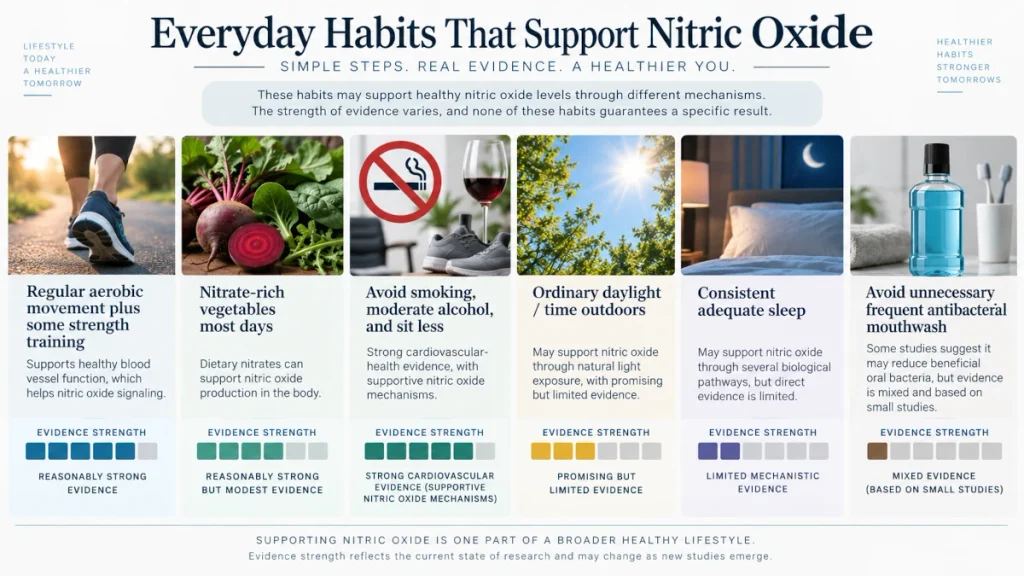
| Move most days (aerobic + some strength) | Enzyme (eNOS / shear stress) | Reasonably strong | Meaningfully raises NO markers; a few mm Hg on BP over weeks |
| Nitrate-rich vegetables most days | Dietary (nitrate–nitrite–NO) | Reasonably strong, modest | Small, dose-related BP effect; varies by person |
| Don’t smoke; moderate alcohol; sit less | Protects both (less scavenging) | Strong for CV health; mechanistic for NO | Removes forces working against NO |
| Daylight / time outdoors | Skin NO stores (non-enzymatic) | Promising but limited | Small, temporary BP drop; weigh vs. sun-safety |
| Enough, consistent sleep | Endothelial / NO function | Limited, mechanistic | Supports vessel function; low-risk |
| Use antibacterial mouthwash sparingly | Oral step of dietary route | Mixed, small | ~2–3.5 mm Hg swing in small trials; don’t override dental advice |
Safety, interactions, and who should check with a clinician first
None of these habits is a treatment, and a few carry real cautions. Expect a few millimeters of mercury over weeks, not a transformation — and never a substitute for prescribed medication.
The interaction that matters most is with blood-pressure medication. Habits and foods that lower pressure can stack with drugs (and with erectile-dysfunction medications) and drop you too low, so if you take these — especially more than one — build changes with your clinician and treat dizziness or fainting as a signal to stop and call. If you have chronic kidney disease, are on a potassium restriction, or have a history of calcium-oxalate kidney stones, get individual advice before leaning hard on high-nitrate greens like spinach.
If you’re pregnant or breastfeeding, exercise and normal daylight are generally fine, but clear new intense training with your clinician and don’t start concentrated beetroot or amino-acid supplements without professional input. Anyone with known heart disease should get clearance before intense exercise, and no one should stop a dentist-prescribed mouthwash on their own. Sun exposure is not a prescribed dose — keep protecting your skin.
Self-care is not enough when readings stay high across a couple of weeks, when you feel faint, or when you’re weighing changes to prescribed treatment. Bring your log to a clinician. For the whole picture of how these pieces fit, the complete nitric oxide and blood pressure guide ties it together.
Red flags — seek urgent care. Call 911 if your blood pressure is over 180/120 mm Hg and you have symptoms such as chest pain, shortness of breath, back pain, numbness or weakness, vision changes, or trouble speaking — that can be a hypertensive emergency, and you should not wait to see if it settles [AHA/ACC, 2025]. If a reading is that high with no symptoms, rest a few minutes, recheck, and contact your clinician promptly if it stays up.
| Health disclaimer: This article on lifestyle habits that support nitric oxide is for education only and is not medical advice, diagnosis, or treatment. Supporting nitric oxide through movement, sleep, daylight, and diet is a complement to blood-pressure care, not a replacement for it. If you have high blood pressure, heart disease, kidney disease, are pregnant or breastfeeding, or take prescription medication, talk with a qualified clinician before changing treatment, exercise, or diet, or before starting any supplement. Do not stop a dentist-prescribed mouthwash or any medication based on this page. If you may be having a hypertensive emergency (a reading over 180/120 mm Hg with symptoms), call 911. |
Frequently Asked Questions
Which lifestyle habit raises nitric oxide the most?
Regular movement has the strongest evidence. A meta-analysis of 37 studies in people with hypertension found exercise raised nitric oxide and improved vessel function, with aerobic exercise having the biggest effect [Liang, 2024].
Can I raise nitric oxide without any supplements?
Yes — that’s the whole point of this page. The best-supported habits are behavioral and dietary: move most days, eat nitrate-rich vegetables, sleep, and stop scavenging NO through smoking and excess alcohol [Liang, 2024] [Norouzzadeh, 2025] [Carlström, 2024].
Does sunlight really affect nitric oxide?
There’s a real mechanism: UVA light can release nitric oxide stored in the skin, and a small study showed a temporary blood-pressure drop independent of vitamin D [Liu, 2014]. The effect is modest and short-lived, and it doesn’t override skin-cancer caution — so treat ordinary time outdoors as a small bonus, not a tanning prescription.
Should I stop using mouthwash?
Not if a dentist prescribed it. Frequent antibacterial rinsing can blunt the mouth’s nitrate step and nudged blood pressure up in small studies [Kapil, 2013] [Bondonno, 2015], so if you use it out of habit you can reasonably cut back — but keep any rinse recommended for a specific dental reason.
How long until these habits show up in my blood pressure?
Some people see shifts within days, but judge real change on a two-to-four-week trend rather than a single reading [AHA/ACC, 2025].
Do I need a gym or hard workouts?
No. Walking plus a little strength work is enough to start; intensity is something you build toward, not a requirement [Liang, 2024].
References
- Carlström M, Weitzberg E, Lundberg JO. Nitric Oxide Signaling and Regulation in the Cardiovascular System: Recent Advances. Pharmacol Rev. 2024;76(6):1038–1062. View source
- Liang C, Song Z, Yao XZ, Xiao Q, Fu H, Tang L. Exercise interventions for the effect of endothelial function in hypertensive patients: A systematic review and meta-analysis. J Clin Hypertens. 2024;26(6):599–614. View source
- Norouzzadeh M, Hasan Rashedi M, Ghaemi S, et al. Plasma nitrate, dietary nitrate, blood pressure, and vascular health biomarkers: a GRADE-assessed systematic review and dose-response meta-analysis of RCTs. Nutr J. 2025;24:47. View source
- Liu D, Fernandez BO, Hamilton A, et al. UVA irradiation of human skin vasodilates arterial vasculature and lowers blood pressure independently of nitric oxide synthase. J Invest Dermatol. 2014;134(7):1839–1846. View source
- Kapil V, Haydar SMA, Pearl V, Lundberg JO, Weitzberg E, Ahluwalia A. Physiological role for nitrate-reducing oral bacteria in blood pressure control. Free Radic Biol Med. 2013;55:93–100. View source
- Bondonno CP, Liu AH, Croft KD, et al. Antibacterial mouthwash blunts oral nitrate reduction and increases blood pressure in treated hypertensive men and women. Am J Hypertens. 2015;28(5):572–575. View source
- Bain AR, Weil BR, Diehl KJ, Greiner JJ, Stauffer BL, DeSouza CA. Insufficient sleep is associated with impaired nitric oxide-mediated endothelium-dependent vasodilation. Atherosclerosis. 2017;265:41–46. View source
- Jones DW, Ferdinand KC, Taler SJ, et al. 2025 AHA/ACC (multi-society) Guideline for the Prevention, Detection, Evaluation, and Management of High Blood Pressure in Adults. Hypertension. 2025;82(10):e212–e316. View source
