
Your blood pressure is supposed to rise when you wake up. That climb — the morning blood pressure surge — is a normal part of your daily rhythm, driven by your sympathetic nervous system switching on, a pulse of cortisol, a release of adrenaline as you wake, and the simple mechanics of going from lying down to standing up [Bilo and colleagues, Integrated Blood Pressure Control, 2018].
So the question worth asking usually isn’t “why did my number jump?” It’s “what number did I land on, and did I measure it properly?”
That distinction is the whole ballgame. The size of your morning jump can’t be measured with a home cuff and has no agreed-upon danger threshold. The morning number itself has clear thresholds your doctor can act on today. Most people spend their worry on the first thing and get the second thing wrong.
What the morning surge actually is
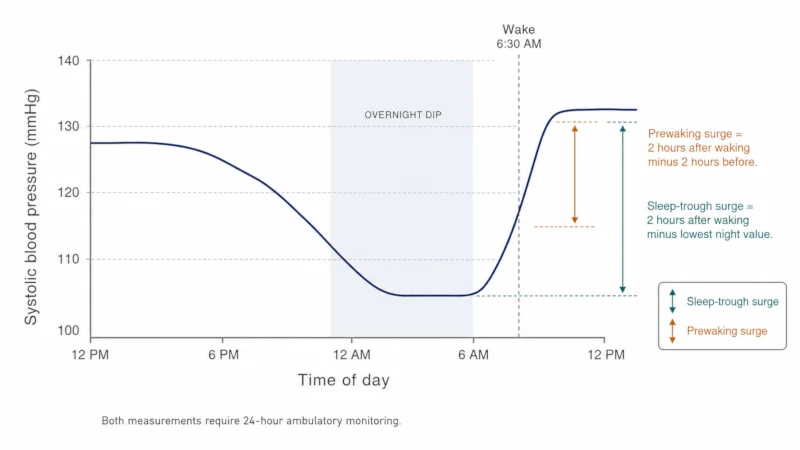
Researchers calculate the surge two standard ways, and both require a 24-hour ambulatory monitor worn on your body — not a home cuff:
- Sleep-trough surge — average systolic pressure across the two hours after you wake, minus the lowest nighttime value.
- Prewaking surge — average systolic across the two hours after waking, minus the average across the two hours before [Bilo and colleagues, 2018].
The most-cited risk cutoff is a sleep-trough surge of 55 mmHg or higher. It comes from a prospective study of 519 older adults with hypertension in Japan, followed for about 41 months. Those in the highest tenth of surge — 55 mmHg and above — had silent brain infarcts more often at baseline (57% versus 33%) and more strokes during follow-up (19% versus 7.3%), and the association held after accounting for their 24-hour average pressure and their nighttime dipping pattern [Kario and colleagues, Circulation, 2003].
That’s a genuine finding. It’s also where careful reading matters. A 2018 review of this literature notes that the 55 mmHg figure “cannot be readily generalized,” and that a large international database analysis found elevated risk at surges above roughly 20 mmHg — a very different number. The same review points out that calculating a surge for any one person “may create difficulties” even using the standardized definitions [Bilo and colleagues, 2018].
| Where the evidence stands: the physiology of the morning rise is well established. An exaggerated surge does appear to carry risk, but the threshold that defines “exaggerated” is unsettled, and no home device produces either measurement. |
The morning number that does matter
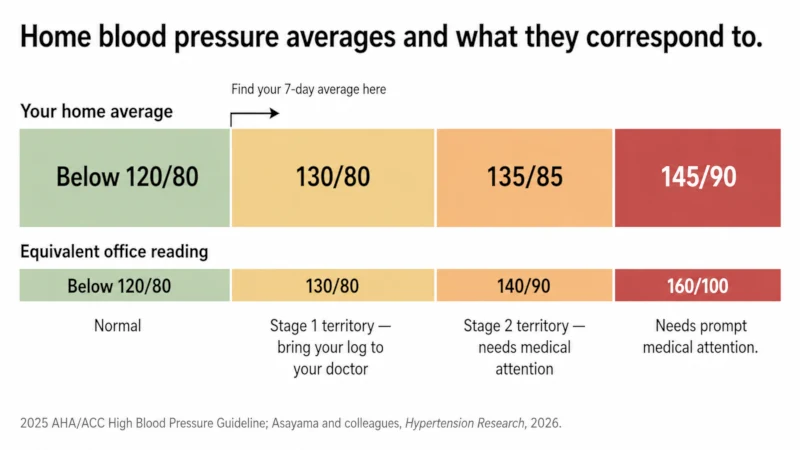
Under the 2025 AHA/ACC high blood pressure guideline, home readings are matched to office categories: a home average of 130/80 mmHg corresponds to an office reading of 130/80, and a home average of 135/85 corresponds to an office reading of 140/90 [Asayama and colleagues, Hypertension Research, 2026]. The guideline’s overall treatment goal is below 130/80 mmHg for most adults [2025 AHA/ACC High Blood Pressure Guideline].
| Home average (mmHg) | Roughly equivalent office reading | What it generally means |
| Below 120/80 | Below 120/80 | Normal |
| 130/80 | 130/80 | Stage 1 hypertension territory — bring your log in |
| 135/85 | 140/90 | Stage 2 territory — needs medical attention |
| 145/90 | 160/100 | Needs prompt medical attention |
Sources: Asayama and colleagues, Hypertension Research, 2026; 2025 AHA/ACC High Blood Pressure Guideline.
An international expert consensus focused specifically on mornings defines morning hypertension as a morning home average of 135/85 mmHg or higher, regardless of what the office reading says [HOPE Asia Network consensus statement, 2022]. That consensus was written for Asian populations rather than the United States, but it lands on the same practical point: your morning average stands on its own.
The short version — a morning average at or above 130/80 deserves a conversation with your doctor, and at or above 135/85 it is elevated by any current standard. Your personal target is a decision for your doctor, not a number to set yourself.
Four things people get wrong about morning readings
A high morning reading by itself doesn’t mean something is wrong. Blood pressure rises in the morning in healthy people. It’s a physiological phenomenon that exists so your circulation can support upright activity [Bilo and colleagues, 2018]. A single high reading is not cause for alarm on its own [American Heart Association guidance on home monitoring].
One reading is not data. Standard protocols call for two readings a minute apart, twice a day, for seven consecutive days — three days and twelve readings is the accepted minimum [American Medical Association 7-step SMBP guide]. Several protocols recommend throwing out the first day entirely, because measurement error clusters at the start of a monitoring stretch [Lin and colleagues on the 722 protocol, 2022].
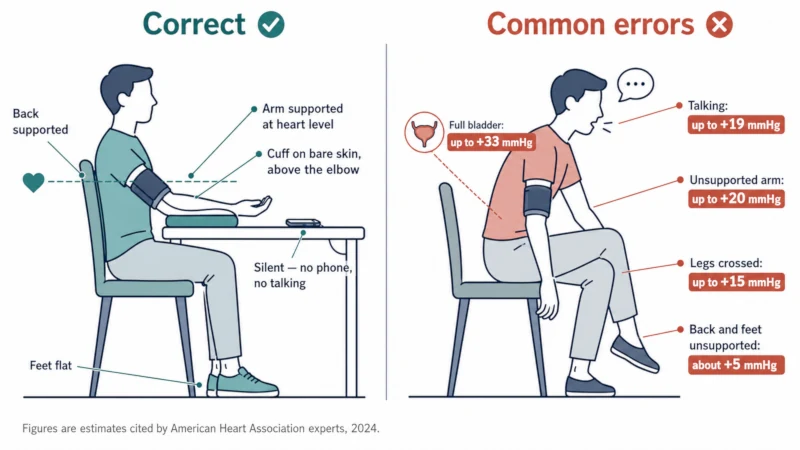
Technique changes the number more than most people believe. The American Heart Association puts figures on the common errors, and they are not small.
| Common error | Reported effect on the reading |
| Measuring with a full bladder | Up to 33 mmHg higher |
| Arm hanging or unsupported | Up to 20 mmHg too high |
| Talking during the measurement | Up to 19 mmHg higher |
| Legs crossed at the knee | Up to 15 mmHg higher |
| Back and feet unsupported | About 5 mmHg higher (up to 20 with poor posture) |
Source: American Heart Association, “The rules for measuring blood pressure — and why they exist,” 2024. These are estimates cited by AHA experts, not pooled results from a systematic review, so treat them as an indication of scale rather than precise corrections.
Add caffeine, exercise, or a cigarette in the 30 minutes beforehand and the reading shifts again, which is why the AHA asks you to avoid all three before measuring [American Heart Association guidance on home monitoring].
A normal office reading doesn’t settle the question. Blood pressure can read normal in a medical office and high everywhere else, which is why the 2025 AHA/ACC guideline puts weight on out-of-office monitoring with a standardized protocol [2025 AHA/ACC High Blood Pressure Guideline]. Morning home readings are one of the few windows into the part of the day a scheduled appointment almost never captures.
What tends to drive a high morning reading
Not every elevated morning number has the same cause. These are the contributors with the most support behind them.
| Contributor | What the pattern looks like | Reasonable first step |
| Medication trough | Highest readings right before the next dose, especially on once-daily morning dosing | Measure before you take your pills; bring the log to your prescriber |
| Obstructive sleep apnea | Consistently elevated mornings; snoring, witnessed pauses in breathing, unrefreshing sleep | Ask your doctor about a sleep study |
| Short or fragmented sleep | Mornings run higher after bad nights, closer to normal after good ones | Log sleep hours next to each reading for two weeks |
| Evening alcohol | Higher morning numbers the day after drinking | Compare mornings after drinking nights and non-drinking nights |
| Measurement conditions | Spikes tied to coffee, rushing, a full bladder, or talking | Re-run one week with strict technique before concluding anything |
| Blunted nighttime dipping | Both night and morning readings are high; more common with sleep apnea, kidney disease, or diabetes | Needs 24-hour ambulatory monitoring — a conversation for your doctor |
Medication timing is a real blind spot. Once-daily blood pressure medication is at its weakest right before the next dose, which for morning dosers is the morning. An international expert consensus describes morning blood pressure control as “the ‘blind spot’ for current hypertensive medication” [HOPE Asia Network consensus statement, 2022]. This is precisely why a pre-dose morning reading is more informative than one taken after you’ve swallowed your pills.
Sleep apnea is the cause most often missed. Roughly 30 to 50% of people with hypertension have obstructive sleep apnea, about half of people with sleep apnea have hypertension, and around 80% of people with resistant hypertension have it. In one group of untreated patients with mild to severe apnea, 84% had a non-dipping nighttime pattern — meaning their pressure never came down overnight, so morning readings started from a higher floor [Shiina, Hypertension Research, 2024]. CPAP treatment lowers blood pressure by about 2 to 7 mmHg systolic and 2 to 5 mmHg diastolic, which the same review calls relatively modest — helpful, but usually not a replacement for medication [Shiina, 2024].
How to take a morning reading worth acting on
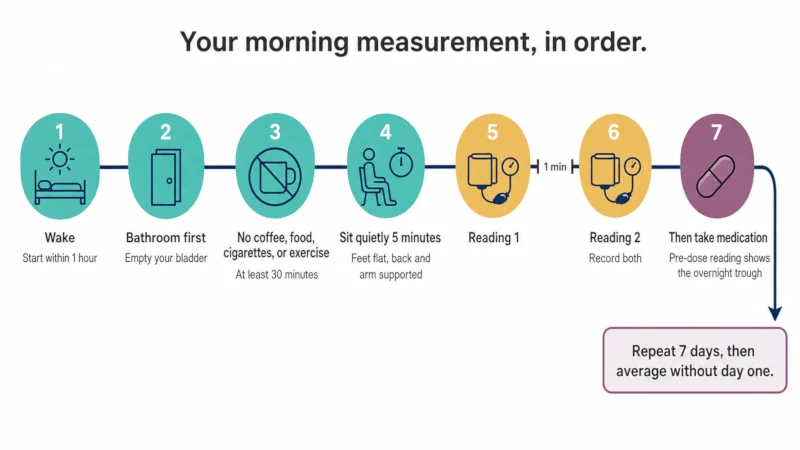
This follows American Heart Association home-monitoring guidance and the widely used “722” schedule — two readings per sitting, two sittings a day, seven days [American Heart Association guidance on home monitoring]; [Lin and colleagues, 2022].
The night before. Set the monitor, the cuff, and your log where you’ll sit. Removing the friction is what makes seven straight days actually happen.
On waking. Use the bathroom first. Skip coffee, food, cigarettes, and exercise until after you’ve measured — the AHA asks for a 30-minute gap at minimum, and morning protocols ask you to measure within an hour of getting up and before your medication.
Sit and settle. Feet flat on the floor, back supported, legs uncrossed, arm resting on a table with the middle of the cuff at heart level, cuff on bare skin just above the bend of the elbow. Then sit quietly for five full minutes. No phone, no conversation, no television. This is the step nearly everyone skips and the one that moves the number most.
Take two readings a minute apart. Record both. Don’t discard the one you don’t like.
Note the context. Date, time, arm used, hours slept, whether you drank the night before, anything unusual.
Take your medication after you’ve recorded. The pre-dose number is the one that shows how well your treatment held overnight.
Repeat for seven days, then average. Set the first day aside when you calculate — it tends to run high. The average is what your doctor can use; individual mornings are noise.
The one-screen version
- Validated upper-arm monitor, correct cuff size
- Measure within an hour of waking, before food, coffee, cigarettes, exercise, or medication
- Bathroom first
- Five minutes of quiet sitting: feet flat, back supported, legs uncrossed, arm supported at heart level, cuff on bare skin
- Two readings, one minute apart — record both
- Note sleep, alcohol, and anything unusual next to each reading
- Seven consecutive days, then average without day one
- Bring the average to your doctor; call 911 for a reading above 180/120 with symptoms
If you’re setting this up for the first time, the complete beginner guide to home blood pressure monitoring covers cuff sizing and device selection in more depth, and the guide to the best time to check blood pressure at home compares morning against evening measurement. Use a validated upper-arm monitor; the AHA maintains a list at validatebp.org, and it advises against relying on cuffless devices such as smartwatches for now [American Heart Association guidance on home monitoring]; [2025 AHA/ACC High Blood Pressure Guideline].
Reading your own log
Average under 130/80. Keep monitoring periodically and keep your doctor in the loop on the numbers.
Average at or above 130/80. Bring the log to an appointment. Your doctor may look at medication dose or timing, screen for sleep apnea, or order 24-hour ambulatory monitoring to see the pattern a home cuff can’t show.
A wide gap between your evening and morning readings. This is a medication-timing conversation, not a self-experiment. A meta-analysis of 10 randomized trials in 1,724 people found that moving antihypertensives to bedtime reduced the morning surge by about 5.3 mmHg (95% CI 1.8 to 8.8 mmHg lower) and improved nighttime dipping compared with morning dosing, with no increase in side effects [Xie and colleagues, BMC Cardiovascular Disorders, 2021]. But the largest trial to test whether timing changes what actually happens to people found no benefit: among 21,104 adults in the UK, evening dosing and morning dosing produced the same rate of heart attack, stroke, and vascular death — 3.4% versus 3.7% [Mackenzie and colleagues, TIME study, The Lancet, 2022].
Both results can be true. Bedtime dosing improves the numbers on the monitor; it has not been shown to improve outcomes. Expert consensus treats bedtime dosing as a case-by-case decision rather than a default, and often prefers a longer-acting drug or twice-daily dosing instead [HOPE Asia Network consensus statement, 2022]. Never move your own dose without talking to your prescriber.
Readings all over the map. Look at your notes before you look for a diagnosis. Inconsistent sleep, rushed mornings, and caffeine creeping in ahead of the measurement explain most of it.
Habits that move morning numbers
Sleep duration has real evidence behind it. A meta-analysis of 16 cohort studies covering over one million people found that sleeping less than seven hours was associated with a modestly higher risk of developing hypertension (HR 1.07, 95% CI 1.06–1.09), rising to HR 1.11 (1.08–1.14) below five hours. The effect was larger in women. The authors note the honest limits: every study was observational, sleep was self-reported, and unmeasured confounding is possible [Hosseini and colleagues, PLOS ONE, 2024].
Evening alcohol is worth testing on yourself. Alcohol raises blood pressure in a roughly linear, dose-dependent way, with no threshold below which the effect disappears — about 1.25 mmHg systolic per additional 12 g per day, roughly one standard drink, in a meta-analysis of seven cohorts [Di Federico and colleagues, Hypertension, 2023]. Its effect on the morning specifically is a step less certain: a Hypertension Research commentary describes drinkers as having higher nighttime pressure, more non-dipping, and a rapid rise before waking with higher morning levels [Metoki and colleagues, Hypertension Research, 2025]. Commentary is weaker evidence than a trial, but the direction is consistent, and tracking your own mornings after drinking and non-drinking nights costs nothing.
Sodium matters for blood pressure generally; its morning-specific effect is murkier. The case for cutting sodium is solid — the AHA recommends staying under 2,300 mg a day and ideally 1,500 mg, and notes that cutting 1,000 mg a day can improve blood pressure, against an American average above 3,100 mg [American Heart Association sodium guidance].
The link between salt and the morning surge in particular is thinner and stranger than it’s usually presented. The main study on it loaded 76 people with essential hypertension with 20 to 23 g of salt a day for a week and found the morning surge increased in the non-salt-sensitive group, not the salt-sensitive one [Osanai and colleagues, Journal of Human Hypertension, 2000]. Those are extreme intakes, the finding is counterintuitive, and it says nothing about what time of day you eat your salt. Cut sodium because it lowers blood pressure — practical swaps are covered in the guide to lowering salt and sugar — not because shifting it to lunch will flatten your morning curve.
Exercise helps over weeks, not minutes. Physical activity raises blood pressure while you’re doing it, which is why the AHA asks you to measure before exercising rather than after [American Heart Association guidance on home monitoring]. The benefit that shows up on your log is a lower resting pressure built over weeks. The guides to exercise for blood pressure and isometric training such as handgrip and wall sits cover the protocols. If you have diagnosed hypertension, heart disease, or symptoms during exertion, clear a new exercise plan with your doctor first.
Consistent sleep timing is a reasonable bet rather than a proven one. Keeping a steady bed and wake time fits what’s understood about circadian blood pressure regulation, but there is no strong trial evidence that schedule regularity by itself lowers morning readings. Low risk, unproven benefit — worth doing, not worth counting on. The relationship between sleep and blood pressure runs deeper than duration alone.
When to stop monitoring and get help
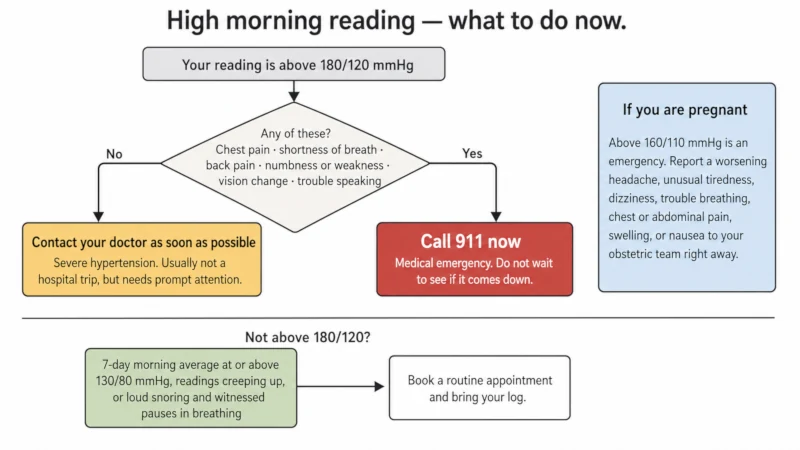
Home monitoring is for spotting patterns over weeks. Some things should not wait for the pattern.
Call 911 immediately if a reading is above 180/120 mmHg and you have any of these: chest pain, shortness of breath, back pain, numbness or weakness, a change in vision, or difficulty speaking. This is a medical emergency, and you should not wait to see whether the pressure comes down on its own [American Heart Association guidance on hypertensive crisis].
Contact your doctor as soon as possible if a reading is above 180/120 mmHg without those symptoms. That’s severe hypertension. It usually doesn’t require hospitalization, but it does need prompt attention [American Heart Association guidance on hypertensive crisis].
Make an appointment if your seven-day morning average is at or above 130/80 mmHg, if your readings are consistently higher than they used to be, or if you have loud snoring, witnessed pauses in breathing, or daytime sleepiness alongside high morning readings.
If you are pregnant, the rules are different. High blood pressure develops in roughly 1 in 12 to 1 in 17 pregnancies in the United States, and a reading above 160/110 mmHg during pregnancy is a medical emergency. Report a worsening headache, overwhelming tiredness, dizziness, trouble breathing, chest or abdominal pain, swelling, or nausea to your obstetric care team right away rather than waiting for your next visit [National Heart, Lung, and Blood Institute guidance on high blood pressure in pregnancy]. Don’t use the thresholds elsewhere in this article to interpret readings during pregnancy — your obstetric team sets those.
Don’t change your own treatment. Do not stop, skip, split, or re-time a blood pressure medication on your own, and don’t add a supplement aimed at blood pressure without checking with your doctor or pharmacist — several interact with antihypertensives and with each other.
| Health disclaimer: This article is for general education and is not medical advice, diagnosis, or treatment. Blood pressure management depends on your full medical history, and numbers alone don’t tell the whole story. Talk with your doctor before changing your treatment, and never stop, adjust, or re-time a prescription medication without your prescriber’s guidance. If you are pregnant or breastfeeding, have heart disease, kidney disease, or diabetes, or take multiple medications, your targets and cautions may differ from the general guidance here — ask a healthcare professional such as your doctor or pharmacist about your specific situation. If you have a reading above 180/120 mmHg with chest pain, shortness of breath, weakness, vision changes, or trouble speaking, call 911. |
Frequently Asked Questions
Is it normal for blood pressure to be higher in the morning?
Yes. Blood pressure rises as you wake — sympathetic nervous system activation, a pulse of cortisol, adrenaline, and standing up all push it above its overnight low [Bilo and colleagues, 2018]. What deserves attention is the level you land on, not the fact that it rose. A morning home average at or above 130/80 mmHg is worth raising with your doctor [Asayama and colleagues, Hypertension Research, 2026].
What counts as an “exaggerated” morning surge, and can I measure mine at home?
You can’t measure it at home — both standard definitions need a 24-hour ambulatory monitor [Bilo and colleagues, 2018]. The most-cited cutoff is a sleep-trough surge of 55 mmHg or more, from a study in which that top tenth had roughly two and a half times the stroke rate over about three and a half years [Kario and colleagues, Circulation, 2003]. But the same 2018 review that lays out the definitions notes the 55 mmHg figure “cannot be readily generalized,” and a large international dataset flagged raised risk above roughly 20 mmHg. There is no settled threshold, which is a good reason not to chase this number.
Should I switch my blood pressure medication to bedtime?
That’s your prescriber’s call, and the evidence pulls in two directions. A meta-analysis of 10 randomized trials found bedtime dosing reduced the morning surge by about 5.3 mmHg [Xie and colleagues, BMC Cardiovascular Disorders, 2021], but the 21,104-person TIME trial found no difference in heart attacks, strokes, or vascular deaths between evening and morning dosing [Mackenzie and colleagues, TIME study, The Lancet, 2022]. Better numbers on the monitor, same outcomes for people. Expert consensus treats the decision case by case and often prefers a longer-acting drug instead [HOPE Asia Network consensus statement, 2022]. Don’t re-time a dose on your own.
Can sleep apnea cause high morning blood pressure?
It’s one of the most commonly missed reasons. About half of people with obstructive sleep apnea have hypertension, roughly 80% of people with resistant hypertension have apnea, and in one group of untreated patients, 84% never had a normal overnight blood pressure drop [Shiina, Hypertension Research, 2024]. If you snore loudly, someone has seen you stop breathing, or you wake unrefreshed, ask your doctor about a sleep study. CPAP typically lowers blood pressure by about 2 to 7 mmHg systolic — real, but usually not enough on its own [Shiina, 2024].
How many mornings should I track before I talk to my doctor?
Seven consecutive days, two readings each morning a minute apart, is the standard. Three days and twelve readings is the accepted minimum if you’re short on time [American Medical Association 7-step SMBP guide]. Set the first day aside when you average [Lin and colleagues, 2022]. Don’t wait out the week if you record a reading above 180/120 mmHg — call your doctor, or 911 if you also have chest pain, shortness of breath, weakness, vision changes, or trouble speaking [American Heart Association guidance on hypertensive crisis].
Does coffee before measuring really change the number?
Enough that every protocol tells you to wait — the AHA asks for at least 30 minutes with no caffeine, exercise, or smoking before a reading [American Heart Association guidance on home monitoring]. It isn’t the biggest error, though. Measuring with a full bladder can add as much as 33 mmHg, and talking during the reading as much as 19 [American Heart Association, “The rules for measuring blood pressure,” 2024]. Fix the technique first, then worry about the coffee.
References
- Bilo G, Grillo A, Guida V, Parati G. “Morning blood pressure surge: pathophysiology, clinical relevance and therapeutic aspects.” Integrated Blood Pressure Control. 2018;11:47–56. Dove Medical Press. DOI: 10.2147/IBPC.S130277 View source
- Kario K, Pickering TG, Umeda Y, et al. “Morning surge in blood pressure as a predictor of silent and clinical cerebrovascular disease in elderly hypertensives: a prospective study.” Circulation. 2003;107(10):1401–1406. American Heart Association. DOI: 10.1161/01.CIR.0000056521.67546.aa · PMID 12642361 View source
- Asayama K, Kikuya M, Ohkubo T. “Definition and classification of office and out-of-office blood pressure across recent guidelines.” Hypertension Research. 2026;49(3):993–996. Springer Nature. DOI: 10.1038/s41440-025-02543-y View source
- “2025 AHA/ACC/AANP/AAPA/ABC/ACCP/ACPM/AGS/AMA/ASPC/NMA/PCNA/SGIM Guideline for the Prevention, Detection, Evaluation and Management of High Blood Pressure in Adults.” Circulation. 2025;152(11). American Heart Association / American College of Cardiology. DOI: 10.1161/CIR.0000000000001356. Summary read at AHA Professional Heart Daily, “2025 High Blood Pressure Guideline — Top Things to Know.” View source
- Kario K, Wang J-G, Chia Y-C, et al. “The HOPE Asia network 2022 up-date consensus statement on morning hypertension management.” The Journal of Clinical Hypertension. 2022;24(9):1112–1120. Wiley. DOI: 10.1111/jch.14555 View source
- American Heart Association. “Monitoring Your Blood Pressure at Home.” heart.org. View source
- American Medical Association. “7-step SMBP quick guide.” AMA (PDF). View source
- Lin H-J, Pan H-Y, Chen C-H, et al. “Standardized home blood pressure monitoring: rationale behind the 722 protocol.” The Journal of Clinical Hypertension. 2022;24(9):1161–1173. Wiley. DOI: 10.1111/jch.14549 · PMC9532917 View source
- American Heart Association. “The rules for measuring blood pressure — and why they exist.” AHA News, June 25, 2024. View source
- Shiina K. “Obstructive sleep apnea-related hypertension: a review of the literature and clinical management strategy.” Hypertension Research. 2024;47(11):3085–3098. Springer Nature. DOI: 10.1038/s41440-024-01852-y View source
- Xie Z, Zhang J, Wang C, Yan X. “Chronotherapy for morning blood pressure surge in hypertensive patients: a systematic review and meta-analysis.” BMC Cardiovascular Disorders. 2021;21:274. BioMed Central. DOI: 10.1186/s12872-021-02081-8 View source
- Mackenzie IS, Rogers A, Poulter NR, et al. “Cardiovascular outcomes in adults with hypertension with evening versus morning dosing of usual antihypertensives in the UK (TIME study).” The Lancet. 2022;400(10361):1417–1425. Elsevier. DOI: 10.1016/S0140-6736(22)01786-X. Results read via the American College of Cardiology trial summary. View source
- Hosseini K, Soleimani H, Tavakoli K, et al. “Association between sleep duration and hypertension incidence: systematic review and meta-analysis of cohort studies.” PLOS ONE. 2024;19(7):e0307120. Public Library of Science. DOI: 10.1371/journal.pone.0307120 View source
- Di Federico S, Filippini T, Whelton PK, et al. “Alcohol Intake and Blood Pressure Levels: A Dose-Response Meta-Analysis of Nonexperimental Cohort Studies.” Hypertension. 2023;80(10):1961–1969. American Heart Association. DOI: 10.1161/HYPERTENSIONAHA.123.21224 View source
- Metoki H, Nobayashi H, Satoh M. “The significance of ambulatory blood pressure monitoring for evaluating circadian blood pressure variations affected by alcohol consumption.” Hypertension Research. 2025;48:1807–1810. Springer Nature. DOI: 10.1038/s41440-025-02167-2. (Commentary.) View source
- Osanai T, Okuguchi T, Kamada T, et al. “Salt-induced exacerbation of morning surge in blood pressure in patients with essential hypertension.” Journal of Human Hypertension. 2000;14:57–64. Springer Nature. DOI: 10.1038/sj.jhh.1000945 · PMID 10673733 View source
- American Heart Association. “How much sodium should I eat per day?” heart.org. View source
- American Heart Association. “Hypertensive Crisis: When You Should Call 911 for High Blood Pressure.” heart.org. View source
- National Heart, Lung, and Blood Institute. “High Blood Pressure and Pregnancy.” National Institutes of Health. View source
