
Ask yourself how hungry you are right now, on a scale of one to ten. If a number doesn’t come easily, you’re in good company — years of diet rules, skipped meals, and eating by the clock can quietly drown out the body’s own signals. The intuitive eating hunger scale is a simple tool for turning that volume back up. You rate hunger and fullness from 1 (painfully empty) to 10 (uncomfortably stuffed), and use those readings to guide when to eat and when to stop.

That’s the whole idea, and it’s worth saying plainly what it is not: it isn’t a diet, a calorie budget, or a set of numbers you have to hit. It’s a way to notice what your body is already telling you. The scale comes from intuitive eating, the non-diet framework created in 1995 by dietitians Evelyn Tribole and Elyse Resch [IntuitiveEating.org, 2025], and it sits inside two of their principles — honoring your hunger and feeling your fullness.
What the hunger–fullness scale actually is
Intuitive eating rests on reconnecting with internal cues rather than external rules — eating for physical rather than emotional reasons, and relying on hunger and satiety signals to decide when and how much to eat [Tylka & Kroon Van Diest, 2013]. The hunger scale is the practical entry point. Think of it as a ruler for sensations you may have stopped noticing: the soft dip in energy that means “time to eat soon,” or the quiet contentment that means “that’s enough.”
Most versions run from 1 to 10. Here’s what each level tends to feel like — though the exact sensations vary from person to person, and even day to day.
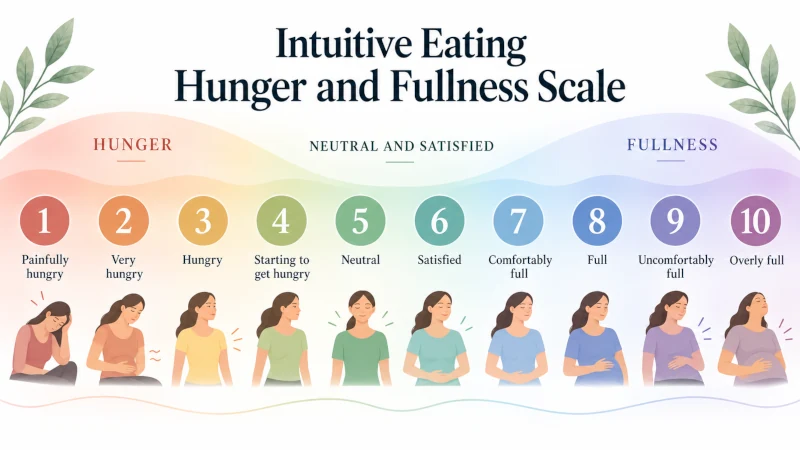
| Level | What it usually feels like |
| 1 | Painfully hungry — lightheaded, shaky, maybe headachy or irritable; food is all you can think about. |
| 2 | Very hungry — strong emptiness and low energy; you feel urgent about eating. |
| 3 | Hungry — a clear growl or hollow feeling; a calm, good time to eat. |
| 4 | Starting to get hungry — first gentle signals; you begin thinking about food. |
| 5 | Neutral — neither hungry nor full, comfortable. |
| 6 | Satisfied — pleasantly content, though you could eat a little more. |
| 7 | Comfortably full — nourished and energized, with no urge to continue. |
| 8 | Full — noticeably full, edging toward too much. |
| 9 | Uncomfortably full — heavy and bloated; you’d rather loosen your waistband. |
| 10 | Overly full — stuffed to the point of feeling unwell. |
When to eat and when to stop
There’s no “correct” number, but a gentle pattern helps most people: eat when you notice real hunger — somewhere around the lower-middle of the scale, before you tip into famished — and stop around comfortable satisfaction, before fullness turns uncomfortable. Waiting until you’re at a 1 or 2 tends to backfire; when you’re ravenous, you eat faster, past comfort, and reach for whatever’s closest [USU Extension, 2021]. Catching hunger earlier keeps you in a calmer, more deliberate relationship with food.

Fullness works the same way in reverse. Somewhere in the satisfied-to-comfortably-full range, most people feel nourished enough to last until the next meal. Some settle a little lower, some a little higher, and both are fine. The point isn’t to land on a target — it’s to notice the difference between “enough” and “too much,” which is easy to miss when you’re distracted or racing through a meal.
Physical hunger also has recognizable signs: a rumbling or hollow stomach, dipping energy, trouble concentrating, sometimes a headache [USU Extension, 2021]. Learning your own version of these is half the skill.
How to use the scale, practically
You don’t need to track every bite. Pick one meal and use it as practice.
Before you eat, pause and name your number. Are you at a gentle 3 or 4, or have you slid down to a 1? In the middle of the meal, check in again — genuinely hungry still, or approaching satisfied? When you finish, notice where you landed. Reflecting afterward matters as much as the rating: were you calmer eating at a 3 than you’d be at a 1? Did a certain meal keep you satisfied longer?

Over a week or two, patterns emerge — when hunger tends to hit, how long different meals hold you, which situations pull you toward eating when you’re not actually hungry. That awareness, not any particular score, is what the tool is for. If it starts feeling like homework or another rule to obey, that’s a signal to loosen your grip on it.
The scale is a tool, not a diet
This is the trap worth naming: the hunger scale can quietly become “the hunger diet” — a new set of rules where you’re only “allowed” to eat at a certain number and you feel guilty for eating outside it. That misses the point entirely. There are plenty of good reasons to eat that aren’t tied to a growling stomach — a shared meal, a food you love, or simply knowing your next chance to eat is hours away. Intuitive eating makes room for those. Rigidly obeying a number just rebuilds the diet mentality the approach is meant to dismantle.

If you’d like the wider context, the scale is one piece of a ten-part framework; our guide to the ten principles of intuitive eating walks through the rest.
Does it work? What the evidence shows
Honesty matters more than hype here, because the research is genuinely mixed in strength.
Fairly consistent: people who eat more intuitively tend to report better psychological health — more positive body image, higher self-esteem, and lower rates of disordered eating. A large meta-analysis found these links to be repeated across many studies [Linardon et al., 2021]. Higher intuitive eating is also associated with a lower body mass index [Van Dyke & Drinkwater, 2014].
The big caveat: most of that evidence is cross-sectional — a snapshot in time — so it shows that intuitive eating travels alongside better outcomes, not that it causes them. In that meta-analysis, roughly 89% of the studies were cross-sectional [Linardon et al., 2021]. Stronger, longer-term work is starting to fill the gap: one study following people from adolescence into young adulthood found that higher intuitive eating predicted better psychological health and less disordered eating years later [Hazzard et al., 2021].
On weight and physical health: a review of clinical studies concluded that intuitive eating supports weight maintenance rather than weight loss, along with better psychological health and possibly some improvement in markers like blood pressure and cholesterol [Van Dyke & Drinkwater, 2014]. If your goal is weight loss specifically, this is the wrong tool — and it was never designed to be that one; our explainer on why intuitive eating isn’t a weight-loss plan covers this in more depth. Trials of structured intuitive eating programs are still early and vary widely in design, so that picture is promising but not settled [Babbott et al., 2023]. For a fuller look at the upsides, see the benefits of intuitive eating.
Who should be careful — and when to get help first

For many people, learning to read hunger and fullness is safe and genuinely helpful. A few situations call for professional support first.
If you have a current or past eating disorder, bring in a professional before relying on the scale. Hunger and fullness cues can be unreliable while a disorder is active, and “eat when hungry, stop when full” can be misread by a mind still steering toward restriction — for instance, believing you have to be at a 1 before you’ve “earned” a meal.
Intuitive eating principles are used within eating-disorder treatment, but usually guided by a registered dietitian or therapist who specializes in that work. During recovery, eating on a consistent schedule — sometimes past the point of comfortable fullness — can be a necessary part of healing, which is the opposite of what the scale alone would suggest. Don’t try to self-treat an eating disorder with a website.
If you manage a condition that depends on some dietary structure — diabetes (especially on insulin), celiac disease, food allergies, chronic kidney disease, and others — you can still use hunger cues, but the medical rules come first. Coordinate the specifics with your doctor or a registered dietitian. During pregnancy and breastfeeding, nutrient needs rise and hunger can shift; eating intuitively is fine, but it’s worth working out the details with your OB or a dietitian. For children and teens, loop in a pediatrician rather than applying an adult framework as-is.
See a doctor or a registered dietitian if food, weight, or body thoughts crowd out daily life; if you’re skipping meals or restricting in ways you can’t ease up on; if you have episodes of feeling out of control with food followed by distress; if there’s any purging; or if you notice rapid weight changes, dizziness, fainting, or a missed period. In the US, the National Alliance for Eating Disorders runs a free helpline staffed by clinicians. If you’re ever in crisis or having thoughts of self-harm, call or text 988 to reach the Suicide and Crisis Lifeline.
| Health disclaimer: This article is for general education, not medical advice, diagnosis, or treatment. The intuitive eating hunger scale is an awareness tool, not a treatment for any medical or mental health condition. If you have a history of disordered eating, a medical condition that requires a specific diet, or you are pregnant or breastfeeding, talk with your doctor or a registered dietitian before making changes. Nothing here replaces personalized care from a qualified professional. If you are in crisis or thinking about self-harm, call or text 988 in the US to reach the Suicide and Crisis Lifeline. |
Frequently Asked Questions
What is the intuitive eating hunger scale?
It’s a 1-to-10 tool for rating physical hunger and fullness, where 1 is painfully hungry and 10 is uncomfortably stuffed. It helps you reconnect with your body’s signals so you can eat when you’re genuinely hungry and stop when comfortably satisfied, rather than following external diet rules.
What number should I eat at, and what number should I stop at?
There’s no single right answer, and treating it as a strict rule works against the purpose. As a gentle guide, many people find it helps to start eating when they notice real hunger — before they’re famished — and to stop around comfortable satisfaction. Where exactly that falls varies by person and by day.
Is the hunger scale a diet?
No. Turning it into rules about when you’re “allowed” to eat recreates the diet mentality intuitive eating is designed to undo. It’s meant to build awareness, not to police your eating, and there are valid reasons to eat that have nothing to do with a growling stomach.
Does intuitive eating actually have science behind it?
Some. People who eat more intuitively consistently show better body image, higher self-esteem, and less disordered eating in research [Linardon et al., 2021]. The main limitation is that most studies are snapshots in time, so they show a strong association more than proven cause and effect — though longer-term studies are beginning to support it [Hazzard et al., 2021].
Is it safe if I’ve had an eating disorder?
It can be part of recovery, but usually with a professional guiding it. Hunger and fullness signals are often unreliable while an eating disorder is active, so working with a registered dietitian or therapist who specializes in eating disorders is safer than self-directing it.
Why do I feel hungry even though I just ate?
It can happen for several reasons — eating too quickly, meals that weren’t satisfying or filling enough, or hunger that’s actually emotional rather than physical. Noticing which one is at play, without judgment, is part of what the scale helps you practice.
References
- Tribole E, Resch E. Definition of Intuitive Eating (10 Principles). The Original Intuitive Eating Website; View source
- Tylka TL, Kroon Van Diest AM. The Intuitive Eating Scale-2: Item refinement and psychometric evaluation with college women and men. Journal of Counseling Psychology. 2013;60(1):137–153. DOI 10.1037/a0030893. View source
- Van Dyke N, Drinkwater EJ. Relationships between intuitive eating and health indicators: literature review. Public Health Nutrition. 2014;17(8):1757–1766. DOI 10.1017/S1368980013002139 (PMID 23962472). View source
- Linardon J, Tylka TL, Fuller-Tyszkiewicz M. Intuitive eating and its psychological correlates: A meta-analysis. International Journal of Eating Disorders. 2021;54(7):1073–1098. DOI 10.1002/eat.23509. View source
- Hazzard VM, Telke SE, Simone M, Anderson LM, Larson NI, Neumark-Sztainer D. Intuitive eating longitudinally predicts better psychological health and lower use of disordered eating behaviors: findings from EAT 2010–2018. Eating and Weight Disorders. 2021;26(1):287–294. DOI 10.1007/s40519-020-00852-4 (PMID 32006391). View source
- Babbott KM, Cavadino A, Brenton-Peters J, Consedine NS, Roberts M. Outcomes of intuitive eating interventions: a systematic review and meta-analysis. Eating Disorders. 2023;31(1):33–63. DOI 10.1080/10640266.2022.2030124 (PMID 35400300). View source
- Utah State University Extension. Learning to Listen to Hunger and Fullness Cues; View source


