
Yes. For nearly everyone with gallstones, bananas are fine — and as fruit goes, they are one of the lower-risk things you can reach for.
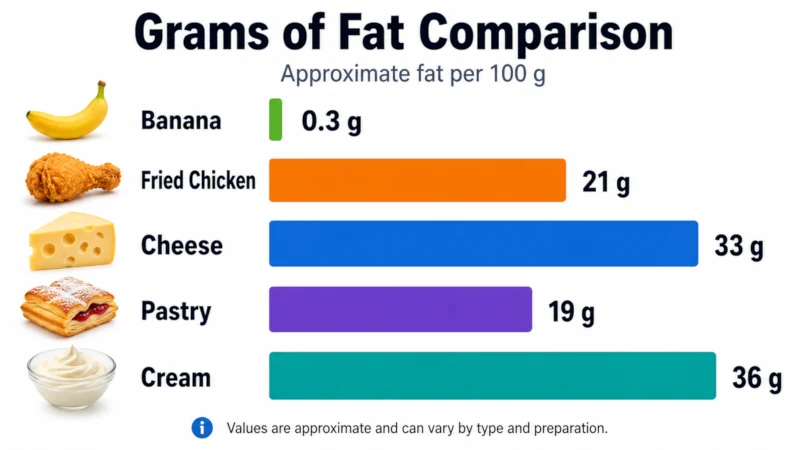
Here is the reason. A gallbladder attack happens when your gallbladder squeezes hard against a bile duct that a stone is blocking. The thing that makes it squeeze is fat. A medium banana contains essentially none — zero grams, per Harvard’s Nutrition Source [Harvard T.H. Chan Nutrition Source on bananas, 2024]. So when people ask can I eat bananas with gallstones, the honest answer is that the banana is very unlikely to be the problem. The fried egg next to it is a different question.
“Safe to eat” is not the same as “treats gallstones,” though, and a lot of writing on this topic blurs the two. This page keeps them apart.
Why fat, not fruit, sets off a gallbladder attack
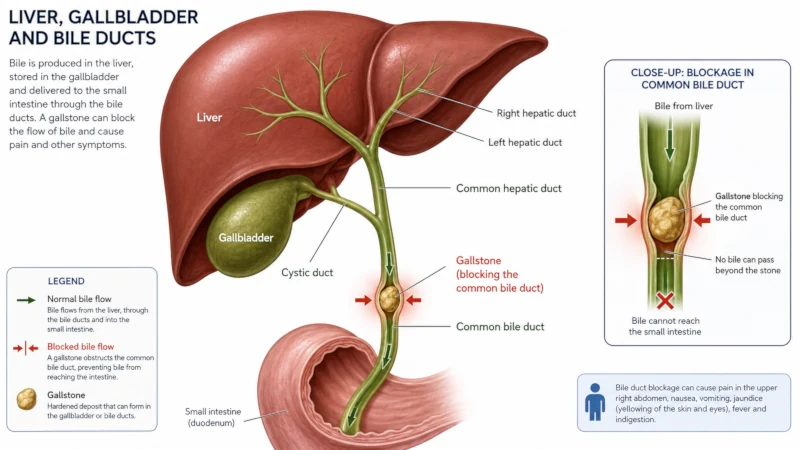
Your gallbladder sits under the liver and stores bile — the fluid that helps you digest fat [Cambridge University Hospitals NHS dietary advice for gallstones, 2025]. When a fatty meal reaches your small intestine, the gallbladder contracts to push bile out. If a stone is in the way, that contraction is what you feel: severe, constant pain under the ribs on the right side, often lasting longer than 30 minutes [NHS guidance on gallstones, 2025]. Attacks tend to follow heavy meals and commonly arrive in the evening or overnight [NIDDK on gallstone symptoms and causes, 2017].
That mechanism is the whole reason a plate of fried chicken is a plausible trigger and a banana is not.
It also explains something that surprises people: cutting fat to zero is not the goal. Dietitians at Cambridge University Hospitals say so plainly — the low-fat diet many patients are handed has little evidence behind it for everyone, and stripping fat out entirely can cause rapid weight loss and nutritional deficiencies, which create problems of their own [Cambridge University Hospitals NHS, 2025]. Fat also does something useful. It makes the gallbladder empty, and a gallbladder that does not empty is precisely where stones form.
What is actually in a banana
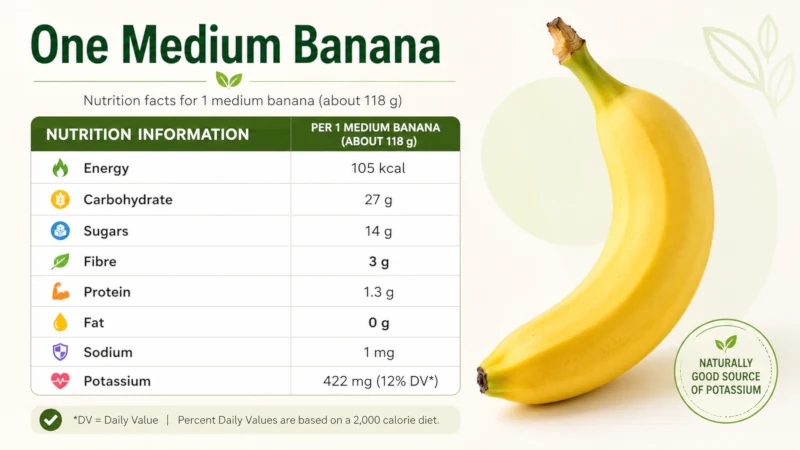
One medium ripe banana gives you roughly 110 calories, 3 grams of fibre, 28 grams of carbohydrate, 15 grams of naturally occurring sugar, about 450 mg of potassium — and no fat [Harvard T.H. Chan Nutrition Source, 2024]. If you want the fuller nutrient breakdown, we cover it separately in our guide to the benefits of eating bananas.
Ripeness changes the picture slightly. Greener bananas carry more resistant starch, a carbohydrate that behaves like fibre: it passes through the small intestine undigested and feeds bacteria in the colon [Harvard, 2024]. Ripeness also nudges the glycaemic index — about 42 for a slightly under-ripe banana and 51 for a ripe one, both in the low range [Harvard, 2024].
None of that is gallbladder-specific. A banana is simply a fat-free, moderately fibrous fruit, which is a sensible thing to be eating.
Fiber and gallstones: what the evidence supports, and what it does not
This is where banana-and-gallstone articles tend to overreach. Here is the evidence, graded honestly.
Expert guidance (strong consensus).
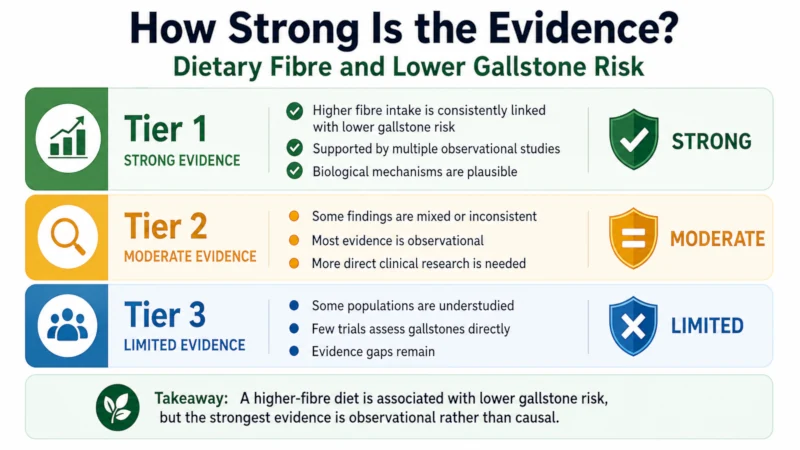
Health agencies recommend a higher-fibre diet to lower gallstone risk. NIDDK’s advice is to eat more high-fibre foods — fruit, vegetables, beans, peas and whole grains — while cutting refined carbohydrates and sugar [NIDDK on eating, diet and nutrition for gallstones, 2017]. The NHS lists “a diet that’s high in fat and low in fibre” among the things that make gallstones more likely [NHS, 2025].
Direct evidence on fiber (limited and observational).
The research tying fiber specifically to fewer gallstones is real but not strong. A 2023 case–control study in BMC Gastroenterology compared 189 people newly diagnosed with gallstone disease against 342 age-matched controls in Tehran. Those in the highest third of total fibre intake had roughly half the odds of gallstone disease compared with the lowest third (odds ratio 0.44) [Tehrani et al., BMC Gastroenterology, 2023]. The authors are careful about what that means: a case–control design cannot establish cause and effect, low-fibre diets tend to be high-fat and high-sugar diets too, so fibre cannot be isolated, and food-frequency questionnaires rely on people remembering what they ate [Tehrani et al., 2023].
Not supported.
That bananas dissolve, prevent, reverse or treat gallstones. No fruit does that. A banana contributes about 3 grams towards a day’s fibre. That is a contribution, not a cure.
How to fit bananas into a gallstone-friendly day
Eat breakfast, and eat it early
Bile made overnight is the most concentrated in cholesterol, and skipping meals reduces gallbladder emptying — which is exactly the condition under which stones form and grow [Cambridge University Hospitals NHS, 2025]. A banana with porridge is a genuinely useful breakfast here, and it takes two minutes. This is probably the single most practical thing on this page.
Watch what you put next to it
The banana is not the risk. Banana bread made with a block of butter is a different food, and so is a smoothie built on full-fat coconut cream, or a banana split. If a reaction is coming, it will come from the fat, which is also why richer takeaway meals deserve more thought than the fruit bowl does.
Keep a short food-and-symptom diary if you are unsure
Triggers vary between people. If you notice a link between fat and your symptoms, trialling a lower-fat intake is reasonable — as an experiment, not a permanent purge [Cambridge University Hospitals NHS, 2025].
Do not build the plate around one fruit
Bananas belong alongside the other foods that suit a gallstone-friendly plate and a broader gallbladder diet food list — not in place of them.
Can I eat bananas with gallstones: Who should be careful
For most people none of this applies. But bananas are a meaningful source of potassium, and potassium is not harmless for everyone.
- Chronic kidney disease. Damaged kidneys clear potassium poorly, and blood levels can climb dangerously high (hyperkalaemia) even on ordinary intakes [NIH Office of Dietary Supplements, Potassium, 2021].
- Certain blood-pressure and heart medicines. ACE inhibitors (such as benazepril), angiotensin receptor blockers (such as losartan) and potassium-sparing diuretics (such as spironolactone and amiloride) all reduce how much potassium you excrete and can push levels too high, particularly if your kidneys are already under strain [NIH ODS, 2021]. This is not a reason to fear a banana. It is a reason to ask your doctor how much potassium suits you, rather than deciding alone.
- Diabetes. Bananas are low-GI but carbohydrate-dense — 28 g in a medium fruit — and riper ones raise blood sugar faster than greener ones [Harvard, 2024]. Portion and ripeness both matter.
- Banana allergy. Uncommon, but real. If bananas make you react, nothing above applies to you.
Pregnancy and breastfeeding: bananas are ordinary food and there is no reason to avoid them. Worth knowing separately — pregnancy itself raises the risk of developing gallstones [Cambridge University Hospitals NHS, 2025]. If you are pregnant and getting upper-right abdominal pain, that is a conversation with your midwife or doctor, not a diet decision.
What actually lowers your risk of more stones
Single-food advice is popular because it is easy. The things that genuinely move the needle are duller.
- Lose weight slowly, if you need to lose it. Fast weight loss is one of the clearest risk factors there is: when you drop weight quickly or go long stretches without eating, your liver releases extra cholesterol into bile and the gallbladder stops emptying properly [NIDDK on dieting and gallstones, 2017]. Experts suggest 5–10% of your starting weight over about six months [NIDDK, 2017]. UK dietitians put a ceiling on the pace: more than about 1 kg (2 lb) a week is too fast [Cambridge University Hospitals NHS, 2025].
- Avoid crash diets and weight cycling. Losing and regaining repeatedly raises risk, and the bigger the swings, the higher the risk [NIDDK, 2017].
- Eat regular meals. Long gaps without food reduce gallbladder emptying [Cambridge University Hospitals NHS, 2025].
- Move. At least 150 minutes a week of moderate activity, plus muscle-strengthening work on two days [NIDDK, 2017].
- Build the diet around fibre, whole grains and unsaturated fats rather than fried food, pastry and sugar [NIDDK, 2017; Cambridge University Hospitals NHS, 2025].
Bananas fit inside that picture. They are not the picture.
Red flags: when to stop thinking about food and get help
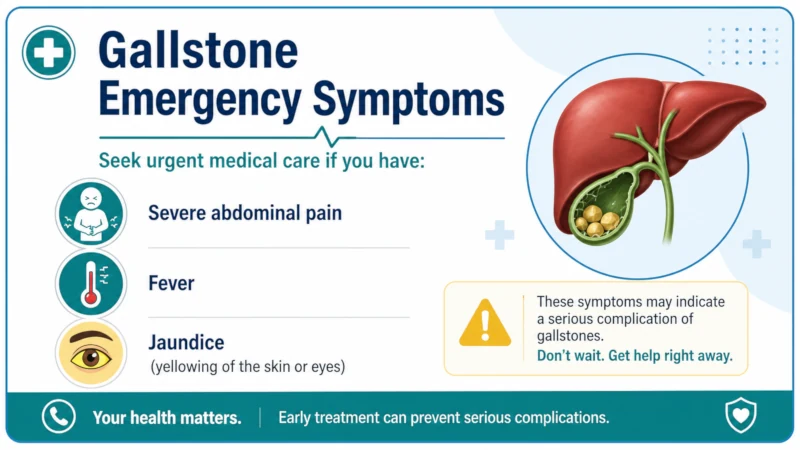
Most gallstones cause no symptoms at all, and silent stones generally need no treatment [NHS, 2025; NIDDK, 2017]. When symptoms do appear, some of them need same-day or emergency care — not a change of diet.
Call 911 (or 999 in the UK) or go to the emergency department if you have:
- sudden, severe pain in your abdomen
- pain spreading from your abdomen through to your back, with vomiting
- a very high temperature, or you feel hot, cold or shivery
- yellowing of your skin or the whites of your eyes
Contact a doctor urgently if you have:
- abdominal pain lasting more than 30 minutes, or several hours
- nausea and vomiting
- fever — even a low-grade one — or chills
- jaundice (yellowing skin or eyes)
- tea-coloured urine and pale stools
[NHS, 2025; NIDDK on symptoms and causes, 2017]
Bile ducts that stay blocked can lead to serious infection or inflammation of the gallbladder, liver or pancreas, and left untreated a blockage can be fatal [NIDDK, 2017].
No diet dissolves a stone or clears a blocked duct. Where gallstones are causing symptoms, the usual treatment is surgery to remove the gallbladder [NHS, 2025]. Food choices are about comfort and future risk. They are not a substitute for that conversation.
| Health Disclaimer: This article is for general education and is not medical advice, a diagnosis, or a treatment plan. Gallstones can cause complications that need urgent care, and no food prevents, dissolves, or treats them. Before changing your diet, starting a weight-loss plan, or adjusting how much potassium you eat — particularly if you have kidney disease, diabetes, or take blood-pressure or heart medication — talk with a doctor, pharmacist, or registered dietitian who knows your history. If you are having severe abdominal pain, fever, or yellowing of the skin or eyes, seek medical care now rather than adjusting what you eat. |
Frequently Asked Questions
Are bananas good for the gallbladder?
They are gallbladder-friendly rather than gallbladder-healing. Being fat-free, a banana does not force the gallbladder to contract, and its fibre counts towards the higher-fibre pattern health agencies recommend for lowering gallstone risk [NIDDK, 2017]. No evidence shows that bananas themselves improve gallbladder function.
Can a banana trigger a gallbladder attack?
It is unlikely. Attacks are driven by the gallbladder contracting against a blocked duct, and dietary fat is the main stimulus — a banana has none [Harvard, 2024; Cambridge University Hospitals NHS, 2025]. Triggers do vary between individuals, so if bananas reliably upset you, a food-and-symptom diary is the way to find out.
How many bananas can I eat a day if I have gallstones?
There is no gallstone-specific limit, and no research setting one. One or two a day is unremarkable for most people. The exception is potassium: if you have kidney disease or take an ACE inhibitor, an ARB or a potassium-sparing diuretic, ask your doctor how much potassium is appropriate for you [NIH ODS, 2021].
Are green bananas better than ripe ones for gallstones?
There is no evidence either way for gallstones specifically. Ripeness changes resistant-starch content and how quickly blood sugar rises [Harvard, 2024], which matters for blood sugar, not for bile. Eat whichever you tolerate and enjoy.
Can I still eat bananas after gallbladder removal?
Yes. After a cholecystectomy most people digest normally, and there is no evidence that a low-fat diet is needed afterwards — a healthy, balanced diet is what is advised [Cambridge University Hospitals NHS, 2025]. If you develop persistent diarrhoea after surgery, tell your doctor, as it is treatable once diagnosed.
References
- National Institute of Diabetes and Digestive and Kidney Diseases (NIDDK). “Eating, Diet, & Nutrition for Gallstones.” NIH, last reviewed November 2017. View source
- National Institute of Diabetes and Digestive and Kidney Diseases (NIDDK). “Symptoms & Causes of Gallstones.” NIH, last reviewed November 2017. View source
- National Institute of Diabetes and Digestive and Kidney Diseases (NIDDK). “Dieting & Gallstones.” NIH, last reviewed November 2017. View source
- NHS. “Gallstones.” nhs.uk, page last reviewed 11 August 2025. View source
- Cambridge University Hospitals NHS Foundation Trust, Nutrition and Dietetics. “Dietary advice for patients with gallstones or inflammation of the gallbladder.” Document 31701, v6, approved 4 September 2025. View source
- Harvard T.H. Chan School of Public Health, The Nutrition Source. “Bananas.” Updated November 2024. View source
- Tehrani AN, Saadati S, Yari Z, et al. “Dietary fiber intake and risk of gallstone: a case–control study.” BMC Gastroenterology. 2023;23:119. DOI 10.1186/s12876-023-02752-0. PMID 37041462. PMCID PMC10091554. View source
- National Institutes of Health, Office of Dietary Supplements. “Potassium: Fact Sheet for Consumers.” Updated 22 March 2021. View source
