
If you’ve landed here, you probably already know the feeling: another diet started with good intentions, worked for a while, then quietly fell apart — and somehow that felt like your fault. The laws of intuitive eating are a way out of that loop. They’re ten principles for eating based on your body’s own signals of hunger, fullness, and satisfaction instead of a rulebook someone else wrote.
A quick note on the word “laws.” Most people search for it, so it’s worth using plainly, but the two registered dietitians who built this framework, Evelyn Tribole and Elyse Resch, call them principles — guidelines, not commandments. They introduced the approach in 1995, and it has since grown into a weight-inclusive, research-studied model with its own validated measurement scale (intuitiveeating.org, 2024). There’s no passing or failing here, which is rather the point.
What intuitive eating actually is
Intuitive eating is a non-diet approach to food. Rather than counting, restricting, or labeling foods “good” and “bad,” you relearn how to notice and trust internal cues — the same cues most of us are born with and slowly tune out after years of dieting (intuitiveeating.org, 2024). It is explicitly not a weight-loss plan, and it doesn’t ask you to earn or compensate for what you eat.
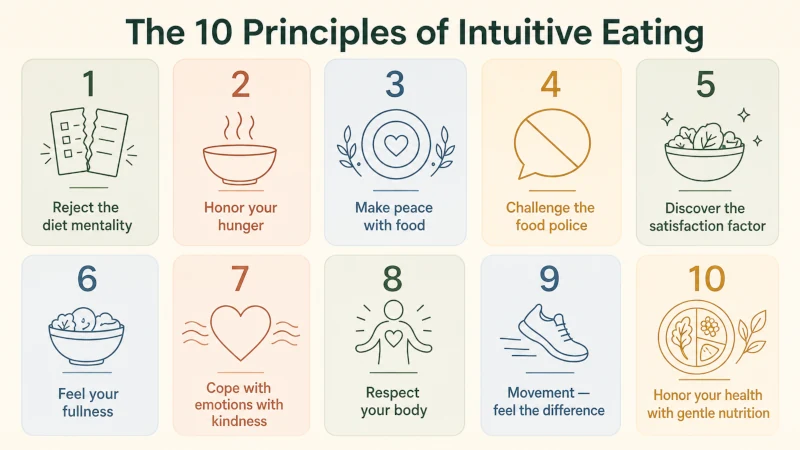
The framework is built from ten principles. Some clear away the mental clutter that drowns out body signals — diet rules, guilt, the running commentary about what you “should” eat. Others help you tune back in to hunger and fullness. Here they are, one at a time.
The 10 laws of intuitive eating
1. Reject the diet mentality
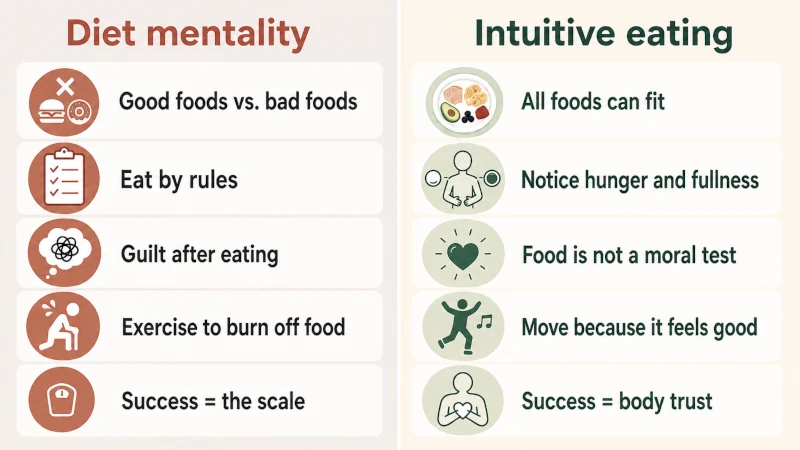
The first principle asks you to let go of the belief that the right diet is still out there, waiting to finally work. That hope is what keeps the cycle spinning. Dieting sets up an all-or-nothing frame, so the moment you deviate, it reads as failure — and the shame that follows tends to drive the next binge, not the next healthy choice (intuitiveeating.org, 2024). Rejecting the diet mentality means naming those rigid rules and stepping off the treadmill.
2. Honor your hunger
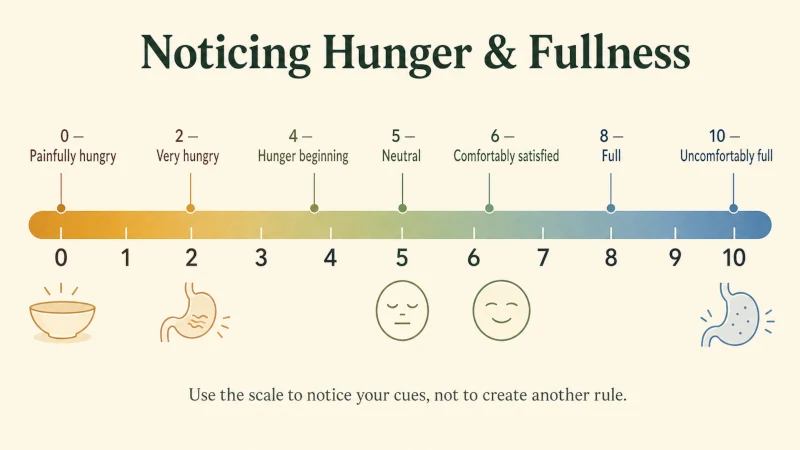
Hunger is not the enemy, and it’s not a test of willpower. It’s a biological signal that your body needs energy. When you keep yourself adequately fed, you stay in a calm, reasonable relationship with food. Wait until you’re ravenous, though, and good intentions tend to evaporate — you eat fast, past comfort, and grab whatever’s closest. Learning to catch that first, gentle hunger cue is where trust with your own body starts to rebuild.
3. Make peace with food
Diets create “forbidden” foods, and forbidden foods create cravings. Give yourself unconditional permission to eat the things you enjoy, and the frantic quality usually fades. It sounds counterintuitive, but the drive to overeat a food often comes from the deprivation, not the food itself. When nothing is off-limits, a cookie becomes just a cookie.
4. Challenge the food police
The “food police” is that internal voice calling you good for eating a salad and bad for eating dessert — plus its external echoes, the comments from other people about what’s on your plate. This principle is about noticing those judgments and refusing to let a food choice become a verdict on your character. More self-compassion, fewer indictments.
5. Discover the satisfaction factor
Here’s a pleasure most diets erase: actually enjoying your food. When you eat something you like, in a setting you find pleasant, and pay attention while you do it, satisfaction arrives — and satisfaction is part of what tells you you’ve had enough. Eating on autopilot tends to leave you vaguely unsatisfied and reaching for more.
6. Feel your fullness
Fullness has its own quiet signal, and it’s easy to miss if you’re distracted or racing to finish. This principle is about pausing mid-meal to check in: Am I still hungry? Comfortably satisfied? Recognizing that “enough” point also helps loosen the grip of the clean-your-plate rule many of us absorbed as kids.
7. Cope with your emotions with kindness
Eating for comfort is human, and the goal isn’t to swear it off. But food can’t actually resolve anxiety, loneliness, boredom, or anger — it only pauses them. The work of this principle is building a wider set of tools so food isn’t the only one you reach for. Movement, rest, connection, and simple practices like guided breathing or meditation apps can all take some of the load. If emotional eating is your sole coping strategy, that’s worth gently addressing rather than shaming.
8. Respect your body
You can’t fully make peace with food while at war with your body. Respecting your body means treating it decently regardless of the number on the scale — feeding it, moving it, resting it, and managing stress in ways that help you feel okay. Bodies come in different sizes, and the aim is to work with yours rather than force it toward a shape it was never going to hold.
9. Movement — feel the difference
Notice the shift here: move because it feels good, not to burn off a meal. When exercise stops being punishment, you’re free to pick what you actually like — walking, dancing, swimming, lifting — and to value how it makes you feel day to day. That reframe is usually what makes movement stick.
10. Honor your health with gentle nutrition
Intuitive eating is not anti-nutrition. The last principle folds in the reality that food choices affect how you feel and function. “Gentle” is the operative word: you generally choose foods that satisfy your body and your taste buds, most of the time, without demanding perfection. One meal, or one week, doesn’t make or break your health. If you want ideas for building satisfying meals, browsing practical foods and nutrition content is a fine place to start — as an addition to the other nine principles, not a replacement for them.
Does intuitive eating actually work? What the research shows
This is where honesty matters more than enthusiasm, because the evidence is genuinely mixed in strength.
Reasonably consistent: Across the research, people who eat more intuitively tend to have better psychological health — more positive body image, higher self-esteem, and lower rates of disordered eating. A large meta-analysis found these associations to be robust and repeated across studies (Linardon et al. meta-analysis, 2021). Higher intuitive eating is also linked to a lower body mass index, and it shows promise as a protective factor against the onset of eating-disorder symptoms.
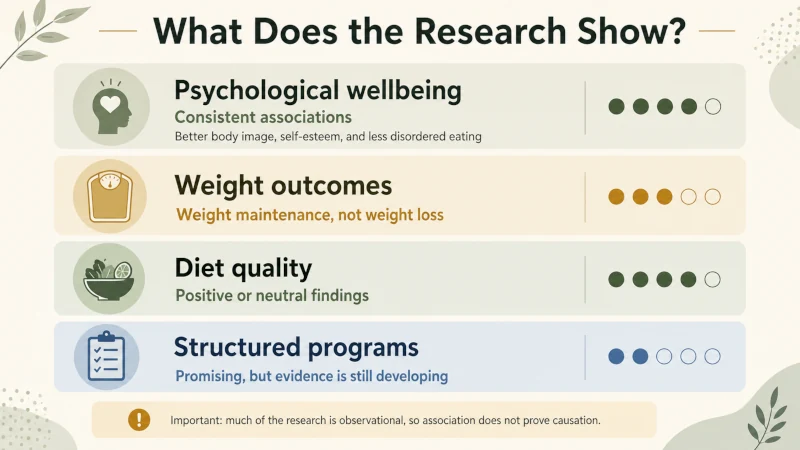
A meaningful limitation: Most of that evidence is cross-sectional — a snapshot in time — so it can show that intuitive eating travels alongside better outcomes, but not that it causes them. In that same meta-analysis, roughly 90% of the studies were cross-sectional (Linardon et al., 2021). That’s the single biggest caveat to keep in mind.
On weight and physical health: A review of clinical studies concluded that adopting intuitive eating tends to support weight maintenance rather than weight loss, along with better psychological health and possibly some improvement in markers like blood pressure and cholesterol — though not necessarily more physical activity (Van Dyke & Drinkwater review, 2014). If your goal is weight loss specifically, intuitive eating is the wrong tool, and it never claimed to be that one.
On diet quality: A systematic review of intuitive eating programs (14 studies, about 3,960 participants) found every study reported a positive or neutral effect on diet quality — reassuring evidence that eating this way doesn’t send nutrition off a cliff (Warner et al. systematic review, 2022).
On structured programs: The trials testing intuitive eating interventions are still early and vary a lot in design, so the picture there is promising but not yet settled (Babbott et al. review, 2023). Translation: encouraging signals, more rigorous studies needed.
What to realistically expect
Because this isn’t a diet, there’s no before-and-after arc and no finish line. Most people describe it as slow relearning — quieting years of rules enough to hear hunger and fullness again. Progress is uneven, and “messing up” isn’t a concept that applies, since there’s nothing to blow. You can start with a single principle rather than overhauling everything at once. What tends to shift first is the mental noise around food; changes in how you actually eat usually follow from there.
Who should be careful — and when to get help first
Intuitive eating is safe and helpful for many people, but a few situations call for professional support before or instead of going it alone.
If you have a current or past eating disorder, this is a place to bring in a professional. Intuitive eating principles are used within eating-disorder treatment, but usually guided by a registered dietitian or therapist who specializes in that work — because hunger and fullness cues can be unreliable while a disorder is active, and “unconditional permission to eat” needs a clinical scaffold in that context. Don’t attempt to self-treat an eating disorder with a website.
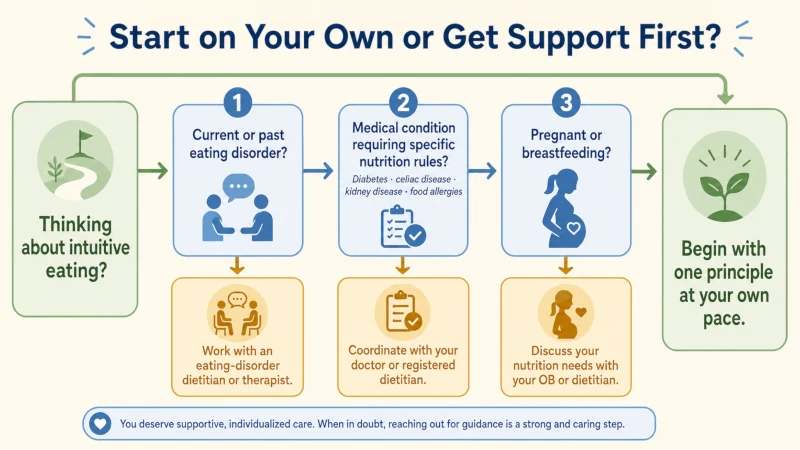
If you manage a condition that depends on some dietary structure — type 1 or type 2 diabetes (especially on insulin), celiac disease, food allergies, chronic kidney disease, or others — the “gentle nutrition” principle still leaves room for the medical rules you need. Intuitive eating’s own framework carves out restrictions that exist for genuine medical reasons. Coordinate the specifics with your doctor or a registered dietitian.
During pregnancy and breastfeeding, nutritional needs rise, and certain nutrients matter more. You can absolutely eat intuitively, but it’s worth working the details out with your OB or a dietitian. And for children and teens, feeding approaches differ; loop in a pediatrician rather than applying an adult framework as-is.
Signs it’s time to see a doctor or a registered dietitian: thoughts about food, weight, or your body that crowd out daily life; skipping meals or rigid restriction you can’t ease up on; episodes of feeling out of control with food followed by distress; any purging behavior; rapid weight changes; dizziness, fainting, or a missed period. For eating-disorder concerns, the National Alliance for Eating Disorders runs a free helpline staffed by clinicians. If you’re ever in crisis or having thoughts of self-harm, call or text 988 in the US to reach the Suicide and Crisis Lifeline.
| Health Disclaimer: A note before you start. This article is for general education, not medical advice, diagnosis, or treatment. Intuitive eating is a food and behavior framework, not a treatment for any medical or mental health condition. If you have a history of disordered eating, a medical condition that requires a specific diet, or you’re pregnant or breastfeeding, talk with your doctor or a registered dietitian before making changes. Nothing here replaces personalized care from a qualified professional. If you’re in crisis or thinking about self-harm, call or text 988 in the US to reach the Suicide and Crisis Lifeline. |
Frequently Asked Questions
Are they called the laws or the principles of intuitive eating?
The creators, dietitians Evelyn Tribole and Elyse Resch, call them the ten principles and describe them as flexible guidelines rather than rules. “Laws” is just the phrase many people use when searching. Either way, they’re meant as a framework to explore, not a checklist to pass.
Is intuitive eating a weight-loss plan?
No. It’s a weight-inclusive approach focused on your relationship with food and your body. Clinical research links it more to weight maintenance than to weight loss, so if losing weight is your specific goal, this isn’t designed to deliver that.
Does intuitive eating actually have science behind it?
Some. People who eat more intuitively consistently show better body image, higher self-esteem, and less disordered eating in the research. The big caveat is that most studies are snapshots in time rather than long-term trials, so they show a strong association more than proven cause and effect.
Is it safe if I’ve had an eating disorder?
It can be part of recovery, but usually with a professional guiding it. Hunger and fullness signals can be unreliable while an eating disorder is active, so working with a registered dietitian or therapist who specializes in eating disorders is the safer path than self-directing it.
Where should I start with ten principles?
Pick one. Many people begin with rejecting the diet mentality or honoring their hunger, because those tend to loosen the mental rules that make everything else harder. You don’t need to work on all ten at once.
Won’t giving myself permission to eat anything mean I only eat junk?
That’s the common fear, and the research is reassuring: across intuitive-eating programs, diet quality stayed neutral or improved rather than declining. The intense pull toward “forbidden” foods usually fades once they stop being forbidden.
References
- Tribole E, Resch E. Definition of Intuitive Eating / 10 Principles of Intuitive Eating. The Original Intuitive Eating Website; accessed 2026. → View source
- Linardon J, Tylka TL, Fuller-Tyszkiewicz M. Intuitive eating and its psychological correlates: A meta-analysis. International Journal of Eating Disorders. 2021. DOI 10.1002/eat.23509. → View source
- Van Dyke N, Drinkwater EJ. Relationships between intuitive eating and health indicators: literature review. Public Health Nutrition. 2014;17(8):1757–1766. DOI 10.1017/S1368980013002139. → View source
- Warner M, D’Arcy A, Utter J, et al. Intuitive Eating Intervention and Diet Quality in Adults: A Systematic Literature Review. Journal of Nutrition Education and Behavior. 2022. DOI 10.1016/j.jneb.2022.08.008. → View source
- Babbott KM, Cavadino A, Brenton-Peters J, Consedine NS, Roberts M. Outcomes of intuitive eating interventions: a systematic review and meta-analysis. Eating Disorders. 2023;31(1):33–63. DOI 10.1080/10640266.2022.2030124. → View source
