
Stand barefoot on a hard floor and look at the inside of your foot. If there is little to no visible gap between the arch and the ground, you may have flat feet.
At the simplest level, flat feet means the arch on the inner side of the foot is very low or absent when you stand. The medical term is pes planus. In some people, the sole of the foot nearly touches the ground from heel to forefoot. In others, the arch is present but much lower than average. [1][2]
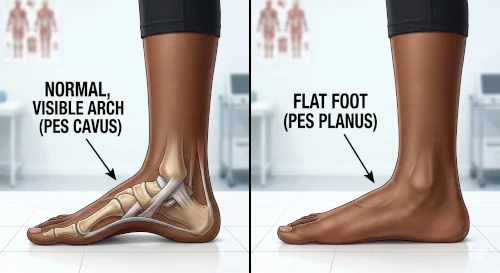
That sounds straightforward, but there is an important nuance here: flat feet are not always a problem. Many people have low arches and no pain, no walking difficulty, and no need for treatment. Others develop symptoms only when the foot becomes overstressed, the arch collapses over time, or the structures supporting the foot stop doing their job well enough. [1][2]
This article explains what flat feet are, what the term actually means, the different types, the most common symptoms, and the main causes. If you want the broader overview, start here next: Flat Feet & Fallen Arches: Causes, Symptoms, and What Helps
What does “flat feet” actually mean?
Flat feet refers to the structure of the foot, specifically the height of the inner arch.
In a foot with a more visible arch, the inside edge curves upward off the ground. In a flat foot, that curve is much smaller or disappears altogether when weight is placed on the foot. Cleveland Clinic describes flat feet as a condition in which the soles of the feet can touch the floor when standing, while the NHS describes it as a common condition where the feet press flat on the ground. [1][2]
Your arches are not just cosmetic. They help your feet absorb force, adapt to uneven surfaces, and distribute weight while walking. That is why a change in arch shape can sometimes affect comfort and movement. [2]
Still, a flatter arch does not automatically mean something is wrong. The NHS is very clear that flat feet are common, usually harmless, and rarely a sign of anything serious. [1]
Flat feet vs. fallen arches
These terms are related, but they are not perfect synonyms.
Flat feet can describe a foot that has always been low-arched. A person may have had flatter feet since childhood and function perfectly well.
Fallen arches usually suggests something slightly different: an arch that has dropped or collapsed over time, especially in adulthood. That distinction matters because a foot that has always been flat is not the same as a foot that is actively changing shape and becoming painful. [2][3]
So if you are asking, “What are flat feet?” the answer is broad. It includes people who were simply born with lower arches, as well as people who developed a flattening arch later in life. But when someone says they have “fallen arches,” it often points more toward the second group. [2][3]
Are flat feet always a problem?
No. This is the most important thing to understand before you start assuming you need orthotics, special shoes, or some kind of treatment plan.
Many people with flat feet never experience pain at all. Their feet work well, they stay active, and their low arches never become a medical issue. Both the NHS and Cleveland Clinic note that flat feet often cause no symptoms and may not need any treatment if they are not causing problems. [1][2]
Flat feet tend to matter more when they are associated with things like:
- foot pain after walking or standing
- ankle pain or swelling
- the foot rolling inward too much
- a visible change in the shape of the arch over time
- activity becoming more uncomfortable than it used to be [1][2][3]
That is why the right question is not just, “Do I have low arches?” It is, “Are my feet comfortable, stable, and functioning well?”
The main types of flat feet
Flat feet are not one single condition. There are several different patterns, and understanding them helps make the topic much less confusing.
Flexible flat feet
This is the most common type.
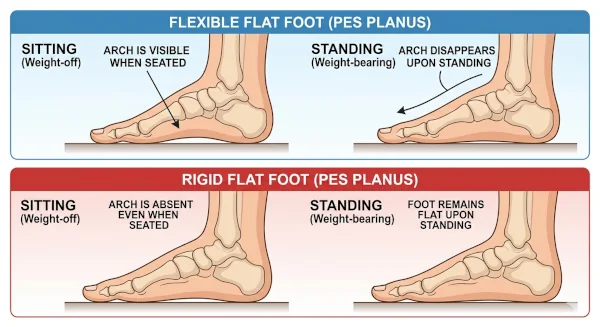
With flexible flat feet, the arch may be visible when you sit down, lift the foot, or stop bearing weight. But when you stand, the arch flattens. Cleveland Clinic notes that this is a very common presentation and may or may not cause symptoms. [2]
For many people, flexible flat feet are simply a structural variation rather than a serious problem.
Rigid flat feet
With rigid flat feet, the foot remains flat whether you are standing or sitting. Cleveland Clinic notes that this type is less common and may affect the foot’s range of motion more noticeably. [2]
This type is generally more clinically significant than flexible flat feet because it is less adaptable and may be linked to underlying structural problems.
Flat feet from childhood
Some people simply grow up with flatter feet.
Oxford University Hospitals notes that most young children have flat feet early on and that most develop a visible arch as they grow. A smaller group does not, and those flatter feet can persist into adulthood. [4]
In many cases, these lifelong low arches are not a problem unless they become painful or interfere with activity.
Adult-acquired flatfoot
This is the type many adults are most concerned about.
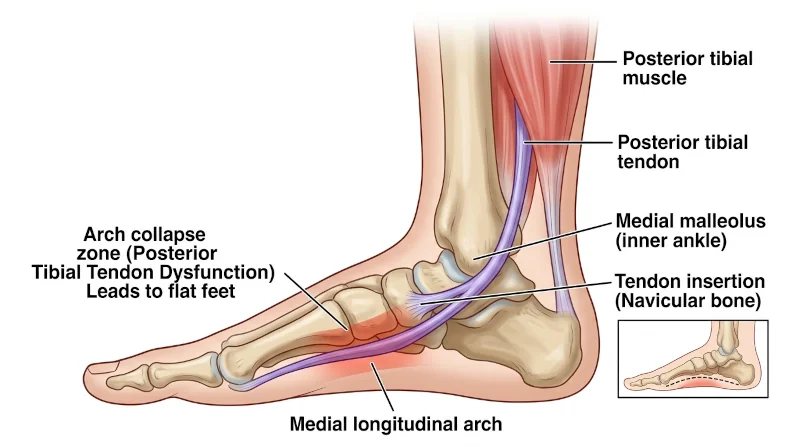
In adult-acquired flatfoot, the arch becomes flatter over time rather than having always been that way. AAOS explains that this often begins with dysfunction of the posterior tibial tendon, which helps support the arch during walking. If that tendon becomes inflamed, overstretched, or damaged, the arch can start to collapse. [3]
This is one of the key reasons it is helpful to distinguish “flat feet” from “fallen arches.” A lifelong flat foot and a progressively collapsing foot are not the same situation.
Flat Feet and Fallen Arches: Causes, Symptoms, and What Helps
What symptoms can flat feet cause?
Some people with flat feet never notice any symptoms at all. Others start to feel discomfort gradually, especially with longer walks, more time on their feet, or changes in activity.
Common symptoms can include:
- aching along the arch or inner foot
- pain around the inside of the ankle
- foot fatigue that builds through the day
- the foot appearing to roll inward while walking
- shoes wearing unevenly
- discomfort with longer periods of standing or walking
- swelling near the inner ankle in more symptomatic cases [1][2][3]
The Cleveland Clinic notes that ankle pain and shin splints can also show up when flat feet are associated with overpronation or altered walking mechanics. [2]
In more advanced adult-acquired cases, AAOS notes that pain can also develop on the outside of the ankle as alignment changes over time. [3]
That does not mean every ache in the foot or leg is caused by flat feet. It just means low arches can sometimes be one part of a larger movement or tendon issue.
What causes flat feet?
There is no single cause. Some people have flatter feet simply because of the way their feet developed. Others develop fallen arches later in life as the structures supporting the arch become weaker, more strained, or injured.
One of the most important causes of adult-acquired flatfoot is posterior tibial tendon dysfunction. AAOS explains that the posterior tibial tendon helps support the arch and stabilize the foot during movement. When it becomes inflamed, stretched, or torn, the arch may begin to collapse. [3]
Other contributors can include:
- inherited foot structure
- ligament laxity
- prior foot or ankle injury
- repeated strain over time
- obesity
- diabetes
- high blood pressure
- inflammatory arthritis or other chronic joint conditions [2][3]
Cleveland Clinic also notes that certain chronic diseases and connective tissue problems may increase the risk of developing flat feet or make the condition harder to manage. [2]
The main point is that “flat feet” is a description, not a single diagnosis. The reason a person has flat feet can differ a lot from one case to another.
Flat feet and overpronation: a quick distinction
This article is mainly about what flat feet are, so this only needs a short explanation.
Flat feet describes foot shape.
Overpronation describes motion.
Overpronation means the foot rolls inward too much during walking or running. Cleveland Clinic defines it as a gait pattern rather than a structural label. [5]
The two often occur together, but not always. A person can have flat feet without major overpronation, and someone can overpronate without having severe arch collapse.
When flat feet may need more attention
Most flat feet do not need treatment. But some patterns are worth paying attention to.
It is a good idea to consider medical evaluation if you notice:
- new or worsening pain
- swelling along the inner ankle
- one foot flattening more than the other
- a clear change in foot shape over time
- difficulty with everyday walking or standing
- symptoms that do not improve with basic self-care and better footwear [1][2][3]
This matters especially if the arch seems to be actively collapsing rather than simply being low.
AAOS emphasizes that progressive collapsing foot deformity can worsen over time if the underlying cause is not addressed. [3]
Flat feet means the inner arch of the foot is low or absent when standing. In many people, that is simply a normal structural variation and never causes problems. [1][2]
But flat feet is a broad term. It can describe a lifelong low arch, a flexible flat foot that only appears under weight, or an adult-acquired collapsing arch linked to tendon dysfunction. That is why the term alone does not tell you everything. [2][3]

Flat Feet and Fallen Arches: Causes, Symptoms, and What Helps
Frequently Asked Questions
What are flat feet?
Are flat feet the same as fallen arches?
Are flat feet normal?
They can be. Many people have flat feet without pain or disability, and the NHS notes that flat feet are common and usually nothing to worry about. [1]
What causes flat feet in adults?
References
- [1] NHS. Flat feet. https://www.nhs.uk/conditions/flat-feet/
- [2] Cleveland Clinic. Flat Feet (Pes Planus): Types, Symptoms & Treatment. https://my.clevelandclinic.org/health/diseases/flat-feet-pes-planus
- [3] American Academy of Orthopaedic Surgeons (AAOS). Progressive Collapsing Foot Deformity (Flatfoot). https://orthoinfo.aaos.org/en/diseases–conditions/posterior-tibial-tendon-dysfunction/
- [4] Oxford University Hospitals. Flat Foot. https://www.ouh.nhs.uk/paediatricorthopaedics/information/conditions/flat-foot/
- [5] Cleveland Clinic. Overpronation: What It Is, Causes & Treatment. https://my.clevelandclinic.org/health/diseases/22474-overpronation
