
Your arches look lower than they used to. Your feet are tired by the end of the day, the inside of one ankle aches after a long walk, or your shoes are wearing down unevenly. If that sounds familiar, flat feet may be part of the picture — but a low arch is not automatically something to fix. Plenty of people have flat feet and fallen arches and never need any treatment at all. The NHS describes flat feet as common and usually nothing to worry about.
The more useful question isn’t “Are my arches low?” It’s “Are my feet comfortable, stable, and handling daily life?” A foot that has always been flat and feels fine is a very different situation from an arch that is slowly dropping and starting to hurt. This page walks through both — what these terms mean, which symptoms are worth attention, why arches fall in adulthood, and what actually helps when they do.
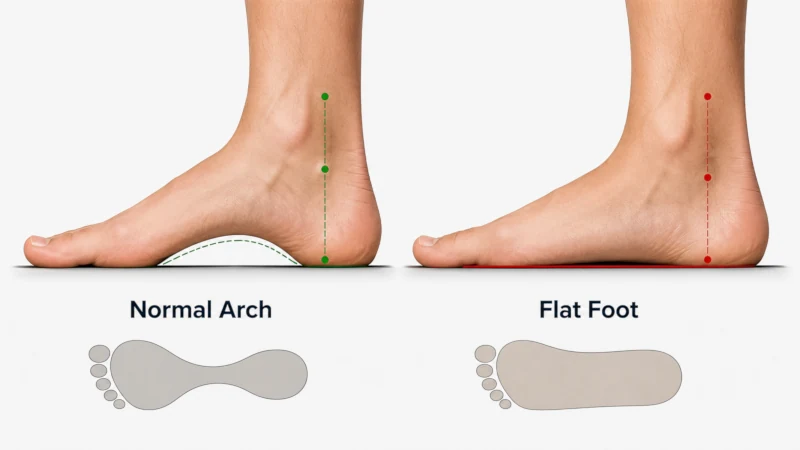
What flat feet and fallen arches actually mean
Flat feet means the arch on the inside of your foot is very low or absent when you stand. The medical name is pes planus. Cleveland Clinic describes it as having little-to-no arch in the sole, so the sole may touch the floor when you stand.
“Fallen arches” is a closely related term, and it’s often used as a plain-English synonym for flat feet — the NHS uses the two interchangeably. In everyday use, though, “fallen arches” tends to carry a slightly more specific meaning: an arch that has dropped over time, usually in adulthood, rather than one you’ve always had. Cleveland Clinic groups this acquired form under the name progressive collapsing foot deformity, previously called adult-acquired flatfoot. The distinction matters, and it runs through the rest of this article.
Your arch isn’t just there for appearance. It acts as a springboard and shock absorber, stores and releases energy as you walk, and helps your foot adapt to uneven ground. But arch height on its own doesn’t tell you whether a foot is healthy. A flatter foot can work perfectly well. Chelsea and Westminster Hospital NHS Foundation Trust puts it plainly: a flat or low-arched foot is not considered abnormal, and the height of the arch has no bearing on how well a foot can function. If you want a fuller breakdown of the different types and how they form, this companion guide on what flat feet are and their main types goes deeper.
Are flat feet always a problem?
No — and this is the single most important thing to take from the page, because a lot of people assume a low arch automatically needs correcting.
Someone can have low arches and still walk normally, exercise comfortably, feel no pain, and need no treatment whatsoever. The NHS notes that flat feet should not stop you doing any activity, including sports, and are rarely a sign of anything serious. Cleveland Clinic makes the same point: many people with flat feet have no symptoms and need no treatment.
Flat feet start to matter more when the low arch comes with other signs — pain after walking or standing, swelling near the inner ankle, the foot rolling inward more than it should, a visible change in foot shape, or symptoms that keep getting worse instead of staying stable. Both Cleveland Clinic and AAOS note that some types of flatfoot can keep progressing, which is why a changing arch deserves more attention than a stable, lifelong one.
Symptoms worth paying attention to
Many people never notice a thing. For others, discomfort builds gradually — usually with longer walks, more standing, or a jump in activity.
The most common symptoms are aching in the arch or along the inner foot, pain or swelling near the inside of the ankle, foot fatigue that builds through the day, shoes wearing unevenly, the foot appearing to roll inward as you walk, and discomfort that eases with rest but returns with activity. AAOS describes pain in the arch or along the inside of the foot and ankle, sometimes with swelling along the tendon, and difficulty walking or standing for long periods.
There’s one shift worth knowing about. As an acquired flatfoot progresses and the heel drifts outward, AAOS notes that pain can move to the outside of the ankle, where the heel bone starts pressing against the outer ankle bone. Pain crossing from the inner to the outer ankle is a sign the alignment is changing, not just that the arch is low.
None of these symptoms proves that flat feet are the culprit. They’re useful clues that your foot mechanics may be worth a closer look.
Lifelong flat feet vs. arches that fall over time
Some people have simply always had low arches. Oxford University Hospitals notes that most young children have flat feet as a normal part of development, and while over 95% grow an arch, a small number keep flatter feet into adulthood — most of them without pain or limitation. A stable, lifelong flat foot is often completely harmless.
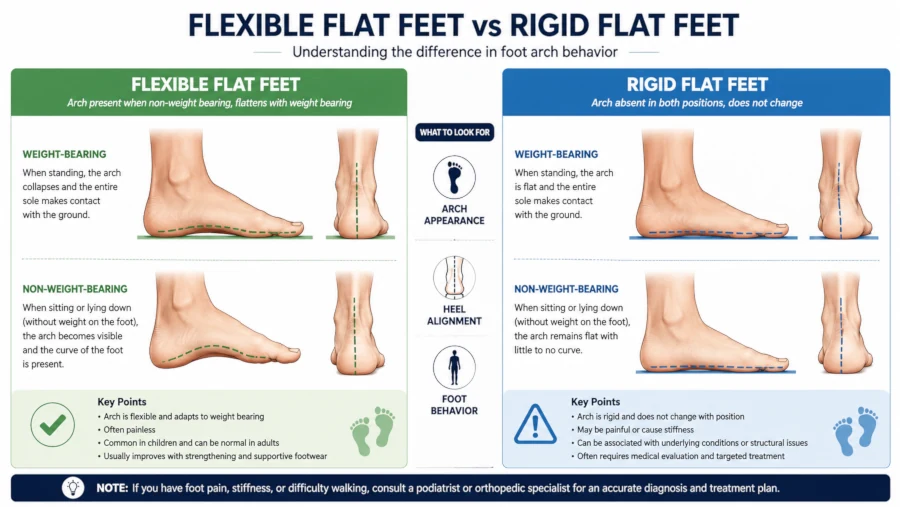
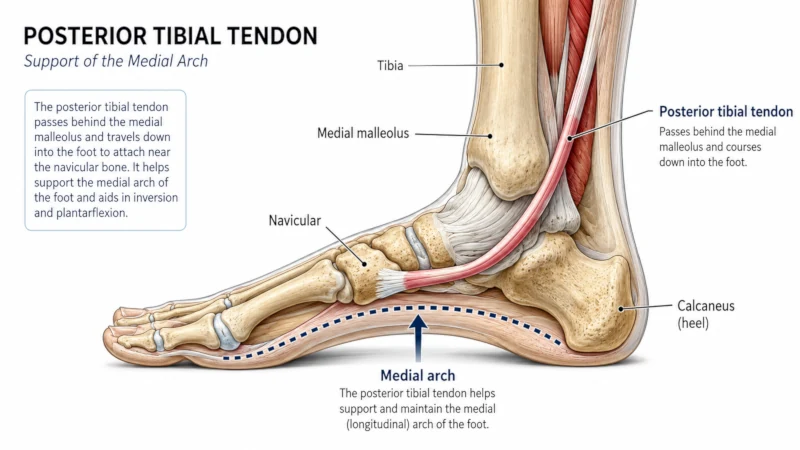
Others develop fallen arches later in life, and that pattern deserves more attention, because the arch isn’t just low — it’s changing. AAOS explains that progressive collapsing foot deformity most commonly begins with dysfunction of the posterior tibial tendon, an important structure that supports the arch during walking; when that tendon becomes inflamed or torn, the arch can begin to collapse. A foot that’s actively flattening, weakening, or becoming painful may need help sooner than one that has looked the same your whole life.
What causes fallen arches in adults?
There’s no single cause. In many adults, the structures that hold the arch up stop handling load as well as they used to.
The most important single cause is posterior tibial tendon dysfunction. AAOS describes how, as this tendon becomes inflamed and weak, it can no longer hold up the arch; the arch begins to sag, putting extra stress on other supporting structures such as the spring ligament, which can start a worsening cycle.
Several factors raise the risk or contribute alongside it. AAOS lists that posterior tibial tendon dysfunction and flatfoot are more common in women and in people over 40, with additional risk factors including obesity, diabetes, and high blood pressure, as well as acute injury or repetitive overuse from high-impact activity. Ligament laxity and prior foot or ankle injury can play a part too. Pregnancy is another period when the arch can flatten more, partly through the changes it brings to how the foot loads.
Inflammatory arthritis is a distinct route to the same result. AAOS explains that in rheumatoid arthritis the ligaments supporting the midfoot weaken and the arch collapses, with the front of the foot commonly turning outward.
The takeaway: “fallen arches” isn’t one diagnosis. It’s usually the visible result of an underlying tendon, ligament, or joint issue that’s worth understanding in context.
Flat feet vs. overpronation: structure vs. movement
These two terms get used as if they’re the same thing. They aren’t. Flat feet describes the shape of your foot. Overpronation describes how your foot moves.
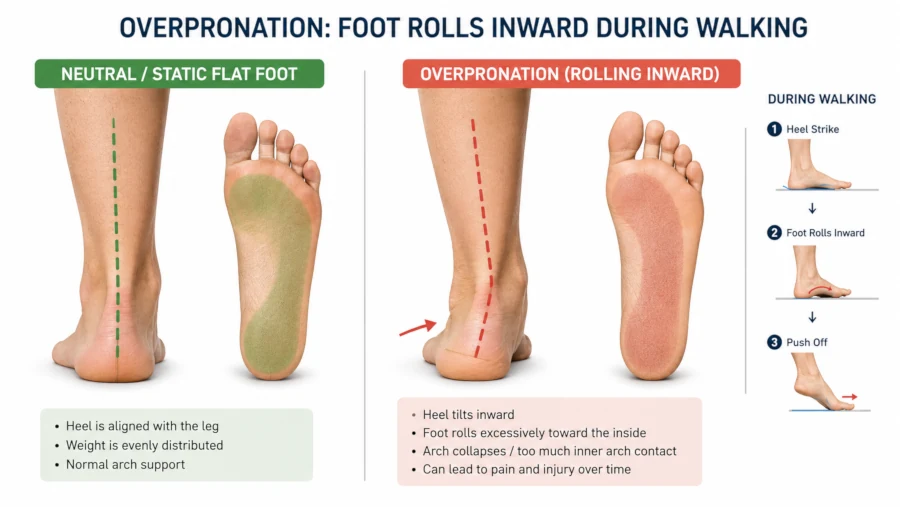
Cleveland Clinic defines overpronation as a gait pattern in which the arches flatten more than they normally would as you walk or run, putting strain on the muscles, tendons, and ligaments that support the arch. People with flat feet are more likely to overpronate, and Cleveland Clinic notes that those with slightly flattened feet are more prone to it — but the two aren’t interchangeable, and you can have one without the other. This companion piece on how flat feet and overpronation differ and overlap covers that overlap in more detail.
The reason it matters is practical. The goal usually isn’t to “rebuild” a visible arch. More often it’s to reduce excess motion, distribute load better, and make standing and walking feel easier — which is a different aim, addressed with different tools.
Can flat feet contribute to heel, ankle, or leg pain?
Yes, but the relationship isn’t simple.
When the arch is low or collapsing, the foot absorbs and transfers force differently. Cleveland Clinic notes that flat feet can lead to foot pain, ankle pain from overpronation, and shin splints from overcompensating. Heel pain is one of the most common related complaints, and the connection makes anatomical sense: the plantar fascia is the band of tissue that supports the arch, and AAOS lists flat feet (or a high arch) among the anatomical factors that make plantar fasciitis more likely.
Inner-ankle pain can point to an overloaded posterior tibial tendon, and — as noted earlier — pain can shift toward the outer ankle in more advanced cases as alignment changes.
What flat feet do not automatically explain is every case of knee, hip, or back pain. Cleveland Clinic does describe how altered foot mechanics and overpronation can contribute to pain further up the chain, including the knees, hips, and lower back — but “can contribute to” is not “is the cause of.” Pain higher up the body usually needs a broader assessment rather than being pinned on the feet alone.
What actually helps when flat feet hurt
If your flat feet are painless, you may not need to do anything. Both the NHS and Cleveland Clinic note that flat feet without symptoms often need no treatment. When symptoms do appear, conservative care is almost always the starting point.
Supportive footwear
This is often the simplest first move. The NHS suggests wide, comfortable shoes with a low heel and a soft insole when flat feet are causing pain — with the honest caveat that these ease symptoms rather than reshape the foot.
Orthotics and arch supports
Orthotic inserts can support foot position, reduce strain, and improve comfort for many people. Cleveland Clinic lists flat feet among the conditions orthotics are used for, and notes they manage symptoms rather than treat the underlying condition; if you stop using ones that help, symptoms may return.
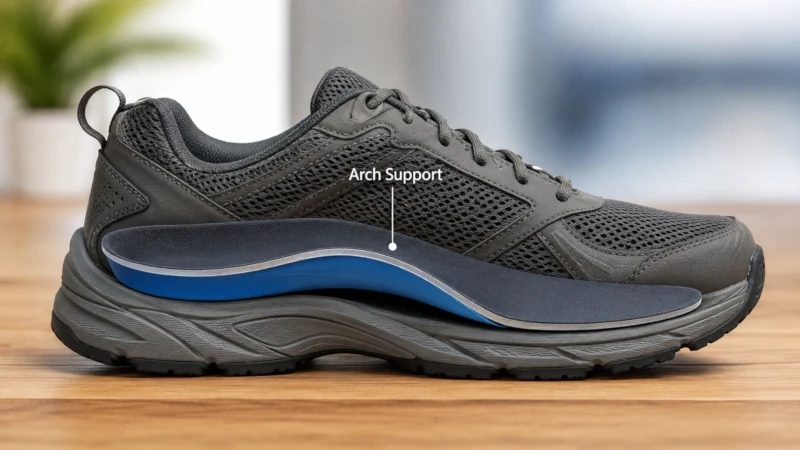
Here’s where honesty matters more than marketing. The evidence that orthotics actually correct adult flat feet is limited. Cleveland Clinic states directly that research on orthotics for treating flat feet in adults shows a lack of evidence, with none of the reviewed studies clearly indicating that orthoses work for flat feet — though the studies also show inserts don’t cause harm. In other words: they’re a reasonable, low-risk way to feel more comfortable and distribute load, but don’t expect them to rebuild an arch. Oxford University Hospitals makes the same point about the structure itself — insoles don’t change the shape of the foot.
Exercises and physical therapy
Strengthening and stretching can help when weakness, tightness, or tendon overload are part of the problem. AAOS’s foot and ankle conditioning program includes stretching and strengthening for the calf, posterior tibialis, peroneal muscles, and plantar fascia. A structured set of targeted foot and ankle exercises is a sensible starting point for mild, flexible flat feet — with realistic expectations, since these build support and comfort rather than restructure a fully collapsed arch.
Physical therapy is especially worth it if the arch seems to be changing, pain is persistent, or you’re not sure whether the real issue is strength, tendon overload, gait, or footwear. AAOS notes that physical therapy to strengthen the tendon, along with calf and Achilles stretching, is part of treatment for milder posterior tibial tendon disease.
Activity, weight, and load
Sometimes the most effective change is reducing the load on the foot. AAOS notes that decreasing or switching from activities that worsen the pain — moving to low-impact options like biking, an elliptical, or swimming — is a useful first step, and that weight loss is an effective way to take stress off the arch and its supporting structures.
When medical or surgical care is needed
This isn’t the first step for most people, but severe or rigid deformity sometimes needs specialist care. Cleveland Clinic and AAOS both note that some advanced cases require more than conservative management — and AAOS is candid that surgery for flatfoot is usually complex, with most patients still noticing some limitation afterward, which is one reason conservative care is tried thoroughly first.
Red flags: when to see a podiatrist or doctor
A low arch on its own is usually not urgent. Some patterns, though, are worth getting evaluated — sooner rather than later.
Make an appointment if you notice new or worsening pain, swelling on the inside of the ankle, one foot becoming flatter than the other, a visible change in foot shape, difficulty rising onto your toes on one foot, pain shifting to the outside of the ankle, or symptoms that aren’t improving with better shoes and basic self-care. The NHS advises seeing a GP if your feet are painful, stiff, weak or numb, if you often get foot or ankle injuries, if you have problems walking or with balance, if you did not have flat feet before, or if only one foot is affected.
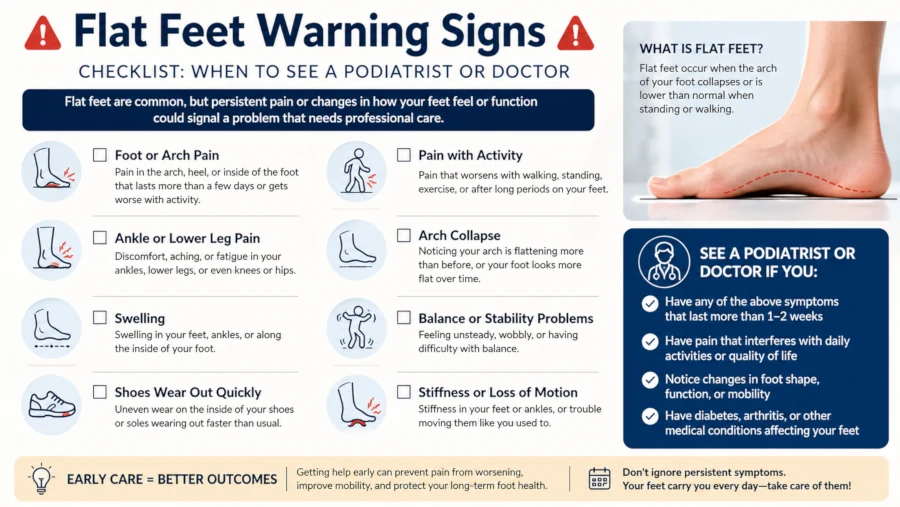
Some situations deserve prompt rather than routine attention. Sudden heel or arch pain after a fall or a “pop” sensation can signal a tendon rupture or fracture and shouldn’t be self-treated. Redness, warmth, swelling, or fever in the foot needs medical evaluation. And if you have diabetes, treat any new foot change, swelling, or deformity as a reason to be seen quickly rather than to wait — Cleveland Clinic notes that diabetes-related nerve damage can lead to the breakdown of bones in the foot and collapse of the arch (Charcot foot), and reduced sensation can hide a developing problem.
AAOS emphasizes that a progressive collapsing flatfoot can worsen over time if the underlying cause isn’t addressed, so a changing arch with inner-ankle pain deserves more attention than a lifelong flat foot that has never caused trouble.
Flat feet and fallen arches are common, and many people will never need treatment. What matters is whether the foot is painful, changing over time, tiring unusually fast, or affecting how you walk and stand. If your feet feel stable and comfortable, you may not need to do much at all. If they’re hurting, collapsing, or limiting you, supportive shoes, orthotics for comfort, targeted exercises, and the right evaluation can help you work out what’s actually going on and what to do next.
| Health Disclaimer: This article is for general education and is not a substitute for professional medical advice, diagnosis, or treatment. Flat feet and fallen arches vary widely from person to person, and a low arch is not the same as a foot problem. Do not rely on a static look at your arch — or on an online article — to rule a problem in or out. If you have foot, ankle, heel, knee, hip, or back pain that is persistent, worsening, or affecting how you walk, or if you notice sudden pain after an injury, swelling, redness, warmth, numbness, or a rapid change in foot shape, see a podiatrist, physical therapist, or doctor. If you have diabetes or reduced sensation in your feet, seek evaluation promptly for any new foot change rather than self-treating. |
Frequently Asked Questions
Are flat feet and fallen arches the same thing?
Often, yes — the terms are used interchangeably, and the NHS treats them as synonyms. In everyday use, “fallen arches” tends to lean toward an arch that has dropped over time, especially in adulthood, while “flat feet” can describe lifelong low arches too. Cleveland Clinic groups the acquired form under progressive collapsing foot deformity.
Do flat feet always need treatment?
No. Many people have flat feet without pain or functional limitation and need no treatment, according to both the NHS and Cleveland Clinic. Treatment becomes relevant when there’s pain, instability, or a changing arch.
What causes arches to fall in adulthood?
The most common cause is dysfunction of the posterior tibial tendon, which supports the arch. AAOS also lists obesity, diabetes, high blood pressure, injury, and age (over 40) as contributing factors, and rheumatoid arthritis can weaken the midfoot ligaments and collapse the arch as well.
Can flat feet cause plantar fasciitis?
They can be one contributing factor. AAOS lists flat feet (or a high arch) among the anatomical factors that make plantar fasciitis more likely, because the plantar fascia supports the arch. Heel pain has several possible causes, so it’s worth assessing in context rather than assuming.
Do orthotics fix flat feet?
Not exactly. They can improve comfort and help distribute load, but the evidence that they correct adult flat feet is limited. Cleveland Clinic notes that research shows a lack of clear evidence that orthoses treat flat feet, though inserts don’t appear to cause harm, and Oxford University Hospitals notes that insoles don’t change the shape of the foot. They manage symptoms rather than rebuild an arch.
What usually helps painful flat feet?
Supportive footwear, orthotics for comfort, targeted exercises, physical therapy, and reducing load on the foot are the common starting points. The NHS, Cleveland Clinic, and AAOS all describe supportive shoes, insoles, foot exercises, activity modification, and — for advanced cases — specialist care.
References
- NHS. Flat feet. National Health Service (UK). Reviewed 24 June 2025. View source
- Cleveland Clinic. Flat Feet (Pes Planus): Types, Symptoms & Treatment. Reviewed 17 November 2024. View source
- American Academy of Orthopaedic Surgeons (OrthoInfo). Progressive Collapsing Foot Deformity (Flatfoot). View source
- Chelsea and Westminster Hospital NHS Foundation Trust. Treating the Flat Foot. View source
- Oxford University Hospitals NHS Foundation Trust. Flat Foot (Paediatric Orthopaedics). View source
- American Academy of Orthopaedic Surgeons (OrthoInfo). Rheumatoid Arthritis of the Foot and Ankle. View source
- Cleveland Clinic. Overpronation: What It Is, Causes & Treatment. Reviewed 1 March 2022. View source
- American Academy of Orthopaedic Surgeons (OrthoInfo). Plantar Fasciitis and Bone Spurs. View source
- Cleveland Clinic. Orthotics: Definition, Risks, Benefits, Types & Tips. Reviewed 26 August 2024. View source
- American Academy of Orthopaedic Surgeons (OrthoInfo). Foot and Ankle Conditioning Program. View source
