
If your feet ache after a long day, your arches sit low, and you want to know whether exercise will fix them — here is the honest answer. Foot and calf exercises can reduce pain and make standing and walking more comfortable. They will not rebuild your arch. Those are two different promises, and only one of them is supported by good evidence.
That distinction matters more than any single movement. A network meta-analysis of ten randomised controlled trials in adults with flatfoot found that both exercise and orthotics reduced pain significantly, while neither realigned foot posture. Exercise alone, or exercise combined with orthotics, outperformed orthotics on their own. [Hoang et al. network meta-analysis, 2021] The NHS makes the same point in plainer language: stretches, exercises and insoles will not change the shape of your feet, but they can help with pain and stiffness. [NHS guidance on flat feet, 2025]
So the goal of the best exercises for flat feet in adults is not a higher arch. It is a foot that tires less, an ankle that feels steadier, and a calf that stops dragging load through your heel. Below are nine exercises worth your time, what each one is actually for, and how to tell when you should stop exercising and get assessed instead.
Best exercises for flat feet in adults: What These Exercises Can and Cannot Do
Adults with flat feet fall into two broad groups, and they respond very differently.
The first group has always had low, flexible arches. The arch may appear when the foot is off the ground and flatten under body weight. This is common and often simply structural. [Cleveland Clinic, 2024] Many people in this group never develop pain at all. [NHS guidance on flat feet, 2025]
The second group develops arch collapse in adulthood. AAOS now calls this progressive collapsing foot deformity, formerly known as adult-acquired flatfoot or posterior tibial tendon dysfunction. It typically begins when the posterior tibial tendon — the main dynamic support for the arch — becomes inflamed or torn and can no longer hold the arch up. Left alone, it can progress from a subtle deformity with mild symptoms to a painful, poorly functioning foot. [AAOS OrthoInfo on progressive collapsing foot deformity]
Home exercise is reasonable for the first group and for early, mild symptoms in the second. It is not a substitute for assessment when the arch is actively changing shape.
For a fuller breakdown of the types and how they differ, see What Are Flat Feet? Causes, Types, and Common Symptoms.
How strong is the evidence, honestly?
Worth grading, because the research is uneven.
- Reasonably strong: exercise reduces pain in adults with flatfoot. This is the most consistent finding across trials. [Hoang et al. network meta-analysis, 2021]
- Mixed and genuinely disputed: whether exercise changes arch position at all. The 2021 network meta-analysis of ten RCTs found no treatment affected navicular drop. A 2022 meta-analysis of six RCTs did find a statistically significant reduction — but of about 0.23 mm, with high statistical heterogeneity between trials. Half of those six trials were rated high risk of bias and none were rated low risk. A fifth of a millimetre is a real result and a clinically negligible one. [Huang et al. meta-analysis, 2022]
- Limited: evidence that these exercises visibly thicken foot muscles. Pooled across trials, the short-foot exercise produced no significant difference in muscle size versus comparison groups. [Huang et al. meta-analysis, 2022]
- Expert guidance rather than trial data: most of the specific exercise prescriptions below. AAOS supports physical therapy that strengthens the tendon for mild posterior tibial tendon disease, and calls calf and Achilles stretching an important part of any flatfoot therapy programme, but does not specify sets and repetitions. [AAOS OrthoInfo on progressive collapsing foot deformity]
The trials also skew young. In the 2022 meta-analysis, participants averaged between roughly 19 and 44 years old, and no trial included anyone over 50. If you are older than that, the findings are a reasonable starting point rather than a direct match. [Huang et al. meta-analysis, 2022]
Who These Exercises Suit
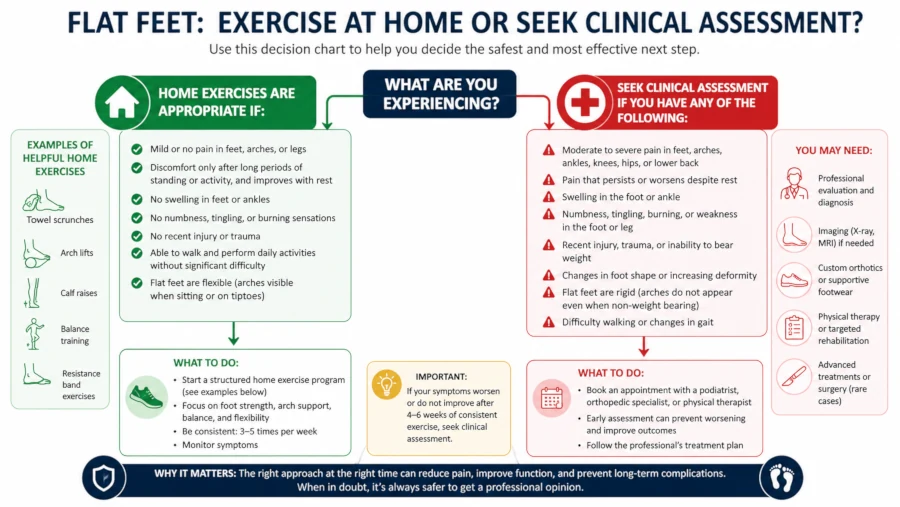
A home programme is a sensible first step if you:
- have flexible flat feet with mild or recent discomfort
- get foot fatigue after long periods standing or walking
- notice arch aching that settles with rest
- want to build foot strength before increasing activity
- have already been assessed and want a structured routine
If overpronation is part of your picture, the distinction is worth understanding, because the two are often confused and call for slightly different work — see Flat Feet vs Overpronation: What’s the Difference?.
Stop and Get Assessed First If You Notice Any of These
Some symptoms point to tendon damage or structural change that needs imaging and clinical management, not a home programme.
- Pain at the inner ankle or along the arch that is sharp, worsening or persistent — this is the course of the posterior tibial tendon. [AAOS OrthoInfo on progressive collapsing foot deformity]
- Swelling behind or below the inner ankle bone. [AAOS OrthoInfo on progressive collapsing foot deformity]
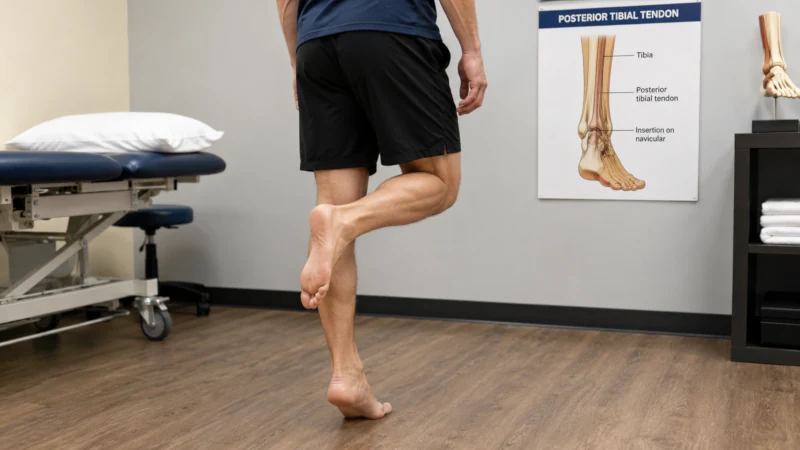
- Difficulty rising onto tiptoe on one leg. AAOS treats a failed single-limb heel rise as a specific sign of posterior tibial tendon problems. [AAOS OrthoInfo on progressive collapsing foot deformity]
- A visible change in foot shape, or one foot flattening more than the other. [NHS guidance on flat feet, 2025]
- Feet that are stiff, weak or numb, or problems with walking or balance. [NHS guidance on flat feet, 2025]
- Pain that does not ease with rest.
In the UK you may be able to refer yourself to a podiatrist without seeing a GP first. [NHS guidance on flat feet, 2025]
The Nine Exercises
These are grouped by what they are actually for. If you only have time for three, do the short-foot exercise, heel raises and the calf stretch — they cover arch activation, load tolerance and the calf tightness that drives so much of this.
Group 1 — Arch and intrinsic foot muscles
1. Short Foot Exercise (Arch Doming)
The most studied of the group. It targets the intrinsic muscles supporting the medial longitudinal arch without recruiting the long toe flexors. In the trial most often cited for it, 28 adults with pes planus were split into two groups: both wore foot orthoses for eight weeks, and one group added the short-foot exercise twice daily. The added exercise group showed greater gains. [Jung et al., 2011] Note the comparison — this was orthoses plus exercise versus orthoses alone, not exercise versus nothing.
How to do it
- Sit or stand with the foot flat on the floor.
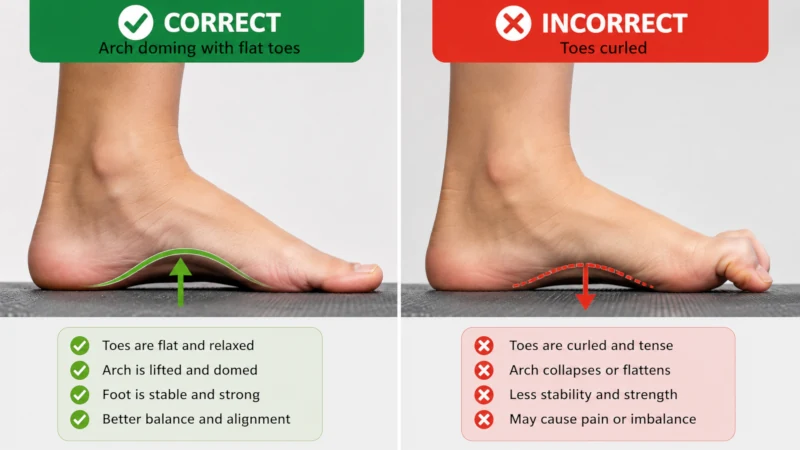
- Without curling your toes, draw the ball of the foot gently toward the heel so a small dome forms under the arch.
- Hold 5–10 seconds, then release fully.
- Progress from seated, to standing on both feet, to standing on one.
Common mistakes: curling the toes, which switches the work to the long toe flexors; pressing hard through the big toe.
Safety note: this is a skill before it is a strength exercise. Most people cannot feel it for the first week or two. That is normal.
Frequency: daily; 2–3 sets of 10 holds per foot.
2. Towel Curls
A simpler way into the same muscle group, and easier to feel than arch doming. Foot muscles that work harder tend to fatigue less over a long day, though the direct trial evidence for towel curls specifically is thinner than for the short-foot exercise. [Huang et al. meta-analysis, 2022]
How to do it
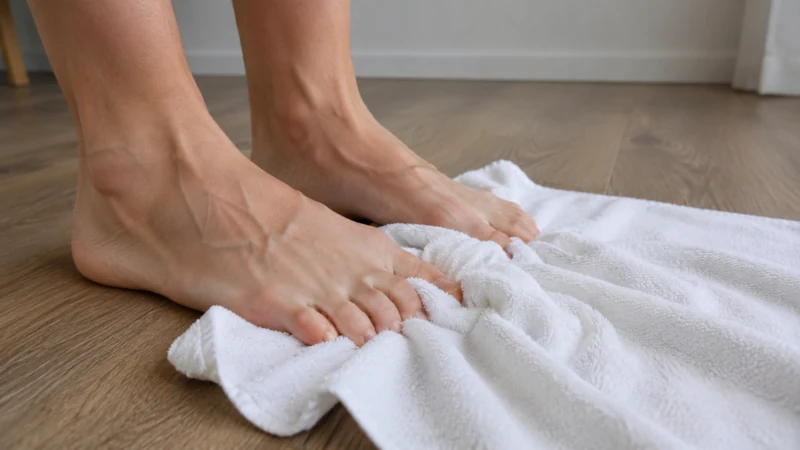
- Sit with a small towel laid flat in front of you.
- Place a bare foot on the towel, heel anchored to the floor.
- Scrunch your toes to draw the towel toward you.
- Release and repeat.
Common mistakes: lifting the heel; rushing the curl instead of controlling it.
Safety note: cramping in the arch is common early on. Cut the repetitions and build up.
Frequency: daily; 2–3 sets of 10.
3. Toe Spreading and Toe Yoga
Years in narrow shoes leave most adults with poor voluntary control of individual toes. Restoring that control is a reasonable aim, and toe-based exercises appear in flatfoot training protocols, though this one is the least directly evidenced of the nine. Treat it as useful preparation rather than a proven intervention.
How to do it
- Sit with feet flat on the floor.
- Spread all toes as wide as you can, then relax.
- Then lift only the big toe, keeping the others down.
- Reverse it — lift the four small toes, keep the big toe down.
Common mistakes: tensing the whole leg instead of isolating the foot.
Frequency: daily; 2–3 sets of 10.
4. Marble Pickup
A functional variation on towel curls that adds a grip-and-release demand. Useful for variety and for keeping the routine interesting; no strong trial evidence separates it from the exercises above.
How to do it
- Scatter 10–15 marbles beside a small bowl.
- Seated, use only the toes and sole to lift each marble into the bowl.
- Switch feet.
Common mistakes: angling the whole leg rather than working from the foot.
Frequency: 2–3 times per week; 2 sets per foot.
Group 2 — The calf and posterior tibialis
This group matters more than most flat-feet articles suggest. AAOS notes that upward ankle motion is often limited in flatfoot, and attributes that restriction directly to calf tightness. [AAOS OrthoInfo on progressive collapsing foot deformity] A tight calf changes how load passes through the arch and heel with every step.
5. Standing Calf Stretch (Straight Leg)
Stretching the calf and Achilles is described by AAOS as an important part of any therapy programme for flatfoot. [AAOS OrthoInfo on progressive collapsing foot deformity] It is also the exercise most people skip.
How to do it
- Stand facing a wall, hands flat at shoulder height.
- Step one foot back about two to three feet.
- Keep the back knee straight and the back heel pressed down.
- Lean forward until you feel a stretch through the back calf.
- Hold 30 seconds, then swap sides.
Common mistakes: letting the back heel lift, which removes the stretch entirely.
Safety note: stretch to tension, never to pain.
Frequency: daily; 2–3 holds of 30 seconds per side.
6. Heel Raises
Strengthens the calf complex and loads the posterior tibialis progressively. The single-leg version doubles as a self-check — being able to rise onto tiptoe on one leg requires a healthy posterior tibial tendon. [AAOS OrthoInfo on progressive collapsing foot deformity]
How to do it
- Stand with feet hip-width apart, a wall or counter within reach.
- Rise slowly onto the balls of both feet.
- Hold 1–2 seconds at the top.
- Lower under control, taking longer to come down than to go up.
- Progress to single-leg raises once ten controlled double-leg reps feel easy.
Common mistakes: bouncing up, dropping down, or letting the feet roll outward at the top.
Safety note: pain along the inner ankle during or after this exercise is a reason to stop and get assessed, not to push through.
Frequency: three times per week; 3 sets of 10–15.
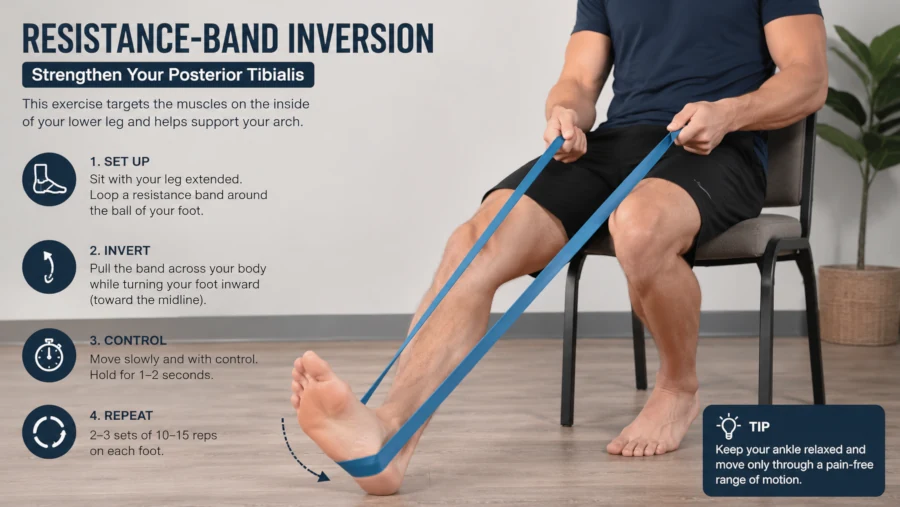
7. Resistance-Band Inversion
Directly targets the posterior tibialis, the primary dynamic support of the medial arch. Strengthening it is central to physical therapy for early posterior tibial tendon disease. [AAOS OrthoInfo on progressive collapsing foot deformity]
How to do it
- Anchor a resistance band at floor level.
- Sit with the band looped around the top of the foot, foot turned slightly outward.
- Pull the foot inward against the band, slowly.
- Return slowly — the lowering half is where most of the benefit sits.
Common mistakes: starting with too heavy a band; turning the whole leg instead of the foot and ankle.
Safety note: skip this exercise entirely if you have an active or suspected tendon injury, or inner-ankle swelling, until you have been assessed. AAOS notes that a cortisone injection into this tendon is generally avoided because of rupture risk — it is a structure worth treating carefully.
Frequency: three times per week; 3 sets of 15.
Group 3 — Balance and ankle mobility
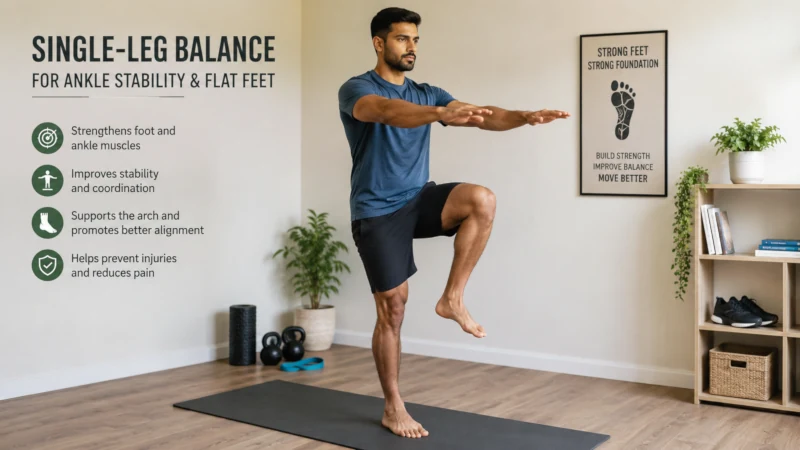
8. Single-Leg Balance
Trains the ankle to control position under load. Flat feet are associated with ankle instability and a higher rate of sprains, which makes balance work a sensible inclusion. [Cleveland Clinic, 2024]
How to do it
- Stand near a counter for safety.
- Lift one foot slightly off the ground.
- Hold 20–30 seconds, keeping the standing foot from rolling inward.
- Progress by closing your eyes or standing on a cushion.
Common mistakes: gripping the floor hard with the toes instead of balancing through the whole foot.
Safety note: keep a hand within reach of support until you are steady.
Frequency: daily; 2–3 holds of 20–30 seconds per side.
9. Ankle Circles and Dorsiflexion
Restricted upward ankle motion is common in flatfoot and traces back to calf tightness. [AAOS OrthoInfo on progressive collapsing foot deformity] This pairs with the calf stretch rather than replacing it.
How to do it
- Seated, lift one foot slightly off the floor.
- Draw ten slow, large circles in each direction.
- Then flex the foot upward as far as comfortable, hold 2 seconds, release. Repeat 10–15 times.
Common mistakes: moving only the toes rather than the ankle joint.
Frequency: daily; 10–15 repetitions each direction.
A Weekly Routine You Will Actually Follow
Nine exercises daily is a plan most people abandon in a fortnight. Split them by load instead.
| Frequency | Exercises |
| Daily (low effort) | Short foot / arch doming · Calf stretch · Ankle circles · Single-leg balance |
| 3× per week (progressive load) | Heel raises · Resistance-band inversion · Towel curls or marble pickup |
Start with two exercises if foot-specific training is new to you. Add the rest over two to three weeks. Consistency does more here than intensity.
How long before anything changes?
Be realistic, and be sceptical of confident timelines. Most trials in this area ran between four and eight weeks. Some found effects by four to six weeks, though the benefit did not keep growing with longer programmes, and the authors note there is no agreed protocol for how long training should continue. [Huang et al. meta-analysis, 2022]
If you are dealing with early posterior tibial tendon symptoms rather than simple fatigue, expect a longer horizon. AAOS is direct about this: pain can last longer than three months even with early treatment, and for people who have had symptoms for many months, another six months of discomfort after starting treatment is not unusual. [AAOS OrthoInfo on progressive collapsing foot deformity] Anyone promising a fortnight’s transformation is selling something.
If you use insoles, keep using them. Exercise and orthotics work through different mechanisms — active muscular support versus passive load distribution — and the evidence suggests the combination beats orthotics alone. [Hoang et al. network meta-analysis, 2021]
Safety, Side Effects, and Who Should Be Careful
These are low-risk movements, but low-risk is not no-risk.
- Common, harmless effects: arch cramping during towel curls and marble pickup, calf soreness for a day or two after heel raises, and frustration with arch doming before it clicks.
- Stop and seek advice if: pain increases during or after the exercise rather than settling, inner-ankle swelling appears, or your balance is getting worse rather than better.
- Skip resistance-band inversion and single-leg heel raises if you have inner-ankle swelling, a known or suspected posterior tibial tendon tear, or cannot currently rise onto tiptoe on that leg.
- Rigid flat feet — where the foot stays flat sitting and standing, and side-to-side movement is limited — are managed differently from flexible flat feet. Get the type confirmed before committing to a programme. [Cleveland Clinic, 2024]
- Diabetes or reduced sensation in the feet: check with your care team first. Reduced sensation means you may not feel a developing blister or strain during barefoot work.
- Pregnancy: ligament laxity and weight change during pregnancy can lower the arch, and balance shifts as pregnancy progresses. The seated exercises are generally reasonable; do single-leg balance work with a hand on a support, or skip it. There is no trial evidence on these exercises in pregnancy, so raise it with your midwife or doctor rather than assuming.
- Falls risk or unsteadiness: do balance work beside a counter, never alone in an open room.
Weight also matters mechanically. AAOS lists obesity among the risk factors for progressive collapsing foot deformity and notes that reducing load is an effective way to take stress off the arch. [AAOS OrthoInfo on progressive collapsing foot deformity] That is a statement about mechanics, not a judgement.
When to See a Podiatrist, Physiotherapist, or Doctor
Book an appointment if you have:
- pain that worsens with exercise, or shows no change after four to six weeks of consistent effort
- swelling along the inner ankle or heel
- a sense of the ankle giving way during ordinary activity
- new or rapid change in the shape of your foot
- frequent foot or ankle injuries, or problems with walking and balance [NHS guidance on flat feet, 2025]
A podiatrist or orthopaedic specialist can establish whether your flat feet are flexible or rigid, whether the tendon is involved, and whether orthotics, supervised therapy or imaging make more sense than a self-directed routine. AAOS notes that most patients in the early stages are treated successfully without surgery. [AAOS OrthoInfo on progressive collapsing foot deformity]
For the wider picture including causes and non-exercise management, see Flat Feet and Fallen Arches: Causes, Symptoms, and What Helps.
| Health Disclaimer: This article is for general information only. It is not medical advice, diagnosis or treatment, and it is not a substitute for assessment by a qualified clinician. Exercises that suit one type of flat foot may be unsuitable for another, and some causes of arch collapse need imaging rather than a home programme. If you have foot or ankle pain that is severe, worsening, or not settling with rest, swelling along the inner ankle, difficulty rising onto tiptoe on one leg, a visible change in foot shape, or numbness in the foot, see a podiatrist, physiotherapist or doctor before starting or continuing these exercises. If you are pregnant, have diabetes or reduced sensation in your feet, or have a diagnosed tendon injury, speak to your clinician first. |
Frequently Asked Questions
Can exercises fix flat feet, or is it too late?
Neither, quite. Exercise is unlikely to change the shape of your arch at any age — the best available pooled evidence found no realignment of foot posture from exercise or orthotics. What it does do reasonably reliably is reduce pain. [Hoang et al. network meta-analysis, 2021] So it is not too late to feel better; it was never really on the table to rebuild the arch.
How long until I notice a difference?
Most trials ran four to eight weeks, with some showing changes by four to six. [Huang et al. meta-analysis, 2022] If you have inner-ankle tendon symptoms rather than general fatigue, AAOS indicates recovery is measured in months, not weeks. [AAOS OrthoInfo on progressive collapsing foot deformity] If nothing has shifted after six weeks of consistent effort, that is a reason to get assessed rather than to try harder.
Should I do these every day?
Split them. Arch doming, calf stretching, ankle circles and balance work are low-load and fine daily. Heel raises and resistance-band inversion load a tendon and benefit from recovery days — three times a week is a sensible starting point.
What is the single best exercise for flat feet?
There isn’t one, but the short-foot exercise has the most direct evidence behind it, and reviews identify it as the best option for isolating the intrinsic foot muscles. [Huang et al. meta-analysis, 2022] Pair it with heel raises and a calf stretch and you have covered the three things that matter most.
Can I do these if I wear orthotics?
Yes, and you probably should. The two work differently — orthotics distribute load passively, exercise builds active support — and pooled trial evidence suggests exercise combined with orthotics outperforms orthotics alone. [Hoang et al. network meta-analysis, 2021] Some clinicians suggest doing the foot-specific exercises barefoot to encourage intrinsic muscle engagement; ask whoever prescribed your orthotics.
Will strengthening my feet stop my knees and back hurting?
Possibly, but do not count on it. Flat feet can contribute to knee, hip and lower-back pain through altered mechanics, [Cleveland Clinic, 2024] and foot work is a reasonable part of addressing that. But pain higher up the chain has many causes and deserves its own assessment rather than being treated as a foot problem by assumption.
References
- National Health Service (UK). Flat feet. NHS, last reviewed 24 June 2025. → View source
- American Academy of Orthopaedic Surgeons. Progressive Collapsing Foot Deformity (Flatfoot). OrthoInfo. Contributed and peer-reviewed by named AAOS surgeons; → View source
- Cleveland Clinic. Flat Feet (Pes Planus). Cleveland Clinic Health Library, medically reviewed, last updated 17 November 2024. → View source
- Hoang N-T-T, Chen S, Chou L-W. The Impact of Foot Orthoses and Exercises on Pain and Navicular Drop for Adult Flatfoot: A Network Meta-Analysis. Int J Environ Res Public Health. 2021;18(15):8063. doi:10.3390/ijerph18158063. PMID 34360354. → View source
- Huang C, Chen L-Y, Liao Y-H, Masodsai K, Lin Y-Y. Effects of the Short-Foot Exercise on Foot Alignment and Muscle Hypertrophy in Flatfoot Individuals: A Meta-Analysis. Int J Environ Res Public Health. 2022;19(19):11994. doi:10.3390/ijerph191911994. → View source
- Jung D-Y, Koh E-K, Kwon O-Y. Effect of foot orthoses and short-foot exercise on the cross-sectional area of the abductor hallucis muscle in subjects with pes planus: a randomized controlled trial. J Back Musculoskelet Rehabil. 2011;24(4):225–231. doi:10.3233/BMR-2011-0299. PMID 22142711. → View source
