
A 7 mg nicotine patch delivers roughly the amount of nicotine your body would absorb from four to seven cigarettes over a full day. That range comes from simple division, and it is worth understanding before you lean on it. A cigarette delivers about 1 to 2 mg of absorbed nicotine [U.S. Surgeon General report on nicotine absorption, 2010], and a 7 mg patch is labeled to release 7 mg over 24 hours [DailyMed NicoDerm CQ labeling, 2025]. Divide one by the other and you get 3.5 to 7 cigarettes, which rounds to four to seven.
The arithmetic is fine. The comparison it implies is not. Total milligrams tells you almost nothing about how a patch will feel, how well it will hold your cravings, or whether it is the right strength for you — because the thing that makes a cigarette a cigarette is speed, and a patch has none of it.
The arithmetic behind “4 to 7 cigarettes”
The 7 mg patch is labeled as “nicotine, 7 mg delivered over 24 hours” [DailyMed NicoDerm CQ labeling, 2025]. Note the word delivered. The physical patch holds more nicotine than it releases; the number on the box is the dose designed to reach you across the wear period, not the total sitting in the adhesive.
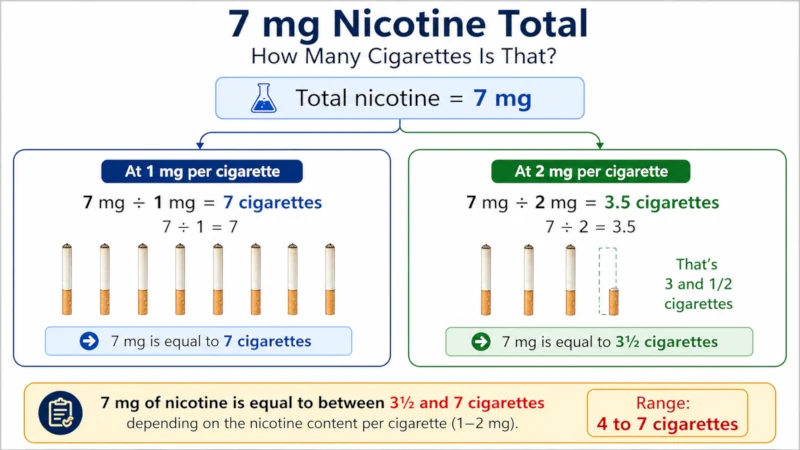
For cigarettes, the reference figure comes from a 2010 U.S. Surgeon General report, which puts absorbed nicotine at 1 to 2 mg per cigarette [U.S. Surgeon General report on nicotine absorption, 2010]. Running the numbers both ways:
- 7 mg ÷ 1 mg per cigarette = 7 cigarettes
- 7 mg ÷ 2 mg per cigarette = 3.5 cigarettes
So the honest answer is a range — approximately four to seven cigarettes’ worth of nicotine, spread across 24 hours. Anyone quoting a single precise number is rounding away real uncertainty.
Why that range is softer than it looks
Neither side of the equation is fixed. How much nicotine you actually absorb from a cigarette depends on how deeply you inhale, how often you puff, how much of the cigarette you smoke, the product itself, how long it has been since your last one, and how quickly your body clears nicotine. Two people smoking the same brand can end up in different places.
The patch is the more predictable half, because it is manufactured to release a measured dose. Even so, skin, circulation, where you place it, and how long you keep it on all shift the result.
This is why saying a 7 mg patch “equals” a specific number of cigarettes is misleading in practice. It supplies a similar total quantity of nicotine to what four to seven cigarettes would deliver — over a far longer stretch of time, and in a completely different pattern.
A 7 mg patch does not feel like smoking four to seven cigarettes
Delivery speed is the whole story. Nicotine from a cigarette reaches its peak blood concentration within about five minutes. Nicotine from a patch takes roughly four to nine hours to reach its peak [U.S. Surgeon General report on nicotine absorption, 2010]. Same drug, same rough total, entirely different experience.
| 7 mg nicotine patch | Cigarettes |
| Releases nicotine gradually; peaks in about 4–9 hours | Peaks within about 5 minutes |
| Worn for 16 or 24 hours | Finished in minutes |
| Produces steady background nicotine levels | Produces repeated peaks and drops |
| No immediate rush | Rapid, strongly reinforcing effect |
| No smoke reaches the lungs | Smoke carries the chemicals that cause most smoking-related disease |
| Intended to reduce withdrawal while you stop | Sustains the habit and the dependence |
Peak-time data: 2010 Surgeon General report.
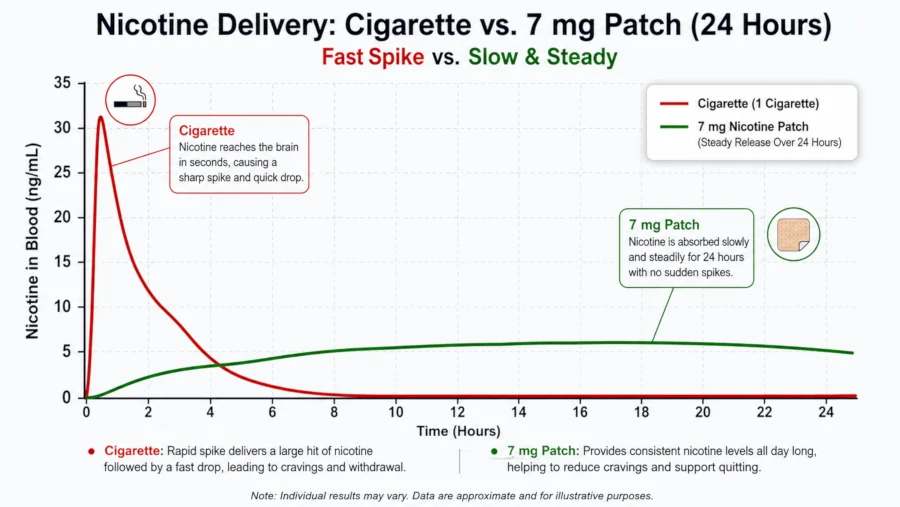
That gap explains something people find genuinely confusing. If you smoked five or six a day and a 7 mg patch supposedly covers that, why are you still white-knuckling it at 3 p.m.? Because what you are missing is not only milligrams. It is the spike, the hand-to-mouth routine, the excuse to step outside, and a reliable answer to stress. A patch replaces one of those four.
If you are building a full quit attempt rather than just choosing a dose, our practical quit plan covers quit-day preparation, craving scripts, and how medication and behavioral support fit together.
Is 7 mg a strong nicotine patch?
No. It is the lowest of the three standard over-the-counter strengths, and it is designed mainly as the last step before you stop using patches altogether.
| Step | Strength | Typical role |
| Step 1 | 21 mg | Starting dose for people smoking more than 10 cigarettes a day |
| Step 2 | 14 mg | Middle step, or the starting dose for 10 or fewer a day |
| Step 3 | 7 mg | Final step before stopping |
Source: NicoDerm CQ labeling on DailyMed and CDC patch guidance. Other brands may differ.
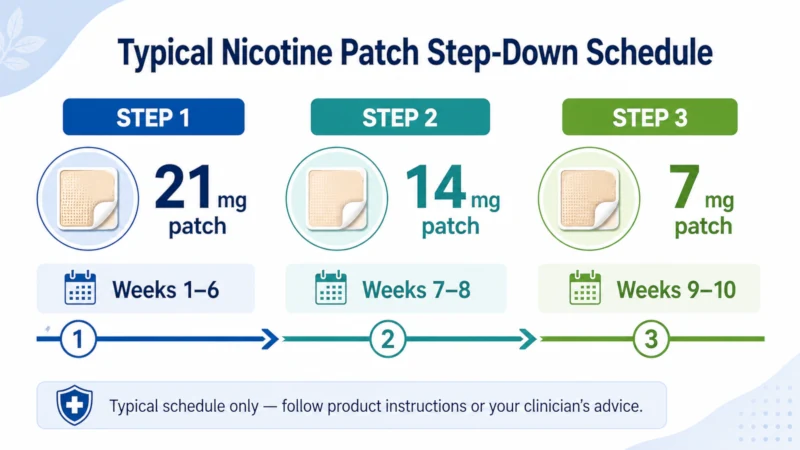
Current NicoDerm CQ labeling sets out a 10-week schedule: if you smoke more than 10 cigarettes a day, 21 mg for weeks 1–6, then 14 mg for weeks 7–8, then 7 mg for weeks 9–10. If you smoke 10 or fewer a day, the label tells you to skip Step 1 entirely — start at 14 mg for six weeks, then 7 mg for two weeks, then stop [DailyMed NicoDerm CQ labeling, 2025]. The CDC gives compatible advice and describes a typical taper of 8 to 12 weeks [CDC guidance on using nicotine patches, 2024].
Brands vary. Read the label that came in your box rather than assuming every patch follows the same schedule.
Who a 7 mg patch is actually for
Based on the labeled use and CDC guidance, 7 mg fits a few situations:
- You are finishing a step-down program and stepping off 14 mg
- You smoke 10 or fewer cigarettes a day and a clinician or pharmacist has recommended starting lower
- You had uncomfortable nicotine effects on a higher strength
- You are on an individualized plan your healthcare provider has set out
Both the CDC and the product label pick a starting dose from a single number: how many cigarettes you smoke per day [CDC guidance on using nicotine patches, 2024] [DailyMed NicoDerm CQ labeling, 2025]. That is a workable rule of thumb, not a full measure of dependence — which is exactly why the CDC’s advice, if you are still craving heavily on a given dose, is to move up or add a short-acting product rather than assume the dose was right.
Do not choose a patch strength by dividing milligrams by cigarettes. The arithmetic at the top of this page describes the product; it does not prescribe your dose.
Signs 7 mg may be too low for you
Watch for the pattern rather than any single bad afternoon:
- Frequent or intense cravings that do not settle
- Irritability, restlessness, or anxiety that stays high
- Trouble concentrating
- Strong recurring urges to abandon the quit attempt
- Repeated slips
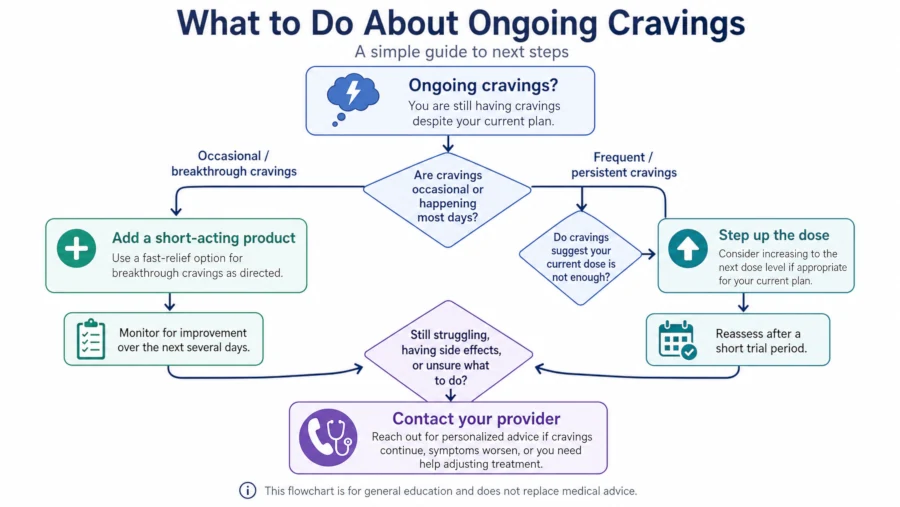
The CDC is direct about what to do: if you are having a lot of cravings on the patch, you may not be on a strong enough dose, and stepping up or adding gum or a lozenge are both reasonable options [CDC guidance on using nicotine patches, 2024].
Do not wear two patches at once unless a healthcare provider has specifically told you to, and do not cut a patch — cutting it interferes with how it releases nicotine.
Some cravings are behavioral rather than pharmacological. Stress, coffee, alcohol, driving, and finishing a meal all pull hard, and a higher dose will not touch them. Replacing the routine works better; our guide to foods and habits that support a quit attempt has practical substitutions, with the honest caveat that food does not “detox” nicotine or replace proven treatment.
Combining the patch with gum or lozenges
This is one of the better-supported adjustments available without a prescription. The patch gives you a steady background level; a short-acting product handles breakthrough cravings as they arrive. The CDC states that using two nicotine replacement medicines together is more likely to help you quit successfully than using one alone, and pairs the patch with one short-acting option — gum, lozenge, nasal spray, or oral inhaler [CDC guidance on combining quit-smoking medicines, 2024].
Follow the directions on each product, and check the precautions for both before you start. Adding a second nicotine product on your own every time a craving hits is a different thing from a planned combination.
Does the nicotine patch actually work?
Yes, and the evidence here is unusually strong. A Cochrane systematic review pooled 133 trials with 64,640 participants and found that any form of nicotine replacement raised the chance of stopping smoking for at least six months by about 50% to 60% compared with placebo or no treatment (risk ratio 1.55, 95% CI 1.49 to 1.61). For patches specifically the figure was 1.64 (95% CI 1.53 to 1.75, across 51 trials and 25,754 participants). Cochrane rated the overall quality of this evidence as high [Cochrane review of nicotine replacement therapy, 2018].
Read that carefully, because the phrasing matters. Increasing your odds by 50% to 60% is not the same as a 50% to 60% success rate. It means that whatever your chance of quitting would have been on this attempt, the patch improves it meaningfully. Most people who use a patch still do not quit on that attempt. Most people who quit for good needed more than one try.
The same review found that the effect held up regardless of how much extra counseling people received — but more support still improved outcomes on top [Cochrane review of nicotine replacement therapy, 2018]. The FDA likewise describes approved cessation products as roughly doubling the chance of quitting successfully [FDA consumer update on cessation products, 2022]. Medication plus coaching is the strongest combination on offer. In the U.S., 1-800-QUIT-NOW gives you free coaching by phone.
Is a patch safer than smoking?
Substantially, yes. Nicotine is addictive and it raises heart rate and blood pressure, and a patch does not change that. What it removes is the smoke. The FDA describes nicotine replacement as supplying measured doses of nicotine without exposing you to the toxic chemicals found in cigarette smoke [FDA consumer update on cessation products, 2022] — and it is the burning tobacco, not the nicotine, that causes most smoking-related disease.
A patch may supply a comparable amount of nicotine to several cigarettes. It does not carry a comparable health risk.
Switching to chewing tobacco, dip, or snus is not an equivalent move — those products keep the dependence going and bring their own serious risks, as our guide to the dangers of smokeless tobacco explains.
Side effects and safety
Common side effects
- Redness, itching, or burning where the patch sits
- Headache
- Trouble sleeping
- Vivid dreams
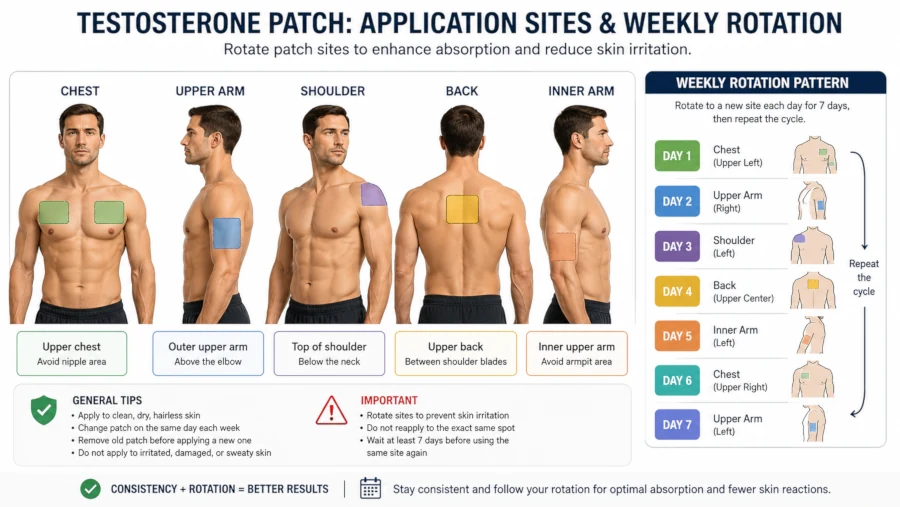
Rotating the site each day helps with skin irritation — put the patch on clean, dry, hair-free skin on the upper body, and avoid using the same spot more than once a week [CDC guidance on using nicotine patches, 2024]. If vivid dreams or broken sleep are the problem, both the CDC and current NicoDerm CQ labeling say you can take the patch off at bedtime and apply a fresh one in the morning [DailyMed NicoDerm CQ labeling, 2025]. Check your own product’s directions first.
Signs of too much nicotine
Stop using the product and get medical advice if you notice nausea, vomiting, dizziness, unusual weakness, or a rapid heartbeat. The same applies to an irregular heartbeat or palpitations, or to skin redness that has not cleared after four days, swelling, or a rash [DailyMed NicoDerm CQ labeling, 2025].
Nicotine patches and blood pressure: what the evidence actually says
The sources here do not fully agree, and the disagreement is worth stating plainly rather than resolving in whichever direction sounds more dramatic.
Product labeling takes the cautious position: nicotine can raise heart rate and blood pressure, so the label tells you to ask a doctor before use if you have heart disease, a recent heart attack, an irregular heartbeat, or high blood pressure that is not controlled with medication [DailyMed NicoDerm CQ labeling, 2025].
The trial evidence is more reassuring on hard outcomes. Cochrane found no evidence that nicotine replacement increases the risk of heart attacks. It did find that chest pain or palpitations were reported more often with NRT than control (odds ratio 1.88, 95% CI 1.37 to 2.57), while noting that these events were rare in both groups and that serious adverse events were extremely rare [Cochrane review of nicotine replacement therapy, 2018].
Both things are true at once: no signal for heart attacks, a real but small signal for chest pain and palpitations, and a label that asks people with existing heart problems to check first. If you have a cardiac history, that conversation with your clinician is the right step — not a reason to keep smoking, which is the far larger risk.
If you already track your numbers at home, keeping the log going through a quit attempt is sensible; our home blood pressure monitoring guide covers how to take readings consistently enough to be meaningful.
Do not stop or adjust a prescribed blood-pressure medication because you have quit smoking or started a patch. That decision belongs to your prescriber.
Who should talk to a healthcare professional first
The CDC lists these as reasons to check with a doctor or other healthcare provider before starting a patch [CDC guidance on using nicotine patches, 2024]:
- A heart attack in the last two weeks
- A serious heart rhythm problem
- Angina that is severe or getting worse
- Allergy to adhesive tape, or a serious skin condition such as psoriasis or eczema
- You could be pregnant, or you are breastfeeding
- You are under 18
The NicoDerm CQ label adds several more: uncontrolled high blood pressure, stomach ulcers, diabetes, a history of seizures, use of a non-nicotine stop-smoking medicine, and prescription medicines for depression or asthma, where your dose may need adjusting [DailyMed NicoDerm CQ labeling, 2025]. A clinician may still recommend the patch in many of these situations. The point is that the decision should be individualized rather than assumed.
Pregnancy and breastfeeding
Current labeling is specific: if you are pregnant or breastfeeding, use this medicine only on the advice of your healthcare provider. The label states that smoking can seriously harm your child, that you should try to stop without any nicotine replacement medicine, and that while the product is believed to be safer than smoking, the risks to your child are not fully known [DailyMed NicoDerm CQ labeling, 2025]. The CDC gives the same instruction to seek medical advice first [CDC guidance on using nicotine patches, 2024].
Keeping patches away from children and pets
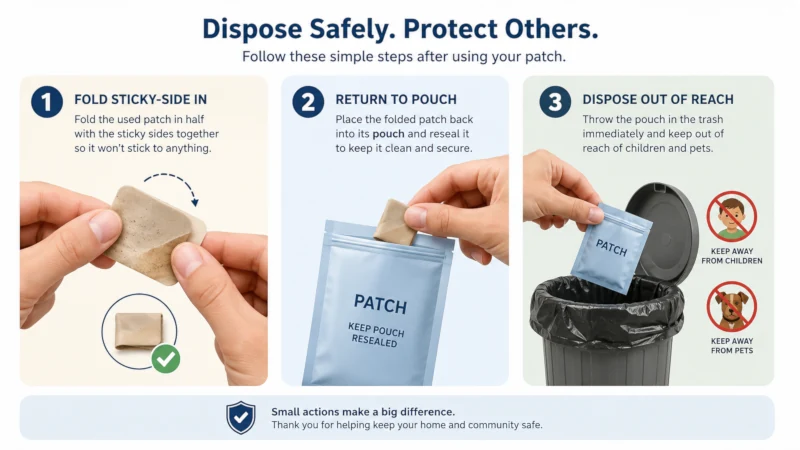
Used patches still hold enough nicotine to make a child or a pet seriously ill. Fold each one in half with the sticky sides together, put it back in its pouch if you have it, and dispose of it where it cannot be reached. If a child or animal chews, swallows, or has prolonged skin contact with a patch, call Poison Control at 1-800-222-1222 right away, or get emergency medical or veterinary help [CDC guidance on using nicotine patches, 2024] [DailyMed NicoDerm CQ labeling, 2025].
What if you smoke while wearing a patch?
One slip does not end a quit attempt, and it does not mean you have to take the patch off. The CDC’s guidance is to throw away the cigarettes, get back on track, and keep using the patch as directed [CDC guidance on using nicotine patches, 2024].
Repeated smoking while on nicotine replacement is different, and it is worth a conversation with a doctor, pharmacist, or tobacco-treatment specialist. It usually means the dose is wrong, the triggers have not been addressed, or you would do better with a combination and some coaching.
When to get urgent help
Call 911 or go to an emergency room for:
- Chest pain or pressure, or pain spreading to the jaw, neck, or arm
- Severe or sudden trouble breathing
- Fainting
- Sudden weakness or numbness on one side, sudden trouble speaking, sudden vision loss, or sudden loss of balance
- Signs of a serious allergic reaction, such as difficulty breathing or a spreading rash
Quitting can also affect mood. The CDC advises getting help if feelings of depression or anxiety last more than two weeks or get worse [CDC guidance on using nicotine patches, 2024]. In the U.S., the Suicide & Crisis Lifeline can be reached by calling or texting 988 at any hour.
| Health Disclaimer: This article is for general education and information only. It is not medical advice and does not replace diagnosis, treatment, or guidance from a qualified healthcare professional. Nicotine patches are medicines: follow the directions on the product you actually buy, and do not use more than one patch at a time or alter a patch. Talk with a doctor or pharmacist before starting a patch if you are pregnant, breastfeeding, under 18, have a heart condition, uncontrolled high blood pressure, diabetes, stomach ulcers, a history of seizures, a significant skin condition, or take prescription medicine — including medicines for depression or asthma. Do not stop or change a prescribed medication on your own. Call 911 for chest pain, severe breathing difficulty, fainting, or signs of stroke, and call Poison Control at 1-800-222-1222 if a child or pet is exposed to a patch. Free confidential quit coaching is available in the U.S. at 1-800-QUIT-NOW. |
Frequently Asked Questions
Does a 7 mg nicotine patch equal seven cigarettes?
Only at the low end of the estimate. If each of your cigarettes delivered about 1 mg of absorbed nicotine, 7 mg would match seven of them. Because absorption ranges from roughly 1 to 2 mg per cigarette, four to seven is the more honest range — and it describes total nicotine over 24 hours, not equivalent effect.
Does a 7 mg patch contain only 7 mg of nicotine?
No. The 7 mg figure is the amount designed to be delivered across the wear period. The patch itself holds more than it releases, which is one reason you should never cut, open, or alter one.
How long does a 7 mg patch last?
Most are made to be worn for up to 24 hours, and current NicoDerm CQ labeling permits either 16 or 24 hours. If cravings hit as soon as you wake, wear it overnight; if it disrupts your sleep, remove it at bedtime and apply a fresh one in the morning.
Will a 7 mg patch stop every craving?
No, and it is not designed to. A patch reduces physical withdrawal. It does not remove the habits, triggers, and routines built around smoking. Cravings that stay frequent and intense usually mean the dose is too low, a short-acting product would help, or a specific trigger needs its own plan.
Can I wear two 7 mg patches instead of one 14 mg patch?
Not unless a healthcare provider has told you to. Both the CDC and the product label say not to wear more than one patch at a time. Use the manufactured strength you need and follow its directions.
Is it better to quit without nicotine replacement?
Not for most people. Some quit unaided, and that is a legitimate route. But nicotine replacement has high-quality evidence behind it — Cochrane found it raises the odds of quitting by about 50% to 60% — and using it is not a sign of weak willpower. The best method is the one that is safe for you and that you will actually stick with.
References
- DailyMed. “NICODERM CQ — nicotine patch, extended release.” U.S. National Library of Medicine; label updated July 14, 2025. → View source
- Centers for Disease Control and Prevention; Office on Smoking and Health. “How Tobacco Smoke Causes Disease: A Report of the Surgeon General,” Table 4.4 — bioavailability and time to maximum nicotine concentration by product. 2010. Hosted by NCBI Bookshelf (NBK53018). → View source
- Centers for Disease Control and Prevention. “How to Use Nicotine Patches.” Tips From Former Smokers. Last reviewed October 4, 2024. → View source
- Centers for Disease Control and Prevention. “How to Combine Quit Smoking Medicines.” Tips From Former Smokers. Last reviewed October 4, 2024. → View source
- U.S. Food and Drug Administration. “Want to Quit Smoking? FDA-Approved and FDA-Cleared Cessation Products Can Help.” Content current as of July 21, 2022. → View source
- Hartmann-Boyce J, Chepkin SC, Ye W, Bullen C, Lancaster T. “Nicotine replacement therapy versus control for smoking cessation.” Cochrane Database of Systematic Reviews 2018, Issue 5, Art. No. CD000146. DOI: 10.1002/14651858.CD000146.pub5. → View source
