
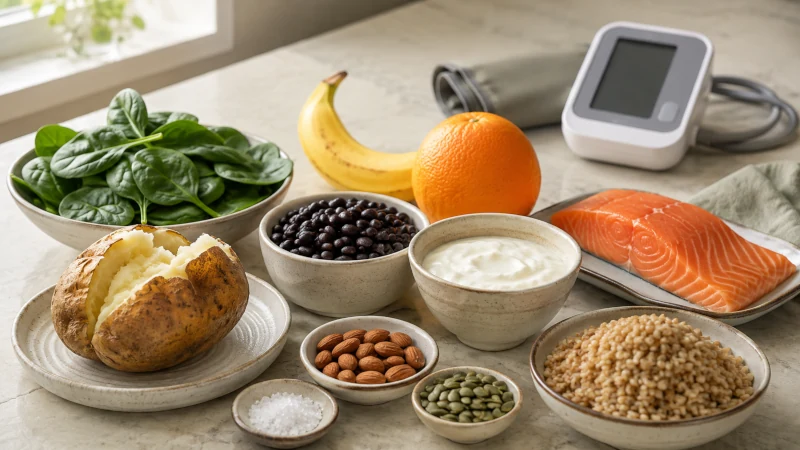
“Cut the salt” is the blood-pressure advice everyone has heard — and for a lot of people it genuinely helps. But sodium is only one of three electrolytes that shape your numbers, and treating it as the whole story leaves real gains on the table. Thinking about electrolytes for blood pressure means looking at sodium alongside potassium and magnesium, which pull in the opposite direction. The balance between them can matter as much as any single one. This guide covers what the evidence actually supports, what you can do about it, and — just as important — when changing your electrolyte intake could be dangerous.
What the “just cut salt” advice misses
The core mistake is treating this as a one-ingredient problem. Most of the public conversation orbits sodium: eat less, and your pressure drops. That logic holds for many people, but framing it as “sodium bad” creates blind spots.
Not everyone responds to sodium the same way
Some people are salt-sensitive — their blood pressure rises and falls more sharply with how much sodium they eat — while others barely budge. The American Heart Association notes that if you are salt-sensitive, sodium has a larger effect on your pressure than it does for people without that trait [AHA, Sodium and Salt]. Salt sensitivity is more common in people who already have high blood pressure, in older adults, and in Black Americans, though estimates of exactly how many people are affected vary. Practically: if aggressive sodium cutting does little for your readings, that doesn’t mean sodium is irrelevant — it means the response isn’t uniform, and potassium and magnesium deserve attention too.
The potassium counterweight
Potassium is the electrolyte most people underuse. Higher potassium intake helps lower blood pressure partly by widening blood vessels and by helping the kidneys clear sodium in urine, which reduces blood volume — an effect that tends to be strongest in salt-sensitive people [NIH ODS, Potassium]. Most Americans fall short of the recommended intake: adults average about 3,016 mg a day for men and 2,320 mg for women, below the adequate-intake targets of 3,400 mg (men) and 2,600 mg (women) [NIH ODS, Potassium]. So while people take salt off the table, they often don’t add potassium-rich food — and the ratio between the two matters, not just either one alone.
Magnesium, the quiet one
Magnesium plays a smaller, quieter role. It’s a cofactor in hundreds of enzyme reactions and helps move calcium and potassium across cell membranes, which supports normal blood-vessel tone and heart rhythm [NIH ODS, Magnesium]. Low magnesium intake is common — roughly 48% of Americans get less than the estimated average requirement from food [NIH ODS, Magnesium] — but its independent effect on blood pressure is modest, which we’ll return to below.
“Electrolyte” products aren’t automatically safe
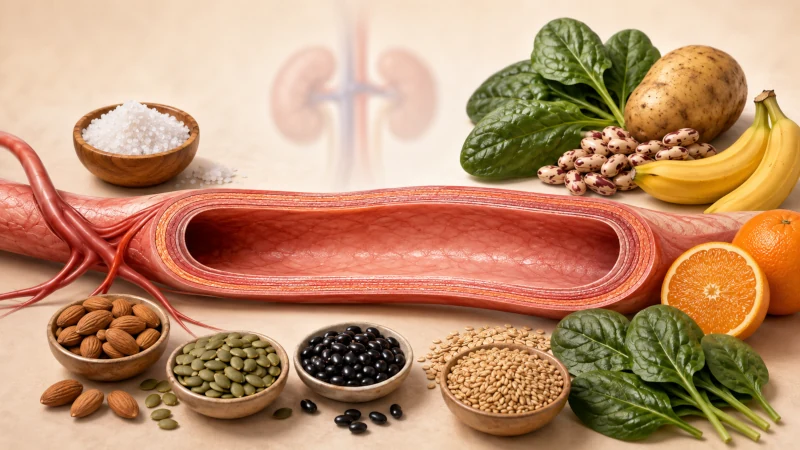
Walk down any supplement aisle and you’ll find electrolyte powders and drinks marketed for “heart health.” Many are fine for healthy people. But some carry enough sodium or potassium to be a real problem if you have kidney disease or take certain blood-pressure medications. A “heart health” label is marketing, not clinical clearance. The safety section below spells out who needs to be careful.
One more gap: people cut sodium, start a supplement, and stop there — without touching sleep, stress, activity, or overall diet. Electrolytes don’t work in isolation. If you’re also improving your sleep and blood pressure or building an exercise routine for blood pressure, the combined effect is usually more meaningful than any single lever.
Electrolytes for Blood Pressure: How to actually do it, step by step
1. Get a baseline
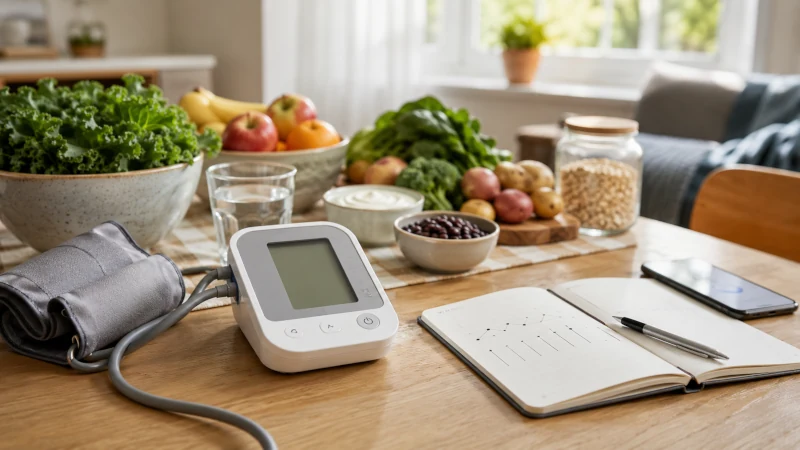
Before you change anything, know your numbers. A single clinic reading tells you far less than a week of consistent home readings. If you’re not already measuring at home, our guide to home blood pressure monitoring walks through choosing a validated cuff and taking readings that you can actually trust. Take a rough, honest inventory of your food, too: mostly home-cooked, heavily processed, or restaurant-heavy? More than 70% of the sodium Americans eat comes from packaged, prepared, and restaurant foods — not the saltshaker [AHA, Sodium and Salt].
2. Bring sodium down to a realistic target
The American Heart Association recommends no more than 2,300 mg of sodium a day, with an optimal goal of no more than 1,500 mg for most adults; for many people, cutting about 1,000 mg a day is enough to improve blood pressure [AHA, How Much Sodium]. That optimal target is roughly two-thirds of a teaspoon of salt across everything you eat in a day — not just what you add while cooking.
The most reliable move isn’t obsessive label-reading; it’s shifting patterns. Cook more at home, lean less on processed meats, canned soups, fast food, and packaged snacks, and rinse canned beans and vegetables to wash off some sodium [AHA, Sodium and Salt]. For a fuller approach, see our guide to cutting back on salt (and sugar).
What about going very low? Here the evidence is genuinely mixed. The AHA says there’s no reliable evidence that eating below 1,500 mg a day is a risk for most people [AHA, How Much Sodium], while some clinicians are cautious about very low intakes in specific situations — for example, certain diuretics or particular health conditions. If you’re considering dropping well below 1,500 mg, calibrate it with your clinician rather than chasing the lowest possible number.
3. Raise potassium — through food first
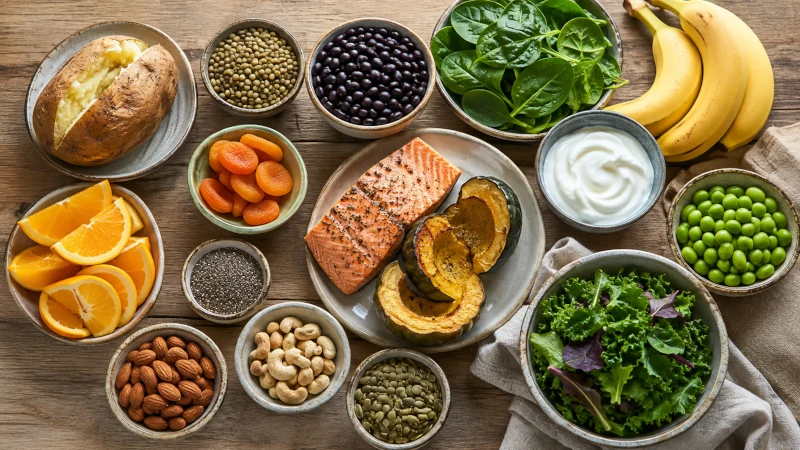
For most healthy adults, food beats supplements for potassium. Good sources include potatoes (with skin), dried apricots, lentils and beans, acorn squash, oranges and orange juice, bananas, spinach, plain and Greek yogurt, salmon, and chicken [NIH ODS, Potassium]. Notably, the potassium in whole foods comes bound with phosphate, citrate, and other compounds — not the potassium chloride found in supplements and salt substitutes — and arrives alongside fiber and other nutrients [NIH ODS, Potassium].
The DASH eating pattern is built on this logic, emphasizing fruits, vegetables, whole grains, and low-fat dairy. In trials it lowered systolic pressure by about 5.5 mmHg and diastolic by about 3.0 mmHg [NIH ODS, Potassium]. Worth an honest caveat: DASH also raises magnesium and calcium at the same time, so potassium’s solo contribution can’t be cleanly separated — the pattern as a whole is what carries the strongest evidence.
Important safety note: if you have chronic kidney disease, you may need to limit potassium rather than raise it. Damaged kidneys can’t always clear excess potassium, and high blood levels (hyperkalemia) are dangerous. The same caution applies if you take ACE inhibitors, ARBs, or potassium-sparing diuretics — in those situations, even dietary potassium below the usual target can push levels too high [NIH ODS, Potassium]. Talk with your doctor or a dietitian before increasing potassium meaningfully.
4. Consider magnesium — carefully
Magnesium is harder to single out because its blood-pressure effect is small. A meta-analysis of 34 randomized, double-blind, placebo-controlled trials (about 2,028 people) found that supplementation at a median dose of roughly 368 mg a day for about three months lowered systolic pressure by around 2.0 mmHg and diastolic by around 1.8 mmHg [Zhang et al., 2016]. The effect was larger in people who started with low magnesium, insulin resistance, or higher baseline pressure [Zhang et al., 2016]. The NIH describes magnesium’s blood-pressure effect as “marginal” overall, and in 2022 the FDA allowed only a qualified claim, concluding that the evidence is “inconsistent and inconclusive” [NIH ODS, Magnesium].
Good food sources include pumpkin and chia seeds, almonds and cashews, spinach, black beans, edamame, whole grains, and plain yogurt [NIH ODS, Magnesium]. If you do supplement, better-absorbed forms such as magnesium citrate or chloride tend to cause less digestive upset than magnesium oxide, which is the form most likely to cause loose stools [NIH ODS, Magnesium]. The tolerable upper limit for magnesium from supplements is 350 mg a day for adults; above that, diarrhea and cramping become common, and people with reduced kidney function can accumulate magnesium to dangerous levels [NIH ODS, Magnesium]. As with potassium, this is a decision to make with a clinician, not an aisle impulse.
5. Track, adjust, and give it weeks
Dietary changes move blood pressure over weeks, not days. A realistic trial is four to eight weeks of consistent changes, judged by reliable home readings rather than single-day numbers — morning versus evening timing, caffeine, stress, and posture all add noise. Change one thing at a time so you can tell what’s working.
The three electrolytes at a glance
| Electrolyte | Main role in blood pressure | Everyday food sources | General adult target | Key caution |
| Sodium | Regulates fluid volume; excess raises pressure, especially in salt-sensitive people | Processed and restaurant foods, bread, canned goods, cured meats | < 2,300 mg/day; optimal ≤ 1,500 mg [AHA] | Very low intake is debated; avoid extreme restriction without clinical guidance |
| Potassium | Counters sodium, relaxes vessels, helps kidneys excrete sodium | Potatoes, beans and lentils, dried apricots, bananas, spinach, yogurt, salmon | 2,600 mg (women) / 3,400 mg (men) [NIH] | Dangerous to raise with kidney disease or certain BP medications (hyperkalemia) |
| Magnesium | Supports vessel tone; helps move calcium and potassium across cell membranes | Pumpkin and chia seeds, almonds, spinach, black beans, whole grains | 310–420 mg by age/sex [NIH] | Supplements above 350 mg/day often cause loose stools; risky with kidney impairment |
When electrolytes can be dangerous
This is where the conversation gets serious. Electrolyte changes that are low-risk for a healthy person can be genuinely hazardous with certain medications or kidney disease.
If you take blood pressure medication
| Medication class (example) | Effect on electrolytes | What to watch |
| ACE inhibitors (lisinopril) | Reduce urinary potassium loss — can raise potassium | Don’t add potassium supplements or high-potassium electrolyte drinks without your prescriber |
| ARBs (losartan) | Similar potassium-raising effect | Same caution as ACE inhibitors |
| Potassium-sparing diuretics (spironolactone, amiloride) | Actively retain potassium; also reduce magnesium loss | Real risk of hyperkalemia; avoid supplemental potassium |
| Thiazide diuretics (hydrochlorothiazide) | Increase urinary potassium and magnesium loss | Some people need more potassium — but only under monitoring |
| Loop diuretics (furosemide) | Increase loss of both potassium and magnesium | Levels are usually monitored; don’t self-supplement without guidance |
Interactions above are drawn from the NIH Office of Dietary Supplements fact sheets for [potassium] and [magnesium].
If you have kidney disease
The kidneys control electrolyte balance. When they aren’t working well, even modest increases in potassium or magnesium can push blood levels into dangerous territory [NIH ODS, Potassium]. If you have any stage of chronic kidney disease, work with a renal dietitian before changing electrolyte intake. General advice does not apply here.
Electrolyte drinks, supplements, and salt substitutes

Many “electrolyte” products carry significant sodium, and some contain potassium at levels that interact with the medications above. Salt substitutes are a specific case: swapping potassium chloride for some sodium chloride can lower sodium and raise potassium, and a large trial in older adults with high blood pressure or prior stroke found this swap reduced stroke, major cardiovascular events, and death [Neal et al., NEJM 2021]. But that trial deliberately excluded many people with kidney problems, and salt substitutes are not safe for people with kidney disease or those on potassium-raising medications, because a single teaspoon can carry up to about 2,800 mg of potassium [NIH ODS, Potassium]. Read labels, and check with a clinician before relying on one.
Quick checklist
- Track your sodium for a few days with an app or labels — most people underestimate their intake.
- Get potassium from whole foods (beans, greens, potatoes, yogurt) before reaching for supplements.
- On an ACE inhibitor, ARB, or potassium-sparing diuretic? Don’t add potassium supplements without asking your prescriber first.
- Any stage of kidney disease? Talk to a renal dietitian before changing electrolyte intake.
- Use a validated home monitor and measure consistently to judge whether changes are working.
- Give dietary changes four to eight weeks — don’t judge by single readings.
- Magnesium from food is generally safe to increase; supplement doses are a separate conversation.
- Don’t assume “natural” or “electrolyte” products are automatically safe with your conditions or medications.
| Health disclaimer This article is for educational purposes only and is not medical advice. It cannot account for your history, your medications, or your kidney function. If you have high blood pressure, heart disease, kidney disease, are pregnant or breastfeeding, or take prescription medications, talk with a qualified clinician before changing your diet, supplements, or treatment. Do not start potassium or magnesium supplements — or stop or adjust any blood pressure medication — without the clinician who manages your care. If you think you are having a medical emergency, call 911. |
Frequently Asked Questions
Do electrolytes lower blood pressure?
Not as a single “treatment,” and not in isolation. Potassium and magnesium each have evidence for modest blood-pressure benefits, strongest when your intake is low to begin with [NIH ODS, Potassium] [Zhang et al., 2016], and cutting excess sodium helps many people, especially those who are salt-sensitive. But “electrolytes” as a category are part of your overall dietary pattern, not a standalone fix.
Can I just take an electrolyte supplement instead of changing my diet?
Not equivalently. Whole foods deliver potassium and magnesium alongside fiber and other compounds, and the strongest evidence is for eating patterns like DASH rather than isolated pills [NIH ODS, Potassium]. Supplements can fill a specific gap, but they also carry more interaction risk than food — particularly with blood-pressure medications.
Is sea salt or Himalayan salt better for blood pressure than table salt?
No meaningful difference. Table salt is about 40% sodium and 60% chloride [AHA, Sodium and Salt], and specialty salts are still predominantly sodium chloride; their trace minerals are present in amounts too small to matter. If it contains sodium, it affects salt-sensitive people regardless of the marketing.
Can you get too much potassium from food?
For people with normal kidney function, that’s rare — healthy kidneys clear excess dietary potassium, and the NIH did not set an upper limit for potassium from food [NIH ODS, Potassium]. The real risk comes from supplements, potassium-based salt substitutes, or conditions and medications that impair potassium excretion.
Should I use a potassium-based salt substitute?
It can meaningfully cut sodium and raise potassium, and one large trial linked the swap to fewer strokes and cardiovascular events in older adults with high blood pressure [Neal et al., NEJM 2021]. But salt substitutes are not safe for people with kidney disease or those on potassium-raising medications [NIH ODS, Potassium]. Check with a clinician before using one.
My diet looks healthy but my potassium is still low — why?
Some medications (especially thiazide and loop diuretics) increase potassium loss, and absorption can vary [NIH ODS, Potassium]. Low potassium on lab work despite a reasonable diet is a reason to talk with your clinician about the cause, not to self-supplement blindly.
References
- American Heart Association. “Get the Scoop on Sodium and Salt.” View source
- American Heart Association. “How Much Sodium Should I Eat Per Day?” View source
- National Institutes of Health, Office of Dietary Supplements. “Potassium — Health Professional Fact Sheet.” View source
- National Institutes of Health, Office of Dietary Supplements. “Magnesium — Health Professional Fact Sheet.” View source
- Neal B, Wu Y, Feng X, et al. “Effect of Salt Substitution on Cardiovascular Events and Death.” N Engl J Med. 2021;385(12):1067–1077. DOI 10.1056/NEJMoa2105675 (PMID 34459569). View source
- Zhang X, Li Y, Del Gobbo LC, et al. “Effects of Magnesium Supplementation on Blood Pressure: A Meta-Analysis of Randomized Double-Blind Placebo-Controlled Trials.” Hypertension. 2016;68(2):324–333. DOI 10.1161/HYPERTENSIONAHA.116.07664. View source
