
Contents
- 1 Medical disclaimer
- 2 Quick answer
- 3 How beetroot juice may help blood pressure simple nitric oxide explanation
- 4 What results to expect, and what NOT to expect
- 5 Who should be cautious
- 6 Juice vs powder vs capsules, what’s easiest for beginners?
- 7 How to use beetroot juice safely
- 8 2–3 week tracking plan
- 9 Mouthwash note
- 10 Common mistakes and easy fixes
- 11 Frequently Asked Questions
- 12 Next Reads
- 13 Conclusion
- 14 References
Medical disclaimer
This article about beetroot juice for blood pressure is for educational purposes only and is not medical advice. If you have high blood pressure, heart disease, kidney disease, are pregnant, or take prescription medications, talk with a qualified clinician before changing treatment or starting supplements.
Quick answer
Beetroot juice may support healthier blood pressure in some people, mostly because beets contain dietary nitrate that can contribute to nitric oxide (NO) signalling.[1] Research suggests average blood pressure reductions are often modest and results vary.[2] [4] The safest way to try beetroot juice is to start small, track your blood pressure for 2–3 weeks, and be extra cautious if you’re on blood pressure medication.
How beetroot juice may help blood pressure simple nitric oxide explanation
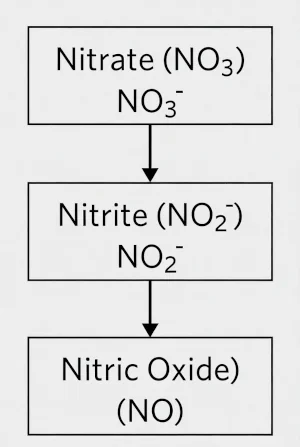
Beets are naturally rich in dietary nitrates. After you drink beetroot juice, nitrate can circulate in the body and participate in the nitrate → nitrite → nitric oxide pathway.[1]
Nitric oxide helps blood vessels relax and widen a bit. A simple way to picture it: if your arteries are like a garden hose, tighter walls mean higher pressure; more relaxed walls can mean easier flow. That’s the basic reason people try beetroot juice for blood pressure support.[1]
• nitric oxide for blood pressure
• nitric oxide foods
What results to expect, and what NOT to expect
- Expect a small-to-moderate change for some people, and no change for others.[2] [4]
- Don’t expect beetroot juice to replace medications or clinician care.
- Don’t judge it off one reading. Use averages and trends over 2–3 weeks.
Blood pressure responds to many variables (salt, sleep, stress, alcohol, activity, and medication timing). Your best proof is a consistent home BP log.
Who should be cautious
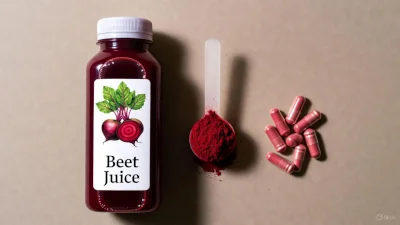
“Natural” doesn’t always mean “risk-free.” The main safety issue is blood pressure dropping too low, especially when beetroot juice is combined with medications or other products that also lower BP.
- People on blood pressure medications (risk of additive lowering).
- Anyone who already runs low or gets dizzy/faints easily.
- Kidney disease or reduced kidney function (ask your clinician before supplement-like experiments).
- History of calcium-oxalate kidney stones (beets are relatively high in oxalate; get clinician guidance).
- Pregnancy/breastfeeding (get clinician guidance).
- People using nitrate medications for chest pain or PDE-5 inhibitors (discuss with your clinician due to low-BP risk).
Juice vs powder vs capsules, what’s easiest for beginners?
The biggest issue with beet products is consistency: different products can have different nitrate content, and some include added sugar or “performance blends.” For beginners, choose the form you can repeat daily without side effects, and don’t change multiple things at once.
| Option | Pros | Cons | Beginner pick? |
| Bottled beet juice (unsweetened) | Easy to measure; simple routine | Taste; can be pricey; check added sugar | Good start (small dose) |
| Fresh beet juice (DIY) | No additives; control ingredients | Messy; stains; nitrate varies; short shelf life | Okay if you love DIY |
| Beetroot powder | Stable storage; easy to mix | Taste; can clump; nitrate varies by brand | Good if you hate juice volume |
| Capsules | No taste; portable | Dose/nitrate content can be unclear; fillers | Only if brand is very transparent |
How to use beetroot juice safely
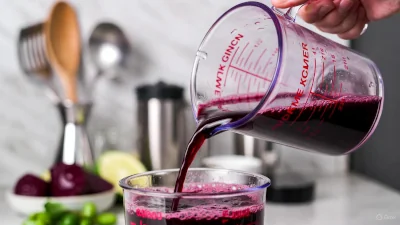
- Pick ONE product and ONE time of day you can repeat.
- Start low: many beginners start around 2–4 oz (60–120 mL) daily, or half a serving of powder.
- Only increase if you feel fine and your BP readings aren’t dropping too far (avoid big jumps).
- Keep everything else steady during the test (salt, alcohol, exercise, meds).
Practical note: In a well-known hypertension trial, participants used 250 mL daily (~8.5 oz) of beetroot juice for weeks.[3] That doesn’t mean you should start there—starting lower is safer and often easier to tolerate.
2–3 week tracking plan
This is the step that makes the experiment actually useful. Trends beat single readings.
BP technique refresher: sit quietly 5 minutes, feet flat, arm supported at heart level, same cuff, same time windows.
| Days | Beetroot intake | BP checks | Goal |
| 1–7 (baseline) | None | Morning + evening | See your normal trend / variability |
| 8–10 (start low) | 2–4 oz daily (or 1/2 powder serving) | Morning + evening | Check tolerability + early trend |
| 11–21 (hold steady) | Keep the SAME daily dose | Morning + evening (or 5–6 days/week) | Look for a trend change over time |
What counts as a “good” result?
- A lower weekly average, not one “perfect” day.
- Fewer high spikes with a consistent routine.
- Better control with no dizziness or concerning symptoms.
Mouthwash note
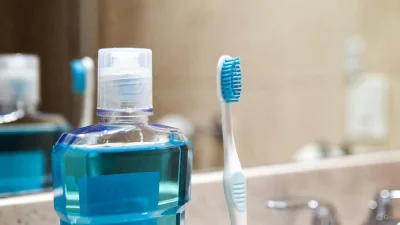
The nitrate pathway depends partly on oral bacteria. Frequent antibacterial mouthwash has been shown to blunt oral nitrate reduction and was associated with higher systolic blood pressure in treated hypertensive adults.[5]
This doesn’t mean you should ignore dental advice. It means: during your beetroot test, keep mouthwash habits consistent—and if you change them, track that as a separate experiment.
Does mouthwash reduce nitric oxide?
Common mistakes and easy fixes
- Starting with a huge glass → start low and increase slowly.
- Changing 3–4 things at once → change one variable (beetroot) and track.
- Not measuring BP consistently → use the same routine and look at averages.
- Using a sugary beet “drink” → choose unsweetened options.
- Ignoring dizziness/lightheadedness → reduce dose or stop and talk with your clinician.
Frequently Asked Questions
- How fast can it work? Some people notice changes within hours, but a 2–3 week trend is a better test than one day.[2] [4]
- How much beetroot juice should I drink? Many beginners start around 2–4 oz daily and adjust only if tolerated. If you feel dizzy or your BP drops too low, reduce or stop.
- Can I take beetroot juice with blood pressure meds? Sometimes, but the risk is BP going too low. Track closely and speak with your clinician before increasing dose.
- Is beet powder as good as juice? It can be, but nitrate amounts vary by brand. Treat it like an experiment and track the same way.
- Why did my urine or stool turn pink/red? Beets can cause beeturia and it’s often harmless. If you have pain, fever, or concern about bleeding, get checked.
Next Reads
- Nitric oxide for blood pressure
- Nitric oxide foods
- Beet juice timing for blood pressure
- Does mouthwash reduce nitric oxide
Conclusion
Beetroot juice can be a reasonable “food-first” experiment for some people, but it’s not a substitute for medical care. Start small, track your BP trend for 2–3 weeks, and prioritize safety—especially if you take BP medications or have kidney/heart conditions.
References
- [1] Gee LC, Ahluwalia A. Dietary Nitrate Lowers Blood Pressure: Epidemiological, Pre-clinical and Clinical Evidence. Curr Hypertens Rep. 2016. (PMC) https://pmc.ncbi.nlm.nih.gov/articles/PMC4729801/
- [2] Siervo M, Lara J, Ogbonmwan I, Mathers JC. Inorganic nitrate and beetroot juice supplementation reduces blood pressure in adults: a systematic review and meta-analysis. J Nutr. 2013 Jun;143(6):818–826. doi:10.3945/jn.112.170233. https://pubmed.ncbi.nlm.nih.gov/23596162/
- [3] Kapil V, Khambata RS, Jones DA, et al. Dietary nitrate provides sustained blood pressure lowering in hypertensive patients: a randomized, phase 2, double-blind, placebo-controlled study. Hypertension. 2015. (PMC) https://pmc.ncbi.nlm.nih.gov/articles/PMC4288952/
- [4] Norouzzadeh M, et al. Plasma nitrate, dietary nitrate, blood pressure, and vascular health biomarkers: a GRADE-Assessed systematic review and dose-response meta-analysis of randomized controlled trials. Nutr J. 2025;24:47. doi:10.1186/s12937-025-01114-8. (PMC) https://pmc.ncbi.nlm.nih.gov/articles/PMC11931885/
- [5] Bondonno CP, et al. Antibacterial mouthwash blunts oral nitrate reduction and increases blood pressure in treated hypertensive men and women. Am J Hypertens. 2015 May;28(5):572–575. doi:10.1093/ajh/hpu192. https://pubmed.ncbi.nlm.nih.gov/25359409/
Last updated: 2025-12-28