
Does mouthwash, oral bacteria, and nitric oxide affect your blood pressure? For most people, the occasional rinse won’t move the needle. But there is a real mechanism worth understanding. The bacteria living in your mouth help turn dietary nitrate into nitric oxide — the signaling molecule your arteries use to relax — and frequent antibacterial mouthwash can interrupt that step. In small human studies, interrupting it nudged blood pressure up by a few points. That is the connection between mouthwash, oral bacteria, nitric oxide, and blood pressure, and it matters most if you are eating nitrate-rich vegetables to support your heart. [Kapil et al., 2013] [Bondonno et al., 2015]
This is not a reason to abandon oral care. It is a reason to use mouthwash on purpose rather than on autopilot — and to know the small, honest size of the effect before you change anything.
Mouthwash, oral bacteria, and nitric oxide: The short answer
Frequent antibacterial mouthwash can reduce how much nitrate your mouth converts to nitrite, one step in how your body produces nitric oxide. [Lidder & Webb, 2013] In short controlled studies, that interruption produced a small rise in blood pressure — on the order of 2 to 3.5 mm Hg. [Kapil et al., 2013] [Bondonno et al., 2015] The effect is small, the studies are small, and none of it overrides oral care your dentist has prescribed. If you reach for mouthwash out of habit rather than for a specific dental reason, dialing back is a low-risk thing to try.
How your mouth fits into blood pressure control
Your body makes nitric oxide in more than one way. One route runs straight through your mouth. When you eat nitrate-rich vegetables — leafy greens, beets, celery — some of that nitrate ends up concentrated in your saliva. Bacteria on the back of your tongue reduce it to nitrite. You swallow, and your body converts nitrite into nitric oxide, especially in tissues that are low on oxygen. Nitric oxide then signals the muscle in your artery walls to relax. [Lidder & Webb, 2013]
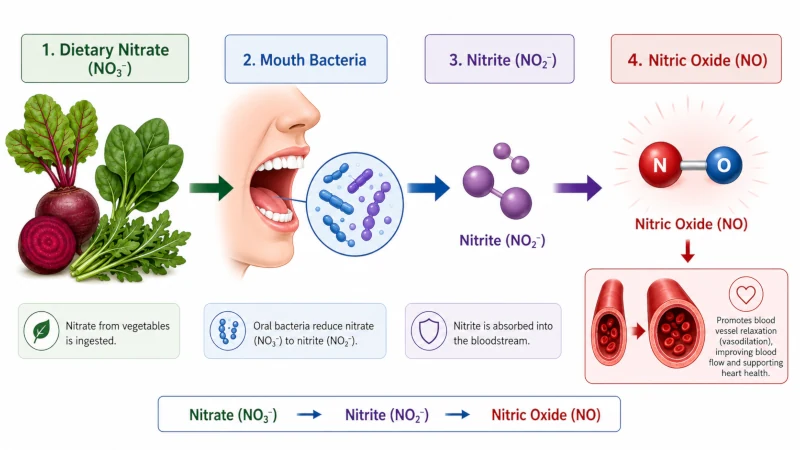
Antibacterial mouthwash is designed to kill oral bacteria. That is useful for some dental problems, but it does not spare the nitrate-reducing species. Knock those bacteria back and the first conversion step slows down, which is why oral-hygiene products and vegetables end up in the same blood-pressure conversation. For the broader picture of how nitric oxide affects arteries, see the complete nitric oxide and blood pressure guide.
Dietary nitrate → concentrated in saliva → oral bacteria reduce it to nitrite → body converts nitrite to nitric oxide → arteries relax
What the research actually shows about mouthwash and blood pressure
The mechanism is well established. The blood-pressure effect in real people is where honesty matters, because the studies are small and the strongest evidence is short-term.
Well established: the mouth is part of the pathway
That oral bacteria perform a real, measurable step in nitric-oxide production is not in dispute. It is described across reviews of the nitrate–nitrite–nitric oxide pathway. [Lidder & Webb, 2013]
Limited but consistent: short-term human trials
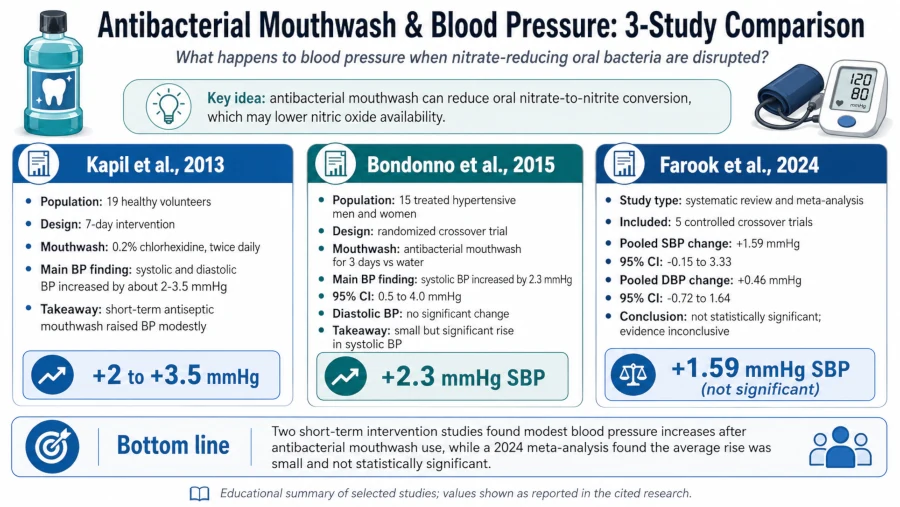
Two small randomized studies point the same direction. In 19 healthy volunteers, a week of twice-daily antiseptic (chlorhexidine) mouthwash cut oral nitrite production by about 90% and plasma nitrite by about 25%, with systolic and diastolic blood pressure rising roughly 2 to 3.5 mm Hg. [Kapil et al., 2013] In 15 adults already treated for high blood pressure, three days of antibacterial mouthwash was linked to a small rise in systolic pressure of about 2.3 mm Hg. [Bondonno et al., 2015] These are real signals, but each involved only a handful of people over days, not months.
Observational only: longer-term use
A longitudinal cohort of 540 adults followed for about three years found that people using over-the-counter mouthwash twice a day or more had a higher incidence of new hypertension — an incidence rate ratio of 1.85 compared with less-frequent users, and 2.17 compared with non-users. [Joshipura et al., 2020] One honest caveat sits inside that same study: blood pressure measured at a single visit did not show the association, and observational data cannot prove that mouthwash caused the hypertension.
The overall verdict
A 2025 systematic review that pooled this literature concluded the evidence is suggestive but not strong enough to establish cause and effect, limited by small samples, short follow-up, and differing mouthwash types. [Sindhusha et al., 2025] In plain terms: a plausible mechanism plus a small, fairly consistent short-term effect, and softer long-term data. Worth knowing, not worth panic.
How the human studies compare
| Study | Who | What they did | What changed | Evidence weight |
| Kapil et al., 2013 | 19 healthy adults | 7 days antiseptic mouthwash, twice daily | Oral nitrite −90%, plasma nitrite −25%, BP up ~2–3.5 mm Hg | Small randomized study |
| Bondonno et al., 2015 | 15 treated hypertensive adults | 3 days antibacterial mouthwash | Systolic BP up ~2.3 mm Hg | Small randomized crossover |
| Joshipura et al., 2020 | 540 adults, ~3 years | Tracked usual OTC mouthwash habit | Twice-daily+ users: higher new-hypertension rate (IRR 1.85–2.17) | Observational cohort (no causation) |
Effect sizes are drawn from the studies named above; observational associations are not proof of cause.
What this does not mean
- It does not mean mouthwash is always bad. Some people need an antibacterial rinse for a specific dental reason, and that use is legitimate.
- It does not mean you should ignore gum disease. Gum disease is associated with cardiovascular disease, though a causal link has not been established. [AHA periodontal statement, 2025] Leaving it untreated to protect nitric oxide would be the wrong trade.
- It does not mean one rinse ruins your nitric oxide. The signal in the research is about frequent, ongoing antibacterial use — not a single swish.
A practical middle ground for mouthwash and blood pressure
You do not have to choose between a healthy mouth and a healthy pathway. Match your approach to why you are using mouthwash in the first place.
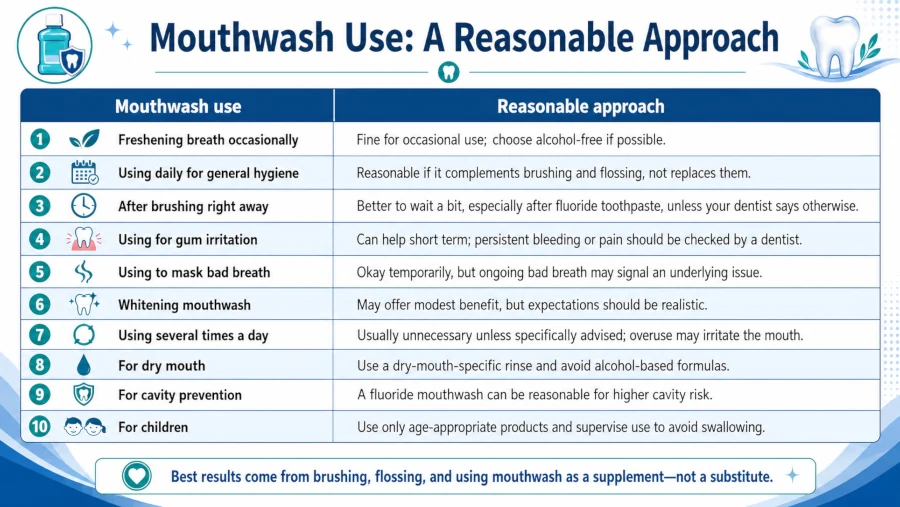
| Your situation | A reasonable approach |
| You were prescribed an antibacterial mouthwash | Use it as directed by your dentist or clinician. Do not stop on your own. |
| You use it daily out of habit | Consider reducing the frequency and putting brushing and flossing first. |
| You are running a nitrate-food or blood-pressure experiment | Keep your mouthwash routine steady during the baseline. If you change it, treat that as its own separate experiment. |
An oral routine that supports both goals
- Brush twice a day with fluoride toothpaste.
- Clean between your teeth daily with floss or an interdental brush — often more valuable than mouthwash.
- If you use mouthwash, consider timing it away from nitrate-rich meals so the two do not overlap.
- Keep up regular dental checkups, especially if you have any gum symptoms.
How to test whether mouthwash affects your blood pressure
If you are curious whether your mouthwash habit nudges your readings, you can test it — carefully, one change at a time.
- Collect a 7-day blood-pressure baseline, measured at the same time each day.
- For the next 14 days, keep diet and exercise steady and change only your mouthwash frequency — but only if it is safe for you to do so.
- Track your blood-pressure trend, your mouthwash use, and any oral symptoms.
- If you have gum disease or specific dentist instructions, do not change your routine without approval.
For the full home-measurement method and a ready-made experiment framework, see nitric oxide and blood pressure tracking. If food is your main lever, the nitric oxide foods guide and lifestyle habits that support nitric oxide pair well with this test.
| What to track | Why it matters |
| Blood-pressure trend over 2–3 weeks | A trend reduces the noise of any single reading; guidelines emphasize repeated, properly taken measurements. [AHA/ACC, 2025] |
| Mouthwash frequency and type | Antibacterial and cosmetic rinses are not the same variable. |
| Nitrate-food intake | Keeps the pathway consistent so you are testing one thing. |
| Oral symptoms | Bleeding gums, pain, or sensitivity are signals to stop and ask your dentist. |
Who should be cautious, and the red flags that need a professional
Most of this is low-stakes self-experimentation. A few situations are not.
- Do not stop a dentist-recommended rinse on your own — particularly if you use it for gum disease, an infection, recent oral surgery, or a specific condition.
- If you are pregnant or breastfeeding, keep following your dentist’s guidance and raise any planned change with your clinician rather than adjusting on your own.
- Be extra careful if you have periodontal disease, a weakened immune system, or you are recovering from a dental procedure.
Oral warning signs that deserve a dentist:
- Bleeding gums, gum pain, or persistent bad breath.
- A mouth sore or ulcer that does not heal within about two weeks.
Blood-pressure warning signs that are an emergency:
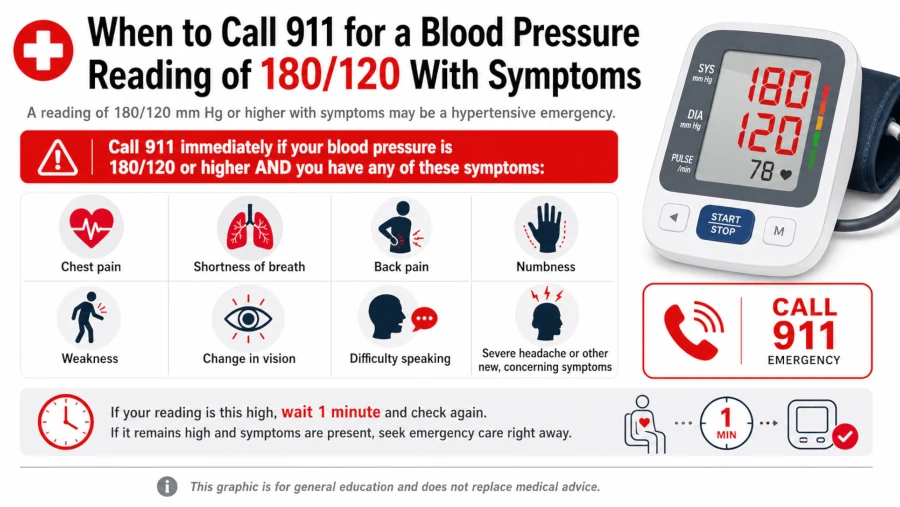
Call 911 if a reading is 180/120 mm Hg or higher and you have symptoms such as chest pain, shortness of breath, back pain, numbness or weakness, vision changes, or trouble speaking. If it is that high without symptoms, wait five minutes, retake it, and contact your clinician promptly if it stays elevated. [AHA/ACC, 2025]
Self-care is not enough when readings stay high across a couple of weeks, when you feel faint or unusually dizzy, or when you are weighing changes to prescribed treatment. Bring your log to a clinician. Herbal and dietary options belong in the same conversation — see herbs for high blood pressure and nitric oxide supplements for blood pressure — but none of them replace medical care.
| Health disclaimer This article about mouthwash, oral bacteria, nitric oxide, and blood pressure is for educational purposes only. It does not diagnose, treat, cure, or prevent disease and is not a substitute for medical or dental care. Do not stop or change a prescribed mouthwash, or any blood-pressure medication, based on this page. Talk with a qualified clinician or dentist before making changes if you have high blood pressure, heart disease, kidney disease, gum disease, a weakened immune system, are pregnant or breastfeeding, or take prescription medication. If you may be having a hypertensive emergency (a reading of 180/120 mm Hg or higher with symptoms), call 911. |
Frequently Asked Questions
Is alcohol-free mouthwash better for nitric oxide?
The key variable is antibacterial action, not alcohol. An alcohol-free rinse may feel gentler, but if it still strongly targets bacteria it can affect the same nitrate-reducing step. Check the active ingredient and how often you use it.
Should I stop mouthwash if I have high blood pressure?
Not if it was prescribed — talk to your dentist first. If it is optional and habitual, you can reduce the frequency and track your readings over a few weeks to see whether it makes any difference for you.
Does one rinse hurt my nitric oxide levels?
A single rinse is not the concern in the research. The measurable effects came from frequent, ongoing antibacterial use, not an occasional swish.
Does tongue scraping affect this?
Tongue scraping can freshen breath for some people. Be gentle and avoid irritating the tissue. It is not a substitute for evaluating a frequent antibacterial-mouthwash habit.
What is the simplest takeaway?
If you are using nitrate-rich foods to support your blood pressure, a frequent antibacterial mouthwash habit is worth a second look — but keep any rinse your dentist recommends, and let a blood-pressure trend, not a single reading, guide you. [Joshipura et al., 2020]
References
- Lidder S, Webb AJ. Vascular effects of dietary nitrate via the nitrate–nitrite–nitric oxide pathway. Br J Clin Pharmacol. 2013;75(3):677–696. (PMID 22882425; PMCID PMC3575935) View source
- Kapil V, Haydar SMA, Pearl V, Lundberg JO, Weitzberg E, Ahluwalia A. Physiological role for nitrate-reducing oral bacteria in blood pressure control. Free Radic Biol Med. 2013;55:93–100. (PMID 23183324; PMCID PMC3605573) View source
- Bondonno CP, Liu AH, Croft KD, et al. Antibacterial mouthwash blunts oral nitrate reduction and increases blood pressure in treated hypertensive men and women. Am J Hypertens. 2015;28(5):572–575. (PMID 25359409) View source
- Joshipura K, Muñoz-Torres F, Fernández-Santiago J, Patel RP, Lopez-Candales A. Over-the-counter mouthwash use, nitric oxide and hypertension risk. Blood Press. 2020;29(2):103–112. (PMID 31709856; PMCID PMC7125030) View source
- Sindhusha BSD, Srinivas R, Pachava S. Does mouthwash use increase risk of diabetes and hypertension? A systematic review. J Indian Assoc Public Health Dent (SAGE). 2025. doi:10.1177/30497418251384004 View source
- Writing Committee. 2025 AHA/ACC/… Guideline for the Prevention, Detection, Evaluation and Management of High Blood Pressure in Adults. Hypertension. 2025;82(10):e212–e316. (PMID 40811516) View source
- Tran AH, Zaidi AH, Bolger AF, et al. Periodontal Disease and Atherosclerotic Cardiovascular Disease: A Scientific Statement From the American Heart Association. Circulation. 2025. doi:10.1161/CIR.0000000000001390 (PMID 41399933) View source
