
Here is the short version. Nitric oxide (NO) is a tiny signal your blood vessel lining releases to tell arteries to relax, and when that signal works well, blood moves more easily and pressure can sit a little lower ([Carlström et al., 2024]). The most reliable way to support nitric oxide for blood pressure is not a bottle of pills. It is nitrate-rich vegetables most days, regular movement, decent sleep, and measuring your own numbers so you can see what actually changes. That is supportive care that sits on top of guideline-based treatment [2025 AHA/ACC guideline] — not a replacement for it.
This guide grades the evidence honestly: where it is reasonably strong, where it is only promising, and where it is genuinely mixed. If you are on blood pressure medication, pregnant, or living with kidney disease, treat the safety section as the most important part of the page and talk with your clinician before you change anything.
What nitric oxide actually does in your arteries
Picture your arteries as flexible pipes. The inner lining, the endothelium, releases chemical messages that decide how wide or tight the pipe becomes. NO is one of the most important of those messages: it signals the muscle layer in the artery wall to loosen, which improves blood flow and lowers resistance [Carlström et al., 2024].
In high blood pressure, this signaling is often blunted — the endothelium makes less usable NO, or oxidative stress mops it up before it can act [Hermann et al., 2006]. That is one reason blood pressure and vessel health track together. It is also why NO gets so much attention. But it is one lever among many. Genetics, kidney function, salt sensitivity, vessel stiffness, sleep, and stress all push on your numbers too, and the kidneys in particular are tightly wired into NO biology and salt handling [Lee, 2008]. Supporting NO can help; it will not override the rest of the system.
The two ways your body makes nitric oxide
1) The dietary nitrate pathway
Nitrate from vegetables (think leafy greens and beets) gets converted, step by step, into signaling that behaves like NO. The first step happens in your mouth, where certain bacteria reduce nitrate to nitrite; your body then uses that nitrite downstream [Lidder & Webb, 2013]. The chain looks like this:
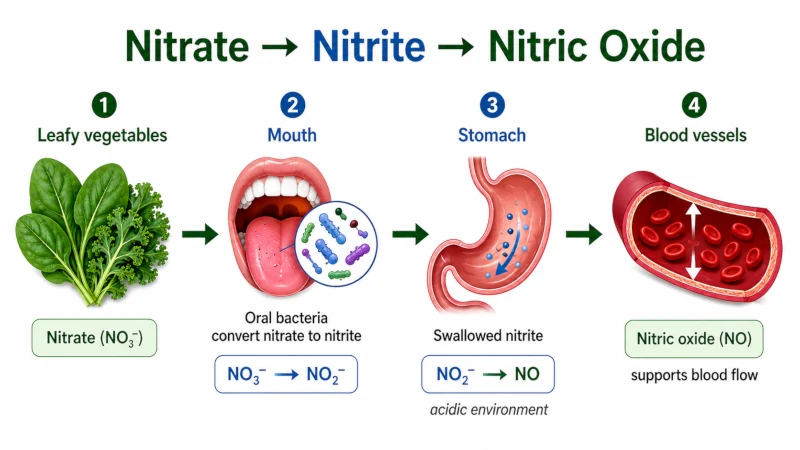
Nitrate-rich foods → oral bacteria reduce nitrate to nitrite → nitrite supports NO signaling
That oral step is the reason mouthwash sometimes enters the conversation, which we cover below.
2) The enzyme (eNOS) pathway
Your body also makes NO directly through enzyme systems — chiefly endothelial nitric oxide synthase (eNOS) — using the amino acid L-arginine. Inflammation, oxidative stress, and chronic disease can all interfere with this pathway, which is part of why NO availability tends to fall in hypertension [Carlström et al., 2024].
Nitric oxide for blood pressure: What the evidence actually shows
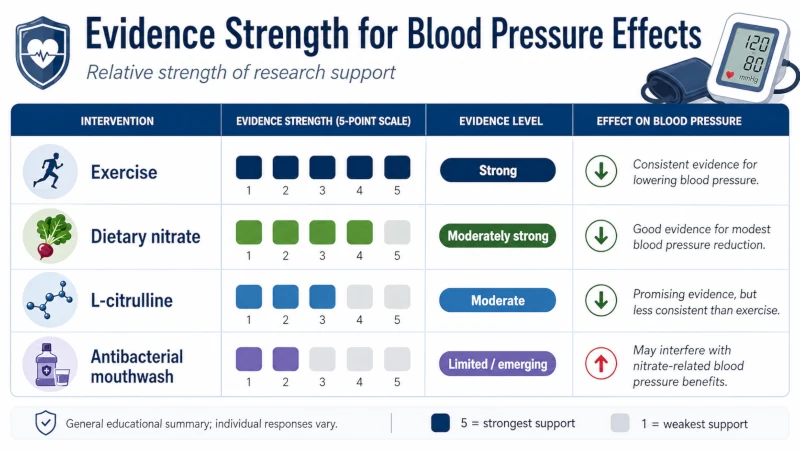
Reasonably supported — dietary nitrate. A 2025 GRADE-assessed systematic review pooling 75 randomized trials (1,823 participants) found that dietary nitrate modestly lowered blood pressure and improved markers of vascular function [Norouzzadeh et al., 2025]. Earlier work links dietary nitrate to better endothelial function and blood pressure [d’El-Rei et al., 2016], and reviews of nitrate-rich vegetables describe cardioprotective effects, with beetroot a standout source [Olas, 2024]. The honest caveat: the effect is modest, not medication-sized.
Reasonably supported — regular exercise. A 2024 systematic review and meta-analysis of 37 studies (2,801 people with hypertension) found that exercise raised nitric oxide levels and improved flow-mediated dilation while lowering endothelin-1, a vessel-tightening signal [Liang et al., 2024]. In that analysis, higher-intensity aerobic sessions of roughly 35–50 minutes, 3–4 times a week for 10–12 weeks, moved the NO needle most — but you do not need to start there.
Promising but modest — L-citrulline. A 2025 meta-analysis of 15 randomized trials (415 middle-aged and older adults) found L-citrulline supplementation and watermelon intake reduced systolic pressure by about 4 mm Hg and diastolic by about 2.5 mm Hg on average [Luo et al., 2025]. Worth knowing, not miraculous — and because it can lower pressure, it needs care alongside BP medication.
Mixed and limited — mouthwash. A small crossover trial in 15 treated hypertensive adults found that three days of antibacterial mouthwash blunted oral nitrate reduction and nudged systolic pressure up by roughly 2 mm Hg [Bondonno et al., 2015], and an observational study linked frequent over-the-counter mouthwash use with higher hypertension risk [Joshipura et al., 2020]. These are small and observational signals, not proof — and never a reason to ignore dental care.
Context-dependent — L-arginine. L-arginine is a direct NO precursor, but human blood-pressure results have been inconsistent, and it interacts with medical conditions and medications. Treat any specific claim about it with caution and decide it with a clinician rather than a label.
The frame that matters most. Current guidelines position lifestyle and, when indicated, medication as the core of blood pressure care, aiming for a target of under 130/80 mm Hg for most adults [2025 AHA/ACC guideline]. Everything on this page is an add-on to that foundation.
A safe priority order that keeps you out of trouble
If you do these in order, you get most of the benefit with the least risk:
- Measure first. Learn to take your blood pressure correctly and consistently so you can tell signal from noise. See how to track blood pressure and nitric oxide.
- Eat the nitrate. Add nitrate-rich vegetables most days. See the nitrate-rich foods guide.
- Move regularly. Walking plus a little strength work goes a long way. See lifestyle habits that support nitric oxide.
- Consider supplements last, and only if appropriate and monitored. See nitric oxide supplements for blood pressure.
Nitrate-rich foods to start with
You do not need exotic ingredients. A daily salad base plus an occasional beet does most of the work [Olas, 2024].
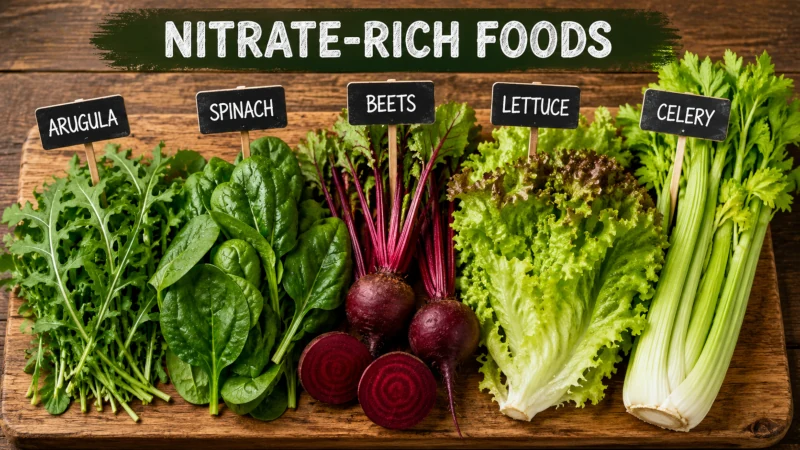
| Food | Easy way to use it | Worth knowing |
| Arugula | A generous salad base | Often among the highest nitrate greens |
| Spinach | Sauté, omelet, or smoothie | High in oxalate; people prone to kidney stones may want moderation |
| Beets | Roast, shred, or juice | Can turn urine or stool pink or red — usually harmless |
| Lettuce | Salads and wraps | Nitrate content varies quite a bit by type |
| Celery | Snack or soup base | A moderate everyday source |
Supplements: what to know before you try one
Food first is the safer default, but if you and your clinician are weighing a supplement, here is a realistic picture. None of these replaces treatment, and all of them can lower pressure enough to matter if you already take BP medicine.
| Option | Why people try it | Main cautions |
| Beetroot juice / powder | A concentrated dietary-nitrate source | May lower BP; the kidney-stone caution for high-oxalate sources applies to some people |
| L-citrulline | Supports NO biology; modest BP drop in a meta-analysis [Luo et al., 2025] | BP can drop too far with BP meds — discuss dosing with a clinician [2025 AHA/ACC] |
| L-arginine | A direct NO precursor | Evidence is mixed; interactions and medical context matter |
Realistic expectations: think a few points, not a transformation. Common side effects across nitrate sources are mild (beet-colored urine, occasional stomach upset). The interaction that matters most is with blood-pressure-lowering medication, where stacking effects can drop you too low. If you are pregnant or breastfeeding, there is not enough safety data to recommend concentrated supplements — keep it food-first and ask your clinician. Anyone with kidney disease, frequent low-BP symptoms, or a history of kidney stones should get individual advice before starting.
A simple 2–4 week self-test

Change one thing at a time and watch the trend, not any single reading [2025 AHA/ACC guideline]. A single high number after a stressful morning tells you very little.
| Track this | How | Why it matters |
| Home blood pressure | Same time, seated, back and arm supported, after 5 minutes rest | Consistency is what reveals a real trend |
| Symptoms | Note dizziness, weakness, headaches | Catches BP dropping too low or intolerance |
| What you changed | Note nitrate foods, walks, or mouthwash use | Links the habit to the outcome |
| Mouthwash use | Note antibacterial rinses | Frequent antibacterial use may blunt the oral nitrate step |
A 14-day starter plan
- Most days: 1–2 servings of nitrate-rich vegetables (greens, plus optional beets).
- Most days: 20–40 minutes of walking or similar activity.
- 2–3 days a week: a simple strength routine, as tolerated.
- Throughout: track blood pressure consistently — see blood pressure tracking.
- If you use mouthwash: note whether it is antibacterial, and do not change your dental routine without professional advice (more on mouthwash and NO).
Safety: who should be cautious, and the red flags
Be extra careful, and involve your clinician before making changes, if you take blood pressure medication (especially more than one), have episodes of dizziness or fainting, live with kidney disease or heart failure, or are pregnant or breastfeeding. Kidney function and blood pressure control are closely tied to NO biology, so changes can land differently for you [Lee, 2008].
Herbs are their own category with their own interactions — if you are exploring those, read the honest, evidence-graded rundown in our guide to herbs for high blood pressure first.
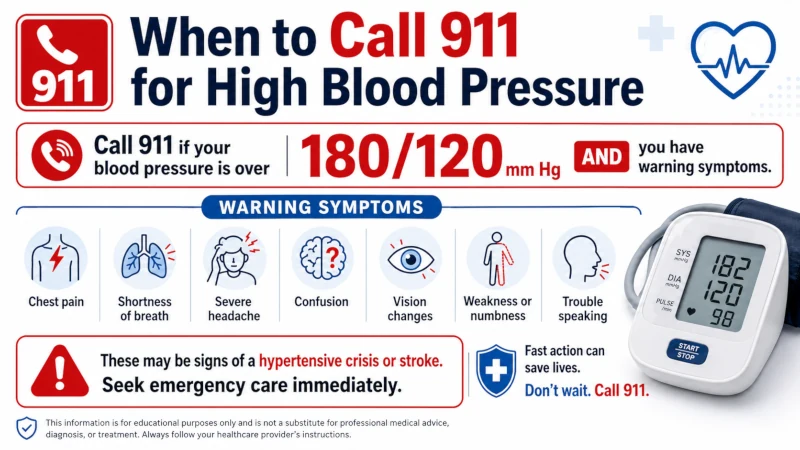
| Red flags — seek urgent care Call 911 if your blood pressure is higher than 180/120 mm Hg and you have symptoms such as chest pain, shortness of breath, back pain, numbness or weakness, vision changes, or difficulty speaking — this can be a hypertensive emergency, and you should not wait to see if it settles [American Heart Association]. If a reading is that high with no symptoms, rest a few minutes, recheck, and contact your clinician promptly if it stays elevated. |
Common mistakes to avoid
- Changing three things at once — you will not know what actually helped.
- Judging progress from random one-off readings instead of a consistent trend.
- Expecting NO support to replace medication; guideline treatment still matters [2025 AHA/ACC].
- Using strong antibacterial mouthwash daily while leaning on nitrate foods, which may work against the oral step [Bondonno et al., 2015].
| A note on safety This article is for general education and is not medical advice. Nitric oxide support through food, movement, and — where appropriate — supplements is a complement to blood pressure care, not a substitute for it. If you have high blood pressure, heart disease, kidney disease, are pregnant or breastfeeding, or take prescription medication, talk with a qualified clinician before changing treatment or starting any supplement. If you think you may be having a hypertensive emergency, call 911. |
Frequently Asked Questions
Does nitric oxide cure high blood pressure?
No. It is one supportive lever, not a cure and not a replacement for medical care. Guidelines still put lifestyle and, when needed, medication at the center [2025 AHA/ACC guideline].
Do nitrate-rich foods really lower blood pressure?
They can, modestly. A meta-analysis of 75 randomized trials found dietary nitrate produced small but real reductions in blood pressure for some people [Norouzzadeh et al., 2025]. Food-first is the safest way to test it.
How soon might I see a change?
Some people notice shifts within days, but confirm anything with a 2–4 week trend rather than a single reading [2025 AHA/ACC guideline].
Does mouthwash really matter?
Possibly, if you rely on nitrate foods. Frequent antibacterial mouthwash can blunt the oral nitrate step and has been linked to small blood-pressure changes in some studies [Bondonno et al., 2015] [Joshipura et al., 2020]. Do not stop prescribed dental rinses without your dentist’s advice.
Do I need supplements?
Usually not first. Start with food, movement, and consistent measurement; consider a supplement only if it is appropriate for you and monitored by a clinician.
References
- Carlström M, Weitzberg E, Lundberg JO. Nitric Oxide Signaling and Regulation in the Cardiovascular System: Recent Advances. Pharmacological Reviews. 2024;76(6):1038–1062. View source
- Hermann M, Flammer A, Lüscher TF. Nitric Oxide in Hypertension. The Journal of Clinical Hypertension. 2006;8(12 Suppl 4):17–29. (PMC8109558) View source
- Lidder S, Webb AJ. Vascular effects of dietary nitrate via the nitrate–nitrite–nitric oxide pathway. British Journal of Clinical Pharmacology. 2013;75(3):677–696. View source
- d’El-Rei J, Cunha AR, Trindade M, Neves MF. Beneficial Effects of Dietary Nitrate on Endothelial Function and Blood Pressure Levels. International Journal of Hypertension. 2016;2016:6791519. View source
- Norouzzadeh M, et al. Plasma nitrate, dietary nitrate, blood pressure, and vascular health biomarkers: a GRADE-assessed systematic review and dose-response meta-analysis of RCTs. Nutrition Journal. 2025;24(1):47. View source
- Olas B. The Cardioprotective Role of Nitrate-Rich Vegetables. Foods. 2024;13(5):691. View source
- Liang C, et al. Exercise interventions for the effect of endothelial function in hypertensive patients: a systematic review and meta-analysis. The Journal of Clinical Hypertension. 2024;26(6):599–614. View source
- Writing Committee. 2025 AHA/ACC (multi-society) Guideline for the Prevention, Detection, Evaluation, and Management of High Blood Pressure in Adults. Hypertension. 2025;82(10):e212–e316. View source
- Bondonno CP, et al. Antibacterial mouthwash blunts oral nitrate reduction and increases blood pressure in treated hypertensive men and women. American Journal of Hypertension. 2015;28(5):572–575. View source
- Joshipura K, et al. Over-the-counter mouthwash use, nitric oxide and hypertension risk. Blood Pressure. 2020;29(2):103–112. View source
- Luo P, Chen J, Liu K, Zhang J. Does L-citrulline supplementation and watermelon intake reduce blood pressure in middle-aged and older adults? A systematic review and meta-analysis of RCTs. Clinical Nutrition ESPEN. 2025;69:653–664. View source
- Lee J. Nitric oxide in the kidney: its physiological role and pathophysiological implications. Electrolyte & Blood Pressure. 2008;6(1):27–34. View source
- American Heart Association. When To Call 911 About High Blood Pressure (Understanding Blood Pressure Readings). heart.org. View source
