
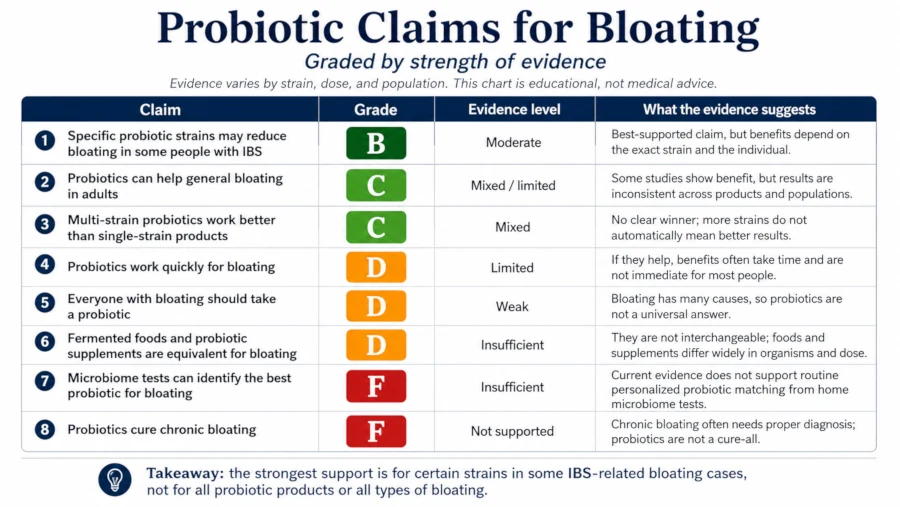
There is no single best probiotics for bloating and gas — and the honest reason matters more than any product list. Probiotic effects are strain-specific, the trials use dozens of different products at different doses, and both major American gastroenterology societies currently stop short of recommending probiotics for routine irritable bowel symptoms [AGA, 2020; ACG, 2021].
That is not the same as saying they never help. Pooled trial data hints at a real benefit for some people, probiotics are inexpensive, and for healthy adults the risk is low [NCCIH, 2019]. So a careful, time-limited trial is a reasonable thing to do. What the science can’t give you is a confident ranking. This guide gives you the next best thing: what’s actually known, how to read a label without being fooled, how to test one properly on yourself, and what tends to help more than a capsule does.
Where the evidence stands, at a glance
| The claim | What the evidence shows | Strength |
| Probiotics reliably cure bloating | No probiotic has been shown to cure or reverse bloating. Guidelines don’t endorse routine use for IBS symptoms. | Not supported |
| Probiotics may ease overall IBS symptoms and abdominal pain | A meta-analysis of 53 trials in 5,545 people found a possible benefit — but couldn’t identify which species, strain, or combination is best. | Promising, limited |
| Specific strains beat others for gas | Individual strains have supportive trials, but head-to-head evidence is thin and the pooled data can’t rank them. | Mixed |
| Probiotics help some kinds of constipation | Reviews show modest benefit for adult constipation, notably with Bifidobacterium lactis. | Promising, limited |
| Higher CFU counts work better | No good human evidence that more is better for bloating. | Not supported |
“Promising, limited” means worth trying, not guaranteed to work. Sources: Ford et al., 2018; NCCIH, 2019; ACG, 2021.
First: how much gas is actually normal?
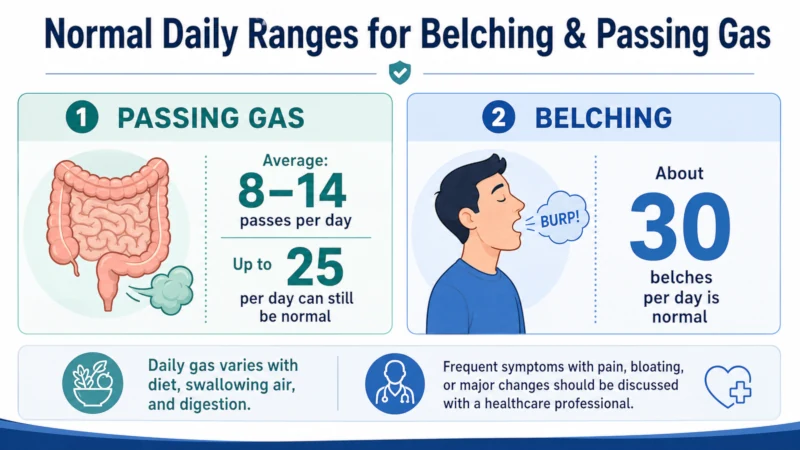
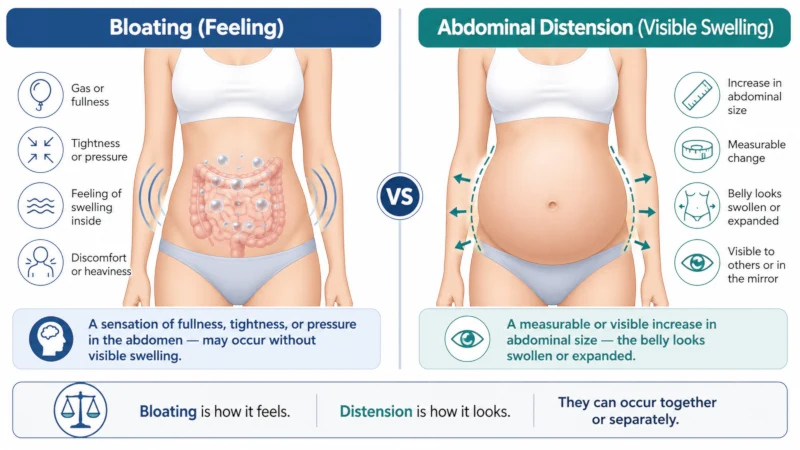
A lot of what gets treated as a gut problem is ordinary physiology. People belch up to about 30 times a day and pass gas roughly 8 to 14 times a day, and experts consider up to 25 times a day to be within normal range [NIDDK, 2021]. Bloating — the feeling of fullness or swelling — is also not the same thing as distension, where the abdomen visibly gets bigger. Only about half of people who feel bloated actually distend [NIDDK, 2021].
That distinction is useful. If your belly feels tight but nothing visible is happening, the problem is often sensation and motility, not literal volume. Gas symptoms are worth acting on when they happen often, bother you, or interfere with your day.
What’s driving it
Gas gets into your digestive tract two ways: you swallow air, and bacteria in your large intestine ferment carbohydrates your small intestine didn’t absorb [NIDDK, 2021].
- Swallowed air. Chewing gum, sucking hard candy, fizzy drinks, eating fast, and smoking all send more air down. So do loose-fitting dentures.
- Fermentable carbs. FODMAPs — poorly absorbed sugars in wheat, onion, garlic, legumes, and some fruit — get fermented by gut bacteria and produce gas [Monash University]. Cruciferous vegetables and beans are the classic offenders.
- Underlying conditions. IBS and other disorders of gut–brain interaction, lactose or fructose intolerance, small intestinal bacterial overgrowth, celiac disease, constipation, and reflux can all amplify gas symptoms [NIDDK, 2021].
If food is clearly the trigger, that’s where the biggest lever usually sits. Our guide to the foods most likely to set off IBS symptoms walks through the structured way to find yours, which beats guessing.
So where do probiotics actually fit?
Probiotics are live microorganisms intended to have a health benefit. Most contain Lactobacillus or Bifidobacterium species, sometimes the yeast Saccharomyces boulardii [NCCIH, 2019]. Prebiotics are different — they’re fibers that feed the microbes you already have. A synbiotic combines both.
Here’s the part most “best probiotics” lists skip. The largest meta-analysis in this area pooled 53 randomized trials in 5,545 people with IBS. It found probiotics may improve overall symptoms and abdominal pain — but it could not determine which species, strains, or combinations are most likely to help [Ford et al., 2018; NCCIH, 2019].
Weighing that same body of evidence, the American Gastroenterological Association declined to make any recommendation for probiotics in IBS, citing heavy inconsistency across studies [AGA, 2020]. The American College of Gastroenterology went a step further and suggests against probiotics for treating global IBS symptoms — a conditional recommendation based on very low quality evidence [ACG, 2021].
Read that carefully, because it’s easy to over-read in either direction. “Very low quality evidence” is a verdict on the studies, not proof the capsules do nothing. And these recommendations are about overall IBS symptom scores — not specifically about gas and bloating, which some trials treated as separate outcomes with more encouraging results. What the guidelines are really saying is: nobody can yet tell you which product to buy.
The strains with the most human data
These names come up repeatedly in trials of gas, bloating, and IBS-type symptoms. That means they’ve been studied, not that they’re proven winners — and a strain that worked in one trial population may do nothing for you.
- Lactobacillus plantarum 299v — studied for IBS-type bloating and abdominal pain.
- Bifidobacterium infantis 35624 — the single strain behind Align, with IBS trial data behind it.
- Lactobacillus rhamnosus GG — one of the most-studied strains overall, mostly for diarrhea and general gut balance.
- Bifidobacterium lactis — the strain with the most support for adult constipation, which matters because constipation drives a lot of bloating [NCCIH, 2019].
- Saccharomyces boulardii CNCM I-745 — a yeast, best evidenced for diarrhea rather than bloating.
How to read a probiotic label without getting played
Probiotics sold as dietary supplements don’t need FDA approval before they go on sale, and they can’t legally claim to treat or prevent disease [NCCIH, 2019]. Some products have even been found to contain organisms that weren’t on the label — a real quality problem, not a theoretical one [NCCIH, 2019]. So the label is your only lever. Four things are worth checking:
- Full strain names. “Lactobacillus” tells you nothing. “Lactobacillus plantarum 299v” tells you the manufacturer knows exactly what’s in the capsule and can point to trials on it. Vague genus-only labels are a yellow flag.
- CFU at end of shelf life, not at manufacture. Some brands print the count on the day it was made, which is not the number that reaches you.
- Storage instructions. Shelf-stable is convenient; refrigerated is not automatically stronger. What matters is that you follow whichever the label says, because poor storage kills the organisms.
- Third-party testing and allergens. Independent verification is a reasonable proxy for the label being true. Check for dairy, gluten, and soy if you react to them.
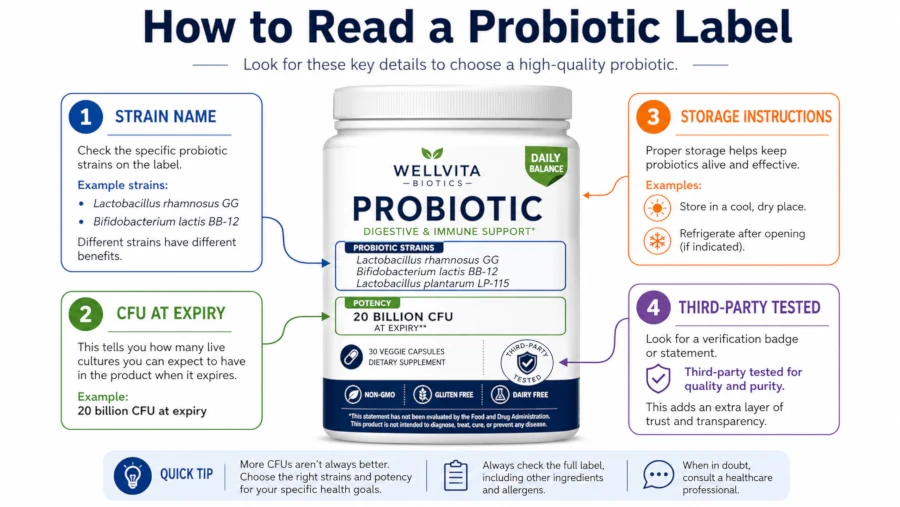
Notice what isn’t on that list: a bigger CFU number. There’s no good human evidence that a 50-billion product beats a 10-billion one for bloating, and higher doses are more likely to cause the gas you’re trying to get rid of during the first couple of weeks.
The products people ask about
These are the formulas that come up most often in this category. They’re grouped by what they’re built for — that’s a more useful way to choose than a ranking the evidence can’t support. Check the current label for strain names, CFU count, and storage before you buy, since formulations change.
| Product | Approach | Best suited to |
| Align | Single strain: Bifidobacterium infantis 35624 | Someone who wants the strain with the most direct IBS trial data, at a modest dose |
| Culturelle Digestive Daily | Single strain: Lactobacillus rhamnosus GG; shelf-stable | Travel and disrupted routines; sensitive guts that don’t tolerate big blends |
| Garden of Life Dr. Formulated Once Daily | Multi-strain blend; men’s and women’s versions; shelf-stable | General digestive support when no specific strain is being targeted |
| Nature’s Bounty Probiotic 10 | Multi-strain blend, lower cost | A first, low-commitment trial to see how your gut responds |
| Seed DS-01 | Synbiotic (probiotic + prebiotic); vegan; two-layer capsule | Plant-based diets and allergen avoidance; premium price |
| Renew Life Ultimate Flora Extra Care | Broad multi-strain, Bifidobacterium-heavy | People whose main complaint sits in the lower gut alongside irregularity |
| Visbiome (formerly marketed as VSL#3) | High-potency multi-strain; usually refrigerated | Complex or medically supervised cases — worth discussing with a clinician first |
One caution on that last row. High-potency, multi-strain formulas are the most likely to cause a noticeable adjustment period, and they are the least sensible place to start. If lower-dose products haven’t helped, that’s usually a signal to re-examine the diagnosis with a clinician, not to escalate the dose. And more strains is a marketing feature, not a proven advantage.
How to run a fair four-week trial
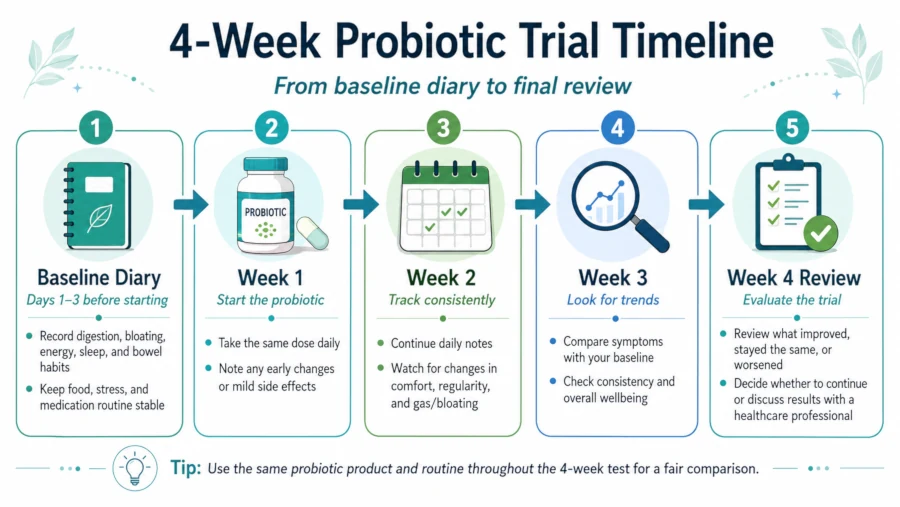
Most people test probiotics badly — they change three things at once, quit after five days, and learn nothing. If you’re going to spend the money, get an answer out of it.
- Pick one product and stick with it. Ideally one with a named strain. Don’t stack it with a new diet, a new fiber supplement, and a new exercise routine in the same week.
- Write down your baseline. Before you start, note for a few days: how bloated you feel (0–10), how often you pass gas, and your stool pattern. Memory is unreliable and placebo effects are strong here.
- Give it four to eight weeks. That’s the window most trials use. Expect a possible bump in gas in the first week or two as fermentation patterns shift.
- Judge it honestly, then stop or continue. If nothing has changed by eight weeks, it isn’t working for you. Stop. Trying a different strain family is reasonable; trying a fifth product in a row is not.
Meanwhile, work the levers with better odds: slow your eating, drop the gum and fizzy drinks, and address constipation if it’s part of the picture. Building meals around foods that support gut health and foods that are easier to digest tends to do more than a capsule. If cramping is a big part of your picture, enteric-coated peppermint oil has stronger guideline support for IBS symptoms than probiotics do.
Side effects, interactions, and who should be careful
For healthy adults, probiotics have a long track record of apparently safe use — but few studies have examined safety in detail, so the true frequency of side effects isn’t well established [NCCIH, 2019].
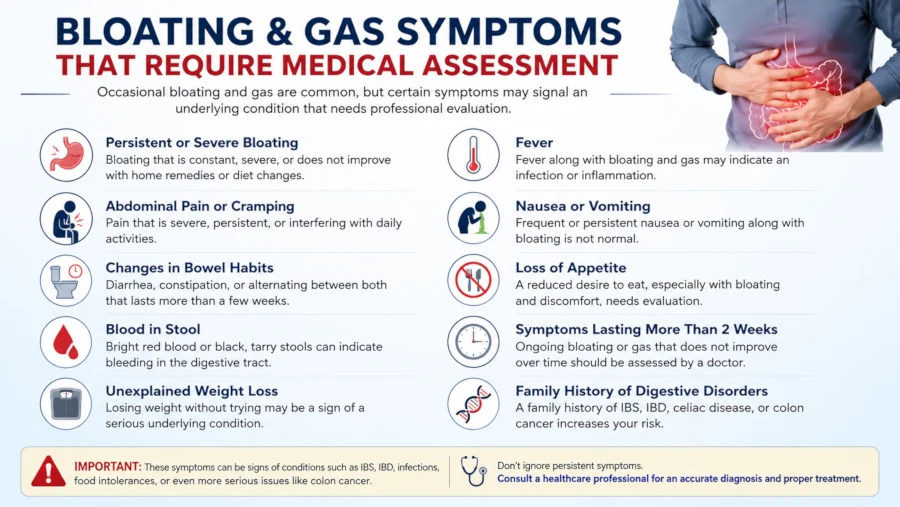
Common effects
Extra gas, bloating, and looser or firmer stools in the first days to weeks are the usual complaints. They typically settle. If symptoms get worse and stay worse, stop the product.
Interactions
There’s no well-established interaction between probiotics and common medications. The real caution is with immunosuppressants and with antibiotics — if you’re on either, ask your prescriber or pharmacist rather than assuming.
Pregnancy and breastfeeding
Fermented foods are fine. Probiotic supplements haven’t been well studied in pregnancy or breastfeeding, so the safe answer is to check with your midwife, obstetrician, or GP before starting one, rather than to assume that “natural” means “tested.”
Who should avoid them or get medical advice first
- Anyone with a weakened immune system, a serious illness, or a central line — the risk of harm from probiotics is higher in these groups [NCCIH, 2019].
- Premature infants. The FDA has warned that probiotics given to preterm babies have caused severe and in some cases fatal infections [NCCIH, 2019].
- People taking immunosuppressive medication, or recovering from major surgery.
- Anyone using a probiotic as a reason to put off getting an unexplained symptom looked at.
When bloating and gas need a doctor, not a supplement
Most gas is benign. Some isn’t. Talk with a doctor if [NIDDK, 2021]:
- Your symptoms change suddenly, or bother you enough to affect daily life.
- Gas comes with abdominal pain, constipation, diarrhea, or weight loss.
Seek care promptly — don’t wait out a supplement trial — for blood in the stool or black, tarry stools, unexplained weight loss, persistent vomiting, difficulty swallowing, symptoms that wake you at night, iron-deficiency anemia, or new bowel symptoms starting after age 50. Bloating that is genuinely new, persistent, and progressive in a woman also deserves prompt assessment, because that pattern can point to ovarian disease. None of that is a job for a probiotic.
| Health disclaimer: This article is for general education and is not a substitute for personalized medical advice, diagnosis, or treatment. Probiotics are dietary supplements, not medicines, and they are not reviewed by the FDA for effectiveness before sale. Talk with a qualified healthcare professional before starting one — especially if you are pregnant or breastfeeding, giving it to a child, immunocompromised, seriously ill, or taking prescription medication. If you have red-flag symptoms such as rectal bleeding, unexplained weight loss, or persistent vomiting, seek medical care rather than relying on a supplement. |
Frequently Asked Questions
What is the best probiotic for bloating and gas?
There isn’t one, and the honest answer is more useful than a fake one. Effects are strain-specific, and the largest meta-analysis couldn’t identify which species or strain works best [Ford et al., 2018]. Pick a product with a full strain name on the label, give it four to eight weeks, and judge it against a written baseline.
How long do probiotics take to work for bloating?
Trials generally measure results over four to eight weeks, not days. Some people notice gas changes in the first fortnight; for others the shift in stool pattern and comfort is gradual. If nothing has changed after eight weeks, that product isn’t working for you.
Can probiotics make gas worse at first?
Yes, and it’s common. A new probiotic — particularly a high-dose, multi-strain one — can increase gas and bloating for the first days to weeks as fermentation patterns shift. That usually settles. If it intensifies or keeps worsening, stop and consider a lower dose or a different strain.
Is yogurt as good as a probiotic supplement?
Not for targeting a specific strain. Many yogurts contain live cultures, but rarely the named strains at the doses used in research. Supplements let you pick a specific strain and dose. That said, fermented foods are a genuinely good habit and carry none of the label-accuracy problems that supplements can have [NCCIH, 2019].
Do I need a high CFU count?
No good human evidence says higher is better for bloating. What matters more is that the strain is named, that the count is guaranteed through the expiry date, and that you take it consistently. Very high doses mostly buy you a rougher adjustment period.
If the guidelines don’t recommend probiotics, why try one at all?
Because “we can’t recommend this” and “this doesn’t work” are different statements. The guidelines reflect inconsistent trials, not proof of failure [AGA, 2020; ACG, 2021]. For a healthy adult, a four-week trial of a well-labelled product is low-cost and low-risk. Just don’t let it delay looking into a symptom that needs a diagnosis.
References
- National Center for Complementary and Integrative Health (NCCIH), National Institutes of Health. Probiotics: Usefulness and Safety. 2019. View source
- National Institute of Diabetes and Digestive and Kidney Diseases (NIDDK), National Institutes of Health. Symptoms & Causes of Gas in the Digestive Tract. Last reviewed June 2021. View source
- Ford AC, Harris LA, Lacy BE, Quigley EMM, Moayyedi P. Systematic review with meta-analysis: the efficacy of prebiotics, probiotics, synbiotics and antibiotics in irritable bowel syndrome. Alimentary Pharmacology & Therapeutics. 2018;48(10):1044–1060. DOI 10.1111/apt.15001. PMID 30294792. View source
- Su GL, Ko CW, Bercik P, et al. AGA Clinical Practice Guidelines on the Role of Probiotics in the Management of Gastrointestinal Disorders. Gastroenterology. 2020;159(2):697–705. DOI 10.1053/j.gastro.2020.05.059. PMID 32531291. View source
- Lacy BE, Pimentel M, Brenner DM, et al. ACG Clinical Guideline: Management of Irritable Bowel Syndrome. American Journal of Gastroenterology. 2021;116(1):17–44. View source
- Monash University. The Low FODMAP Diet. View source
