
Contents
- 1 Medical disclaimer
- 2 Quick answer
- 3 How low is “too low” blood pressure?
- 4 Why nitric oxide (NO) supplements can lower BP
- 5 The #1 risk: stacking (starting too much at once)
- 6 Warning signs your BP may be too low
- 7 Who is at higher risk
- 8 The safest way to test an NO supplement
- 9 How to measure BP so you don’t get false alarms
- 10 If you feel dizzy: what to do
- 11 Frequently Asked Questions
- 12 Next reads
- 13 References
Medical disclaimer
This article that answers the question “can nitric oxide supplements lower blood pressure too much?” is for educational purposes only and is not medical advice. If you have high blood pressure, heart disease, kidney disease, are pregnant, or take prescription medications, talk with a qualified clinician before changing treatment or starting supplements. Do not stop or adjust blood pressure medication without your prescriber.[5]
Quick answer
Yes—it’s possible, especially if you already take blood pressure (BP) medication, have a lower baseline BP, or you start multiple BP‑lowering tools at once (“stacking”). Guidelines emphasize BP plans should be managed safely and adjusted with clinicians.[5] Dietary nitrate (beet/leafy greens) and L‑citrulline studies show modest BP reductions on average, which is helpful for many people, but can be too much for some—particularly when combined with meds, dehydration, alcohol, or heat exposure.[2][3][5]
How low is “too low” blood pressure?
There isn’t one perfect number for everyone, because symptoms matter. In general, many clinicians consider BP around < 90/60 mmHg more concerning—especially if you have symptoms like dizziness, fainting, or weakness. But even higher numbers can feel “too low” if your body is used to higher readings (for example, if you usually run 150/95 and suddenly you’re 110/70).
The key idea: a sudden drop + symptoms is the situation to take seriously.
Why nitric oxide (NO) supplements can lower BP
Nitric oxide is a signaling molecule that helps blood vessels relax. When vessels relax, resistance can decrease and BP may drift lower.[1] Common “NO supplements” work in different ways, but the end result can overlap: slightly easier vessel relaxation.
Common “NO boosters” and how they can affect BP
| Type | Common examples | How it may influence BP | Why problems happen |
| Dietary nitrate | Beetroot juice, arugula, spinach, romaine | Can modestly lower BP in some settings on average.[2] | Often combined with meds, dehydration, or other BP-lowering tools |
| Amino acids | L‑citrulline, L‑arginine, watermelon | Meta‑analyses show modest average BP reductions in some groups.[3] | Dose too high, stacking, sensitive individuals |
| Pre‑workout blends | “NO boosters” mixes | May combine multiple actives; effects can add up | Hard to know what you’re reacting to |
| Lifestyle NO support | Walking, exercise, sleep consistency | Exercise improves endothelial function markers and can improve BP trends.[4][5] | Too many changes at once makes the BP drop feel sudden |
The #1 risk: stacking (starting too much at once)
Most “too low BP” stories aren’t from one small change. They’re from stacking:
• Starting a supplement + increasing walking + cutting salt + adding sauna + drinking less water (all in the same week)
• Or starting an NO supplement while on BP meds, then adding alcohol or heat exposure
Even healthy tools can combine into a bigger drop than you expected.
Warning signs your BP may be too low
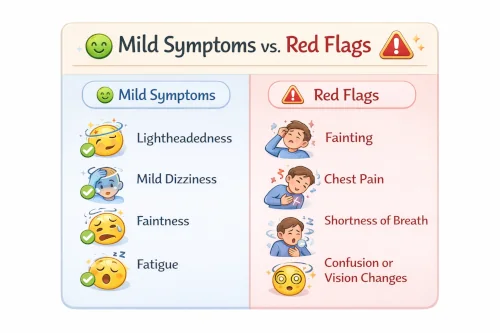
Use this as a practical checklist. If you have red‑flag symptoms, seek urgent evaluation.
Symptoms: mild vs urgent
| Symptom | Why it matters | First step | When it’s urgent |
| Dizziness / lightheadedness | Can be hypotension, dehydration, or med/supplement stacking | Sit/lie down; drink water; recheck BP in 10–15 min | Urgent if severe, recurrent, or with chest pain/shortness of breath |
| Feeling faint / near‑syncope | Higher risk sign than mild dizziness | Stop new supplement; check BP; contact clinician | Urgent if you actually faint |
| Fainting (syncope) | Can signal dangerous drop or rhythm issue | Seek urgent evaluation | Always urgent |
| Unusual weakness / “washed out” feeling | May indicate BP drop or electrolyte issues | Check BP + hydration; stop new change | Urgent if sudden with confusion or severe symptoms |
| Blurred vision / confusion | Could indicate poor perfusion or other causes | Stop new supplement; get medical help | Urgent, especially with neuro symptoms |
Who is at higher risk
If any of these apply, involve your clinician before supplement testing (and track closely). Guidelines emphasize safe monitoring and clinician-guided adjustments.[5]
- You take BP medication (especially more than one).
- You already run low BP or have had fainting episodes.
- You’re older and more prone to dehydration or orthostatic hypotension.
- You have kidney disease (BP regulation is more complex).[6]
- You use chest pain nitrates or other strong vasodilators (requires clinician oversight).
Higher-risk situations and safer approaches
| Situation | Why risk is higher | Safer approach |
| On BP meds | Additive BP‑lowering effects | Clinician‑supervised trial + home BP log; change one thing at a time[5] |
| Low baseline BP | Less margin before symptoms | Avoid supplement trials without supervision; prioritize food + movement instead |
| Kidney disease | Complex fluid/electrolyte/BP regulation | Discuss plan with clinician; avoid DIY stacking[6] |
| Dehydration / heat exposure | Lower blood volume → BP drops easier | Hydrate; avoid sauna/alcohol during trial week |
| Multiple supplements | Hard to know what caused symptoms | Test one ingredient at a time (single‑ingredient product) |
The safest way to test an NO supplement
If you’re going to test a supplement, treat it like a mini‑experiment. This avoids panic and helps you learn what actually works for you.
7‑day baseline + 14‑day test
| Phase | What you do | What you avoid | What to record |
| Days 1–7 (baseline) | Measure BP daily with consistent technique | Changing meds/salt/exercise drastically | 2 readings, 1 min apart; average + symptoms |
| Days 8–21 (test) | Add ONE supplement at lowest reasonable dose | Adding other new BP tools; sauna; heavy alcohol; dehydration | BP + dose/time + symptoms |
| If symptoms happen | Stop the new supplement and reassess | “Pushing through” dizziness/faintness | Lowest BP reading + what happened + hydration |
How to measure BP so you don’t get false alarms
A lot of “my BP crashed” moments are measurement problems. Keep it consistent:
- Sit quietly for 5 minutes before measuring.
- Feet flat, back supported, arm supported at heart level.
- Take 2 readings 1 minute apart and record the average.
- Compare weekly averages—not one-off spikes/dips.[5]
If you feel dizzy: what to do
- 1) Sit or lie down immediately (don’t “push through”).
- 2) Drink water. If you haven’t eaten, have a small snack.
- 3) Recheck BP after 10–15 minutes.
- 4) Stop the new supplement for now.
- 5) If symptoms are severe, you faint, or you have chest pain/shortness of breath, seek urgent evaluation.
Frequently Asked Questions
- Is this common? Many people tolerate nitrate foods and single‑ingredient supplements well. The risk rises when you’re on BP meds, have low baseline BP, or stack multiple changes quickly.[5]
- What’s the safest first step for NO support? Food-first nitrate vegetables + regular walking + good measurement. These are supported by research and guidelines as part of a broader BP plan.[2][4][5]
- Should I stop my BP medication if my numbers improve? No. Do not adjust medication without your prescriber. Guidelines emphasize safe, clinician‑guided changes.[5]
- Can NO supplements affect kidneys? The NO system is involved in kidney physiology and BP regulation. If you have kidney disease, involve your clinician before supplement use.[6]
Next reads
- Nitric Oxide: The Complete Guide for Blood Pressure & Heart Health
- Nitric Oxide Supplements for Blood Pressure: What Helps, What’s Safe
- L‑Citrulline Dosage for Blood Flow (Plus BP Safety)
- Nitric Oxide Foods: Nitrate‑Rich Vegetables + Easy Meal Ideas
- Nitric Oxide and Blood Pressure: What It Does and What to Track
- Beetroot Juice for Blood Pressure (How to Use It Safely)
References
- [1] Rodionov RN, et al. Nitric Oxide in Hypertension. Int J Mol Sci. 2021. (Open access via PMC) https://pmc.ncbi.nlm.nih.gov/articles/PMC8109558/
- [2] Norouzzadeh M, et al. Plasma nitrate, dietary nitrate, blood pressure, and vascular health biomarkers: systematic review and dose-response meta-analysis of randomized controlled trials. Nutr J. 2025. https://pubmed.ncbi.nlm.nih.gov/40128734/
- [3] Luo P, et al. Does L‑citrulline supplementation and watermelon intake reduce blood pressure in middle‑aged and older adults? Systematic review & meta‑analysis of randomized controlled trials. 2025. https://pubmed.ncbi.nlm.nih.gov/40789388/
- [4] Liang C, et al. Exercise interventions for the effect of endothelial function in hypertension patients: systematic review and meta-analysis. 2024. (Open access via PMC) https://pmc.ncbi.nlm.nih.gov/articles/PMC11180684/
- [5] 2025 AHA/ACC/AANP/AAPA/ABC/ACCP/ACPM/AGS/AMA/… Guideline for the Prevention, Detection, Evaluation, and Management of High Blood Pressure in Adults. Hypertension. 2025. https://www.ahajournals.org/doi/10.1161/HYP.0000000000000249
- [6] Lee J, et al. Nitric oxide in the kidney: its physiological role and pathophysiological implications. 2008. (Open access via PMC) https://pmc.ncbi.nlm.nih.gov/articles/PMC3894485/
Last updated: 2026-01-03