
Your monitor is probably fine. Almost every confusing reading comes from method, not from the machine — and the method takes about ten minutes a day for a week. Sit still for five minutes. Take two readings a minute apart. Do that once in the morning and once in the evening for seven days, then average them. That average is the number worth acting on, and everything else about home blood pressure monitoring is detail hanging off that one idea.
A single reading is close to meaningless on its own. Yours moves with posture, bladder, caffeine, conversation and the hour of the day. The number that alarmed you at 8 p.m. often will not survive a careful measurement the next morning. What follows is how to build a log your doctor can actually use — and how to read it without checking four more times tonight.
What home blood pressure monitoring can and cannot do
Measuring yourself does not lower your blood pressure. That reads as obvious written down, but the way monitors are sold implies otherwise.
The strongest evidence here is an individual patient data meta-analysis that pooled 15 randomized trials covering 7,138 people. Self-monitoring on its own reduced systolic pressure by about 1 mmHg at 12 months — an effect small enough that the confidence interval crossed zero (−1.0 mmHg, 95% CI −3.3 to 1.2). Paired with real support, the picture changed. With intensive co-interventions — scheduled medication adjustment by a doctor, pharmacist or the patient, plus education or lifestyle counseling — systolic pressure fell by about 6 mmHg (−6.1 mmHg, 95% CI −9.0 to −3.2) (Tucker and colleagues, PLOS Medicine, 2017).
Take that as an instruction rather than a discouragement. The cuff is a measuring instrument. It pays off when the readings feed a decision — a dose change, a confirmed diagnosis, a follow-up appointment moved up — and it does close to nothing sitting in a drawer.
Two jobs home readings do particularly well:
- They confirm a diagnosis. The U.S. Preventive Services Task Force gives blood pressure screening its strongest rating, a Grade A, and recommends obtaining measurements outside the clinical setting to confirm the diagnosis before treatment begins (U.S. Preventive Services Task Force, 2021).
- They catch the two mismatches. White coat hypertension means readings run high at the office and normal everywhere else. Masked hypertension is the reverse — the office numbers look fine while pressure runs high during ordinary life (American Heart Association News, 2022). Only out-of-office measurement tells those apart, and masked hypertension is the one that otherwise goes untreated.
Choose a monitor that has actually been tested
Buy an automatic, cuff-style, upper-arm monitor. That is the type the American Heart Association recommends, and it specifically discourages wrist and finger models (American Heart Association guidance on home monitoring, 2025). European practice guidelines put it more bluntly: wrist devices are “generally not recommended because of their inferior accuracy compared with upper-arm devices,” with a narrow exception for validated wrist devices in people whose arms are too large for a reliable upper-arm reading (European Society of Hypertension measurement guidelines, 2021 — European guidance).
Validation matters more than brand or price. Monitors are supposed to pass an established accuracy protocol, and the 2021 European guidelines report that fewer than 10% of devices on the market have done so. In the US, the American Medical Association runs ValidateBP, a free listing of monitors that have passed independent accuracy review (American Medical Association ValidateBP). Check your model there before you buy — or check the one already in your cabinet.
Skip the cuffless gadgets for now. The 2025 AHA/ACC high blood pressure guideline advises against relying on cuffless devices, including smartwatches, until the technology is more precise and reliable (2025 AHA/ACC high blood pressure guideline). European guidance reaches the same conclusion: cuffless devices should not be used for diagnostic or treatment decisions.
One more step people skip. Take your new monitor to your next appointment and have your doctor or nurse check that you are using it correctly and getting results that line up with the office equipment. The American Heart Association suggests bringing it in about once a year (American Heart Association guidance on home monitoring, 2025).
Getting the cuff size right
A cuff that is too small pushes readings up by roughly 2 to 10 mmHg (American Heart Association, Measuring Blood Pressure Accurately). The sizing rule is proportional: the inflatable bladder inside the cuff should run 75% to 100% of your arm circumference in length and 37% to 50% in width.
You do not have to do that arithmetic. Wrap a tape measure around the midpoint of your bare upper arm, note the number, and match it to the range printed on the cuff or listed in the device instructions (ESH practice guidelines, 2021 — European guidance). If you land near the top of one cuff’s range, order the next size up. Many monitors sell a large or extra-large cuff separately, and it is the cheapest accuracy upgrade you can buy.
How to take a reading that counts
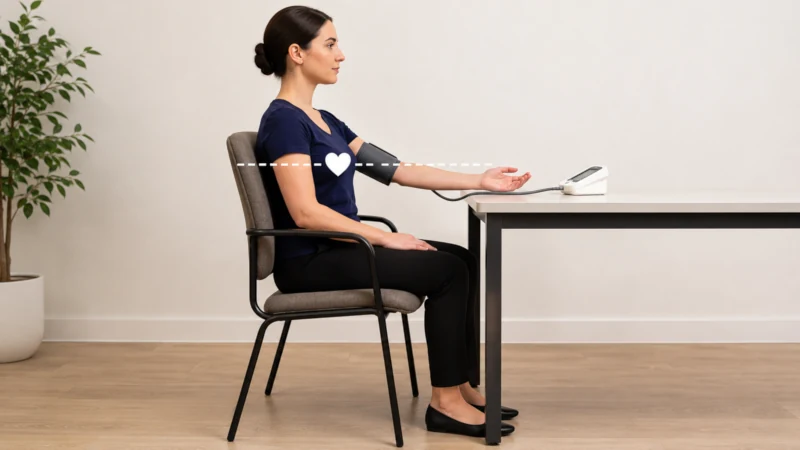
The preparation does more work than the technique. Both the CDC and the American Heart Association converge on the same short list (CDC guidance on measuring blood pressure, 2024):
- Nothing to eat or drink for 30 minutes beforehand — and no caffeine, smoking or exercise in that window.
- Empty your bladder first.
- Sit in a chair with your back supported and stay quiet for a full five minutes. No phone, no conversation.
Then, for the measurement itself:
- Feet flat on the floor, legs uncrossed, back against the chair.
- Rest your arm on a table so the cuff sits at heart level. Prop it on a book or a cushion if the table is low.
- Put the cuff on your bare upper arm, with the bottom edge just above the bend of your elbow. Snug, not tight.
- Press start and stay silent. Do not move your arm.
- Write down the reading and the time.
- Wait a minute, then take a second reading exactly the same way.
Two readings is the standard, not a nicety — the AHA says to take two one minute apart each time you measure, and the CDC says at least two, one to two minutes apart (American Heart Association guidance on home monitoring, 2025). Average them. That average is your reading for that session.
Errors that quietly inflate your numbers
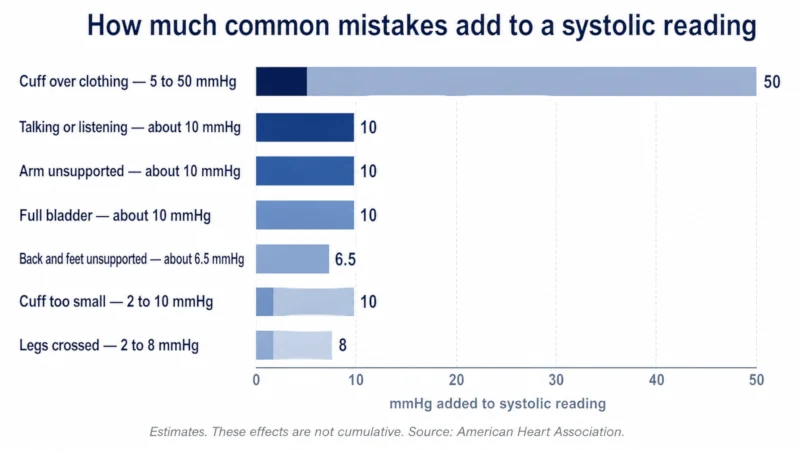
The American Heart Association publishes rough magnitudes for the common mistakes (American Heart Association, Measuring Blood Pressure Accurately):
| Mistake | Typical effect on systolic reading | Fix |
| Talking, or listening to someone talk | about 10 mmHg | Stay silent from the moment you press start. |
| Arm unsupported | about 10 mmHg | Rest the arm on a table at heart level. |
| Full bladder | about 10 mmHg | Use the bathroom before you sit down. |
| Back and feet unsupported | about 6.5 mmHg | Use a chair with a back. No perching on a stool. |
| Legs crossed | 2 to 8 mmHg | Both feet flat on the floor. |
| Cuff over clothing | 5 to 50 mmHg | Bare arm. Take the sleeve off rather than pushing it up. |
| Cuff too small | 2 to 10 mmHg | Measure your arm and match the printed range. |
Those figures are estimates, and the AHA notes they are not cumulative — you cannot add them up to predict how far off a sloppy reading will be. What they explain is how a rushed measurement lands 15 points above a careful one taken ten minutes later, with nothing wrong with the device.
The clothing one surprises people most. A thin cotton sleeve might add a few points; a thick sweater can throw the reading off by dozens (American Heart Association News, 2022). For a fuller walkthrough of the physical technique, see our step-by-step technique guide.
The seven-day routine that produces a usable number
You do not need to measure four times a day forever. You need a structured week to establish where you actually stand, then a much lighter maintenance rhythm.
| Phase | When | How many | How long |
| Baseline week | Morning and evening, at roughly the same hours each day | 2 readings per session, 1 minute apart | 7 consecutive days |
| Before a medication change or follow-up | Morning and evening | 2 readings per session | 3–7 days before the appointment |
| Maintenance | Same time of day each week | 2 readings, 1 minute apart | 1–2 sessions per week |
Morning means within an hour of waking, after you have used the bathroom, before breakfast and before you take any blood pressure medication. Evening means before dinner, or at least two hours after eating.
Consistency beats precision here. Measuring at 7 a.m. on Monday and 11 a.m. on Wednesday introduces variation you cannot interpret, because blood pressure follows a daily rhythm and morning numbers tend to run higher than evening ones. If you want the detail behind that pattern, we cover morning versus evening readings and the morning blood pressure surge separately.
One protocol difference worth knowing about: European practice guidelines tell you to discard the first day entirely and average everything after it, on the grounds that first-day readings tend to run high while you are still learning the routine (European Society of Hypertension measurement guidelines, 2021 — European guidance). US guidance does not spell out that step. Discarding day one costs you nothing, so it is a reasonable default — just mention which convention you used when you hand the log over.
After the baseline week, drop to one or two sessions a week unless your doctor asks for more (CDC, living with high blood pressure, 2024). You are watching a trend, not auditing yourself every morning.
How to average your log
Average the session averages. Here is a full week, with day one set aside:
| Day | Morning session average | Evening session average |
| Day 1 | set aside | set aside |
| Day 2 | 134/85 | 128/81 |
| Day 3 | 131/83 | 127/80 |
| Day 4 | 136/86 | 130/82 |
| Day 5 | 133/84 | 126/79 |
| Day 6 | 130/82 | 129/81 |
| Day 7 | 135/85 | 128/80 |
Add the twelve systolic numbers: 1,567. Divide by 12: 130.6, which rounds to 131. Do the same for the diastolic numbers: 988 divided by 12 is 82.3, which rounds to 82.
The weekly average is 131/82. Not the 136 that showed up on Thursday morning, and not the 126 from Friday evening. Those two readings are the same week, the same person, the same cuff — which is exactly why neither of them is the answer.
Write the readings down as you go, on paper or in the app that came with the monitor, and bring the log to your appointment. The CDC’s advice is simply to record every reading and share it with your care team, because treatment decisions rest on readings collected over time rather than on any single visit (CDC, living with high blood pressure, 2024).
What your average actually means
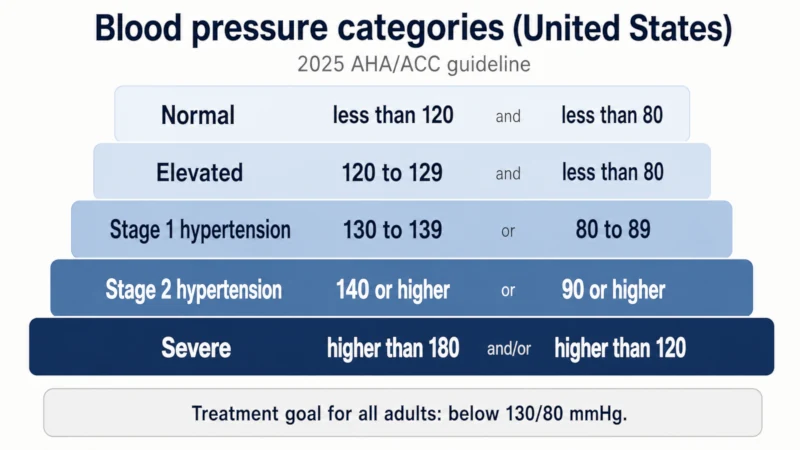
Here are the categories used in the US, unchanged in the 2025 AHA/ACC high blood pressure guideline (American Heart Association blood pressure categories, 2025):
| Category | Systolic (mmHg) | Diastolic (mmHg) | |
| Normal | less than 120 | and | less than 80 |
| Elevated | 120–129 | and | less than 80 |
| Stage 1 hypertension | 130–139 | or | 80–89 |
| Stage 2 hypertension | 140 or higher | or | 90 or higher |
| Severe | higher than 180 | and/or | higher than 120 |
The 2025 guideline sets a treatment goal of below 130/80 for all adults (2025 AHA/ACC high blood pressure guideline). That does not mean a home average of 131/82 puts you on medication tomorrow — treatment decisions weigh overall cardiovascular risk, not one number — but it does mean 131/82 is worth a conversation.
Here is where the guidance genuinely splits. The US categories above are written for office readings, and US practice applies the same 130/80 threshold to home averages. European guidelines set separate numbers: office 140/90, home 135/85 (European Society of Hypertension measurement guidelines, 2021 — European guidance). So the same 131/82 average reads as stage 1 hypertension under US thresholds and as normal under the European home threshold.
Neither set of experts is careless; they drew the lines from different trial evidence. If you have been reading British or European sources and wondering why the numbers do not match your doctor’s, that is why. In the US, use the US thresholds — and treat them as the start of a discussion rather than a verdict.
Expect your home average to differ from what the office machine says. If home runs lower, that pattern may be white coat hypertension. If home runs consistently higher than the office by 15 or 20 points, suspect technique or the device before you assume the worst: recheck your cuff size, your posture, and whether your model is on the validated list.
Then close the log. The routine that keeps people sane is a boring one — measure at fixed times, record, stop looking. Do not take a fourth reading because the third seemed high; you will mostly be measuring your own reaction to the third reading. The things that move the average over months are the ones you already suspect: regular exercise, sleep quality, and cutting back on sodium. The readings are feedback on those efforts, not a grade on your character.
When to call your doctor, and when to go now
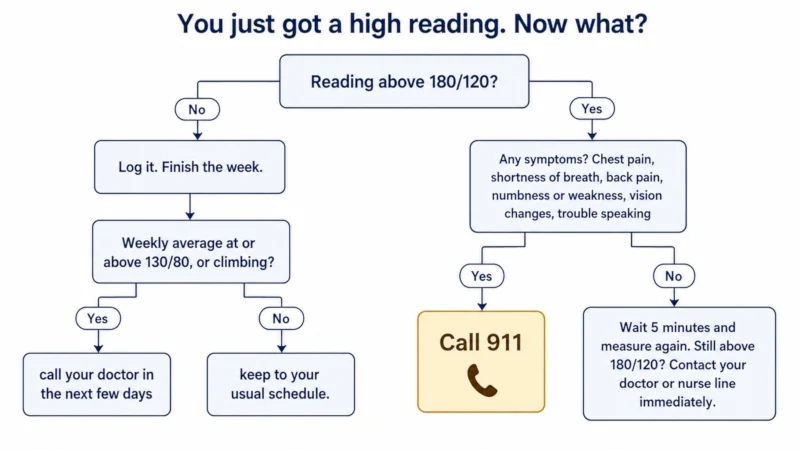
Call your doctor, in the next few days, if:
- Your weekly average sits at or above 130/80, or above whatever target your doctor set for you.
- Your average has climbed noticeably from one week to the next without an obvious explanation.
- Your readings have become erratic in a way they were not before.
- You are getting persistent error messages, or the two readings in a session differ by more than 10 to 15 mmHg every time.
Get help right away if:
- Your reading is above 180/120 and you have symptoms — chest pain, shortness of breath, back pain, numbness or weakness, vision changes, or difficulty speaking. Call 911 (American Heart Association blood pressure categories, 2025).
- Your reading is above 180/120 with no symptoms. Wait five minutes, measure again, and if it is still that high, contact your doctor or nurse line immediately.
One high reading on its own is not an emergency. A pattern of very high readings is a reason to call, and a severely elevated reading with symptoms is a reason to stop reading this and dial.
If you are pregnant
High blood pressure develops in roughly 1 in every 12 to 17 pregnancies in the US, and checking at home is part of standard care (NHLBI on high blood pressure in pregnancy, 2024). The thresholds are different, though: NHLBI describes a sudden spike above 160/110 mmHg as a medical emergency. Warning signs that need immediate attention include a worsening headache, overwhelming tiredness, dizziness, trouble breathing, chest or belly pain, swelling, or nausea. Ask your obstetric team what numbers they want you to report and how often to measure, rather than applying general adult targets to your pregnancy.
If your heart rhythm is irregular
Automatic monitors work by reading pulsations in the artery, and devices validated in the general adult population may not be accurate in people with arrhythmias, particularly atrial fibrillation (European Society of Hypertension measurement guidelines, 2021 — European guidance). If you have a known irregular rhythm, or your monitor repeatedly flags one, ask your doctor which device to use and whether your home numbers can be relied on at all.
If monitoring is making you anxious
For some people the cuff becomes the problem — checking spirals into rechecking, and the readings climb because of the checking. If that is where you have landed, say so out loud at your next appointment. There are alternatives, including 24-hour ambulatory monitoring, and a schedule of one session a week is a legitimate prescription rather than a failure of discipline.
And whatever your log says, do not change or stop a blood pressure medication on your own. Dose decisions belong to the person who prescribed it, working from your readings alongside everything else in your chart.
| Medical disclaimer: This article is for educational purposes and is not medical advice. It cannot account for your history, your medications or your risk. If you have high blood pressure, heart disease, kidney disease, an irregular heart rhythm, or you are pregnant or breastfeeding, talk with your doctor before changing how you monitor, and before changing treatment, diet, exercise or supplements. Never stop or adjust a blood pressure medication without the prescriber who wrote it. If you think you are having a medical emergency, call 911. |
Frequently Asked Questions
How often should I check my blood pressure at home?
Start with twice a day — morning and evening, two readings each time — for seven days, which is the protocol European guidelines use for diagnosis and before appointments (ESH practice guidelines, 2021 — European guidance). After that, one or two sessions a week is usually enough if your numbers are stable. Around a medication change, your doctor may want three to seven days of twice-daily readings before the follow-up visit. Ask what they want to see; the schedule should match the decision it is feeding.
Can I use a wrist monitor or my smartwatch instead?
The American Heart Association recommends an automatic upper-arm cuff and discourages wrist and finger monitors (American Heart Association guidance on home monitoring, 2025). A validated wrist device is a reasonable fallback if your upper arm is too large for any available cuff, and it has to be held at heart level exactly as instructed. Smartwatches and other cuffless devices are a different matter: the 2025 AHA/ACC guideline says not to rely on them for blood pressure measurement until they get more precise (2025 AHA/ACC high blood pressure guideline).
What if my two readings are very different?
A gap of a few points is ordinary. If the two readings in a session differ by more than about 10 to 15 mmHg, take a third after another minute and average all three, and note it in your log. When it happens every session, the usual culprits are talking, an arm that keeps slipping below heart level, a cuff that is the wrong size, or an irregular heart rhythm — worth mentioning to your doctor rather than solving alone.
Should I measure in both arms?
Check both arms the first time you use a new monitor. European guidelines advise measuring both arms at the initial visit; a difference in systolic pressure greater than 10 mmHg should be confirmed with repeat measurements, and a consistent difference above 20 mmHg calls for investigation of arterial disease (European Society of Hypertension measurement guidelines, 2021 — European guidance). Once you know which arm reads higher, use that arm every time so your log stays comparable.
My home readings are lower than the ones at my doctor’s office. Which is right?
Both, in the sense that they are measuring different situations. Readings that are high in the office and normal at home describe white coat hypertension; the reverse pattern, normal at the office and high at home, is masked hypertension and is the more dangerous of the two because it tends to go untreated (American Heart Association News, 2022). That is precisely why out-of-office measurement is recommended to confirm a diagnosis before treatment starts (U.S. Preventive Services Task Force, 2021). Bring the log — your doctor needs both pictures.
Do I have to measure at the exact same minute every day?
Within the same hour is fine. Measuring between 7:00 and 8:00 a.m. and again between 6:00 and 7:00 p.m. is consistent enough. What you are avoiding is comparing a 6 a.m. reading to an 11 p.m. one, which mostly shows you the daily rhythm rather than anything that changed.
References
- American Heart Association. Monitoring Your Blood Pressure at Home. Last reviewed August 14, 2025. View source
- American Heart Association. Understanding Blood Pressure Readings. Last reviewed August 14, 2025. View source
- American Heart Association. Measuring Blood Pressure Accurately (target:BP resource, drawing on Muntner P, et al. Measurement of Blood Pressure in Humans: A Scientific Statement From the American Heart Association. Hypertension. 2019;73(5)). View source
- American Heart Association News. Monitoring blood pressure at home can be tricky. Here’s how to do it right. May 23, 2022. View source
- American Heart Association / American College of Cardiology. 2025 Guideline for the Prevention, Detection, Evaluation and Management of High Blood Pressure in Adults — Top Things to Know. Published August 14, 2025. Full guideline: Circulation, DOI 10.1161/CIR.0000000000001356. View source
- American Heart Association and American Medical Association. Self-Measured Blood Pressure Monitoring at Home: A Joint Policy Statement (fact sheet). Updated February 2022. View source
- American Medical Association. ValidateBP — Validated Device Listing. View source
- Centers for Disease Control and Prevention. Measure Your Blood Pressure. Last reviewed December 13, 2024. View source
- Centers for Disease Control and Prevention. Living With High Blood Pressure. Last reviewed December 13, 2024. View source
- National Heart, Lung, and Blood Institute. High Blood Pressure During Pregnancy. Last updated April 30, 2024. View source
- Stergiou GS, Palatini P, Parati G, O’Brien E, Januszewicz A, Lurbe E, Persu A, Mancia G, Kreutz R. 2021 European Society of Hypertension practice guidelines for office and out-of-office blood pressure measurement. Journal of Hypertension. 2021;39(7):1293–1302. DOI 10.1097/HJH.0000000000002843. (European guidance.) View source
- Tucker KL, Sheppard JP, Stevens R, et al. Self-monitoring of blood pressure in hypertension: A systematic review and individual patient data meta-analysis. PLOS Medicine. 2017;14(9):e1002389. DOI 10.1371/journal.pmed.1002389. View source
- U.S. Preventive Services Task Force. Hypertension in Adults: Screening. Grade A recommendation, 2021. View source
