Black walnuts are a nutrient-dense food with protein, unsaturated fats, fiber, minerals, and plant compounds such as phenolics. Those are real black walnut benefits. What is much less certain is whether black walnut — especially its hull, leaf, bark, tinctures, or extracts — can treat medical conditions.
That distinction matters because black walnut (*Juglans nigra*) is not the same species as the English or Persian walnut (*Juglans regia*) used in most human clinical trials. A small human study has tested black walnuts directly, but the evidence is nowhere near strong enough to support claims that they cure parasites, lower blood pressure, prevent cognitive decline, or treat fungal infections. Fitschen et al., 2011
If you enjoy black walnuts as food, they can fit comfortably into a balanced diet. If you are considering a concentrated hull or leaf product for a health problem, the safety and evidence questions are different.
What Is a Black Walnut?
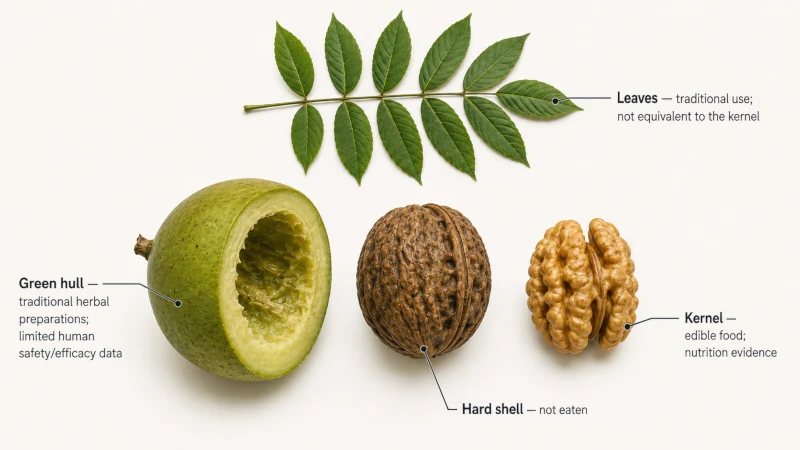
Black walnut is the nut of *Juglans nigra*, a tree native to eastern North America. The edible kernel has a bolder, earthier flavor than the more familiar English walnut, and its shell is notably hard. The green outer hull, leaves, and bark have also been used in traditional herbal preparations, but those non-food parts should not be treated as nutritionally or medically equivalent to the kernel.
This species difference is easy to miss. Most supermarket walnuts and nearly all of the best-known walnut clinical studies involve *Juglans regia*. Our guide to walnut health benefits explains that broader evidence base and why it cannot simply be copied onto black walnut.
Black Walnut Nutrition: What Is Well Established
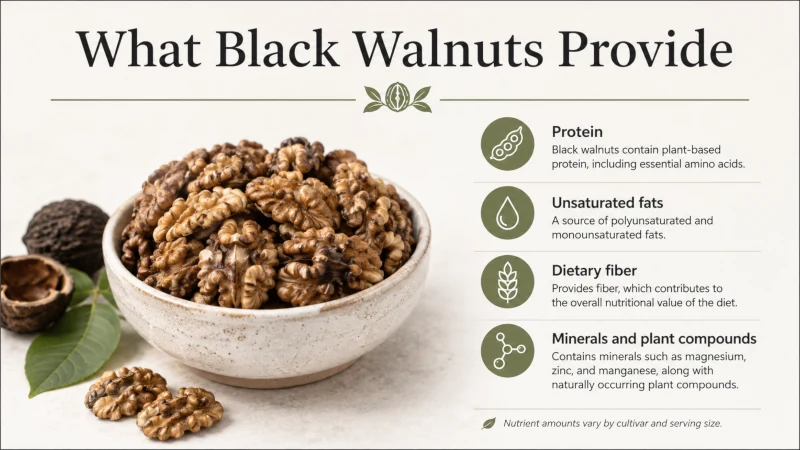
The nutritional case for black walnuts is stronger than the medicinal case. A 2022 analysis of black walnut cultivars reported about 24.06 grams of protein per 100 grams of kernels and described the nuts as dense in dietary fiber, monounsaturated fats, and polyunsaturated fats. The study also quantified vitamins, minerals, and amino acids across cultivars. Frontiers in Nutrition, 2022
Black walnut kernels also contain phenolic compounds. In an analysis of 11 cultivars, researchers identified 16 phenolics, including phenolic acids, flavonoids, and catechins; ellagic acid was the predominant phenolic. That tells us the food contains biologically interesting plant compounds. It does not, by itself, prove that eating black walnuts prevents a disease. Vu et al., 2018
Black Walnut Benefits: What the Evidence Actually Supports
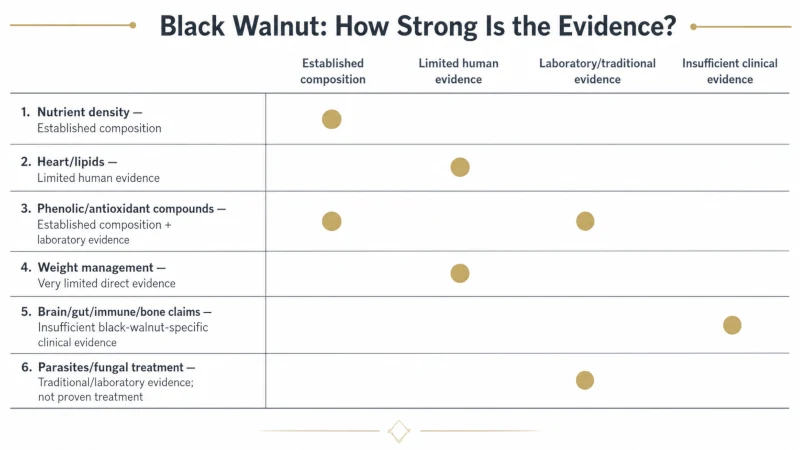
| Claim | Evidence for black walnut itself | Practical interpretation |
| Nutrient density | Established composition evidence | A useful whole-food source of protein, unsaturated fats, fiber, minerals, and plant compounds. |
| Heart/lipids | Limited human evidence | Promising enough to study, but not proven to lower cholesterol or cardiovascular risk on its own. |
| Antioxidant activity | Composition and laboratory evidence | Black walnut kernels and hull extracts contain phenolics; clinical disease-prevention benefits are unproven. |
| Weight management | Very limited direct evidence | A short trial did not show weight gain from 30 g/day, but black walnut is not a weight-loss treatment. |
| Brain, gut, immune, bone health | Insufficient black-walnut-specific clinical evidence | Nutrients may fit healthy dietary patterns, but condition-specific benefit claims should not be made. |
| Parasites, Candida, fungal/skin conditions | Traditional and laboratory evidence; inadequate human treatment evidence | Do not substitute black walnut preparations for diagnosis or proven treatment. |
1. A nutrient-dense source of protein and unsaturated fats
If your goal is simply to improve diet quality, the kernel is the most defensible place to focus. Black walnuts provide protein plus unsaturated fats and fiber in a compact food. Those nutrients can contribute to satiety and overall diet quality, especially when nuts replace foods higher in refined carbohydrates or saturated fat.
Black walnuts should still be viewed as one food within a broader eating pattern. If increasing fiber is a goal, include a range of fiber-rich foods such as beans, vegetables, fruit, and whole grains rather than relying on nuts alone.
2. Possible cardiovascular benefits, but black-walnut evidence is limited
The most relevant direct human study compared black and English walnuts. Thirty-six participants ate 30 grams per day for 30 days. English walnuts improved blood lipids; the black-walnut effects varied by sex. Neither nut caused weight gain during the study, and both altered red-blood-cell fatty-acid composition. In a small meal test involving six people with high cholesterol, English walnuts maintained endothelial function, while black walnuts did not. The researchers concluded that more black-walnut research was needed before making a specific cardiovascular recommendation. Fitschen et al., 2011
The broader walnut literature is more encouraging, but it mostly reflects English walnuts. A 2018 meta-analysis of 26 controlled trials involving 1,059 participants found walnut-enriched diets reduced total cholesterol by about 6.99 mg/dL and LDL cholesterol by about 5.51 mg/dL compared with control diets, without a significant change in body weight or blood pressure. Guasch-Ferré et al., 2018 Those findings are useful context, not proof that black walnuts produce the same effects.
3. Phenolic compounds with antioxidant activity
Black walnut kernels contain multiple phenolic compounds, including ellagic acid, and extracted hulls show antioxidant activity in laboratory assays. Vu et al., 2018 Wenzel et al., 2017
“Antioxidant” can sound more clinically meaningful than it is. A test-tube antioxidant result does not tell us that a hull tincture prevents cancer, slows aging, lowers inflammation in people, or treats infection. Human outcome studies are needed before making those claims.
4. Weight and fullness: useful food, not a weight-loss treatment
Nuts contain fat and are calorie-dense, but that does not mean a normal serving automatically promotes weight gain. In the 30-day black-versus-English-walnut trial, adding 30 grams of either nut did not cause weight gain. Fitschen et al., 2011
That is different from showing that black walnuts cause weight loss. Use them as a satisfying food — for example, in oatmeal, yogurt, salads, or baked dishes — rather than as a “fat-burning” remedy.
5. Brain, gut, immune, and bone claims need more direct research
Black walnuts contain nutrients relevant to normal body function, but direct clinical trials have not established that black walnuts improve memory, prevent cognitive decline, “boost” immunity, build bone density, or treat digestive disorders. Those claims are stronger than the black-walnut evidence can currently support.
For brain and nerve health, the more useful approach is a varied dietary pattern built around established nutrients and foods. See our evidence-based guide to foods for the nervous system for that broader context.
Black Walnut vs. English Walnut: Why the Species Matters
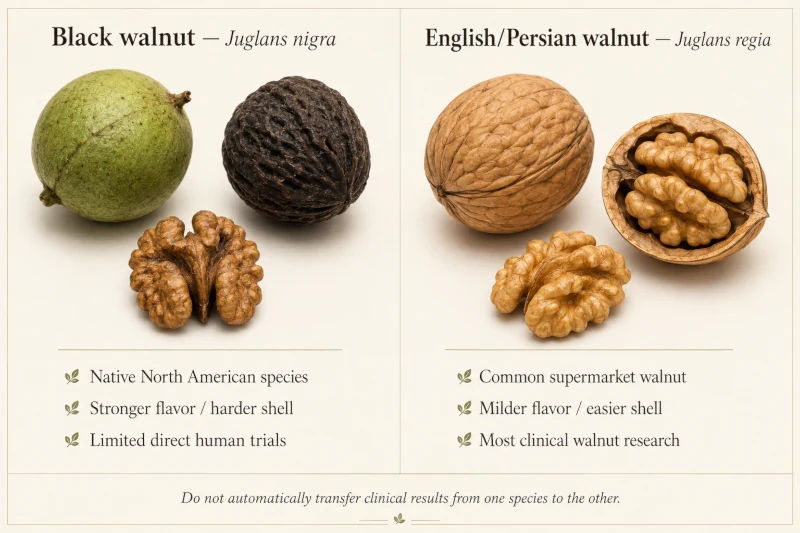
| Feature | Black walnut | English/Persian walnut |
| Scientific name | Juglans nigra | Juglans regia |
| Common U.S. use | Specialty nut; strong flavor; native North American species | Most supermarket walnuts and the species used in most clinical trials |
| Human clinical evidence | Limited | Substantially larger evidence base, especially for blood lipids and cardiovascular risk factors |
| Can evidence be transferred directly? | No | N/A — studies should be interpreted for the species actually tested |
This is the main reason sweeping online lists of black walnut benefits can be misleading. Walnuts share many nutritional features, but clinical outcomes demonstrated with one species should not be presented as if they were proven for another.
What About Black Walnut Hull for Parasites, Candida, or Skin Problems?
Black walnut hull has a long history in herbal practice, and laboratory work has found phenolic compounds with antioxidant and antibacterial activity in black walnut material. For example, one study measured antioxidant activity in extracted black walnut husks. That was a laboratory extraction study, not a trial showing that people with parasites, Candida overgrowth, ringworm, warts, herpes, or other infections were cured by black walnut. Wenzel et al., 2017
For suspected intestinal parasites, diagnosis matters because different organisms require different treatments. Our guide to herbs that kill parasites explains the evidence limits and why confirmed infections usually call for standard antiparasitic care.
The same principle applies to skin problems. Ringworm and other fungal infections of the skin can resemble eczema, dermatitis, and other conditions. A home-applied hull tincture can also irritate skin. If a rash is spreading, painful, recurrent, near the eyes, associated with fever, or not improving, get a medical diagnosis rather than repeatedly applying a concentrated botanical extract.
There is no established evidence-based oral dose of black walnut hull, leaf, or bark for treating parasites or fungal disease. That is a reason to avoid copying traditional tincture or capsule doses into modern medical guidance.
How to Use Black Walnuts as Food
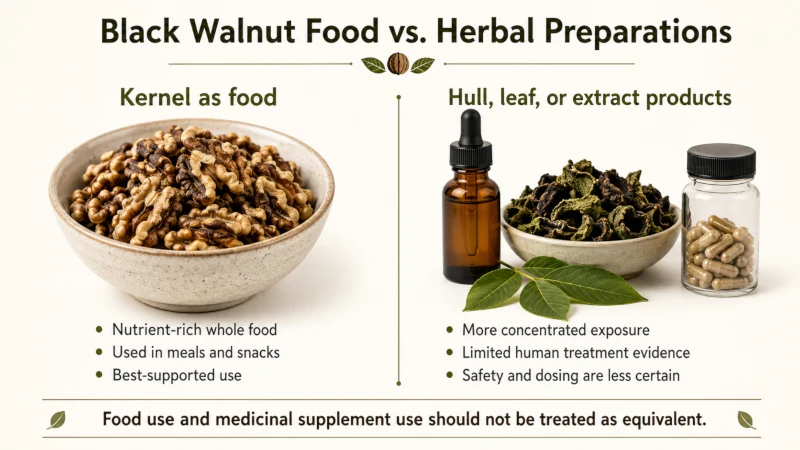
As food, black walnuts are straightforward: use the kernels the way you would use other nuts. Their stronger flavor means a little can go a long way. Practical options include:
- Add chopped black walnuts to oatmeal or unsweetened yogurt.
- Toss them into salads with fruit, leafy greens, or roasted vegetables.
- Use a small amount in muffins, quick breads, or whole-grain pancakes.
- Combine them with other nuts and seeds for a snack instead of eating a large portion at once.
- Refrigerate or freeze shelled nuts if you will not use them soon; their unsaturated fats can become rancid with prolonged warm storage.
The 2011 black-walnut trial used 30 grams per day — roughly an ounce — as a research amount, not as a medically proven dose. Fitschen et al., 2011 Your appropriate portion depends on the rest of your diet, calorie needs, allergies, and tolerance.
Black Walnut Side Effects and Safety
Tree-nut allergy and anaphylaxis
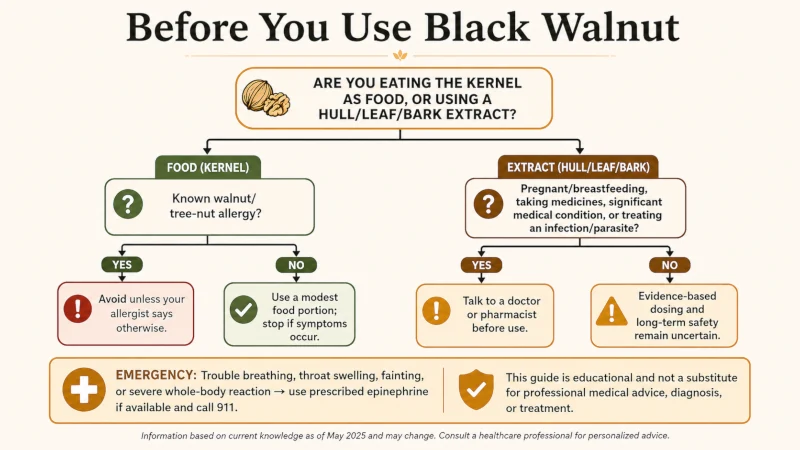
Black walnut is a tree nut and can trigger serious allergic reactions. Researchers have identified a black-walnut allergen called Jug n 4, and the FDA classifies tree nuts among the major food allergens. Zhang et al., 2017 FDA Food Allergies, accessed 2026
Do not eat black walnuts if you have a known walnut allergy unless your allergist has specifically told you they are safe. Trouble breathing, throat swelling, fainting, or a rapidly progressing whole-body allergic reaction can be anaphylaxis. Use prescribed epinephrine if available and call 911. MedlinePlus Food Allergy, 2026
Digestive tolerance
A large serving of nuts can cause fullness, bloating, loose stools, or stomach discomfort in some people, especially if they suddenly increase fat or fiber intake. Start with a modest food portion if black walnuts are new to you. Persistent or severe digestive symptoms deserve medical evaluation rather than repeated self-testing with supplements.
Hull, leaf, bark, and concentrated extracts
Concentrated preparations are a different exposure from eating the kernel. Safety data are thinner, product strength can vary, and traditional use does not establish a safe modern dose. A medically reviewed Natural Products monograph notes that interactions are not well documented and advises disclosing herbal products before surgery or medical procedures. Drugs.com Natural Products monograph, 2025
Topical hull products may also irritate skin. Stop using a topical preparation if it causes burning, blistering, swelling, or a worsening rash.
Pregnancy and breastfeeding
Eating familiar foods in ordinary dietary amounts is a different question from taking a concentrated herbal preparation. For black walnut preparations, reliable pregnancy and breastfeeding safety data are inadequate. The Natural Products monograph advises avoiding black walnut preparations during pregnancy and lactation. Drugs.com Natural Products monograph, 2025
Medications and medical conditions
Do not assume a black walnut supplement is interaction-free simply because it is natural. Documented interaction data are limited, which creates uncertainty rather than proof of safety. If you take prescription medicines, use anticoagulants, have a significant medical condition, are preparing for surgery, or are considering a concentrated hull/leaf product, ask a doctor or pharmacist to review the product and ingredient list first.
When to Talk to a Doctor
Get medical advice rather than relying on black walnut supplements if you have a suspected parasite or fungal infection, a persistent unexplained rash, ongoing diarrhea or abdominal pain, unexplained weight loss, blood in the stool, fever, or symptoms that are getting worse.
Call 911 for signs of a severe allergic reaction such as trouble breathing, throat swelling, fainting, or rapidly worsening multi-system symptoms after eating a nut. MedlinePlus Food Allergy, 2026
| Health Disclaimer This article is for educational and informational purposes only. It does not diagnose, treat, cure, or prevent any disease and is not a substitute for medical advice. Black walnut kernels used as food and concentrated hull, leaf, bark, tincture, or extract products are not equivalent exposures. Talk with your doctor or pharmacist before using a black walnut supplement if you take medicines, have a medical condition, are pregnant or breastfeeding, or are considering it to treat symptoms. Seek urgent care for severe or worsening symptoms, and call 911 for a suspected anaphylactic reaction. |
Frequently Asked Questions
Are black walnuts healthier than English walnuts?
Not clearly. Black and English walnuts have overlapping nutritional strengths, but they are different species. Black walnuts are protein- and unsaturated-fat-rich and contain phenolics, while English walnuts have a much larger body of human clinical research. “Healthier” depends on what you are measuring; the evidence does not justify calling black walnuts medically superior.
Do black walnuts kill parasites?
Black walnut hull has a history of traditional use and laboratory studies show bioactive compounds, but that is not the same as clinical proof that it clears intestinal parasites in people. A suspected parasite should be diagnosed so the organism can be treated appropriately.
Can black walnuts lower cholesterol?
A small trial found that black-walnut effects on blood lipids varied by sex and concluded that more research was needed. Broader walnut trials — mostly English walnuts — show modest LDL and total-cholesterol reductions, but those results should not be presented as proven black-walnut effects.
How many black walnuts should I eat per day?
There is no medically required daily amount. One direct study used 30 grams per day for 30 days, but that was a research amount, not a therapeutic prescription. A modest nut serving can fit a balanced diet if you tolerate tree nuts and account for total calories.
Is black walnut hull safe to take every day?
Long-term safety and effective dosing for concentrated hull preparations are not well established. Avoid self-prescribing a daily hull product for parasites, fungal infections, or other medical conditions. Pregnancy and breastfeeding are additional reasons to avoid medicinal black walnut preparations unless a qualified professional specifically recommends otherwise.
Can I put black walnut tincture on ringworm or warts?
Laboratory antibacterial activity does not prove that a tincture will safely treat a human skin infection or wart. Concentrated hull products may irritate skin, and several conditions can look similar. Use condition-specific, evidence-based treatment after a proper diagnosis if the problem persists or spreads.
References
- Fitschen PJ, Rolfhus KR, Winfrey MR, et al. “Cardiovascular effects of consumption of black versus English walnuts.” Journal of Medicinal Food. 2011;14(9):890-898. PMID 21488754. DOI 10.1089/jmf.2010.0169. View source
- “Quantification of Vitamins, Minerals, and Amino Acids in Black Walnut (Juglans nigra).” Frontiers in Nutrition. 2022;9:936189. DOI 10.3389/fnut.2022.936189. View source
- Vu DC, Vo PH, Coggeshall MV, Lin C-H. “Identification and Characterization of Phenolic Compounds in Black Walnut Kernels.” Journal of Agricultural and Food Chemistry. 2018;66(17):4503-4511. PMID 29663801. DOI 10.1021/acs.jafc.8b01181. View source
- Guasch-Ferré M, Li J, Hu FB, Salas-Salvadó J, Tobias DK. “Effects of walnut consumption on blood lipids and other cardiovascular risk factors: an updated meta-analysis and systematic review of controlled trials.” American Journal of Clinical Nutrition. 2018;108(1):174-187. PMID 29931130. DOI 10.1093/ajcn/nqy091. View source
- Wenzel J, Storer Samaniego C, Wang L, et al. “Antioxidant potential of Juglans nigra, black walnut, husks extracted using supercritical carbon dioxide with an ethanol modifier.” Food Science & Nutrition. 2017;5(2):223-232. PMID 28265357. DOI 10.1002/fsn3.385. View source
- Zhang Y-Z, Du W-X, Fan Y, et al. “Purification and Characterization of a Black Walnut (Juglans nigra) Allergen, Jug n 4.” Journal of Agricultural and Food Chemistry. 2017;65(2):454-462. PMID 27936684. DOI 10.1021/acs.jafc.6b04387. View source
- U.S. Food and Drug Administration. “Food Allergies.” FDA. Current page accessed August 24, 2026. View source
- National Library of Medicine. “Food Allergy.” MedlinePlus. Current page accessed August 24, 2026. View source
- Wolters Kluwer / Drugs.com. “Walnut Uses, Benefits & Dosage” (Juglans nigra L.; Juglans regia L.). Medically reviewed; updated November 19, 2025. View source
