
If you’ve come across a bag of dried fumitory or a tincture and want to know what it’s good for, here’s the honest short version. The fumitory benefits with real backing are modest: this bitter European herb has a long tradition for easing minor digestive upset — that bloated, over-full, sluggish feeling after a meal — and a European medicines regulator recognizes it for exactly that, based on centuries of use rather than strong clinical trials. The bigger claims you’ll read elsewhere, from clearing eczema to lowering blood pressure, mostly rest on folk tradition and lab studies, not solid evidence in people.
That doesn’t make fumitory useless. It makes it a gentle traditional remedy with a narrow, believable role and a few cautions worth knowing. Here’s the full picture.
What fumitory actually is
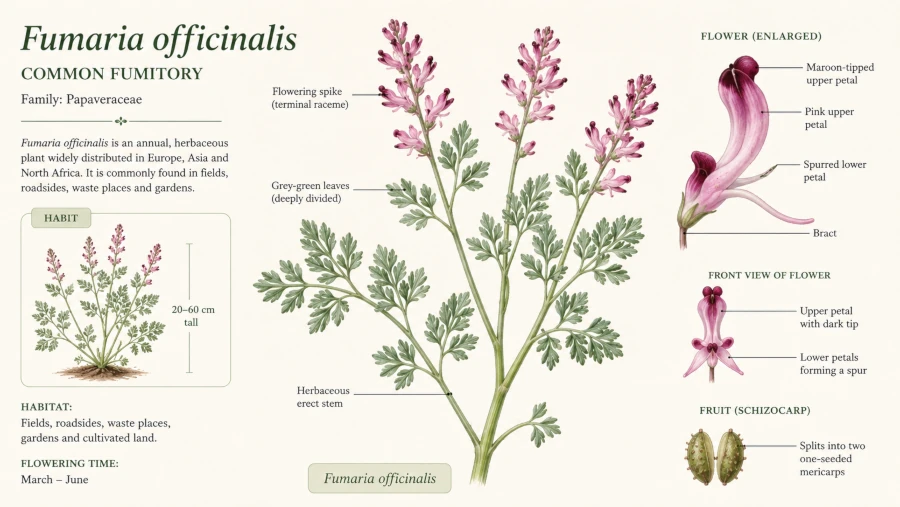
Fumitory is a small annual plant, Fumaria officinalis, with feathery grey-green leaves and pink flowers tipped in deep maroon. It belongs to the poppy family (Papaveraceae; older herbals place it in its own family, Fumariaceae). You’ll also see it called earth smoke or hedge fumitory.
The name comes from the Latin fumus, meaning smoke. Two explanations have followed the plant since antiquity: from a distance its hazy grey foliage can look like smoke rising from the ground, and Pliny noted that the juice of the crushed plant stings the eyes the way smoke does. Physicians from Dioscorides onward valued it, mainly as a “depurative,” or blood-cleansing, herb [EMA, 2023]. The part used in herbal medicine is the dried above-ground portion gathered while flowering — leaves, stems, and flowers — not the root.
What the evidence says about fumitory’s benefits
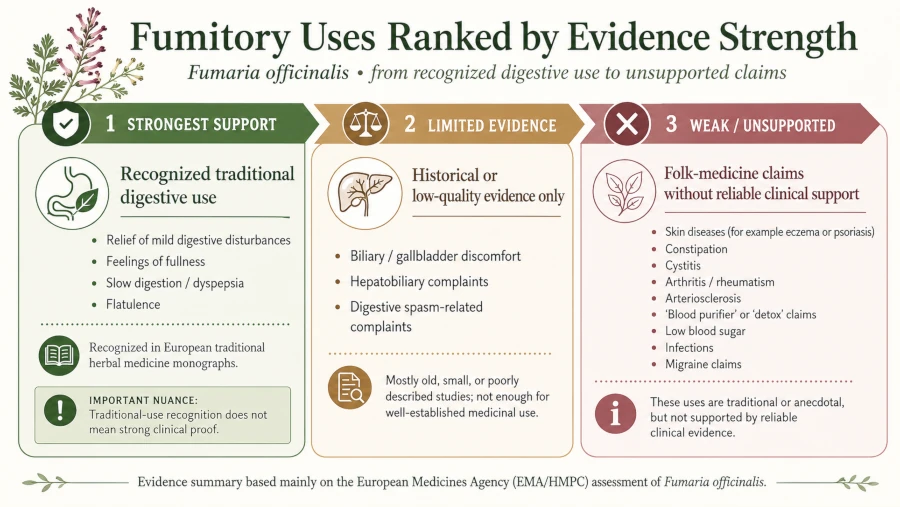
Fumitory’s reputation is broad, but the evidence behind each use varies a lot. It helps to sort the claims into what’s recognized, what’s only traditional, and what’s a case of mistaken identity.
Easing minor digestive discomfort (the best-supported use)
This is the one use with official standing. The European Medicines Agency lists fumitory as a traditional herbal medicinal product for relieving digestive disturbances such as a feeling of fullness, slow digestion, and flatulence [EMA, 2023]. Germany’s Commission E reached a similar conclusion, approving it for cramping discomfort in the gut and biliary system [Drugs.com, 2025].
One thing to be clear about: “traditional use” is a specific, honest category. The EMA grants it on the basis of long-standing use and a plausible mechanism, while stating plainly that efficacy is not proven by clinical trial data. Fumitory is a bitter, and bitter herbs — like gentian or European centaury — have traditionally been taken before meals to nudge along digestive secretions. That’s the believable, modest role here — not a cure for any disease.
A reality check sits alongside this. When fumitory extract was actually tested in a clinical trial for irritable bowel syndrome (IBS) over 18 weeks, it didn’t outperform a placebo [WebMD]. So for a defined gut condition like IBS, the trial evidence is negative. For everyday post-meal heaviness, the support is traditional, not experimental.
Fumitory has long been classed as a choleretic, an herb thought to stimulate the flow of bile. This is part of why it was traditionally used for sluggish digestion of fatty foods, alongside other traditional choleretic herbs such as Belgian endive and mugwort.
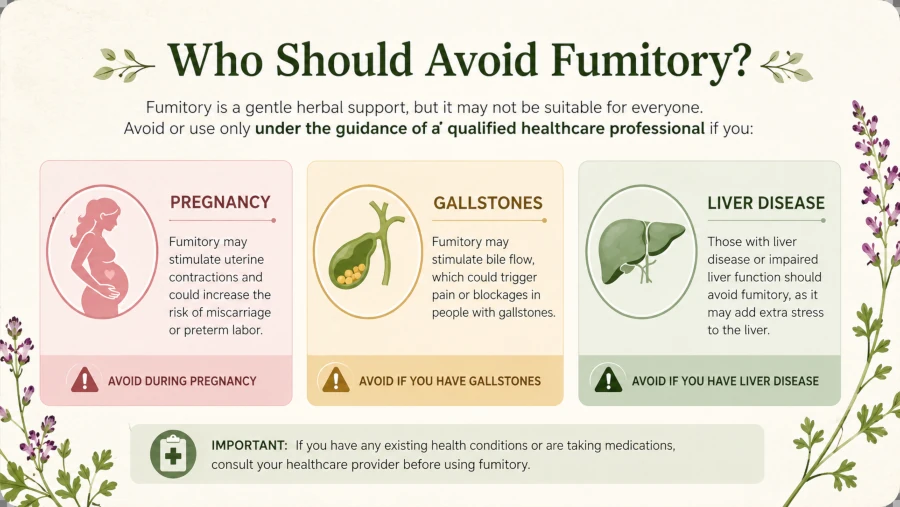
It’s also the reason for an important caution. Precisely because it may stimulate bile, the EMA advises against using fumitory if you have a blocked bile duct, gallstones, cholangitis (inflammation of the bile ducts), or liver disease [EMA, 2023]. The same property that earned its traditional reputation is the reason some people should steer clear. Self-treating suspected gallbladder trouble with an herb is not a good idea — that’s a situation for a doctor.
Skin conditions like eczema
Fumitory carries an old folk reputation for eczema, rashes, and itchy skin, tied to the idea of it being a “blood purifier.” That idea, and terms like “autointoxication” or “intestinal putrefaction” that sometimes accompany it, reflect a much older theory of disease rather than current understanding.
When researchers looked for studies supporting skin uses, they found very little [Hentschel, 1995]. So if you’re hoping fumitory will clear eczema, set expectations low: the tradition is real, the evidence is thin, and proven eczema treatments exist for a reason.
Diuretic, “blood purifier,” and blood pressure
Fumitory was traditionally taken as a mild diuretic and “depurative.” A laboratory study in rats did find that a Fumaria extract modestly increased urine output, though the effect was weaker than a standard diuretic drug [Păltinean et al., 2017]. That’s animal evidence, not a reason to rely on it.
The claim worth correcting most firmly is blood pressure. You may see fumitory listed as a remedy for hypertension, sometimes described as “blood-thinning.” There’s no good clinical evidence that fumitory lowers blood pressure or thins the blood [Drugs.com, 2025]. High blood pressure is a serious, often symptomless condition that needs proper measurement and treatment — please don’t manage it with an herb.
The psoriasis and MS mix-up worth knowing about
Here’s a genuine source of confusion. You’ll sometimes see fumitory linked to psoriasis or even multiple sclerosis. The connection is historical and chemical, not herbal-practical.
Fumaric acid was first isolated from Fumaria officinalis, and synthetic fumaric acid esters — chiefly dimethyl fumarate — are real, regulated prescription drugs (sold as Fumaderm for psoriasis in Germany, and Tecfidera for relapsing multiple sclerosis) [DermNet, 2024; ScienceDirect]. These are manufactured, carefully dosed, and monitored medicines with their own side-effect profiles. They are not the same thing as drinking fumitory tea, and the herb itself has not been shown to treat psoriasis or MS. If you see fumitory marketed on the back of those drugs, treat it as a red flag for over-claiming.
What’s inside fumitory
The herb’s activity is usually attributed to a group of isoquinoline alkaloids — protopine (historically called fumarine) is the main one, alongside allocryptopine, cryptopine, and others — plus flavonoids, phenolic acids, bitter principles, mucilage, and potassium salts [EMA, 2023].
The alkaloids are the double-edged part. They’re behind the plant’s traditional antispasmodic effect on the gut, but they’re also why fumitory isn’t a “more is better” herb: in animals, large doses of protopine have caused excitation and convulsions. Sensible amounts matter.
How to use fumitory, and how much
Most people take fumitory as a tea before meals, or as a standardized extract or tincture. The figures below follow the dose ranges set out in the EMA’s traditional-use monograph, which is the most reliable yardstick available [EMA, 2023].
| Form | Single dose | Daily dose |
| Dried herb, as tea | ~2 g in 250 ml boiling water | 4.8–6.4 g, split into 3–4 cups |
| Powdered herb | 220 mg | up to 1,100 mg |
| Dry extract | 250 mg | up to 1,000 mg |
| Liquid extract | 0.5–2 ml | 2–4 ml |
| Tincture | 0.5–1 ml | 1–4 ml |
| Fresh plant juice | — | 3.5–4 g |
Take it before meals, and keep courses short. If your digestive symptoms last longer than two weeks while you’re using it, or get worse, stop and check with a doctor or pharmacist [EMA, 2023].
A note for anyone working from older herbals: some traditional sources — including the earlier version of this very article — recommend much stronger brews, such as 50 grams of plant per litre of water, or a full gram of dry extract before every meal. Those run well above the regulator-aligned amounts in the table. When sources disagree, follow the product label and lean toward the lower, official figures. For context, fumitory extract appeared possibly safe at up to 500 mg three times daily for up to 18 weeks in study settings, but that’s a research ceiling, not a daily target [WebMD].
Safety, side effects, and who should avoid fumitory
Used sensibly and short-term, fumitory has a reassuring track record. The EMA monograph reports no known side effects, no documented drug interactions, and centuries of European use without notable safety signals [EMA, 2023]. That’s genuinely good news for a traditional herb.
The honest caveat is that “nothing reported” isn’t the same as “thoroughly studied.” Formal tests on toxicity, genotoxicity, and effects in pregnancy simply haven’t been done [EMA, 2023]. So the safe approach is to respect the dose and the cautions below rather than assume an herb is harmless because it’s natural.
Take care or avoid fumitory if you:
- Have a bile-duct blockage, gallstones, cholangitis, or liver disease — its bile-stimulating effect makes it unsuitable [EMA, 2023].
- Are pregnant or breastfeeding — safety hasn’t been established, so it’s not recommended [EMA, 2023].
- Are giving it to a child or teenager — not recommended under 12 for the tea, or under 18 for stronger preparations, due to lack of data [EMA, 2023].
- Are allergic to the plant — a known hypersensitivity is a clear reason not to use it [EMA, 2023].
- Take prescription medication — although no specific interactions are documented, fumitory’s alkaloids can influence liver enzymes (CYP1A) in laboratory models, so check with a pharmacist first, especially if you take medicines with a narrow safety margin such as anticoagulants.
When to skip the herb and see a doctor
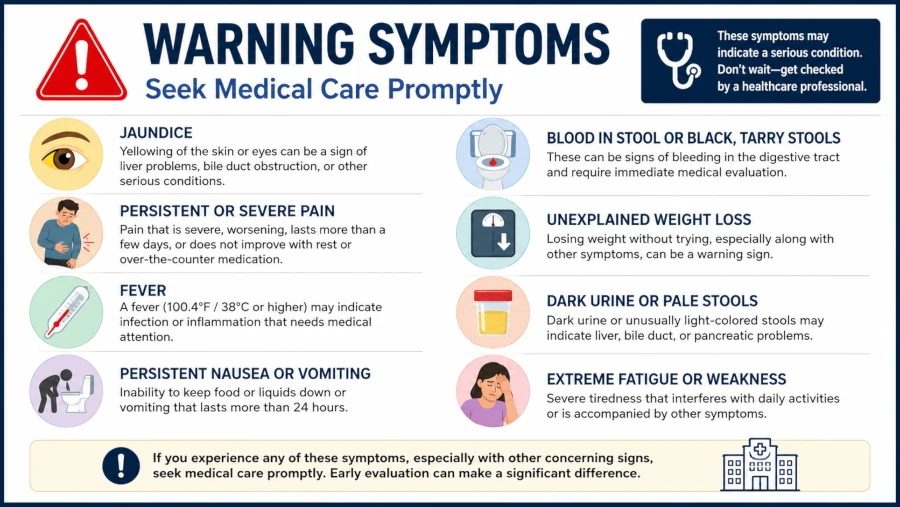
Fumitory is for mild, short-lived digestive niggles. Some symptoms point to something an herb can’t fix. Get medical care if you have:
- Digestive symptoms lasting more than two weeks, or steadily worsening
- Severe abdominal pain, fever, or yellowing of the skin or eyes (jaundice), pale stools, or dark urine — possible liver or gallbladder problems
- Vomiting blood, black or tarry stools, unexplained weight loss, or trouble swallowing — these need prompt evaluation
- High blood pressure you’re trying to manage — get it measured and treated properly rather than reaching for an herb
| Health Disclaimer Please read: This article is for general education and information only. It isn’t medical advice, and it isn’t a substitute for diagnosis or treatment from a qualified health professional. Herbal remedies can interact with medications and aren’t right for everyone. If you’re pregnant, breastfeeding, taking prescription medicine, or managing a health condition, talk to your doctor or pharmacist before using fumitory or any herbal product. If you have severe or persistent symptoms, seek medical care. |
Frequently Asked Questions
What is fumitory used for?
Its best-supported use is easing minor digestive complaints — bloating, fullness, slow digestion, and gas — taken as a bitter tea or extract before meals. A European regulator recognizes this traditional use, while noting it isn’t proven by clinical trials. Other traditional uses (skin, “blood purifying,” urine flow) have much weaker evidence.
Does fumitory really work?
For mild after-meal discomfort, its long traditional use and bitter action make it plausible, though unproven in trials. For specific conditions it’s less convincing: a clinical trial in IBS found no benefit over placebo, and there’s no good evidence it lowers blood pressure or clears eczema.
Is fumitory safe?
At traditional doses and for short periods, it has a long history of use without notable safety problems, and no side effects are formally listed. But it contains alkaloids that can be harmful in large amounts, and it hasn’t been thoroughly tested, so stick to recommended doses and the cautions above.
Who should not take fumitory?
Avoid it if you have gallstones, a blocked bile duct, cholangitis, or liver disease; if you’re pregnant or breastfeeding; if you’re allergic to the plant; and don’t give it to children or teens. If you take prescription drugs, check with a pharmacist first.
Is fumitory the same as the psoriasis drug dimethyl fumarate?
No. Dimethyl fumarate (used for psoriasis and multiple sclerosis) is a synthetic, prescription fumaric acid ester. Fumaric acid was originally found in the fumitory plant, but the drug and the herbal tea are not interchangeable, and the herb hasn’t been shown to treat either condition.
How long can I take fumitory?
Keep it short-term. If digestive symptoms persist beyond two weeks while using it, or get worse, stop and see a doctor or pharmacist.
References
- European Medicines Agency, Committee on Herbal Medicinal Products (HMPC). European Union herbal monograph on Fumaria officinalis L., herba (Final, Revision 1; 12 May 2023). EMA/HMPC/367011/2021. View source
- European Medicines Agency (HMPC). Assessment report on Fumaria officinalis L., herba (Revision 1). View source
- Drugs.com. Fumitory (professional monograph; reviewed Jul 21, 2025). View source
- WebMD. Fumitory: Uses, Side Effects, Interactions, Dosing. View source
- DermNet. Fumaric acid esters. View source
- ScienceDirect Topics. Fumaric acid methyl ester / Fumaderm overview. View source
- Hentschel C, Dressler S, Hahn EG. Fumaria officinalis (fumitory) — clinical applications. Fortschr Med. 1995. PMID 7672742. View source
- Păltinean R, et al. Diuretic activity of Fumaria species, 2017.
