

Three ingredients dominate this shelf: dietary nitrate (usually beetroot), L-citrulline, and L-arginine. All three can lower blood pressure by a few points on average. That is the honest ceiling. Nitric oxide supplements for blood pressure are a nudge, not a treatment — and the more useful question is not which one works best. It is which one is safe for you, because every one of them lowers pressure through the same pathway several common medications already use.
If you take medication for blood pressure, chest pain, or erectile dysfunction, that overlap is the main event. Guideline-based care — accurate measurement, lifestyle changes, and medication when indicated — is still what actually controls hypertension. [2025 AHA/ACC high blood pressure guideline] A food-first approach built on nitrate-rich vegetables, regular movement, and decent sleep remains the safest starting point. If you want the wider picture before the supplement details, start with our complete guide to nitric oxide for blood pressure.
What counts as a nitric oxide supplement
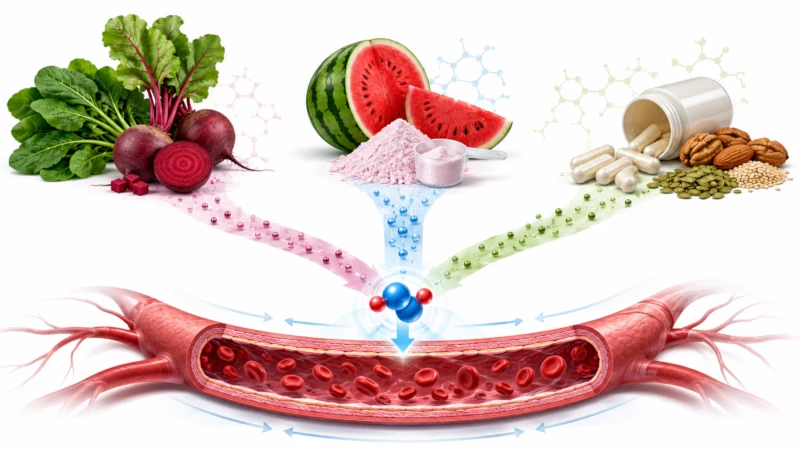
Nitric oxide (NO) is a short-lived gas your blood-vessel lining releases to tell arteries to relax. You cannot bottle it. [Carlström, 2024] What is sold instead are ingredients that feed the two pathways your body uses to make or mimic that signal.
- Dietary nitrate (beetroot, leafy greens). Bacteria on the back of your tongue reduce nitrate to nitrite, which your body then uses downstream through the nitrate–nitrite–NO pathway. [Lidder & Webb, 2013]
- L-citrulline. An amino acid your body converts to arginine, feeding the enzyme route that produces NO.
- L-arginine. The direct substrate for that same enzyme route. [Mayo Clinic on L-arginine and blood pressure]
Marketing tends to blur these together in “NO booster” blends. They are not interchangeable — the evidence behind them differs, and so do the safety warnings.
Nitric oxide supplements for blood pressure: What the evidence actually shows
Dietary nitrate: the deepest research trail
A 2025 GRADE-assessed systematic review and dose-response meta-analysis pooled 75 randomized controlled trials covering 1,823 participants. It found a dose-related reduction in blood pressure: for each additional millimole of nitrate per day, medium-term systolic pressure fell by a weighted mean of 0.48 mm Hg (95% CI −0.71 to −0.25), with smaller reductions in the acute and short-term analyses. [Norouzzadeh, 2025]
Per millimole, that is tiny. The authors themselves estimate that roughly 8 mmol of nitrate per day would be needed to reach a 2 mm Hg reduction — the threshold usually treated as clinically meaningful. For scale, one “nitrate unit” is 1 mmol, about 62 mg of nitrate. [Lidder & Webb, 2013]
Beetroot specifically behaves in a way worth knowing: the largest medium-term systolic reduction appeared at about 150 mL per day (−4.56 mm Hg, 95% CI −6.42 to −2.71), after which the effect plateaued rather than continuing to climb. [Norouzzadeh, 2025] More is not better here. Certainty of the evidence was rated low to moderate depending on the outcome, so treat these as best current estimates rather than settled numbers.
L-citrulline: real, but studied in a narrow group
A 2025 meta-analysis of 15 randomized trials in middle-aged and older adults — 415 participants across 24 datasets — found L-citrulline supplementation and watermelon intake reduced systolic pressure by 4.02 mm Hg (95% CI −6.54 to −1.50) and diastolic by 2.54 mm Hg (95% CI −4.27 to −0.81). The effect was largest when citrulline was combined with arginine. [Luo, 2025]
Two things to hold alongside that. The total sample is small for a blood-pressure question, and the population was specifically middle-aged and older adults — so it does not automatically generalize to a healthy 30-year-old. Earlier and smaller pooled analyses of citrulline alone did not consistently find significant changes in brachial blood pressure, which is why “promising in older adults” is a fairer summary than “proven.”
L-arginine: better evidence than its reputation, worse safety profile
L-arginine is often written off as the weak option. That is not quite right. Mayo Clinic describes the research as mixed but notes that more recent work suggests it may help lower blood pressure, citing a large review in which adults taking daily supplements lowered systolic pressure by about 6.4 mm Hg and diastolic by about 2.6 mm Hg. Those benefits were linked to under 9 grams a day taken for 4 to 24 days, and long-term effects have not been established. [Mayo Clinic, 2024]
So arginine is not the underperformer of the group on effect size. It is the one with the longest list of reasons some people should not take it at all — which is covered in the safety section below, and is the part that should actually drive your decision.
Comparison at a glance
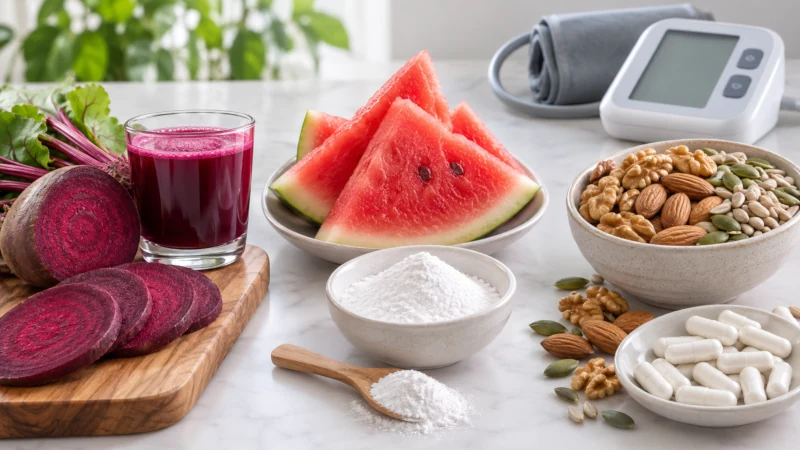
| Option | How it works | Strongest evidence | Main cautions |
| Dietary nitrate (beetroot, greens) | Nitrate → nitrite via oral bacteria → supports NO signaling | 75 RCTs, dose-related systolic drop; beetroot effect peaks near 150 mL/day then plateaus | Pink urine and stool; GI upset; blunted by frequent antibacterial mouthwash |
| L-citrulline | Raises arginine availability for the NO-making enzyme | 15 RCTs in middle-aged and older adults: about −4.0/−2.5 mm Hg | Additive with blood-pressure medication; GI upset; small evidence base |
| L-arginine | Direct substrate for the same enzyme route | Pooled review: about −6.4/−2.6 mm Hg at under 9 g/day, short term | Avoid after heart attack, with kidney disease, or with a herpes or cold-sore history; multiple drug interactions |
What a few mm Hg actually buys you
The American Heart Association and American College of Cardiology classify blood pressure as normal below 120/80, elevated at 120–129 systolic, stage 1 hypertension at 130–139 systolic or 80–89 diastolic, and stage 2 at 140/90 or above. The treatment goal for most adults is below 130/80. [2025 AHA/ACC guideline]
Put the supplement numbers against that scale and the picture is clear. A 3-to-4-point average shift can matter if you are sitting at the top of the elevated range or the bottom of stage 1. It will not bring stage 2 hypertension into target range, and it should not be used to delay care that would. Individual response also varies widely — some people see a meaningful drop, others see nothing.
The guideline is explicit about sequence: lifestyle changes for everyone, with medication added when readings and cardiovascular risk warrant it. For lower-risk adults at 130/80 or above, that means an initial three-to-six-month trial of lifestyle changes before medication is started. [2025 AHA/ACC guideline] A supplement can sit inside that window. It cannot replace it.
Nitric oxide supplements for blood pressure: dosing and timing
This is educational context, not a prescription. Research protocols vary enormously, and the right approach depends on your health and your medications.
- Dietary nitrate / beetroot. Daily doses across the pooled trials ranged from 0.35 to 27.84 mmol. Benefit plateaued rather than scaling with dose, and the medium-term systolic effect for beetroot peaked around 150 mL per day. [Norouzzadeh, 2025]
- L-citrulline. Trial doses vary and are sometimes split through the day; effects build over weeks rather than hours. [Luo, 2025]
- L-arginine. The reviewed benefit was linked to under 9 grams a day over 4 to 24 days. Tolerance is inconsistent and stomach upset is common. [Mayo Clinic, 2024]
The rule that matters most: do not stack multiple vasodilators. If you already take blood-pressure medication, adding one of these — let alone two — without supervision can drop your pressure further than intended.
Safety: who should be careful, and who should skip it

“Natural” does not mean risk-free, and dietary supplements are not reviewed for safety and effectiveness before they go on sale the way prescription drugs are. Two categories of risk matter here: side effects, and interactions.
Common side effects
Beetroot and nitrate products commonly turn urine and stool pink or red — harmless, but startling if you are not expecting it. Trials have also reported abdominal pain, diarrhea, nausea, headache, and general stomach discomfort, though across the pooled analysis the overall adverse-event rate was no higher than placebo (risk ratio 1.00, 95% CI 0.35 to 2.82). [Norouzzadeh, 2025] Stomach upset is the most frequently reported problem with L-arginine.
Medication interactions
- Blood-pressure medication. The effects add up. This is the single most common way people get into trouble with these products.
- Nitrate medications and PDE5 inhibitors. This is where careful wording matters. FDA prescribing information contraindicates sildenafil with nitric oxide donors such as organic nitrates or nitrites in any form — meaning nitrate drugs like nitroglycerin — because the combination can cause a dangerous drop in blood pressure. [FDA prescribing information, sildenafil] Dietary nitrate from beetroot is a chemically different, inorganic form and is not what that contraindication describes. But both routes act on the same NO pathway, and sildenafil alone lowers systolic pressure by around 8 mm Hg — more when combined with a blood-pressure drug — so if you use a PDE5 inhibitor, ask your doctor or pharmacist before adding any of these supplements.
- L-arginine specifically. It can affect blood thinners including aspirin and warfarin, certain diuretics, nitroglycerin, some blood-pressure medicines, erectile dysfunction medicines, and diabetes medicines. [Mayo Clinic, 2024]
Who should not take these without medical advice
| If this applies to you | What to do |
| You have had a heart attack | Do not take L-arginine — there is concern the supplement may increase the risk of death. |
| You have kidney disease | Do not take L-arginine; it can disturb electrolytes and has caused dangerous heart rhythms in people with kidney failure. Ask about concentrated nitrate products too. |
| You get cold sores or genital herpes | Avoid L-arginine — too much can reactivate the virus. |
| You have asthma or allergies | Use L-arginine only with medical advice; it can make both worse. |
| You have surgery scheduled | Tell your care team. You will likely be told to stop L-arginine at least two weeks beforehand. |
| You are pregnant or breastfeeding | Keep it food-first. Talk with your doctor before using any concentrated supplement. |
| You faint, feel dizzy, or run low readings | Get individual advice before adding anything that lowers blood pressure further. |
| You take more than one blood-pressure medicine | Ask your doctor or pharmacist first — the effects stack. |
The condition-specific L-arginine cautions above come from Mayo Clinic. [Mayo Clinic, 2024]
When self-care is not enough
Supplements are a low-stakes experiment. These situations are not.
- Call 911 if a reading is above 180/120 mm Hg and you have symptoms such as chest pain, shortness of breath, back pain, numbness or weakness, vision changes, or trouble speaking.
- A reading above 180/120 without symptoms: wait a few minutes, recheck, and contact your doctor promptly if it stays there.
- Fainting, near-fainting, or new dizziness after starting a supplement: stop it and call your doctor.
- Readings that stay above your target across two weeks of consistent measurement: bring the log to your doctor rather than adding another product. [2025 AHA/ACC guideline]
- Never stop or reduce prescribed blood-pressure medication on your own.
The mouthwash factor
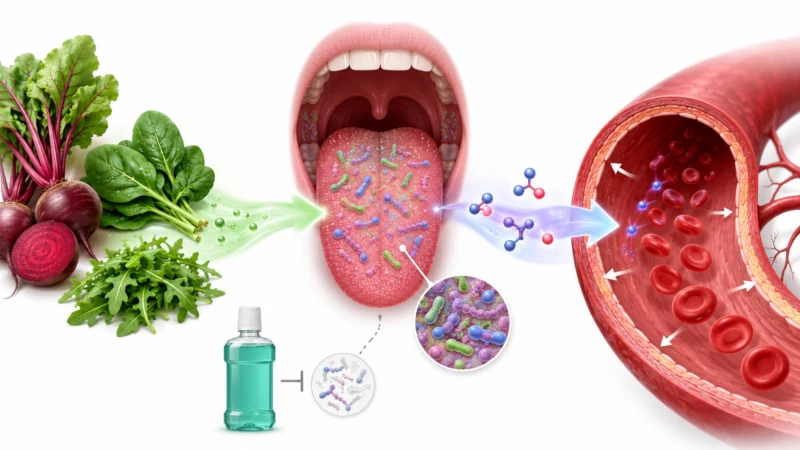
This one only applies to the dietary-nitrate route, because that pathway starts in your mouth. In a small randomized crossover trial, 15 adults already being treated for hypertension used antibacterial mouthwash for three days; oral nitrate-to-nitrite conversion dropped and systolic pressure rose by 2.3 mm Hg (95% CI 0.5 to 4.0), with no change in diastolic pressure. [Bondonno, 2015]
A longitudinal cohort of 540 adults found that people using over-the-counter mouthwash twice a day or more had a higher rate of new hypertension than less frequent users (incidence rate ratio 1.85, 95% CI 1.17 to 2.94). The same study reported no association when blood pressure was measured at a single visit, and observational data cannot establish cause. [Joshipura, 2020]
So: a plausible mechanism and a small, fairly consistent short-term signal. Not a reason to abandon oral care, and definitely not a reason to stop a rinse your dentist prescribed. If you rinse daily out of habit while leaning on beetroot for blood pressure, that is worth a second look. More detail is in our piece on antibacterial mouthwash, oral bacteria, and nitric oxide.
How to test one properly
If you and your doctor decide a trial makes sense, run it like an experiment so you get an answer instead of a guess.
- Take a 7-day baseline of home blood pressure first, measured at the same time each day, seated and rested. [2025 AHA/ACC guideline]
- Change one variable — a single supplement. Not two, and not alongside a new exercise plan.
- Start with the smallest reasonable dose.
- Track your blood-pressure trend and any symptoms daily for about two weeks.
- Stop and contact your doctor if you feel dizzy or lightheaded, or your readings drop further than expected.

Learning to track your blood pressure at home correctly is what turns this from a hunch into information. And if the trial is inconclusive, the daily habits that support nitric oxide — walking, sleep, stress — are doing more work than any capsule.
| What to track | How often | Why it matters |
| Blood-pressure trend | Daily, or 4–5 times a week | Trends beat single readings |
| Dose and timing | A daily note | Lets you spot patterns |
| Symptoms | As needed | Low blood pressure often shows up as dizziness |
| Sleep and caffeine | A daily note | Both are major confounders |
Reading the label
- Does the label state the exact dose of the active ingredient, or hide it in a proprietary blend?
- Is it a single ingredient? Blends make it impossible to know what you reacted to.
- Is there third-party testing, such as USP or NSF certification?
- Does it duplicate something you already take? Pre-workout formulas often contain beetroot, citrulline, and arginine together.
If blood-pressure support is your goal, food-first options are a gentler place to start than layering several products. [Mayo Clinic, 2024] Bring the actual bottle — or a photo of the label — to your next appointment.
| Health Disclaimer: This article is for general education only and is not medical advice, diagnosis, or treatment. It does not claim that any supplement cures, prevents, or treats high blood pressure or any other condition. If you have high blood pressure, heart disease, kidney disease, are pregnant or breastfeeding, or take prescription medication, talk with a doctor or pharmacist before starting, stopping, or changing any treatment or supplement. Do not stop prescribed blood-pressure medication on your own. If you have a reading above 180/120 mm Hg together with symptoms such as chest pain, shortness of breath, weakness, vision changes, or trouble speaking, call 911. |
Frequently Asked Questions
Do I need a supplement to raise nitric oxide?
For most people, no. Nitrate-rich vegetables, regular movement, and decent sleep are the better-supported and lower-risk starting point, and dietary nitrate is where the research trail is deepest. [Norouzzadeh, 2025]
Can these replace blood-pressure medication?
No. Average effects are a few mm Hg, and the treatment goal for most adults is below 130/80. Follow guideline-based care and never stop a prescription on your own. [2025 AHA/ACC guideline]
Which is safest to start with: beetroot, citrulline, or arginine?
None is universally safest, but beetroot or leafy greens is usually the gentlest opening move because it is food rather than a concentrated dose. L-arginine carries the longest list of conditions that rule it out, including a previous heart attack, kidney disease, and a history of cold sores or genital herpes. [Mayo Clinic, 2024]
Does mouthwash really interfere?
Frequent antibacterial rinsing can blunt the mouth-bacteria step that the dietary-nitrate route depends on, and small studies link it to a modest rise in systolic pressure. [Bondonno, 2015] It has no bearing on citrulline or arginine, and it is not a reason to stop a rinse your dentist recommended.
How long before I know whether it is working?
Judge it on a two-to-four-week trend, not a single reading — and only if you took a proper baseline first. Blood pressure moves for dozens of reasons in a single day. [2025 AHA/ACC guideline]
What is the most common mistake?
Changing several things at once and not measuring, so you never learn what helped — or notice that your pressure dropped too far.
References
- Carlström M, Weitzberg E, Lundberg JO. Nitric Oxide Signaling and Regulation in the Cardiovascular System: Recent Advances. Pharmacological Reviews. 2024;76(6):1038–1062. → View source
- Lidder S, Webb AJ. Vascular effects of dietary nitrate (as found in green leafy vegetables and beetroot) via the nitrate–nitrite–nitric oxide pathway. British Journal of Clinical Pharmacology. 2013;75(3):677–696. PMID 22882425; PMCID PMC3575935. → View source
- Norouzzadeh M, Hasan Rashedi M, Ghaemi S, et al. Plasma nitrate, dietary nitrate, blood pressure, and vascular health biomarkers: a GRADE-assessed systematic review and dose-response meta-analysis of randomized controlled trials. Nutrition Journal. 2025;24:47. → View source
- Luo P, Chen J, Liu K, Zhang J. Does L-citrulline supplementation and watermelon intake reduce blood pressure in middle-aged and older adults? A systematic review and meta-analysis of randomized controlled trials. Clinical Nutrition ESPEN. 2025;69:653–664. → View source
- Mayo Clinic. L-arginine: Does it lower blood pressure? Mayo Foundation for Medical Education and Research. January 13, 2024. → View source
- Bondonno CP, Liu AH, Croft KD, et al. Antibacterial mouthwash blunts oral nitrate reduction and increases blood pressure in treated hypertensive men and women. American Journal of Hypertension. 2015;28(5):572–575. PMID 25359409. → View source
- Joshipura K, Muñoz-Torres F, Fernández-Santiago J, Patel RP, Lopez-Candales A. Over-the-counter mouthwash use, nitric oxide and hypertension risk. Blood Pressure. 2020;29(2):103–112. PMID 31709856. → View source
- American Heart Association. Top Things to Know: 2025 High Blood Pressure Guideline. Professional Heart Daily. Updated August 14, 2025. → View source
- Jones DW, Ferdinand KC, Taler SJ, et al. 2025 AHA/ACC multisociety Guideline for the Prevention, Detection, Evaluation, and Management of High Blood Pressure in Adults. Hypertension. 2025;82:e212–e316. PMID 40811516. → View source
- U.S. Food and Drug Administration. VIAGRA (sildenafil citrate) tablets — Highlights of Prescribing Information. Revised December 2017. → View source
