
A few floaters you have had for months or years, that look the same and drift out of the way when you move your eyes, are common and usually harmless. New symptoms are a different matter. A sudden increase in floaters, new flashes of light, or a curtain or shadow over part of your vision needs an eye exam the same day, because these can be signs of a retinal tear or retinal detachment. [NEI, Floaters, 2024] [AAO, Floaters and Flashes, 2025]
Eye floaters and flashes usually come from a normal aging change in the gel that fills your eye. Occasionally that change tears the retina, and only a dilated eye exam can tell which is happening. [NEI, Vitreous Detachment, 2024]
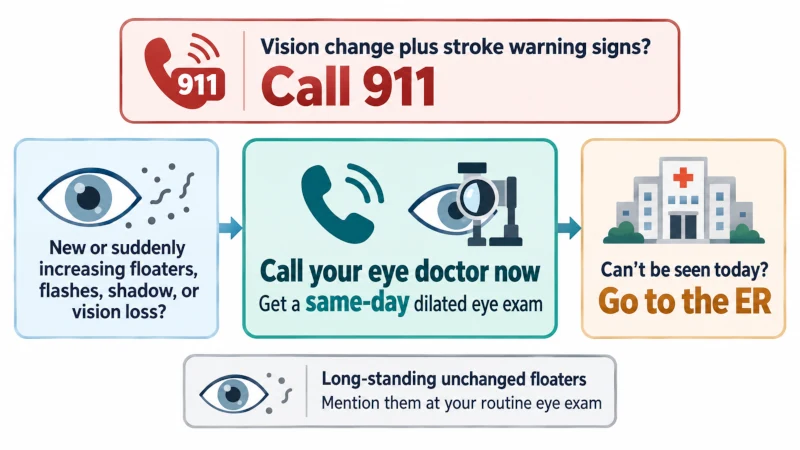
| Get care now Call your eye doctor right away, and go to the emergency room if you cannot be seen today, if you notice: A sudden shower of new floaters or a big jump in the number you seeNew flashes of light, especially flashes that keep repeatingA dark shadow, curtain, or gray veil over part of your visionSudden blurring or loss of vision in one eye Retinal tear and detachment can be medical emergencies, and prompt treatment helps protect your sight. [NEI, Retinal Detachment, 2025] Call 911 if sudden trouble seeing comes with face drooping, arm or leg weakness or numbness, trouble speaking, confusion, loss of balance, or a sudden severe headache. These can be signs of a stroke. [CDC, Stroke Signs, 2026] |
What eye floaters are
Floaters look like specks, dots, threads, rings, or cobwebs drifting across your vision. They seem to sit in front of your eye, but they actually float inside it, and what you see is the shadow they cast on the retina, the thin, light-sensitive layer lining the back of the eye. [AAO, Floaters and Flashes, 2025] They slide away when you look straight at them and stand out most against something bright, like a white wall or blue sky. [NEI, Floaters, 2024]
The vitreous, explained simply
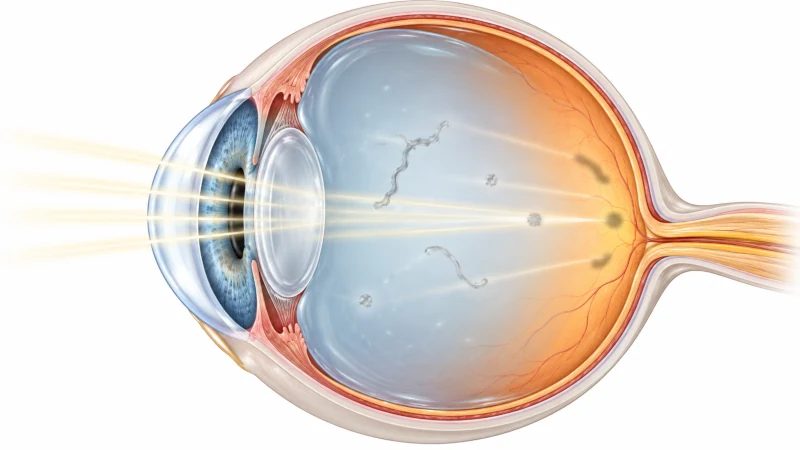
Most of the inside of your eyeball is filled with the vitreous humor, a clear gel threaded with very fine fibers. Early in life the gel is firm and attached to the retina. [ASRS, Retinal Tears] Light passes through it to reach the retina, so anything suspended in the gel, such as a clump of fibers or a little blood, can cast a shadow.
Why floaters become more common with age
Over the years the vitreous slowly turns more liquid and shrinks. Its fibers bunch together into strands, and those strands cast the shadows you see. [NEI, Floaters, 2024] [ASRS, Posterior Vitreous Detachment] Almost everyone develops some floaters with age. They are more likely if you are very nearsighted, have diabetes, or have had cataract surgery. [NEI, Floaters, 2024]
What flashes of light can mean
Flashes look like sparks, flickering lights, or brief streaks of lightning, usually off to the side of your vision. They happen when the vitreous rubs or pulls on the retina. [AAO, Floaters and Flashes, 2025] They tend to be most noticeable in dim light or the dark. [ASRS, Posterior Vitreous Detachment]
Occasional flashes are common with age and can come and go for weeks or months. Even so, the American Academy of Ophthalmology advises that any new floaters or flashes be examined by an ophthalmologist. [AAO, Floaters and Flashes, 2025] A flash means the retina is being tugged, not whether it has been damaged.
Flashes that may be a migraine aura
A different kind of visual disturbance looks like jagged or zigzag lines, shimmering spots, or heat waves. It can affect one or both eyes, lasts up to about 20 minutes, and is often caused by a migraine aura, which can happen with or without a headache afterward. [AAO, Floaters and Flashes, 2025] If you have never had this before, or it looks different from your usual aura, have it checked rather than assuming it is a migraine.
Posterior vitreous detachment: the usual cause of new floaters and flashes
As the vitreous shrinks, it eventually peels away from the retina. This is called posterior vitreous detachment, or PVD. It usually happens after age 50, becomes very common after 80, and is more likely if you are nearsighted. [NEI, Vitreous Detachment, 2024] PVD is rare before age 40. An eye injury or recent eye surgery, such as cataract surgery, also makes it more likely, and people who have a PVD in one eye often develop one in the other eye within about a year. [ASRS, Posterior Vitreous Detachment]
The most common first sign is a sudden increase in floaters, sometimes with flashes, and some people notice one larger floater shaped like a ring. In most people PVD is a normal event that does not threaten sight. About 85% never develop a complication, flashes usually fade within about three months, and floaters tend to become less noticeable. [ASRS, Posterior Vitreous Detachment]
Why retinal traction matters
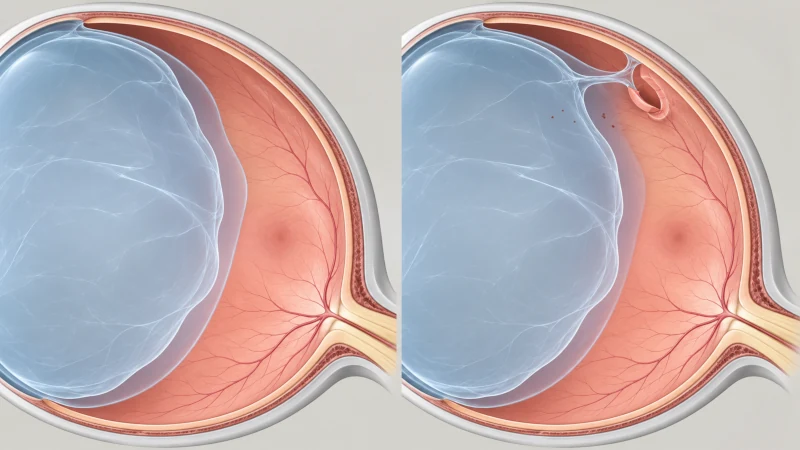
Traction simply means pulling. While the gel is separating, it can tug hard wherever it is stuck to the retina more firmly than usual, including thin patches of retina called lattice degeneration. If the pull is strong enough, it can tear the retina or a small retinal blood vessel. [ASRS, Posterior Vitreous Detachment] Retina specialists note that most retinal tears happen this way, during a PVD, rather than from injury. [ASRS, Retinal Tears]
A tear matters because fluid from inside the eye can seep through it and lift the retina away from the back wall of the eye. That is a retinal detachment. A detached retina stops working, and without prompt treatment it can cause permanent vision loss. [AAO, Detached Retina, 2023] [NEI, Retinal Detachment, 2025]
How often does a tear turn up? A 2009 meta-analysis that pooled 17 studies found a retinal tear in about 14% of people who saw an eye specialist for sudden floaters or flashes. [Meta-analysis in JAMA, 2009] Those patients had already been referred to specialists, so the figure may overstate the risk for everyone who notices a new floater, but it shows why new symptoms deserve an exam.
Floater patterns that are usually benign
These patterns fit ordinary, age-related floaters:
- Floaters you have had for months or years that have not changed in number or appearance
- Floaters you notice mostly against a bright sky, a white screen, or a blank wall
- A floater that drifts when you move your eyes and settles when you stop
- Floaters that were examined when they first appeared and have stayed the same since
Stable, long-standing floaters are not a reason for alarm; mention them at your next routine eye exam. What changes the picture is something new.
Warning signs of a retinal tear or retinal detachment
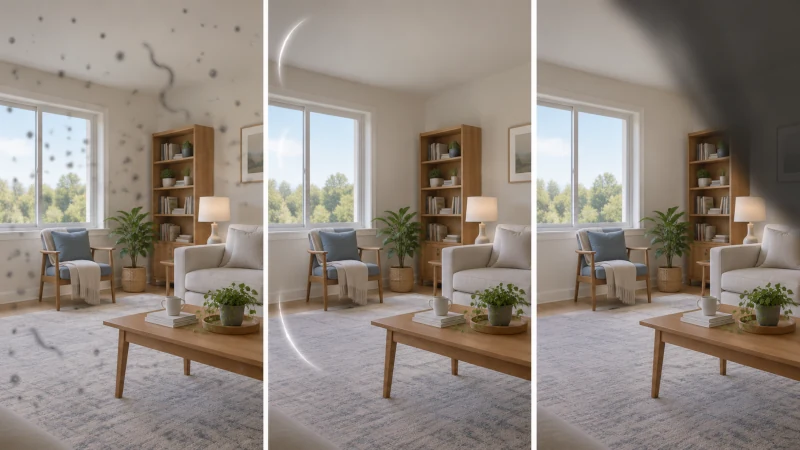
Symptoms cannot confirm or rule out a tear or detachment, but the following signs mean you should be examined promptly. [AAO, Detached Retina, 2023] [NEI, Retinal Detachment, 2025] None of them involves pain, so a painless eye is not a reason to wait.
A sudden shower or increase of floaters
Retina specialists describe the floaters of an acute tear as a sudden burst of black spots, as though someone shook pepper into your vision. If a torn blood vessel bleeds into the vitreous, vision can also become blurry. [ASRS, Retinal Tears] In the 2009 meta-analysis, people first told they had an uncomplicated PVD who then noticed a burst of 10 or more new floaters had a much higher chance of a tear. [Meta-analysis in JAMA, 2009]
New flashes
Flashes that start suddenly, or a lot of flashes, are on the AAO list of reasons to call an ophthalmologist immediately. [AAO, Detached Retina, 2023] [AAO, Floaters and Flashes, 2025]
A curtain, veil, shadow, or missing area of vision
A dark shadow at the side or center of your vision, or a gray curtain covering part of it, is a classic sign that the retina may be detaching. [AAO, Floaters and Flashes, 2025] [NEI, Retinal Detachment, 2025] Do not wait to see whether it spreads.
Sudden blurring or loss of vision
A noticeable drop in vision along with new floaters or flashes is one of the most important warning signs. In the meta-analysis, a person’s own sense that their vision had gotten worse was the symptom most strongly linked to a retinal tear. [Meta-analysis in JAMA, 2009]
Who is at higher risk
Anyone can have a retinal tear or detachment, and no risk factor is required. [NEI, Retinal Detachment, 2025] [ASRS, Retinal Tears] The chance is higher if you:
- Are nearsighted, especially very nearsighted (high myopia); a severe form called degenerative myopia adds risk [NEI, Retinal Detachment, 2025] [AAO, Detached Retina, 2023]
- Have had a retinal tear or detachment before, including in the other eye [AAO, Detached Retina, 2023]
- Have a family member who had a retinal detachment [NEI, Retinal Detachment, 2025]
- Have had a serious eye injury [NEI, Retinal Detachment, 2025]
- Have had eye surgery, such as cataract or glaucoma surgery; cataract surgery is a recognized risk factor for new retinal tears [AAO, Detached Retina, 2023] [AAO Preferred Practice Pattern, 2025]
- Have thin or weak areas of retina, such as lattice degeneration, found on an eye exam; lattice is present in roughly 6% to 8% of people [AAO, Detached Retina, 2023] [AAO Preferred Practice Pattern, 2025]
- Have diabetic retinopathy or certain other retinal conditions [NEI, Retinal Detachment, 2025]
- Use glaucoma eye drops that make the pupil small, such as pilocarpine (do not stop a prescribed drop on your own; ask the prescriber) [AAO, Detached Retina, 2023]
- Are older, since the vitreous changes that trigger tears become more common with age [ASRS, Retinal Tears]
Mention any of these when you call about new symptoms. Protective eyewear during sports and other risky activities lowers the chance of an injury-related detachment. [NEI, Retinal Detachment, 2025]
Eye floaters and flashes: where to go and how fast
New symptoms call for a dilated retinal exam. Call your ophthalmologist or optometrist first; if they cannot see you today, go to the emergency room. [NEI, Floaters, 2024]
| What you notice | What to do |
| A sudden shower of new floaters, new or repeated flashes, a shadow or curtain, or sudden blurring or vision loss in one eye | Call your eye doctor right away for a same-day exam. If you cannot be seen today, go to the ER. [NEI, Retinal Detachment, 2025] |
| Sudden trouble seeing plus face drooping, weakness or numbness, trouble speaking, confusion, loss of balance, or a sudden severe headache | Call 911. [CDC, Stroke Signs, 2026] |
| A few new floaters with no flashes and no change in vision | Call your eye doctor today and describe exactly what changed; new floaters should be examined. [AAO, Floaters and Flashes, 2025] |
| An eye injury, even if vision seems normal | See an eye doctor to check for early retinal damage. [NEI, Retinal Detachment, 2025] |
| You were recently checked for PVD and now notice more floaters, a shadow, or worse vision | Call back right away rather than waiting for your scheduled follow-up. [AAO Preferred Practice Pattern, 2025] [Meta-analysis in JAMA, 2009] |
| Floaters you have had for a long time that have not changed | Mention them at your next routine eye exam, and seek care sooner if anything changes. |
Floaters, or blurry vision from dry eye?
Not every visual change comes from the retina. Dry eye commonly causes stinging or burning, a scratchy or gritty feeling, and blurred vision, especially while reading. [AAO, What Is Dry Eye?] Our guide to dry eye syndrome symptoms and relief covers that kind of blur. If your eyes feel dry but you also notice new floaters, flashes, or a shadow, those take priority: get examined the same day.
How an ophthalmologist evaluates new floaters and flashes
Expect questions about when symptoms started, which eye is affected, whether you see flashes or a shadow, and about nearsightedness, past eye surgery, and injuries. Your vision will be measured, a step clinical guidance calls for in everyone with new floaters or flashes. [Meta-analysis in JAMA, 2009]
The central step is a dilated retinal examination. Drops widen your pupil so the doctor can look at the retina through a special lens. [AAO, Detached Retina, 2023] To see the far edges of the retina, where tears usually form, the doctor may press gently on your eyelid. This is called scleral depression. It can feel uncomfortable but helps find tears. [NEI, Floaters, 2024] [ASRS, Retinal Tears]
The doctor will also look for pigment or blood floating in the vitreous, findings strongly associated with a retinal tear. [Meta-analysis in JAMA, 2009] If bleeding blocks the view, an ultrasound of the eye can help, and an imaging test called optical coherence tomography (OCT) can show exactly where the retina sits. [ASRS, Retinal Tears] [NEI, Retinal Detachment, 2025]
A normal first exam is good news, but it is not always the final word. The AAO guideline puts the chance of a new tear in the weeks after an uncomplicated PVD at about 2%, and recommends that selected patients return promptly with any new symptoms or within six weeks. [AAO Preferred Practice Pattern, 2025] The 2009 meta-analysis found a somewhat higher figure, 3.4% within six weeks, in the studies it pooled. [Meta-analysis in JAMA, 2009] Keep any follow-up visit your doctor schedules. [ASRS, Posterior Vitreous Detachment]

Treatment
Treating a retinal tear
Acute horseshoe-shaped tears and tears caused by injury usually need treatment. [AAO Preferred Practice Pattern, 2025] Some small, low-risk tears found in people without symptoms can be watched instead. [ASRS, Retinal Tears]
Treatment seals the tear with scar tissue. With laser photocoagulation, the doctor aims a laser through the pupil to make tiny burns around the tear. With cryopexy, a freezing probe is placed on the white of the eye over the tear. Both are usually done in the eye doctor’s office after numbing drops. You may see a flash during laser treatment or feel cold and pressure during freezing, and you may be asked to avoid vigorous exercise or heavy lifting while the eye heals. [NEI, Laser and Freeze Treatment, 2024]
When a tear is treated before it becomes a detachment, the outlook is very good, and treatment nearly eliminates the risk of that tear progressing. New, separate tears can still form later, so ongoing monitoring matters. [ASRS, Retinal Tears]
Repairing a retinal detachment
A detached retina needs surgery. The main approaches are: [AAO, Detached Retina, 2023]
- Pneumatic retinopexy: a gas bubble presses the retina back into place while you hold a set head position for several days.
- Vitrectomy: the surgeon removes the vitreous that is pulling on the retina and replaces it with an air, gas, or oil bubble.
- Scleral buckle: a soft band sewn to the outside of the eye supports the retina as it heals; it is usually permanent and not visible.
Laser or freezing treatment is often combined with these operations. [NEI, Retinal Detachment, 2025] While a gas or air bubble is in the eye, you cannot fly, travel to high altitudes, or scuba dive, because pressure changes make the gas expand. [AAO, Detached Retina, 2023]
Repair works for about 9 out of 10 people, though some need a second procedure. [NEI, Retinal Detachment, 2025] Results are better when the detachment is repaired early, especially before it reaches the macula, the center of the retina responsible for sharp central vision. [AAO Preferred Practice Pattern, 2025] Vision often begins improving four to six weeks after surgery, and how much returns depends on the damage the detachment caused. [AAO, Detached Retina, 2023]
Floaters that are simply bothersome
Most age-related floaters need no treatment and tend to fade or become less noticeable over time. [AAO, Floaters and Flashes, 2025] For age-related floaters, the National Eye Institute lists only no treatment or, when floaters interfere with daily life, a surgery called vitrectomy; eye drops, supplements, and eye exercises are not among the options. [NEI, Floaters, 2024] Vitrectomy carries real risks and is seldom necessary. [AAO, Floaters and Flashes, 2025]
Why feeling better doesn’t prove your retina is safe
PVD symptoms usually calm down over several weeks, which is reassuring only after an exam has shown a healthy retina. The National Eye Institute is clear that the only way to know whether a vitreous detachment has caused a serious problem is a dilated eye exam. [NEI, Vitreous Detachment, 2024]
Some retinal tears cause no noticeable symptoms at all, [ASRS, Retinal Tears] and a small detachment may not affect your vision at first. [NEI, Retinal Detachment, 2025] Tears can also appear in the weeks after PVD symptoms begin, even after a normal first visit. [AAO Preferred Practice Pattern, 2025]
So if you had a sudden burst of floaters or flashes that has since settled down and you never had it checked, book a prompt exam anyway. If anything new appears, such as more floaters, more flashes, or a shadow, get seen the same day. For more guides on eye symptoms and when they need attention, visit our Eye & Vision health guides.
| Health Disclaimer: This article is for general education and is not a substitute for professional medical advice, diagnosis, or treatment. Floaters and flashes have many causes, and only an eye examination can tell whether your retina is healthy. Do not use this article to rule out a retinal tear or detachment. If you notice a sudden increase in floaters, new flashes, a shadow or curtain in your vision, or sudden vision loss, contact an eye doctor right away or go to the emergency room. Call 911 if vision changes come with stroke warning signs. Do not stop or change prescribed eye drops or other medicines without talking to the prescribing clinician. |
Frequently Asked Questions
Are eye floaters normal?
Yes. Almost everyone develops some floaters with age as the vitreous gel changes. [NEI, Floaters, 2024] Floaters that have been stable for a long time are usually harmless. New floaters, especially a sudden shower of them, should be examined. [AAO, Floaters and Flashes, 2025]
When should I worry about eye floaters?
Call your eye doctor right away if floaters appear suddenly or multiply, or come with new flashes, a shadow or curtain in your vision, or blurred or lost vision. If you cannot be seen that day, go to the emergency room. [NEI, Floaters, 2024]
What causes flashes of light in the eye?
Most flashes happen when the vitreous gel rubs or pulls on the retina, often during posterior vitreous detachment. Zigzag or shimmering lights lasting up to about 20 minutes are often a migraine aura. [AAO, Floaters and Flashes, 2025] New flashes still need an exam, because the same pulling can tear the retina.
Can floaters go away?
Age-related floaters often fade or become less noticeable over weeks to months, and flashes from PVD usually settle within about three months. [AAO, Floaters and Flashes, 2025] [ASRS, Posterior Vitreous Detachment] Fading does not prove the retina is undamaged, so new floaters should still be checked.
What does retinal detachment vision look like?
People often describe a dark shadow or curtain moving across part of their vision, at the side or in the center, sometimes with many new floaters and flashes. [NEI, Retinal Detachment, 2025] Only an eye exam can confirm a detachment, and it needs care right away.
Should new floaters be checked even if my eye doesn’t hurt?
Yes. The warning signs of a retinal tear or detachment involve vision, not pain, and some tears cause no obvious symptoms. [ASRS, Retinal Tears] A dilated eye exam is the only way to know your retina is intact. [NEI, Vitreous Detachment, 2024]
References
- American Academy of Ophthalmology (reviewed by Brenda Pagan-Duran, MD). What Are Floaters and Flashes? EyeSmart. View source
- American Academy of Ophthalmology (reviewed by Ninel Z. Gregori, MD). Detached Retina. EyeSmart. View source
- Kim SJ, Bailey ST, Kovach JL, Lim JI, Vemulakonda GA, Ying GS, Flaxel CJ; AAO Preferred Practice Pattern Retina/Vitreous Committee. Posterior Vitreous Detachment, Retinal Breaks, and Lattice Degeneration Preferred Practice Pattern. Ophthalmology. 2025;132(4):P163–P196. doi:10.1016/j.ophtha.2024.12.023. PMID 39918519. View source
- National Eye Institute. Floaters. Last updated December 4, 2024. View source
- National Eye Institute. Vitreous Detachment. View source
- National Eye Institute. Retinal Detachment. View source
- National Eye Institute. Laser Surgery and Freeze Treatment for Retinal Tears. View source
- Foundation of the American Society of Retina Specialists. Posterior Vitreous Detachment. Retina Health Series. View source
- Foundation of the American Society of Retina Specialists. Retinal Tears. Retina Health Series. View source
- Hollands H, Johnson D, Brox AC, Almeida D, Simel DL, Sharma S. Acute-onset floaters and flashes: is this patient at risk for retinal detachment? View source
- Centers for Disease Control and Prevention. Signs and Symptoms of Stroke. View source
- American Academy of Ophthalmology. What Is Dry Eye? EyeSmart. View source


