
Age-related macular degeneration (AMD) is an eye disease that damages the macula, the small central part of the retina you rely on for reading, driving, and recognizing faces. It blurs sharp central vision while side vision usually stays intact, and it does not cause total darkness National Eye Institute, 2021. In 2019, about 20 million people in the United States were living with some form of AMD, roughly 1.5 million of them with the late, vision-threatening stage JAMA clinical review, 2024.
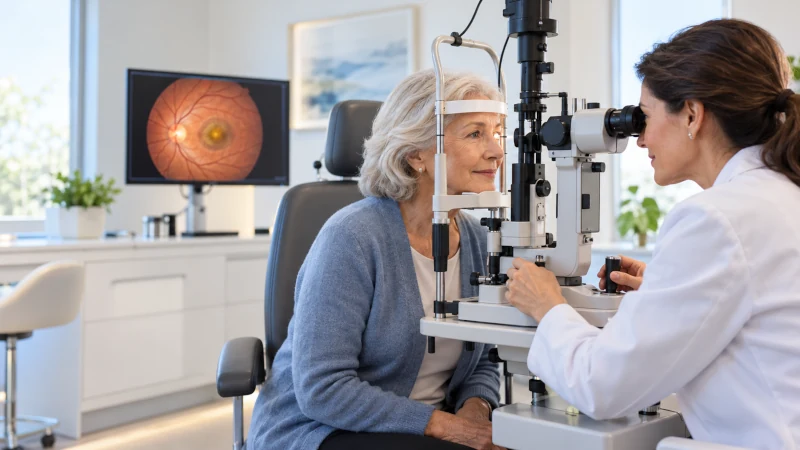
Three facts matter most. Early AMD usually causes no symptoms, so only an eye exam finds it. Dry and wet AMD need different treatments. And new waviness or a blurry central spot calls for an eye doctor the same day, because wet AMD does best with prompt treatment JAMA clinical review, 2024.
Nutrition matters, but narrowly. A vegetable- and fish-rich diet suits everyone; the AREDS2 supplement helps a defined group with intermediate or late AMD. No food or supplement cures or reverses AMD.
What the macula does, and what goes wrong in AMD
The retina is the light-sensing tissue that lines the back of the eye. At its center is the macula, which handles sharp, straight-ahead detail National Eye Institute, 2021. Picture a clock face: someone with advanced AMD may still see the numbers around the rim but not the hands in the middle American Academy of Ophthalmology, 2023.
In AMD, deposits build up beneath the retina and the cells supporting the light-sensing layer slowly break down, driven by aging, inflammation, oxidative stress, and inherited susceptibility JAMA clinical review, 2024.
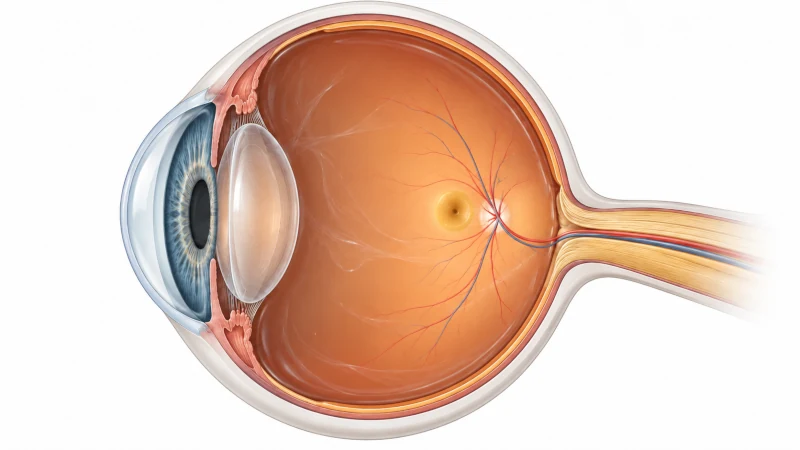
Drusen, in plain English
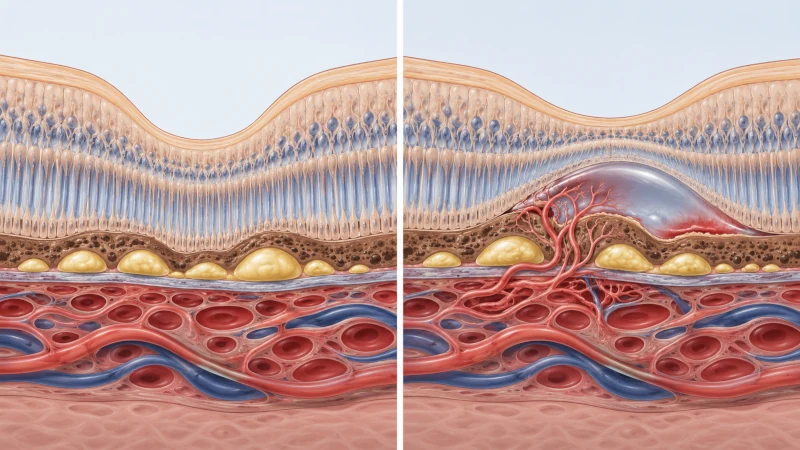
Drusen are tiny yellowish deposits of fats, minerals, and proteins that collect under the retina JAMA clinical review, 2024. A few small ones are common with age. Larger drusen, especially alongside pigment changes, mark AMD and a higher chance of progression. Only an eye exam can find them.
Dry AMD vs. wet AMD
About 8 in 10 people with AMD have the dry form American Academy of Ophthalmology, 2023. Dry AMD, also called atrophic or non-neovascular AMD, involves gradual thinning of the macula along with drusen. It moves through early, intermediate, and late stages, usually over several years National Eye Institute, 2021. Late dry AMD is called geographic atrophy (GA): patches of retinal cells waste away and leave blind spots that can enlarge over time American Academy of Ophthalmology on GA drugs, 2024.
Wet AMD (neovascular AMD) is always late-stage disease. A protein called vascular endothelial growth factor (VEGF) drives abnormal blood vessels to grow beneath the macula, where they leak fluid or blood National Eye Institute on wet AMD treatment, 2024. Any stage of dry AMD can turn into wet AMD National Eye Institute, 2021, and wet AMD can cause symptoms suddenly and worsen quickly JAMA clinical review, 2024. Though less common, it causes most severe vision loss from AMD AAO Preferred Practice Pattern.
Dry and wet AMD at a glance
| Dry AMD | Wet AMD | |
| What happens | Macula thins; drusen build up. Late stage is geographic atrophy. | Abnormal blood vessels grow under the macula and leak. |
| How common | Most cases (about 80%) | Less common, but causes most severe vision loss |
| Usual pace | Slow, often over years | Can start suddenly and progress quickly |
| Typical symptoms | None early; later dim-light trouble, blur, blind spots | New distortion, blurry or dark central spot |
| Main treatment | Monitoring and healthy habits; AREDS2 for intermediate AMD or late AMD in one eye; GA injections for some people | Anti-VEGF eye injections, started promptly |
Early, intermediate, and late stages
Early AMD means medium-sized drusen without pigment changes. Vision is usually normal. Intermediate AMD means large drusen, pigment changes, or both; some people notice trouble in dim light or mild blur. Late AMD, geographic atrophy or wet AMD, is where central vision loss happens JAMA clinical review, 2024. Your stage decides whether AREDS2 is worth discussing and how often you need checks.
Early AMD doesn’t cause symptoms National Eye Institute, 2021. Drusen alone disturb vision little, and good vision in one eye can mask a problem in the other JAMA clinical review, 2024, so check each eye separately.
As the disease advances, people commonly notice National Eye Institute, 2021 JAMA clinical review, 2024:
- Straight lines that look wavy, bent, or broken, such as door frames, tile grout, or lines of text. Doctors call this metamorphopsia.
- A blurry, gray, or blank spot in the center of vision that may grow over time.
- Trouble reading or recognizing faces, even with glasses.
- Needing much brighter light for close work, or slow adjustment when moving into a dim room.
- Colors that look faded or less vivid.

Trouble in low light and low contrast is often the first change people notice; distortion and blur are the most common reasons they seek care JAMA clinical review, 2024.
Who is at risk
Age is the strongest risk factor. People 55 and older are more likely to have AMD National Eye Institute, 2021, and yearly rates of new late AMD climb steeply with each decade after that JAMA clinical review, 2024.
Smoking is the most consistently identified risk factor you can change. In a large study of nearly 62,000 women followed for 12 years, those who smoked 25 or more cigarettes a day developed AMD at a little over twice the rate of women who had never smoked JAMA clinical review, 2024. US ophthalmology guidance strongly recommends quitting for anyone who has AMD or is at risk AAO Preferred Practice Pattern.
Family history and genes matter. A US twin study estimated that about 71% of the risk of late AMD is inherited, and variants near two genes, CFH and ARMS2-HTRA1, are strongly linked to the disease JAMA clinical review, 2024. Still, routine genetic testing isn’t recommended, and relatives without signs of AMD have no proven benefit from AREDS supplements AAO Preferred Practice Pattern. Regular dilated exams are the practical step. AMD is also more common in people of white or northern European ancestry National Eye Institute, 2021.
Heart and metabolic health is less settled. The National Eye Institute advises healthy blood pressure and cholesterol National Eye Institute, 2021, and the American Academy of Ophthalmology lists heart disease and high cholesterol as risk factors American Academy of Ophthalmology, 2023, but a 2024 JAMA review judged links with diabetes and high blood pressure uncertain JAMA clinical review, 2024. Managing them is worthwhile for your heart and may help your eyes; it is not a proven AMD treatment.
Late AMD in one eye raises the risk for the other National Eye Institute, 2021. In the AREDS study, 53% of people with late AMD in one eye and high-risk changes in the other developed late AMD in that eye within five years JAMA clinical review, 2024.
How AMD is diagnosed and monitored
An ophthalmologist or optometrist diagnoses AMD with a dilated eye exam. Drops widen your pupils so the doctor can see the macula through a special lens National Eye Institute, 2021.
Optical coherence tomography (OCT) is a quick, painless scan that shows the layers of the retina in cross-section National Eye Institute, 2021. It spots fluid from wet AMD and tracks treatment, and in one study it detected new wet AMD far more reliably than vision charts or a standard exam JAMA clinical review, 2024. Your doctor may also order fluorescein angiography, in which dye injected into an arm vein highlights leaking vessels, or dye-free OCT angiography American Academy of Ophthalmology, 2023.
Using an Amsler grid at home
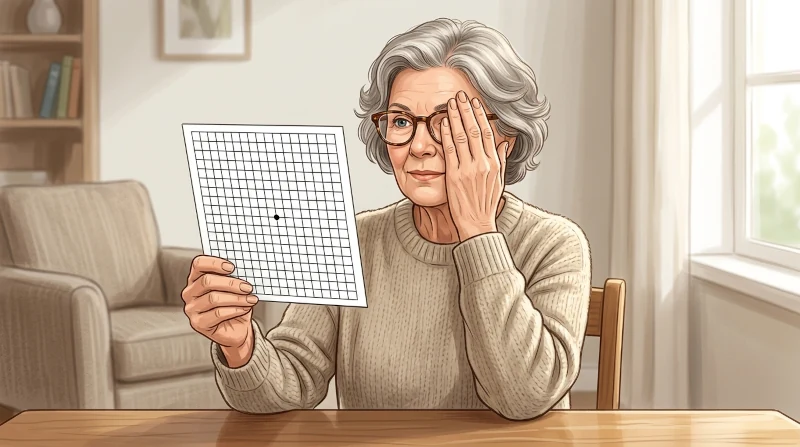
An Amsler grid is a square of straight lines with a center dot. The American Academy of Ophthalmology suggests a daily check: in good light, with reading glasses, hold it 12 to 15 inches away, cover one eye, look at the dot, and note any wavy, blurry, dim, or missing lines; then switch eyes. Call your ophthalmologist right away about any change American Academy of Ophthalmology, 2023.
The grid has limits: in one study it caught only about a third of new wet AMD cases JAMA clinical review, 2024. Use it alongside scheduled exams, not instead of them. With early AMD, the National Eye Institute recommends a dilated exam at least yearly National Eye Institute on AREDS2, 2021.
Treatment depends on the type and stage
Early and intermediate AMD
Early AMD has no specific treatment; care means monitoring, not smoking, eating well, and staying active National Eye Institute, 2021. Intermediate AMD adds AREDS2 (below).
Wet AMD: anti-VEGF injections
Anti-VEGF medicine injected into the eye is the first-line treatment for wet AMD JAMA clinical review, 2024 AAO Preferred Practice Pattern. The eye is numbed and cleaned, and the medicine is given through a very small needle National Eye Institute on wet AMD treatment, 2024. Injections usually start monthly, then the interval is adjusted to how the eye responds National Eye Institute on wet AMD treatment, 2024. Treatment is often long-term and may continue for life JAMA clinical review, 2024.
Drugs in use include aflibercept, ranibizumab and its biosimilars, and bevacizumab, a cancer drug that ophthalmologists widely use off-label for the eye AAO Preferred Practice Pattern American Academy of Ophthalmology on anti-VEGF drugs JAMA clinical review, 2024. Faricimab, which blocks VEGF and a second signaling protein, was approved by the FDA for wet AMD in January 2022 FDA approval letter, 2022. Newer options let some people go longer between injections once the disease is controlled JAMA clinical review, 2024.
In the MARINA trial, about 95% of people given monthly ranibizumab lost less than three eye-chart lines over a year, versus about 62% with sham injections, and some gained vision JAMA clinical review, 2024. Scarring and atrophy can still develop over the years. Serious complications are uncommon but real: infection inside the eye occurred in about 1 in 1,700 injections in one large trial, and retinal detachment and lasting pressure rises can happen JAMA clinical review, 2024. Photodynamic therapy, a light-activated drug plus laser, is used far less often National Eye Institute on wet AMD treatment, 2024.
| Do not postpone wet AMD treatment Supplements, diet changes, and home remedies do not treat active wet AMD, and delays in starting anti-VEGF treatment have been linked to worse vision JAMA clinical review, 2024. AREDS2, if right for you, is an add-on, not a substitute. |
Geographic atrophy: two newer injections
In 2023, the FDA approved two eye injections for geographic atrophy, pegcetacoplan (Syfovre) and avacincaptad pegol (Izervay). Both dampen part of the immune system called the complement pathway JAMA clinical review, 2024. They are given monthly or every other month on an ongoing basis American Academy of Ophthalmology on GA drugs, 2024.
In clinical trials lasting a year, these drugs slowed the growth of atrophy by roughly 14% to 20%. Neither has been shown to improve eyesight or restore lost vision American Academy of Ophthalmology on GA drugs, 2024, and trials found no significant visual-function difference versus sham injections JAMA clinical review, 2024. Side effects include inflammation, surface bleeding, temporary pressure rises, and conversion to wet AMD in some people; rare retinal vasculitis, a blood-flow-blocking inflammation, has been reported after pegcetacoplan, sometimes with severe vision loss American Academy of Ophthalmology on GA drugs, 2024. The JAMA review called their risk-benefit balance uncertain JAMA clinical review, 2024, so weigh a modest slowing against frequent injections with a retina specialist.
Low-vision rehabilitation

AMD is a leading cause of low vision, meaning loss that glasses, medicine, or surgery can’t fully correct National Eye Institute on low vision, 2025. Brighter task lighting, anti-glare lenses, magnifiers, and device settings that enlarge text or read aloud all help, and a vision rehabilitation specialist can teach you to use magnifiers, make your home safer, and rely more on side vision National Eye Institute on low vision, 2025 American Academy of Ophthalmology, 2023. Ask for a referral once vision loss affects daily tasks, and ask whether driving is still safe JAMA clinical review, 2024.
Smoking, diet, and other factors you can change
Quitting smoking
Stopping smoking is the most strongly supported lifestyle step AAO Preferred Practice Pattern, at any age or stage. Your primary care clinician can help with counseling and medicines.
Dietary patterns
In a study of more than 4,000 adults 55 and older, eating fish twice a week was linked to lower AMD risk, and meeting recommendations for vegetables, fruit, and fish to lower risk still JAMA clinical review, 2024. This is observational research, showing association rather than proof, but it fits advice to emphasize leafy greens, colorful produce, and fish National Eye Institute, 2021 American Academy of Ophthalmology, 2023. Less active people also tend to have more AMD, though that evidence is mostly cross-sectional JAMA clinical review, 2024. For specifics, see our guide to the best foods for eye health.
Lutein and zeaxanthin
Lutein and zeaxanthin are yellow plant pigments, called carotenoids, that concentrate in the macula and make up most of the macular pigment AREDS2 trial in JAMA, 2013. Dark leafy greens such as spinach and kale are rich food sources American Academy of Ophthalmology, 2023.
In AREDS2, adding lutein and zeaxanthin to the AREDS formula did not further reduce progression to advanced AMD in the main analysis, and it did not change rates of vision loss. In an exploratory look, people with the lowest dietary intake who received lutein and zeaxanthin had about a 26% lower risk of progression AREDS2 trial in JAMA, 2013. They do not reverse AMD or restore vision; their established role is replacing beta-carotene in AREDS2.
AREDS2 supplements: who benefits and who doesn’t
AREDS2 supplements are a specific high-dose vitamin and mineral formula, named after the trials that tested it. It contains National Eye Institute on AREDS2, 2021:
The AREDS2 formula
| Ingredient | Amount in AREDS2 |
| Vitamin C | 500 mg |
| Vitamin E | 400 IU |
| Lutein | 10 mg |
| Zeaxanthin | 2 mg |
| Zinc | 80 mg |
| Copper (cupric oxide) | 2 mg |
| Beta-carotene | None |
The evidence. In AREDS (3,640 people aged 55 to 80, about six years), antioxidants plus zinc lowered the odds of advanced AMD, mainly in higher-risk people AREDS trial, 2001: a 20% five-year chance of progression versus 28% on placebo JAMA clinical review, 2024. AREDS2 (4,203 people) swapped beta-carotene for lutein and zeaxanthin AREDS2 trial in JAMA, 2013. After ten years of follow-up, the lutein-zeaxanthin version was associated with a further 20% lower risk of late AMD than the beta-carotene version NIH report on 10-year AREDS2 results, 2022.
Who it is for. The National Eye Institute recommends considering AREDS2 if you have intermediate AMD in one or both eyes, or late AMD in only one eye, where it may slow progression in the other eye National Eye Institute on AREDS2, 2021. US ophthalmology guidance takes the same position AAO Preferred Practice Pattern.
Who generally won’t benefit. AREDS2 has not been shown to help people without AMD, people with early AMD, or relatives of people with AMD who have no signs themselves AAO Preferred Practice Pattern. It can’t stop early AMD from becoming intermediate AMD, and if you already have late AMD in both eyes, it probably won’t help National Eye Institute on AREDS2, 2021. In the original trial, people with early AMD had only about a 1.3% five-year chance of advanced AMD AREDS trial, 2001.
Why it isn’t an everyday eye vitamin. The doses far exceed what food provides, can affect digestion and interact with medicines, and an ordinary multivitamin can’t substitute National Eye Institute on AREDS2, 2021. Excess amounts carry risks, including kidney stones from vitamin C, a higher risk of bleeding-type stroke from vitamin E, and copper deficiency from zinc; in the first AREDS trial, people taking zinc had more hospitalizations for genitourinary problems JAMA clinical review, 2024. Don’t combine it with other high-dose products, and tell your doctors you take it.
Beta-carotene and smoking. In AREDS2, lung cancer was more common with beta-carotene (2.0% vs. 0.9%), mostly in former smokers AREDS2 trial in JAMA, 2013, and at ten years beta-carotene nearly doubled lung cancer risk in people who had ever smoked NIH report on 10-year AREDS2 results, 2022. If you smoke or used to smoke, choose the beta-carotene-free AREDS2 formula National Eye Institute on AREDS2, 2021. Beta-carotene from food is a different matter; our guide to vitamin A and beta-carotene safety explains the distinction.
What AREDS2 does not do. It does not cure AMD, reverse damage, or bring back lost vision. It does not prevent AMD in people who don’t have it. It is not a treatment for active wet AMD, and adding omega-3 fish oil to the formula provided no extra benefit AREDS2 trial in JAMA, 2013. Check that any product’s label matches the amounts above National Eye Institute on AREDS2, 2021.
When vision changes need prompt attention
| Call your eye doctor the same day if you notice: Straight lines that newly look wavy or bentA new blurry, dark, or blank spot in the center of your visionA sudden drop in central vision in one eyeAny new change on your Amsler grid These can be signs of wet AMD, which is treatable and does better when treated early National Eye Institute, 2021 JAMA clinical review, 2024. If you can’t reach your eye doctor that day, go to an urgent eye clinic or an emergency room. After an eye injection, call your ophthalmologist immediately for eye pain, increasing redness, light sensitivity, or worsening vision, which can signal infection or inflammation AAO Preferred Practice Pattern American Academy of Ophthalmology on GA drugs, 2024. |
Next steps for your situation
Family history, no diagnosis: get a dilated eye exam, mention your relatives, don’t smoke, and eat plenty of vegetables and fish. AREDS2 isn’t for you unless an exam shows intermediate AMD.
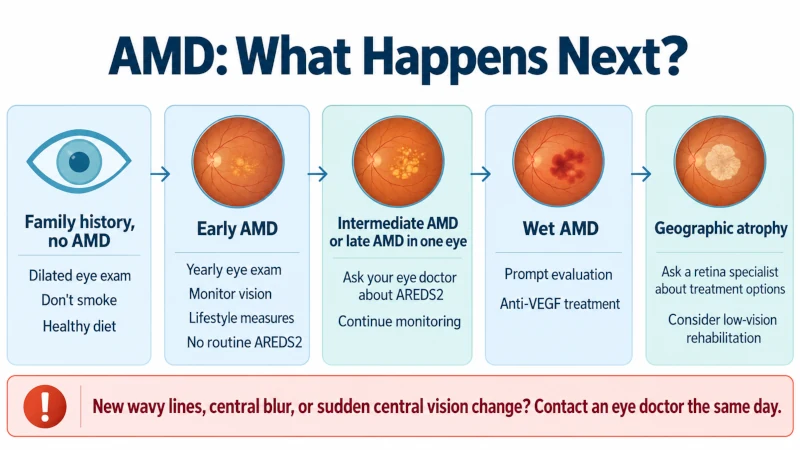
Early AMD: yearly dilated exams, an Amsler grid, and attention to smoking and diet. Supplements haven’t been shown to help.
Intermediate AMD, or late AMD in one eye: ask about AREDS2 and keep up home checks and appointments.
Wet AMD: stay on your injection schedule even when vision feels stable. Geographic atrophy: ask a retina specialist about the newer injections and get a low-vision referral early. More guides on symptoms, nutrition, and eye safety are in our Eye & Vision health hub.
| Health Disclaimer: This article is for general education and is not medical advice, diagnosis, or treatment. Age-related macular degeneration needs evaluation and follow-up by an ophthalmologist or optometrist. Talk with your eye doctor before starting AREDS2 or any supplement, especially if you smoke or used to smoke, take other medicines, or have kidney, liver, or bleeding problems. Never delay or stop prescribed treatment for wet AMD in favor of supplements or diet changes. If you notice sudden distortion, a new dark or blurry spot, or a sudden drop in vision, contact your eye doctor the same day or seek emergency care. |
Frequently Asked Questions
What is the first sign of macular degeneration?
Often there is no sign you can notice; early AMD shows up only on an eye exam as drusen National Eye Institute, 2021. When symptoms do start, trouble seeing in dim light or low contrast is common, and wavy straight lines or a blurry central spot often prompt people to seek care JAMA clinical review, 2024.
What is the difference between dry and wet AMD?
Dry AMD is a slow thinning of the macula with drusen; its late stage is geographic atrophy. Wet AMD is a late stage in which leaky blood vessels grow under the macula and can cause rapid vision loss. Wet AMD is treated with anti-VEGF eye injections; dry AMD is managed with monitoring, AREDS2 for some people, and, for geographic atrophy, newer injections in selected cases National Eye Institute, 2021 JAMA clinical review, 2024.
Can AMD be prevented?
There is no proven way to prevent it entirely, because age and genes play a large role. Not smoking is the strongest step you can take, and a diet rich in vegetables, fruit, and fish is associated with lower risk AAO Preferred Practice Pattern JAMA clinical review, 2024. AREDS2 slows progression in people who already have intermediate AMD; it does not prevent AMD in people without it.
Does AREDS2 help everyone with AMD?
No. It is recommended for intermediate AMD in one or both eyes, or late AMD in one eye. It has not been shown to help early AMD and probably won’t help if both eyes already have late AMD National Eye Institute on AREDS2, 2021.
Can AMD cause complete blindness?
AMD affects central vision and does not typically cause total darkness, because side vision is usually preserved National Eye Institute, 2021. It can, however, cause legal blindness and make it impossible to read or drive JAMA clinical review, 2024. Low-vision rehabilitation helps people use their remaining vision.
How fast can wet AMD progress?
Wet AMD can cause symptoms suddenly and worsen quickly JAMA clinical review, 2024. That is why new distortion or a new central blur needs same-day contact with an eye doctor; delays in treatment have been linked to worse outcomes.
References
- National Eye Institute. Age-Related Macular Degeneration (AMD). National Institutes of Health. https://www.nei.nih.gov/eye-health-information/eye-conditions-and-diseases/age-related-macular-degeneration
- National Eye Institute. AREDS 2 Supplements for Age-Related Macular Degeneration (AMD). National Institutes of Health. https://www.nei.nih.gov/learn-about-eye-health/eye-conditions-and-diseases/age-related-macular-degeneration/nutritional-supplements-age-related-macular-degeneration
- National Eye Institute. Treatments for Wet AMD (Advanced Neovascular AMD). National Institutes of Health. https://www.nei.nih.gov/eye-health-information/eye-conditions-and-diseases/age-related-macular-degeneration/treatments-wet-amd-advanced-neovascular-amd
- National Eye Institute. Low Vision. National Institutes of Health. https://www.nei.nih.gov/eye-health-information/eye-conditions-and-diseases/low-vision
- National Eye Institute. NIH study confirms benefit of supplements for slowing age-related macular degeneration. NEI Research News. June 2, 2022. (Summarizes Chew EY, et al. AREDS2 Report No. 28. JAMA Ophthalmology. 2022;140(7):692–698.) https://www.nei.nih.gov/research-and-training/research-news/nih-study-confirms-benefit-supplements-slowing-age-related-macular-degeneration
- Fleckenstein M, Schmitz-Valckenberg S, Chakravarthy U. Age-Related Macular Degeneration: A Review. JAMA. 2024;331(2):147–157. doi:10.1001/jama.2023.26074. PMID: 38193957. PMCID: PMC12935482. https://pmc.ncbi.nlm.nih.gov/articles/PMC12935482/
- Age-Related Eye Disease Study 2 (AREDS2) Research Group. Lutein + Zeaxanthin and Omega-3 Fatty Acids for Age-Related Macular Degeneration: The Age-Related Eye Disease Study 2 (AREDS2) Randomized Clinical Trial. JAMA. 2013;309(19):2005–2015. doi:10.1001/jama.2013.4997. PMID: 23644932. https://jamanetwork.com/journals/jama/fullarticle/1684847
- Age-Related Eye Disease Study Research Group. A randomized, placebo-controlled, clinical trial of high-dose supplementation with vitamins C and E, beta carotene, and zinc for age-related macular degeneration and vision loss: AREDS report no. 8. Archives of Ophthalmology. 2001;119(10):1417–1436. doi:10.1001/archopht.119.10.1417. PMID: 11594942. https://pubmed.ncbi.nlm.nih.gov/11594942/
- American Academy of Ophthalmology. What Is Macular Degeneration? Edited by David Turbert. November 13, 2023. https://www.aao.org/eye-health/diseases/amd-macular-degeneration
- American Academy of Ophthalmology. What to Know About Syfovre and Izervay for Geographic Atrophy. Reviewed by Rahul N. Khurana, MD. February 18, 2024. https://www.aao.org/eye-health/tips-prevention/syfovre-izervay-geographic-atrophy-amd-macular-deg
- American Academy of Ophthalmology Preferred Practice Pattern Retina/Vitreous Committee. Age-Related Macular Degeneration Preferred Practice Pattern. American Academy of Ophthalmology. 2024 edition, updated 2026. doi:10.1016/j.ophtha.2024.12.018. https://www.aao.org/education/preferred-practice-pattern/age-related-macular-degeneration-ppp
- American Academy of Ophthalmology. Comparison of Anti-VEGF Treatments for Wet AMD. Edited by Anni Delfaro. February 3, 2020. https://www.aao.org/eye-health/diseases/avastin-eylea-lucentis-difference
- US Food and Drug Administration. BLA 761235 Approval Letter: Vabysmo (faricimab-svoa). Center for Drug Evaluation and Research. January 28, 2022. https://www.accessdata.fda.gov/drugsatfda_docs/appletter/2022/761235Orig1s000ltr.pdf


