
AREDS2 supplements are a specific, high-dose mix of vitamins and minerals for people who already have a particular stage of age-related macular degeneration (AMD). If an eye doctor has found intermediate AMD in one or both of your eyes, or late AMD in one eye, the AREDS2 formula can lower the chance that the disease advances to its late, vision-threatening stage. In the trials behind it, that risk dropped by about 25 percent [National Eye Institute, 2025].
Outside that group, the evidence thins out fast. AREDS2 does not stop AMD from starting, hasn’t been shown to help early AMD, can’t bring back lost vision, and isn’t a treatment for wet AMD. Nor is it a general eye-health vitamin, despite the name appearing on many labels. Only a dilated eye exam can tell you whether you fit the group that benefited.
What the AREDS and AREDS2 Trials Were
The name comes from two clinical trials run by the National Eye Institute (NEI). The first, the Age-Related Eye Disease Study (AREDS), enrolled 4,757 people aged 55 to 80 at 11 US clinics and followed them for about five years [NEI trial overview, 2025]. Participants were randomly assigned to antioxidants (vitamin C, vitamin E, and beta-carotene), zinc with copper, both together, or a placebo [AREDS Report No. 8, 2001].
AREDS2 started in 2006 to see whether that formula could be improved. It enrolled 4,203 people aged 50 to 85 at 82 sites and limited enrollment to people with intermediate AMD in both eyes, or intermediate AMD in one eye and advanced AMD in the other. People without AMD or with early AMD were left out on purpose, because the first trial had shown no benefit for them [NEI trial overview, 2025]. AREDS2 tested adding lutein and zeaxanthin, adding omega-3 fatty acids, removing beta-carotene, and lowering the zinc dose [AREDS2 trial in JAMA, 2013].
What Is in the AREDS2 Formula
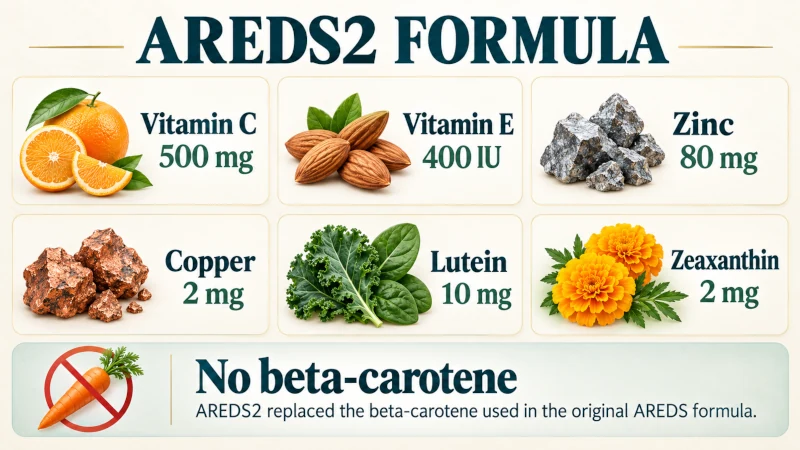
The NEI lists these daily amounts for the AREDS2 formula, shown next to the original AREDS formula it replaced [NEI AREDS 2 supplements page, 2021] [NEI trial overview, 2025]:
| Nutrient | AREDS2 formula | Original AREDS formula |
| Vitamin C | 500 mg | 500 mg |
| Vitamin E | 400 IU | 400 IU |
| Zinc | 80 mg | 80 mg |
| Copper (as cupric oxide) | 2 mg | 2 mg |
| Lutein | 10 mg | None |
| Zeaxanthin | 2 mg | None |
| Beta-carotene | None | 15 mg |
Source: National Eye Institute. The original AREDS formula is not recommended for current or former smokers.
Omega-3 fatty acids are not part of the formula; adding them in AREDS2 had no effect on AMD [NEI trial overview, 2025]. The NEI advises checking a product’s ingredient list to make sure it contains all of these nutrients in these exact amounts [NEI AREDS 2 supplements page, 2021].
What the Evidence Showed
In the original trial, people at high risk of advanced AMD (those with intermediate AMD, or advanced AMD in one eye) who took the full antioxidant-plus-zinc formula had about a 25 percent lower risk of reaching the advanced stage and a 19 percent lower risk of losing central vision, compared with placebo. None of the formulas lowered cataract risk [NEI trial overview, 2025].
Those percentages are relative. In real numbers, in the AREDS follow-up, 34 percent of the highest-risk participants who had taken the formula progressed to advanced AMD, compared with 44 percent of those who had taken placebo [NEI trial overview, 2025]. The supplement shifted the odds; it did not stop progression for everyone.
AREDS2 refined the recipe. In its main analysis, adding lutein and zeaxanthin or omega-3s to the original formula produced no additional overall benefit [AREDS2 trial in JAMA, 2013]. In secondary comparisons, though, people who took a version with lutein and zeaxanthin and no beta-carotene had an 18 percent lower risk of progressing to advanced AMD than people taking the original beta-carotene version, and among those who ate the least lutein and zeaxanthin, the reduction was 26 percent [NEI AREDS FAQ, 2020]. The investigators treated these exploratory findings as reasons for further study, not proof [AREDS2 trial in JAMA, 2013].
A 10-year follow-up, during which all participants were offered the new formula, supported the switch: compared with beta-carotene, lutein and zeaxanthin were associated with a lower risk of late AMD [AREDS2 10-year follow-up, 2022].
Who AREDS2 Supplements Are Meant For
Intermediate AMD in one or both eyes
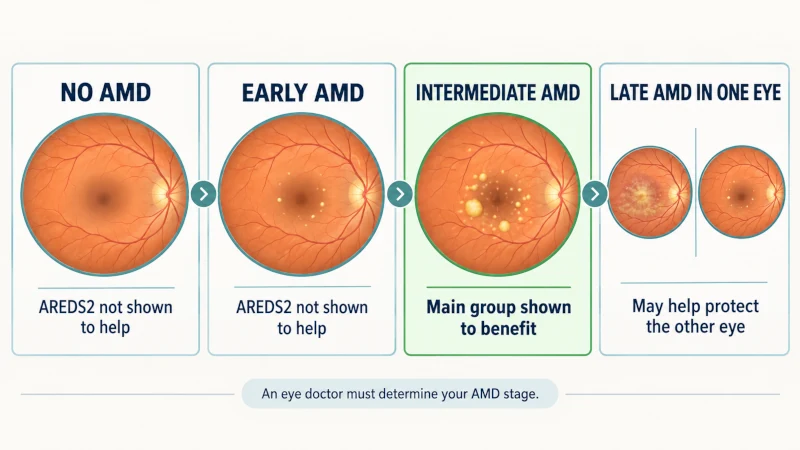
Eye doctors stage AMD partly by drusen, yellow deposits that build up under the retina. In the AREDS classification, intermediate AMD means many medium-sized drusen or at least one large druse in one or both eyes [NEI trial overview, 2025]. This is the core group that benefited. For people at this stage, the NEI says AREDS2 may keep the disease from turning into late AMD [NEI AREDS 2 supplements page, 2021].
Late AMD in one eye
If one eye already has late AMD, wet or dry, and the other does not, AREDS2 may slow progression in the other eye [NEI AREDS 2 supplements page, 2021]. That matters because having late AMD in one eye raises the risk of developing it in the second [NEI AMD overview, 2021].
Late dry AMD: an open question
A 2024 NEI analysis of retinal images from both trials suggested the supplements slowed the spread of geographic atrophy (the late form of dry AMD) toward the center of vision by roughly 55 percent over about three years, but only when the atrophy had not yet reached the fovea, the spot responsible for the sharpest vision. This was a post hoc analysis (a look back at existing trial data), and the NEI team plans a dedicated trial to confirm it [NEI research news, 2024]. For now, it is a question for a retina specialist, not a settled reason to start.
Who Generally Isn’t the Target Population
People without AMD. The NEI is direct: nutritional supplements cannot prevent AMD [NEI AREDS FAQ, 2020]. Being past a certain age, having a parent with AMD, or wanting to protect your eyes is not, by itself, a situation the trials support. Genetic testing doesn’t settle the question either; the NEI says a comprehensive dilated eye exam is the best way to judge your risk [NEI AREDS FAQ, 2020].
People with early AMD. In AREDS, participants with only small drusen or a few medium drusen had a 1.3 percent chance of progressing to advanced AMD over five years [AREDS Report No. 8, 2001], and the trials found no benefit for this group [NEI AREDS FAQ, 2020]. The NEI recommends a dilated eye exam at least once a year instead, so changes are caught early [NEI AREDS 2 supplements page, 2021].
People with late AMD in both eyes. The NEI says AREDS2 probably won’t help at that point, although low-vision services and devices can help you make the most of your remaining sight [NEI AREDS 2 supplements page, 2021]. The 2024 analysis above has reopened this question for late dry AMD.
People looking for a wet AMD treatment. Wet AMD is treated with anti-VEGF medicines injected into the eye or with photodynamic therapy [NEI AMD overview, 2021]. A supplement does not replace those treatments.
You may see mixed messages: the American Academy of Ophthalmology’s patient page says supplements might help early to intermediate AMD at risk of advancing [American Academy of Ophthalmology, 2026], while the NEI says the trials showed no benefit in early AMD [NEI AREDS FAQ, 2020]. Drusen exist on a spectrum, so your eye doctor’s reading of your drusen and risk should decide it.
What AREDS2 Does Not Do
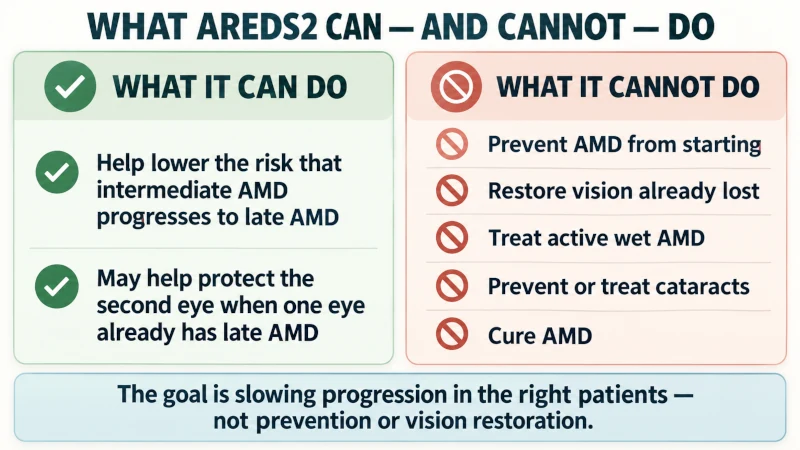
- It doesn’t prevent AMD. The trials found no effect on AMD onset [NEI trial overview, 2025].
- It doesn’t restore lost vision. In AREDS2, none of the added nutrients improved visual acuity [AREDS2 trial in JAMA, 2013]. The realistic goal is to help you keep your vision longer [NEI AREDS FAQ, 2020].
- It doesn’t treat active wet AMD. Eye injections and photodynamic therapy do that job [NEI AMD overview, 2021].
- It doesn’t prevent or treat cataracts. The formulas had no effect on cataract [NEI trial overview, 2025]; our cataracts guide explains what does help.
- It isn’t a cure. The AAO describes these supplements as something that may slow AMD in some people with certain forms of the disease [American Academy of Ophthalmology, 2026].
The Beta-Carotene Problem: Why Smokers Need AREDS2, Not AREDS
While the first trial was underway, two large National Cancer Institute studies found that beta-carotene may increase lung cancer risk in people who smoke [NEI AREDS FAQ, 2020]. AREDS2 saw a similar signal. Current smokers were not given beta-carotene, yet lung cancer occurred in 2.0 percent of participants taking a beta-carotene version versus 0.9 percent of those taking a version without it, and most of the cases were in former smokers [AREDS2 trial in JAMA, 2013]. Ten years out, people originally assigned to beta-carotene still had nearly double the odds of lung cancer, while lutein and zeaxanthin showed no statistically significant increase [AREDS2 10-year follow-up, 2022].
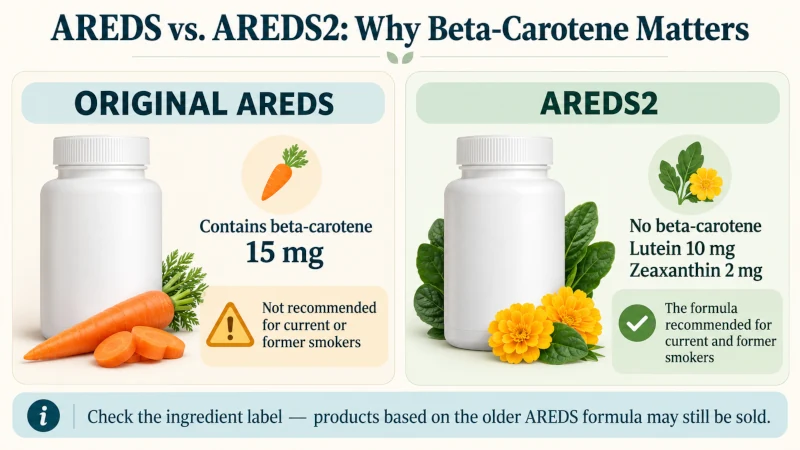
The NEI’s guidance is clear: current and former smokers should take the AREDS2 formula and avoid the original AREDS formula [NEI trial overview, 2025]. Products based on the older recipe are still sold, so read the label. If beta-carotene is listed, it is not the AREDS2 formula. Quitting smoking is also one of the steps that may lower AMD risk in the first place [NEI AMD overview, 2021].
The Ingredients, One by One
Lutein and zeaxanthin
These carotenoids are found in the retina and lens, where they may act as natural antioxidants and help absorb high-energy blue and ultraviolet light [NEI AREDS FAQ, 2020]. They replaced beta-carotene because they offered similar or better protection in AREDS2 analyses and have not been linked to increased cancer risk [NEI AREDS FAQ, 2020].
Zinc and copper
The 80 mg of zinc in AREDS2 is twice the 40 mg daily upper limit set for healthy adults. That limit doesn’t apply to people taking zinc as a medical treatment under a doctor’s care [NIH Office of Dietary Supplements, 2026], which is part of why AREDS2 is a treatment decision rather than a casual purchase. Taking 50 mg or more of zinc for weeks can interfere with copper absorption [NIH Office of Dietary Supplements, 2026], so the formula includes 2 mg of copper to reduce the risk of copper deficiency anemia [NEI AREDS FAQ, 2020].
AREDS2 found no difference between 25 mg and 80 mg of zinc, but that comparison had no placebo group, so the 80 mg dose tested in the original placebo-controlled trial remains the reference [NEI AREDS FAQ, 2020]. In the original trial, digestive problems and hospitalizations for genitourinary conditions were more common with 80 mg of zinc than with placebo [AREDS2 trial in JAMA, 2013]. Zinc can also bind quinolone and tetracycline antibiotics and the drug penicillamine, reducing how well they are absorbed, and thiazide diuretics increase zinc loss in urine [NIH Office of Dietary Supplements, 2026].
Vitamins C and E
The 500 mg of vitamin C and 400 IU of vitamin E are far above everyday needs; the recommended dietary allowance for vitamin E in adults is 22.4 IU. AREDS and AREDS2 found no adverse effects from 400 IU a day, but vitamin E can interact with blood thinners, some chemotherapy drugs, and cholesterol-lowering medicines [NEI AREDS FAQ, 2020]. Research on vitamin E and prostate cancer conflicts: AREDS and AREDS2 found no effect, while a separate large trial found a 17 percent higher prostate cancer risk with 400 IU daily [NEI AREDS FAQ, 2020].
Side Effects, Interactions, and Doubling Up
Because the doses are so large, AREDS2 supplements may change the way your body digests food and the way other medicines work [NEI AREDS 2 supplements page, 2021]. Before starting, give your clinician a list of every prescription, over-the-counter product, and supplement you take [NEI AREDS FAQ, 2020]. A few points deserve extra attention:
- Don’t stack overlapping products. A daily multivitamin alongside AREDS2 is fine; most trial participants took one [NEI AREDS FAQ, 2020]. Adding separate zinc, vitamin E, or a second eye vitamin is different, because it pushes doses past what was tested. AREDS2 participants agreed to stop other supplements containing the study nutrients [AREDS2 trial in JAMA, 2013]. More is not better here; take the formula only as your clinician directs.
- Some conditions need specific advice. AREDS2 excluded people with oxalate kidney stones, Wilson disease, hemochromatosis, or lung cancer [AREDS2 trial in JAMA, 2013], so the formula was not studied in those groups.
- Pregnancy and breastfeeding. The formula was studied in adults aged 50 to 85 [NEI trial overview, 2025], and its zinc content exceeds the 40 mg upper limit that also applies during pregnancy and breastfeeding [NIH Office of Dietary Supplements, 2026]. It is not intended for these situations.
- Prescriptions stay as prescribed. Don’t stop or change a prescribed medicine to make room for AREDS2; your prescriber and pharmacist can sort out timing and interactions.
AREDS2 vs. a Multivitamin
The two are not interchangeable, and one doesn’t replace the other [NEI AREDS FAQ, 2020].
| AREDS2 formula | Typical daily multivitamin | |
| Purpose | Slowing progression of intermediate AMD, or AMD in the second eye | Filling general nutrient gaps |
| Doses | Much higher than everyday needs | Close to everyday needs |
| AMD evidence | Tested in two large NEI trials | Cannot provide the same benefit on its own |
| Can it replace the other? | No; it doesn’t substitute for a multivitamin | No |
The trial doses were much higher than those in multivitamins, the formula helped over and above the multivitamins most participants already took, and diet alone can’t reach these levels [NEI AREDS FAQ, 2020]. An eye vitamin that borrows the AREDS2 name but changes the amounts isn’t the formula that was studied.
Why Food Still Matters
Even when AREDS2 is the right call, the AAO says supplements alone are not enough to prevent or delay advanced AMD and recommends dark leafy greens such as spinach and kale, colorful fruits and vegetables, and fatty fish like salmon [American Academy of Ophthalmology, 2026]. The NEI lists quitting smoking, regular physical activity, healthy blood pressure and cholesterol, and eating leafy greens and fish as choices that may lower your risk or slow vision loss [NEI AMD overview, 2021].
The trial data point the same way. People whose diets were lowest in lutein and zeaxanthin gained the most from adding them [NEI AREDS FAQ, 2020]. Our guide to foods that supply lutein, zeaxanthin, and other eye nutrients covers practical ways to get them.

Why Your Eye Doctor Should Confirm You Fit
Early AMD causes no symptoms, and intermediate AMD may cause none or only mild blurring. Staging depends on what an eye doctor sees during a dilated eye exam, sometimes with optical coherence tomography (OCT) imaging [NEI AMD overview, 2021]. You can’t tell your stage from how your vision feels, and the AAO advises talking with both your ophthalmologist and your primary care doctor about the benefits and risks [American Academy of Ophthalmology, 2026]. Useful questions to bring:
- What stage of AMD do I have in each eye?
- Do I fit the group that benefited in AREDS and AREDS2?
- Does my smoking history, past or present, change which formula I should use?
- Do any of my medicines or health conditions affect this decision?
- How often should I come back for exams?
When to get care quickly
Straight lines that start to look wavy or crooked are a warning sign of late AMD; see your eye doctor right away [NEI AMD overview, 2021]. Any sudden loss of vision, or a new dark or blank spot in your central vision, needs same-day attention. If you can’t reach your eye doctor promptly, go to an emergency room. More conditions are covered in our eye and vision guides.
| Health Disclaimer: This article is for general education and is not a substitute for professional medical advice, diagnosis, or treatment. AREDS2 supplements are intended for specific stages of age-related macular degeneration, and only an eye care professional can determine whether they fit your situation. Do not start AREDS2, combine it with other supplements, or change any prescription medicine without talking with your eye doctor, primary care clinician, or pharmacist, especially if you smoke or used to smoke, take blood thinners or other regular medicines, have kidney stones, Wilson disease, or hemochromatosis, or are pregnant or breastfeeding. If you notice sudden vision loss, a new dark spot, or straight lines that look wavy, seek care right away. |
Frequently Asked Questions
Who should take AREDS2?
People whose eye doctor has diagnosed intermediate AMD in one or both eyes, or late AMD in one eye. That is the group in which the formula lowered the risk of progressing to late AMD by about 25 percent [NEI trial overview, 2025]. The decision should follow a dilated eye exam, not a symptom check or an age cutoff.
Does AREDS2 prevent macular degeneration?
No. The NEI states that nutritional supplements cannot prevent AMD; the formula’s benefit is slowing progression in people who already have intermediate disease [NEI AREDS FAQ, 2020].
Can you take AREDS2 without AMD?
The trials found no benefit for people without AMD or with early AMD [NEI AREDS FAQ, 2020], and the zinc dose is twice the adult upper limit for healthy people [NIH Office of Dietary Supplements, 2026]. Without a diagnosis that fits, the risks aren’t balanced by a proven benefit.
Is AREDS2 safe for smokers?
AREDS2 is the version the NEI recommends for current and former smokers, because it contains lutein and zeaxanthin instead of beta-carotene. The original AREDS formula with beta-carotene should be avoided [NEI trial overview, 2025]. Smokers still need clinician guidance on dose and interactions.
Can AREDS2 improve vision?
No. The added nutrients in AREDS2 did not improve visual acuity [AREDS2 trial in JAMA, 2013]. The goal is to slow further loss and help you keep the vision you have for longer [NEI AREDS FAQ, 2020].
How is AREDS2 different from a multivitamin?
AREDS2 provides much higher doses of a specific set of nutrients tested for AMD, while a multivitamin supplies amounts close to everyday needs. A multivitamin can’t deliver the AREDS2 benefit, and AREDS2 doesn’t replace a multivitamin [NEI AREDS FAQ, 2020].
References
- National Eye Institute. “AREDS/AREDS2 Clinical Trials.” National Institutes of Health. View source
- National Eye Institute. “AREDS 2 Supplements for Age-Related Macular Degeneration (AMD).” National Institutes of Health. View source
- National Eye Institute. “AREDS/AREDS2 Frequently Asked Questions.” National Institutes of Health. View source
- National Eye Institute. “Age-Related Macular Degeneration (AMD).” National Institutes of Health. View source
- Age-Related Eye Disease Study Research Group. “A randomized, placebo-controlled, clinical trial of high-dose supplementation with vitamins C and E, beta carotene, and zinc for age-related macular degeneration and vision loss: AREDS report no. 8.” Archives of Ophthalmology. View source
- The Age-Related Eye Disease Study 2 (AREDS2) Research Group. “Lutein + Zeaxanthin and Omega-3 Fatty Acids for Age-Related Macular Degeneration: The Age-Related Eye Disease Study 2 (AREDS2) Randomized Clinical Trial.” View source
- Chew EY, Clemons TE, Agrón E, Domalpally A, Keenan TDL, Vitale S, Weber C, Smith DC, Christen W; AREDS2 Research Group. “Long-term Outcomes of Adding Lutein/Zeaxanthin and ω-3 Fatty Acids to the AREDS Supplements on Age-Related Macular Degeneration Progression: AREDS2 Report 28.” JAMA Ophthalmology. View source
- National Eye Institute. “NIH study confirms benefit of supplements for slowing age-related macular degeneration.” View source
- National Eye Institute. “Supplements slow disease progression during late stage of ‘dry’ age-related macular degeneration.” View source
- NIH Office of Dietary Supplements. “Zinc: Fact Sheet for Health Professionals.” View source
- American Academy of Ophthalmology. “Vitamins for AMD.” EyeSmart. 2026. View source


