
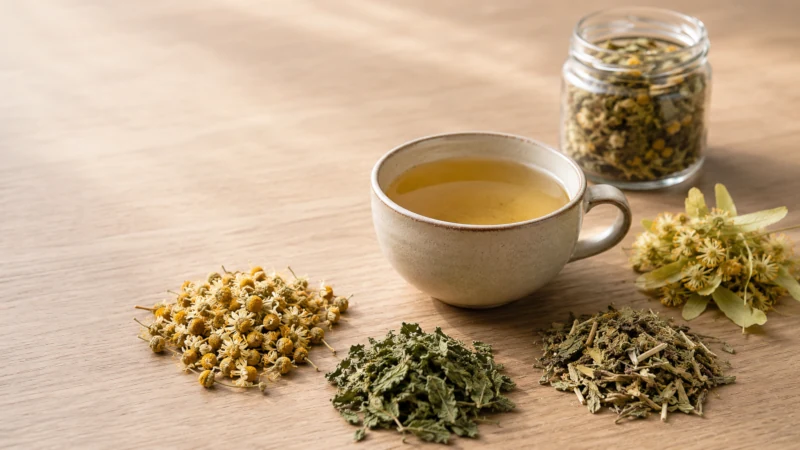
A nervine tea is a herbal infusion built from plants long used to take the edge off ordinary tension — chamomile, lemon balm, passionflower, linden. Brewed properly, it makes a pleasant and low-risk part of a wind-down routine. It is not a treatment for an anxiety disorder, and the evidence behind it is thinner than most recipes admit.
That last part is worth sitting with for a second, because it changes how you should use the tea. The trials that look best were run on concentrated capsule extracts, not cups of tea. The European approvals these herbs carry are for traditional use — meaning the plant has been used this way for decades and appears safe, not that efficacy has been demonstrated. So the honest promise of a nervine tea is a warm, mildly calming ritual with a plausible pharmacological nudge behind it. That is genuinely worth something. It is just not the same as a medicine.
Below you’ll find a four-herb blend with a defensible ratio, per-cup amounts anchored to published dosing rather than invented, a brewing method, and — the part most recipes skip entirely — a straight account of who should not drink this.
What a nervine tea actually is
“Nervine” is a traditional herbalist’s category rather than a pharmacological one. It groups plants reached for when someone is wound up, restless, or having trouble settling at night. There is no regulatory definition of the word and no lab test that makes a plant a nervine.
What does exist is a European Medicines Agency monograph for sedative herbal tea combinations — Species sedativae — which covers blends of two to four herbs drawn from hops, lavender flower, lemon balm, passionflower and valerian root, for the relief of mild symptoms of mental stress and to aid sleep. That monograph is the closest thing to an official version of the idea, and it is where the per-cup amounts further down come from (EMA monograph on Species sedativae, 2020).
Some context on who reaches for this. In 2022, 26.6% of US adults aged 18–29 reported at least mild symptoms of anxiety in the previous two weeks, against 18.2% of adults overall — and that figure was 19.5% in 2019, so it moved sharply (CDC/NCHS, Symptoms of Anxiety and Depression Among Adults, 2024). A calming tea is not the answer to that. But it is a reasonable thing to want.
The four herbs — and what the evidence really shows
For each herb you’ll see two separate things: what human research found, and what European regulators have actually approved. They do not always line up, and the gaps are the interesting part.
Chamomile (Matricaria recutita)
Chamomile has the strongest human evidence of the four, and it is still modest. In a randomised, double-blind, placebo-controlled trial, 57 adults with mild-to-moderate generalised anxiety disorder took either a chamomile extract or placebo for eight weeks. The chamomile group showed a significantly greater drop in Hamilton Anxiety scores (P = 0.047). The authors’ own summary word was modest (Amsterdam et al., 2009).
A 2022 clinical review for US family physicians lists chamomile extract as appearing effective for anxiety, based on a systematic review and meta-analysis of trials the reviewers judged to be at high risk of bias (American Academy of Family Physicians, 2022). For sleep specifically, there is very little to go on: a 2019 review turned up a single insomnia trial, which found no benefit (NCCIH on chamomile, 2024).
Here is the catch that matters most for a tea article: those trials used concentrated capsules. Nobody has shown that a cup of chamomile tea does what a standardised extract does. And European regulators have not approved chamomile flower for stress or sleep at all — the tea dose in the EMA monograph, 1.5–4 g in 150 mL, three to four times daily, sits under the indication for minor gastrointestinal complaints such as bloating and minor spasms (EMA monograph on Matricaria recutita flos, 2015).
Contraindicated if you’re hypersensitive to chamomile or to other plants in the Asteraceae family.
Lemon balm (Melissa officinalis)
Lemon balm is the one herb here whose European approval matches what you want it for. EMA registers it as a traditional herbal medicinal product for relief of mild symptoms of mental stress and to aid sleep, with a tea dose of 1.5–4.5 g in 150 mL of boiling water, one to three times daily (EMA monograph on Melissa officinalis folium, 2013).
A 2024 review in Nutrients concluded that lemon balm holds promise as a calming agent with both anxiolytic and antidepressant signals, alongside possible cognitive and sleep benefits — while stating plainly that further robust randomised trials are needed (Mathews et al., 2024). Worth knowing when you read it: two of the six authors are employed by an ingredient supplier. A 2021 systematic review and meta-analysis of clinical trials points in the same direction (Ghazizadeh et al., 2021).
Two safety notes, neither dramatic, both worth having. EMA records in vitro and animal data suggesting the water extract may inhibit thyroid-stimulating hormone activity, and states that the clinical relevance of this is not known. And EMA’s monograph says lemon balm may impair the ability to drive and use machines — a caution most articles attach only to passionflower.
Passionflower (Passiflora incarnata)
Passionflower carries the same EMA traditional-use indication as lemon balm: mild mental stress and sleep. The tea dose is smaller — 1–2 g in 150 mL, one to four times daily (EMA monograph on Passiflora incarnata herba, 2014).
The trial people cite is a small one. Thirty-six outpatients with generalised anxiety disorder, eighteen per arm, took either passionflower extract drops or oxazepam 30 mg daily for four weeks. Both groups improved and there was no significant difference between them at the end, with less impairment of job performance in the passionflower group (Akhondzadeh et al., 2001). It is a pilot study with eighteen people per arm, and it has not been replicated at scale. The AAFP review calls passionflower’s effectiveness inconclusive because of the small number of studies, and lists ataxia, central nervous system depression and prolonged QTc at large doses, and sedation among its adverse effects (AAFP, 2022).
On safety, US guidance is specific and useful: passionflower may be safe taken as a tea for up to seven nights, and as an extract for up to eight weeks. Possible side effects include drowsiness, dizziness and confusion. It may interact with anaesthesia drugs, so tell your care team if you have surgery scheduled within two weeks. And it should not be used during pregnancy, as it may induce uterine contractions (NCCIH on passionflower, 2025).
Linden, or lime flower (Tilia spp.)
Linden is in this blend for flavour and tradition, and it earns its place on both counts — it brings a soft honeyed note that rounds off chamomile’s slight bitterness. On evidence, there is essentially nothing in the way of clinical trials. EMA registers it for relief of mild symptoms of mental stress on traditional use alone, at 1.5 g in 150 mL, two to four times daily, up to 3–6 g a day (EMA monograph on Tilia flos, 2012).
If you want a rule of thumb for reading herbal claims: “traditional use” means people have done this for a long time without obvious harm. It does not mean it was tested.
How strong is the evidence, honestly?
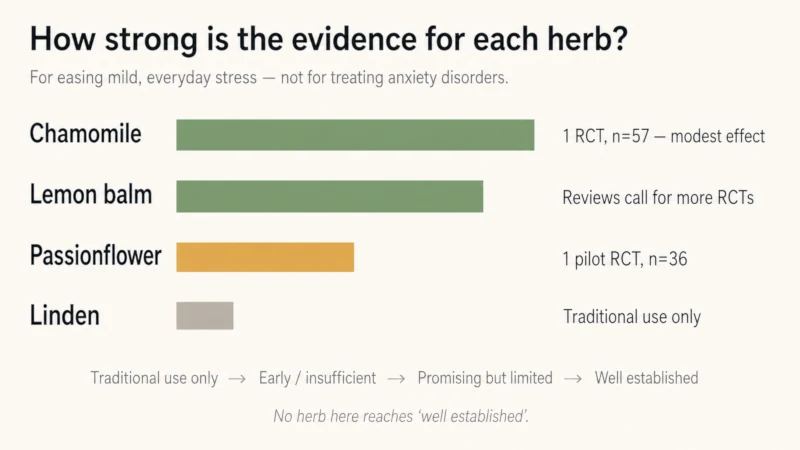
| Herb | Best human evidence | What EMA approves | How to read it |
| Chamomile | One 8-week RCT (n = 57) in mild-to-moderate GAD, modest effect; meta-analysed trials rated high risk of bias | Minor GI complaints — not stress or sleep | Promising but limited, and the trials used capsules, not tea |
| Lemon balm | Systematic reviews and a 2024 narrative review, both calling for more robust RCTs | Mild mental stress; aid to sleep (traditional use) | Promising but limited; best match between what it’s for and what it’s approved for |
| Passionflower | One 4-week pilot RCT (n = 36) vs oxazepam; Cochrane found only two trials | Mild mental stress; aid to sleep (traditional use) | Insufficient — the pilot is interesting, not conclusive |
| Linden | None of consequence | Mild mental stress (traditional use) | Traditional use only |
Not one of these is approved on the basis of demonstrated efficacy. All four sit in the traditional-use category. That is not an indictment — plenty of safe, pleasant, mildly useful things live there — but it does set the ceiling on what you should expect.
Building your nervine tea blend
The ratio
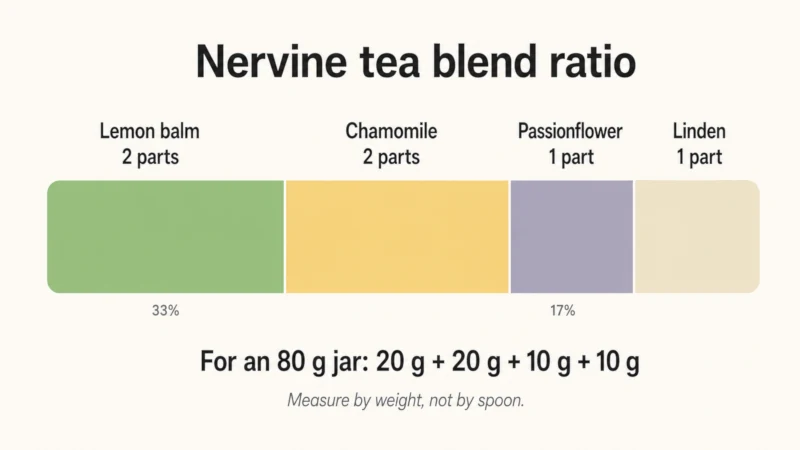
Two parts lemon balm, two parts chamomile, one part passionflower, one part linden — by weight, not volume.
- 2 parts lemon balm (dried leaf)
- 2 parts chamomile (whole flower heads)
- 1 part passionflower (cut aerial parts)
- 1 part linden (flowers with the papery bracts attached)
For a small jar of about 80 g: 20 g lemon balm, 20 g chamomile, 10 g passionflower, 10 g linden. Lemon balm and chamomile lead because they taste best and carry the most evidence between them; passionflower is held back because it is the most sedating of the four; linden is there to soften the whole thing. As it happens, this puts lemon balm at 33% and passionflower at 17% of the blend, both comfortably inside the proportional ranges EMA describes for sedative tea combinations (EMA, Species sedativae, 2020). Chamomile and linden aren’t on EMA’s combination list, so this exact mix isn’t a registered traditional combination — but the structure follows the same logic.
Why you want a scale
Dried leafy herbs vary enormously in density. A teaspoon of finely cut lemon balm and a teaspoon of whole linden bracts differ by several-fold in weight, and the volume conversions circulating online don’t come from any monograph. A kitchen scale that reads to 0.1 g costs about ten dollars and removes the problem entirely.
If you genuinely have no scale, work from Oregon State University Extension’s conversion — a quarter teaspoon of powdered herb equals roughly one teaspoon of dried herb equals about one tablespoon of chopped fresh herb (OSU Extension, Drying Herbs) — and accept that you’re approximating. Approximating is fine here. Just know that you are.
What one cup actually delivers
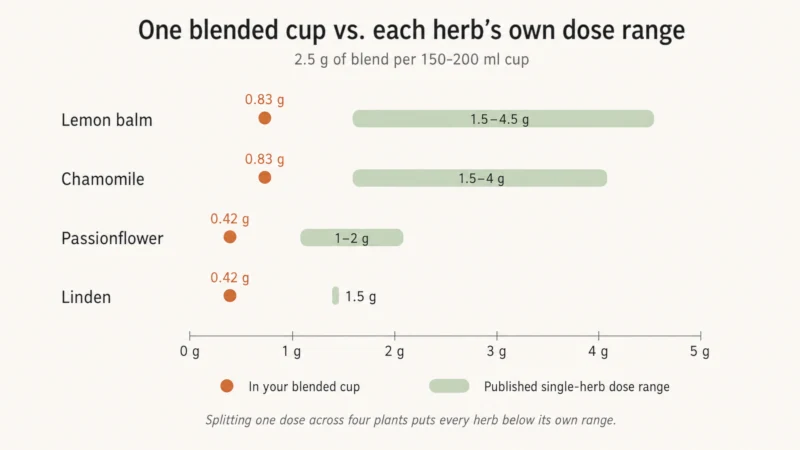
Use 2.5 g of the blend per 150–200 mL cup as a starting point. You can go up to 4 g. That range isn’t arbitrary: EMA’s monograph for sedative tea combinations specifies 1.5–4 g of the combination in 150 mL of boiling water, three to four times daily, with the last dose before bed (EMA, Species sedativae, 2020).
Here is the part almost no recipe tells you. Because you’re splitting one dose across four plants, every herb lands below its own single-herb monograph dose:
| Herb | In a 2.5 g cup | In a 4 g cup | Single-dose range for that herb alone |
| Lemon balm | 0.83 g | 1.33 g | 1.5–4.5 g |
| Chamomile | 0.83 g | 1.33 g | 1.5–4 g |
| Passionflower | 0.42 g | 0.67 g | 1–2 g |
| Linden | 0.42 g | 0.67 g | 1.5 g |
Read that two ways. It’s why this blend is gentle and why it’s an unlikely source of trouble. It’s also why you shouldn’t expect a dramatic effect from one cup. If you want more of a single herb’s traditional dose, brew that herb on its own at its own monograph amount rather than doubling up on the blend.
How to brew it
You’ll need: your blend, a kettle, a heatproof mug or teapot, a fine mesh strainer, a lid or saucer, and a timer.
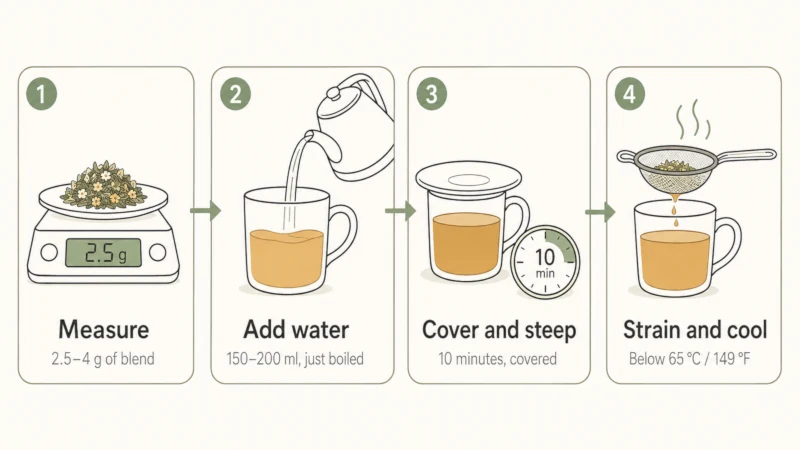
- Measure. 2.5–4 g of blend into the mug.
- Pour. 150–200 mL of just-boiled water over the herbs. EMA tea posology is written around 150 mL of boiling water per dose, so that’s your anchor.
- Cover and steep, 10 minutes. Covering matters more than people think. The aromatic compounds you can smell in the steam are leaving the cup while it sits open — put a saucer on it.
- Strain, then let it cool. Give it a few minutes before the first sip.
That last step isn’t fussiness. The International Agency for Research on Cancer classifies drinking very hot beverages — above 65 °C, about 149 °F — as probably carcinogenic to the oesophagus, Group 2A. The finding is about temperature and thermal injury, not about tea (IARC press release, 2016). Waiting five minutes handles it.
Batch version: about 10 g of blend to 750–800 mL of just-boiled water in a covered teapot, steeped 10–15 minutes, then strained into a thermos. That scales the per-cup amounts to roughly four servings.
How often to drink it — and when to stop
One to two cups a day is a sensible starting point. EMA’s combination monograph permits three to four doses daily, so there’s headroom, but there’s no reason to start at the ceiling. If passionflower makes you drowsy, keep it to the evening.
Two limits are worth writing on the jar. First, every one of these EMA monographs says the same thing: if symptoms persist longer than about two weeks while you’re using the product, talk to a doctor. Second, US guidance describes passionflower as possibly safe taken as a tea for up to seven nights (NCCIH, 2025). Continuous nightly use beyond a week goes past what anyone has actually assessed.
The practical version: use it as a tool for a rough patch, not as a permanent fixture. If you find yourself needing it every night for a month, that is information about something other than the tea.
Who should skip this tea
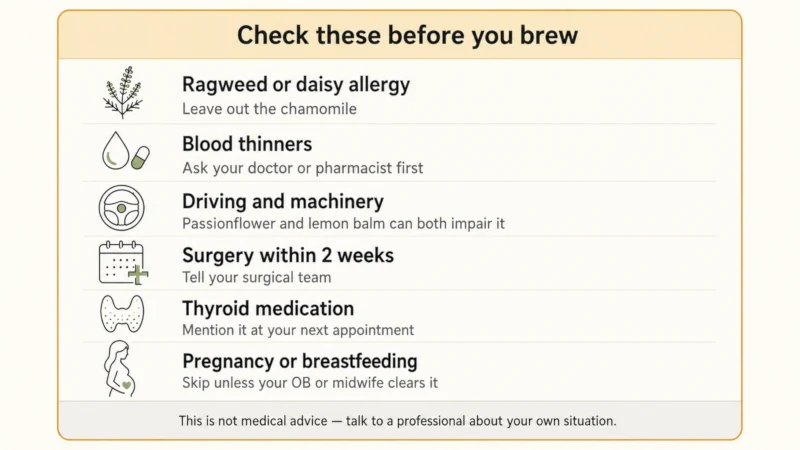
Read this section before you brew, not after.
- Ragweed and daisy-family allergies. Chamomile can trigger reactions in people allergic to ragweed, chrysanthemums, marigolds or daisies. Reactions are uncommon but can be severe, including anaphylaxis. If that’s you, leave chamomile out entirely — the other three herbs are unrelated botanically.
- Warfarin and other blood thinners. A published case report describes a 70-year-old woman on warfarin who drank four to five cups of chamomile tea daily and also used a chamomile skin lotion; her INR reached 7.9 and she developed internal bleeding. That is one case, at high intake, with two routes of exposure. But US health authorities also note that interactions between chamomile and warfarin have been reported, alongside interactions with some drugs metabolised by the liver. If you take an anticoagulant or antiplatelet, clear this with your doctor or pharmacist first.
- Hormonal birth control and estrogen-sensitive conditions. Chamomile may have some estrogen-like effects, and preliminary work suggests taking it alongside birth control pills might reduce their effect. “Preliminary” is doing real work in that sentence — this is a signal, not an established interaction. Raise it with your prescriber rather than quietly changing anything.
- Driving and machinery. EMA attaches the same warning to both passionflower and lemon balm: they may impair the ability to drive and use machines, and affected people should not drive. Find out how this blend hits you at home first.
- Other sedatives. Don’t stack this with sleep medication, benzodiazepines, sedating antihistamines or alcohol without medical advice.
- Upcoming surgery. Passionflower may interact with anaesthesia. Tell your surgical team if you’re taking it within two weeks of a scheduled procedure.
- Thyroid conditions. The lemon balm TSH signal is from in vitro and animal work and EMA says its clinical relevance is unknown. That’s not a reason to panic. It is a reason to mention this tea at your next appointment if you take levothyroxine or have thyroid disease.
- Pregnancy and breastfeeding. The sources genuinely disagree here, and you deserve to know that rather than get a clean answer that isn’t real. NCCIH says little is known about chamomile’s safety in pregnancy or nursing. EMA’s monograph says safety has been established for plain chamomile flower tea, though not for the concentrated extract preparations. Passionflower is clearer: it should not be used in pregnancy, as it may induce uterine contractions, and EMA doesn’t recommend it in pregnancy or lactation — nor does it recommend lemon balm or linden. Given that, the simple course is to skip this blend while pregnant or nursing unless your OB or midwife specifically clears it.
- Under 18. EMA doesn’t recommend lemon balm, passionflower or linden’s stress indication for anyone under 12, and there’s no assessed dosing for teenagers with this combination. Treat this as an adult blend.
- Product quality. Herbal products in the US are regulated as dietary supplements, which are not approved by the FDA before sale. Buy from a supplier that names the botanical species on the label, and follow that label.
| HEALTH DISCLAIMER: This article is for education only and is not a substitute for professional medical advice, diagnosis, or treatment. Nervine herbs are not approved to treat, cure, or prevent anxiety, insomnia, or any other condition, and individual responses and product quality vary widely. Talk to your doctor before adding any herb to your routine — and to a pharmacist as well if you take prescription medication. If you are pregnant, breastfeeding, or managing a chronic condition, get personalised guidance first. Use of any information here is at your own risk. If you are in crisis, do not wait. In the US you can call or text 988 (Suicide & Crisis Lifeline) at any time, or call 911 for an emergency. |
Storing your blend
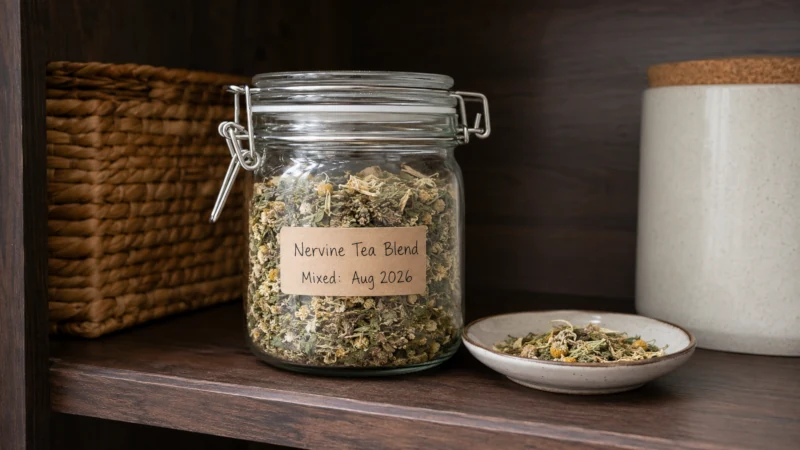
Airtight container, cool, dark, dry. Label the jar with the herb names and the date you mixed it, which matters more than it sounds if you share a kitchen.
On shelf life, two university extension services give different answers, and the gap is worth knowing. Oregon State says dried herbs store effectively for up to a year in a cool, dry, dark place, with best flavour at six to twelve months (OSU Extension). South Dakota State is more conservative: up to three months in a cool, dry location, or up to a year refrigerated or frozen (SDSU Extension, 2022). Both agree on the mechanism — air, light and heat are what degrade the aromatics.
The practical test is your nose. If the jar smells faint when you open it, the volatile compounds have gone and you’re brewing hay. Buying whole flower heads and leaves rather than pre-crushed material helps; whole plant material holds its aroma longest.
If it isn’t doing anything
- Steep longer before you steep stronger. Fifteen minutes covered pulls more out than ten. Try that before adding herb.
- Move up within the range, not past it. Going from 2.5 g to 4 g per cup stays inside EMA’s combination posology. Going beyond it doesn’t.
- Change the timing. Late afternoon or evening suits a passionflower-containing blend better than mid-morning.
- Look at the rest of the day. Caffeine after noon, alcohol in the evening and an inconsistent sleep schedule will each outweigh anything in this cup.
- Recognise the ceiling. As the table above shows, one cup of a four-herb blend delivers less of each plant than the single-herb traditional dose — and those traditional doses themselves rest on long use rather than demonstrated efficacy. If a tea was never going to be enough, more tea won’t fix it.
If you want to keep exploring plant options with more human trial data behind them, ashwagandha and rhodiola have a deeper evidence base than any of these four — with their own interactions and cautions attached. Our guides to adaptogenic herbs and anxiety and to what the evidence supports for ashwagandha go through both.
When tea is the wrong tool
Some things are past the point of self-experimentation, and recognising that early is the move that actually changes something.
Get urgent help — call 911 or go to an emergency room — if you have:
- Chest pain, severe shortness of breath, fainting, or a heart rhythm that feels wrong. Panic attacks and cardiac events overlap in how they feel, and that is not a distinction to make on your own.
- Any thoughts of harming yourself. In the US you can call or text 988 at any time.
Make an appointment with a doctor if:
- Worry, panic or sleeplessness has lasted more than two weeks, or is getting worse.
- It’s costing you work, school, or relationships.
- You’re avoiding things you used to do without a second thought.
- You’ve started drinking or using something to get to sleep.
This is not a consolation prize. For generalised anxiety and panic disorder, US clinical guidance puts cognitive behavioural therapy and SSRI or SNRI antidepressants first line, with strong evidence behind both, and notes that combining them often works better than either alone. Benzodiazepines are specifically not recommended as first-line or long-term treatment (AAFP, Generalized Anxiety Disorder and Panic Disorder in Adults, 2022). Physical activity has its own supporting evidence. Bring a list to your appointment: your symptoms, how long they’ve run, what you’ve tried, and every medication and supplement you take — including this tea.
Frequently Asked Questions
Does nervine tea actually work?
For mild, everyday tension — possibly, a little. All four herbs are approved in Europe on traditional use rather than demonstrated efficacy, and the best trial data comes from concentrated capsule extracts rather than tea. Treat it as a pleasant ritual with a plausible mild effect, not as a treatment.
Can I leave out or swap an herb?
Yes. Leaving chamomile out is the right call if you have a ragweed or daisy-family allergy, and the blend still works. If you’re adding something new, look up its own monograph dosing and cautions first rather than assuming that calming herbs are interchangeable — they aren’t, and some carry real interactions.
Is lavender tea the same as the lavender capsules studied for anxiety?
No, and this trips a lot of people up. The anxiety research on lavender used a specific standardised oral lavender oil preparation at 80 mg a day — a meta-analysis pooled five placebo-controlled trials with 1,213 participants. A pinch of dried lavender flowers in a teapot is a different thing at a different dose by a different route. Add it for the aroma if you like; don’t assume the trial results come with it.
Why does covering the mug matter?
The compounds you smell rising off the cup are aromatic oils, and while the mug is open they leave with the steam instead of ending up in your tea. A saucer on top for ten minutes keeps them where you want them.
How long will my blend stay good?
Somewhere between three months and a year, depending which extension service you ask and how well you store it. Airtight, cool, dark and dry is the whole game. Trust your nose over the calendar: a jar that smells faint has lost its aromatics.
Can I drink this while pregnant?
The safest answer is not without asking your OB or midwife. Passionflower specifically should not be used in pregnancy because it may induce uterine contractions, and European regulators don’t recommend lemon balm or linden in pregnancy or breastfeeding either. Chamomile is the genuinely contested one, with different authorities reaching different conclusions about plain chamomile tea.
References
- Akhondzadeh S, Naghavi HR, Vazirian M, et al. Passionflower in the treatment of generalized anxiety: a pilot double-blind randomized controlled trial with oxazepam. Journal of Clinical Pharmacy and Therapeutics. 2001;26(5):363–367. View source
- American Academy of Family Physicians. DeGeorge KC, Grover M, Streeter GS. Generalized Anxiety Disorder and Panic Disorder in Adults. American Family Physician. 2022;106(2):157–164. View source
- Amsterdam JD, Li Y, Soeller I, et al. A randomized, double-blind, placebo-controlled trial of oral Matricaria recutita (chamomile) extract therapy for generalized anxiety disorder. Journal of Clinical Psychopharmacology. 2009;29(4):378–382. View source
- Centers for Disease Control and Prevention, National Center for Health Statistics. Terlizzi EP, Zablotsky B. Symptoms of Anxiety and Depression Among Adults: United States, 2019 and 2022. National Health Statistics Reports No. 213. 2024. View source
- Dold M, Bartova L, Volz HP, et al. Efficacy of Silexan in patients with anxiety disorders: a meta-analysis of randomized, placebo-controlled trials. European Archives of Psychiatry and Clinical Neuroscience. 2023;273(7):1615–1628. View source
- European Medicines Agency, Committee on Herbal Medicinal Products. Community herbal monograph on Melissa officinalis L., folium. EMA/HMPC/196745/2012. 2013. View source
- European Medicines Agency, Committee on Herbal Medicinal Products. Community herbal monograph on Passiflora incarnata L., herba. EMA/HMPC/669740/2013. 2014. View source
- European Medicines Agency, Committee on Herbal Medicinal Products. Community herbal monograph on Tilia cordata Miller, Tilia platyphyllos Scop., Tilia x vulgaris Heyne or their mixtures, flos. EMA/HMPC/337066/2011. 2012. View source
- European Medicines Agency, Committee on Herbal Medicinal Products. European Union herbal monograph on Matricaria recutita L., flos. EMA/HMPC/55843/2011. 2015. View source
- European Medicines Agency, Committee on Herbal Medicinal Products. European Union herbal monograph on Species sedativae. EMA/HMPC/438183/2017. 2020. View source
- Ghazizadeh J, Sadigh-Eteghad S, Marx W, et al. The effects of lemon balm (Melissa officinalis L.) on depression and anxiety in clinical trials: a systematic review and meta-analysis. Phytotherapy Research. 2021;35(12):6690–6705. View source
- International Agency for Research on Cancer, World Health Organization. IARC Monographs evaluate drinking coffee, maté, and very hot beverages. Press Release No. 244. 2016. View source
- Mathews IM, Eastwood J, Lamport DJ, et al. Clinical Efficacy and Tolerability of Lemon Balm (Melissa officinalis L.) in Psychological Well-Being: A Review. Nutrients. 2024;16(20):3545. View source
- National Center for Complementary and Integrative Health. Chamomile. US National Institutes of Health. Last updated November 2024. View source
- National Center for Complementary and Integrative Health. Passionflower. US National Institutes of Health. Last updated April 2025. View source
- Oregon State University Extension Service. Food Safety & Preservation: Drying Herbs. SP 50-921. Reprinted 2013. View source
- Segal R, Pilote L. Warfarin interaction with Matricaria chamomilla. Canadian Medical Association Journal. 2006;174(9):1281–1282. View source
- South Dakota State University Extension. Preserving Herbs. Updated June 30, 2022. View source
