
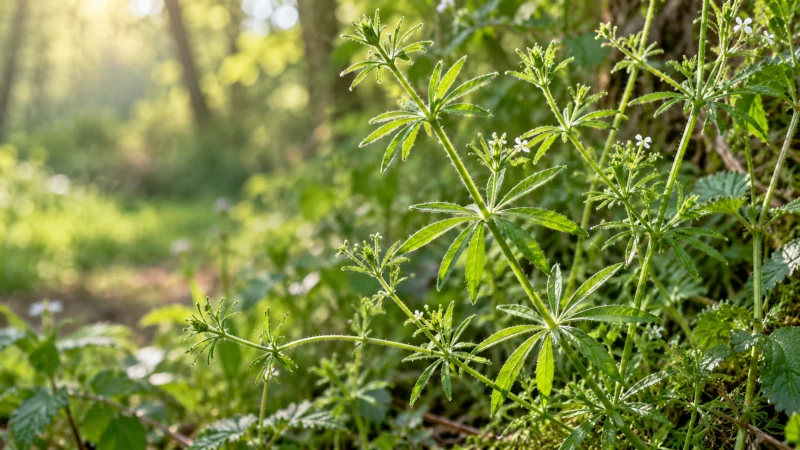
Here’s the honest version up front: cleavers is a gentle, old-fashioned “spring tonic” herb that traditional herbalists reach for to nudge the lymphatic and urinary systems along — and almost everything good said about it comes from centuries of folk use plus a handful of laboratory studies, not from trials in people. So if you came looking for cleavers plant benefits, the useful answer is: it may be a mild diuretic and a soothing skin herb, it’s generally well tolerated in small amounts, and it is not a proven treatment, cure, or “detox” for any disease. Keeping that frame is what lets you use it sensibly.
The plant itself — Galium aparine, also called bedstraw, goosegrass, catchweed, or “sticky willy” — is the weedy vine that clings to your socks on a spring walk. That stickiness is the whole personality of the plant, and, as it turns out, the reason it earned most of its folk names.
What cleavers actually is
Cleavers is an annual herb in the Rubiaceae family — the same botanical family as coffee and the cinchona tree that quinine comes from [Ilina, 2020]. The parts used are the fresh aerial tops: the trailing stems, the whorled leaves, and the tiny white flowers.
How to recognize it
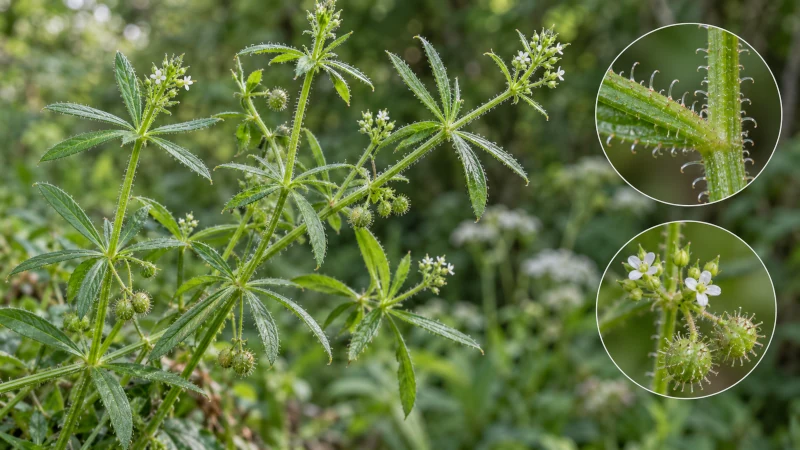
Look for thin, square, sprawling stems covered in minute hooked hairs that grab onto clothing, fur, and neighboring plants. The narrow, lance-shaped leaves grow in star-like whorls around the stem, and in spring and summer the plant throws out very small, white, four-petaled flowers. Even the round seed burrs hitchhike on anything that brushes past.
Where it grows
You’ll find cleavers in hedgerows, damp woodland edges, gardens, and along riverbanks, where it likes rich, moist soil. It grows across Europe, northern Africa, and Asia, and it has spread widely through North America [Ilina, 2020]. For most gardeners it’s a weed first and a herb second.
What’s inside cleavers (and why it might matter)
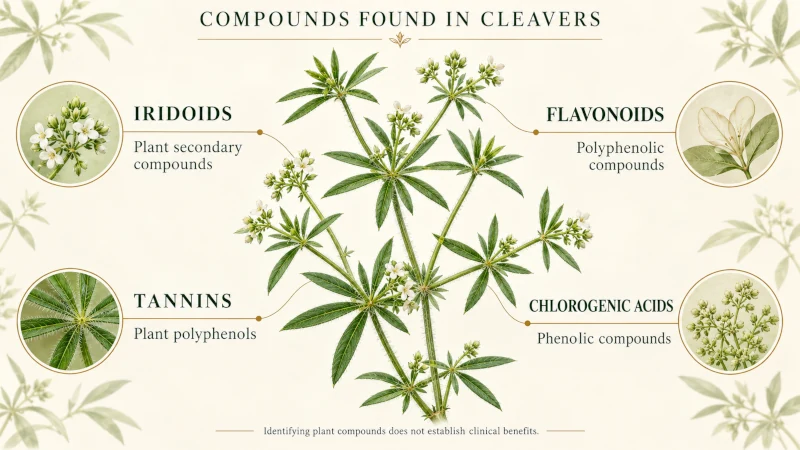
The plant’s traditional reputation lines up, at least loosely, with its chemistry. Analyses of Galium species find iridoids (mainly monotropein, asperulosidic acid, and asperuloside), flavonoids such as quercetin and kaempferol glycosides, and chlorogenic acids [Ilina, 2020]. A 2024 laboratory analysis of cleavers extract also reported phenols, flavonoids, tannins, and assorted terpenoids [Dowlati Beirami, 2024].
Those are the kinds of compounds that show antioxidant and anti-inflammatory activity in a test tube. That’s genuinely interesting — but “active in a test tube” and “does something measurable in your body when you drink the tea” are different claims, and most cleavers research has only reached the first one.
Cleavers plant benefits, graded by evidence
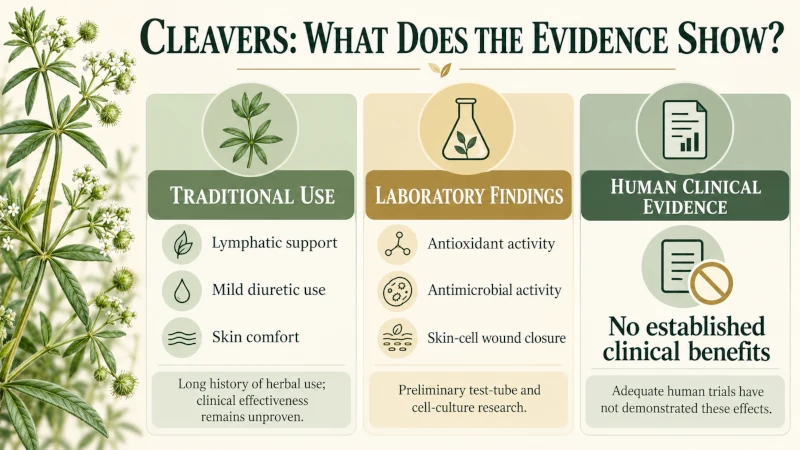
Lymphatic support and “detox”: mostly tradition
This is cleavers’ signature use. Herbalists describe it as a lymphatic herb — something to “get the lymph moving” and ease congestion in the tissues — and it’s traditionally taken as a spring cleansing tonic for that reason [Herbal Reality, 2024].
Two honest caveats belong right next to that claim. First, your lymphatic system doesn’t need a herb to work; it’s cleared by muscle movement, breathing, and normal circulation, and your liver and kidneys handle the actual chemical “detox.” Second, there are no human trials showing cleavers measurably improves lymphatic drainage — the idea rests on traditional practice and on the plant’s mild diuretic reputation. If the appeal is “flushing out toxins,” it’s worth reading a grounded take on what supporting the body’s natural detox organs actually looks like, because no single herb does it on demand.
A gentle diuretic for the urinary tract
Across herbal references, cleavers is classed as a mild diuretic — a plant that gently increases urine output — and it’s been used traditionally to ease fluid retention and to soothe irritation during minor urinary complaints [PeaceHealth, 2015; Herbal Reality, 2024]. That diuretic character is the most consistently repeated of all its uses.
What the evidence does not support is treating it as a fix for urinary tract infections or kidney stones. A UTI with fever, back pain, or blood in the urine needs medical care and often antibiotics; a soothing herb is not a substitute. Cleavers sits alongside other traditional diuretic plants like stinging nettle — useful to know about, easy to over-promise.
Skin and wound care: the best-studied use (still early)
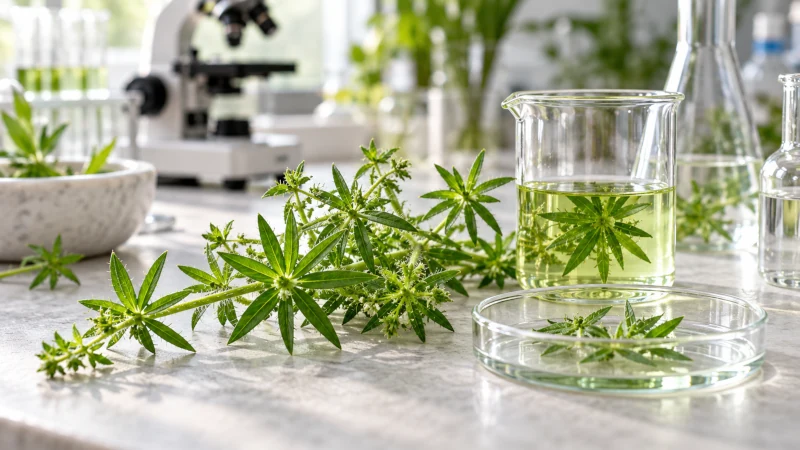
Cleavers has been used topically for centuries — as a poultice, a wash, or an addition to a bath — to calm irritated skin, and this is where the laboratory evidence is strongest. In a 2024 study, a cleavers extract sped up “wound closure” in cultured human skin cells, showed antioxidant activity comparable to vitamin C on one common lab test, inhibited Staphylococcus aureus bacteria, and did not appear toxic to human fibroblast or endothelial cells at the concentrations tested [Dowlati Beirami, 2024]. A separate study found that cleavers infusions stimulated immune cells and scavenged free radicals in vitro, which the authors said “partially” supports the plant’s folk use on skin infections and wounds [Ilina, 2020].
Read that carefully: these are cell-culture and test-tube results. They make the traditional topical use plausible and worth further study; they are not the same as a clinical trial showing cleavers heals wounds on real skin. For anything beyond a minor scrape — a wound that’s deep, spreading, hot, or not healing — see a clinician rather than reaching for a poultice.
Antioxidant and anti-inflammatory activity (lab-stage)
The flavonoids, tannins, and chlorogenic acids in cleavers scavenge free radicals in laboratory assays, and both studies above measured that antioxidant effect directly [Ilina, 2020; Dowlati Beirami, 2024]. Antioxidant activity in a dish is common among leafy plants and doesn’t automatically translate into a health benefit you’d feel, so treat this as mechanism-of-interest, not a reason to expect cleavers to prevent any chronic disease.
Immune “stimulation”: promising in a dish, unproven in people
Cleavers infusions increased the activity of immune cells (lymphocytes) in vitro, and the herb appears in several European traditional remedies aimed at “non-specific” immune defense [Ilina, 2020]. That’s a reasonable lead for researchers. It is not evidence that drinking cleavers tea will strengthen your immune system or fend off illness, and no human study has shown that.
Breast and lymph-node folklore: handle with real caution
Some herbal traditions use cleavers topically over the breast or over swollen lymph nodes, on the theory that it eases lymphatic congestion. There is no clinical evidence behind this, and it’s the one traditional use that carries real risk if it delays care. A new breast lump, skin change, or persistently swollen lymph node is not something to treat with a herb — it needs to be evaluated by a doctor. Use cleavers here, if at all, only as ordinary skin comfort, never as a reason to wait and see.
How people use cleavers
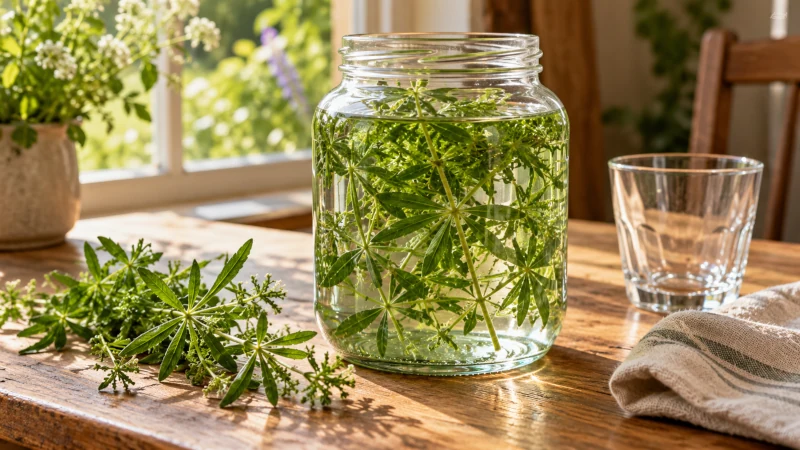
Cleavers is usually taken as a fresh infusion (tea), a tincture, or the pressed fresh juice (succus); it’s most associated with the fresh plant, since drying is thought to weaken it. Traditional amounts reported by herbal references vary, which itself tells you there’s no standardized, clinically validated dose:
| Preparation | Amounts reported by herbal references | Source |
| Fresh infusion (tea) | ~2–3 tsp dried herb steeped 10–15 min, up to ~3 cups/day | PeaceHealth, 2015 |
| Tincture | ~3–8 mL, up to 3× daily (varies by reference and strength) | PeaceHealth 2015; Herbal Reality 2024 |
| Fresh juice (succus) | ~5–15 mL daily | Herbal Reality, 2024 |
Treat these as traditional ranges, not prescriptions. Start low, don’t combine multiple concentrated forms, and if you’re using it topically, do a patch test on a small area first.
Cleavers side effects and safety
Cleavers is generally considered well tolerated in ordinary amounts, and no serious side effects are documented in the herbal literature [PeaceHealth, 2015; Herbal Reality, 2024]. “Well tolerated” is not the same as “risk-free,” though, and a few cautions are worth knowing.
Skin irritation and allergy
Because those tiny hooked hairs cling to skin, some people get redness, itching, or a rash from handling the fresh plant or applying it topically. Do a patch test before broader use and stop if you react. As a member of the Rubiaceae family — which also includes coffee and the quinine-source cinchona tree — cleavers is theoretically a cross-reactivity concern for people with known allergies in that family, though this specific cross-allergy isn’t well documented [Ilina, 2020]. If you have a history of plant allergies, be cautious with first use.
Fluid balance, diuretics, and diabetes
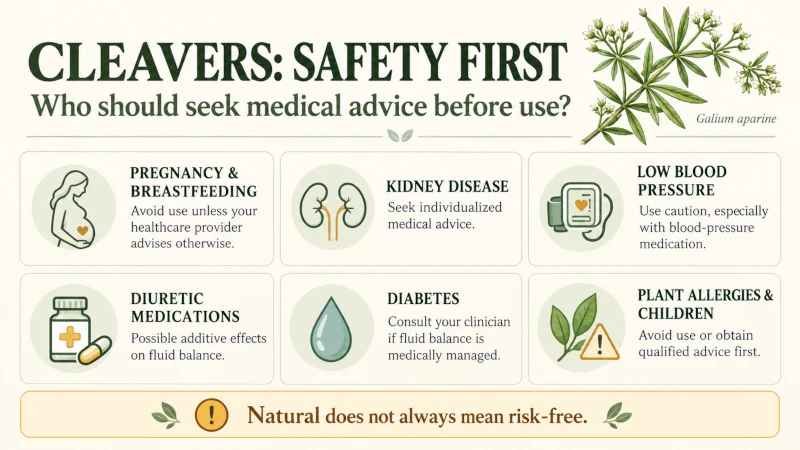
Cleavers’ diuretic effect is mild, but it’s the source of its most practical caution: if you already take a diuretic (“water pill”) or manage a condition where fluid balance is medically controlled, adding a diuretic herb can compound the effect. Herbal references specifically flag caution in diabetes and in anyone whose fluid balance is managed with medication [Herbal Reality, 2024]. Drink enough water if you use it, and watch for signs of over-doing a diuretic: unusual thirst, dry mouth, lightheadedness, or fatigue.
Blood pressure
By nudging fluid output, cleavers may modestly lower blood pressure in some people. That’s usually harmless, but if you have low blood pressure or take blood-pressure-lowering medication, the combination could leave you dizzy — so monitor how you feel. (If lowering blood pressure is your actual goal, the interventions with real evidence are covered in this guide to natural approaches to high blood pressure; a mild diuretic herb isn’t among the strong ones.)
Digestive upset
Taken internally, cleavers occasionally causes mild stomach upset or nausea, particularly in people with sensitive digestion. Effects are usually minor and pass on their own; if your stomach is easily irritated, start with a weak, small serving. For unrelated occasional bloating or gas, some people look at options like activated charcoal — but note charcoal binds many substances, so it isn’t something to take alongside medications or other supplements.
Medication interactions
The clearest documented interaction is with diuretic drugs such as spironolactone and polythiazide: cleavers may add to their effect, which in theory could contribute to cardiovascular side effects [PeaceHealth, 2015]. As a general rule, if you take diuretics, blood-pressure medication, blood thinners, lithium, or any prescription you rely on, check with a pharmacist or doctor before adding cleavers, since diuretic herbs can shift how the body handles some drugs.
Pregnancy and breastfeeding
There isn’t enough reliable safety data on cleavers during pregnancy or breastfeeding [Herbal Reality, 2024]. Given that gap, the sensible course is to avoid it while pregnant or nursing unless a qualified healthcare provider who knows your history says otherwise.
Who should avoid cleavers
Skip it, or get individualized advice first, if you: are pregnant or breastfeeding; have low blood pressure or take blood-pressure or diuretic medication; have diabetes or another condition where fluid balance is medically managed; have kidney disease; have a known Rubiaceae-family allergy; or are giving it to a child.
Red flags: when to skip the herb and see a professional
A soothing herb is the wrong tool for a warning sign. Seek medical care — not cleavers — if you have any of these:
- A urinary infection with fever, chills, back or flank pain, or blood in the urine
- A new breast lump, skin dimpling, or a lymph node that stays swollen for more than a couple of weeks
- A wound that is deep, spreading, hot, oozing, or not healing
- Swelling in one leg, or sudden generalized swelling, which can signal a clot or a heart, kidney, or liver problem rather than something a diuretic herb should touch
- Signs of an allergic reaction — hives, facial swelling, or trouble breathing (seek emergency care)
When symptoms are persistent, severe, or getting worse, self-care isn’t enough; that’s the moment to involve a clinician.
| HEALTH DISCLAIMER: This article is for general education only and is not medical advice. Cleavers is a traditional herb with limited scientific study; nothing here is intended to diagnose, treat, cure, or prevent any disease. Herbs can interact with medications and are not appropriate for everyone. Always talk with a licensed healthcare provider or pharmacist before using cleavers or any herbal remedy — especially if you are pregnant or breastfeeding, take prescription medication, or have a health condition. If you have a medical emergency, call your local emergency number. |
Frequently Asked Questions
Is cleavers good for the lymphatic system?
Traditionally it’s used that way, and herbalists value it as a “lymphatic” herb, but there are no human trials showing it improves lymphatic drainage [Herbal Reality, 2024]. The best-supported action is a mild diuretic effect; the lymphatic reputation is folklore-plus-plausibility, not proof.
Can you drink cleavers tea every day?
Small amounts are generally well tolerated, and it’s traditionally taken as a daily spring tonic for short stretches [PeaceHealth, 2015]. Because it’s a mild diuretic, drink enough water, don’t stack it with other diuretics, and avoid daily use if you’re pregnant, breastfeeding, or on blood-pressure or diuretic medication without medical advice.
Does cleavers actually detox your body?
No herb “detoxes” you on demand — your liver and kidneys do that continuously. Cleavers may act as a gentle diuretic, which is not the same as removing toxins [Herbal Reality, 2024]. Think of it as mild support at most, not a cleanse.
Is cleavers safe to put on your skin?
It has the strongest evidence for topical use, and lab studies suggest antioxidant, antibacterial, and wound-supportive activity [Dowlati Beirami, 2024]. Still, the fresh plant can irritate skin, so patch-test first, and see a clinician for any wound that’s deep, infected, or slow to heal.
What’s the difference between cleavers and yellow bedstraw?
They’re close relatives in the same genus. Cleavers is Galium aparine; yellow bedstraw is Galium verum, historically used to curdle milk for cheese. They share a family and some traditional uses but aren’t interchangeable.
Who should not take cleavers?
Anyone pregnant or breastfeeding, people with low blood pressure or on diuretic or blood-pressure drugs, those with diabetes or kidney disease, anyone with a Rubiaceae (coffee/quinine) allergy, and children — unless a qualified provider advises otherwise [PeaceHealth, 2015; Herbal Reality, 2024].
References
- Ilina T, et al. Immunomodulatory Activity and Phytochemical Profile of Infusions from Cleavers Herb. Molecules. View source
- Dowlati Beirami A, et al. Bringing back Galium aparine L. …an antimicrobial, antioxidant, and in-vitro wound healing assay along with HPTLC fingerprinting study. BMC Complementary Medicine and Therapies. View source
- Herbal Reality. Cleavers (Galium aparine): Benefits, Uses, Safety, Research. View source
- 4. PeaceHealth Health Information Library (content by TraceGains, Inc.). Cleavers. View source
- 5. Mayo Clinic. Quinine (oral route) — Side effects & dosage. View source


