

The things you can do at home that reliably lower blood pressure are unglamorous: less sodium, more potassium, a little less weight, regular walking, less alcohol, better sleep. Combine two or three of them and a systolic reading can move enough to change which category you’re in. The natural home remedies for high blood pressure that get the loudest attention online — hawthorn tea, cayenne, coenzyme Q10 capsules — are, for the most part, the ones with the thinnest evidence behind them.
So this article puts numbers on things: how many points each change is worth, which supplements have real if small trial data, what can interact with your medication, and the readings that mean you should stop reading and call someone.
Know your numbers before you change anything
High blood pressure gives you almost nothing to go on. “High blood pressure usually has no warning signs or symptoms, and many people do not know they have it,” the CDC says, and “measuring your blood pressure is the only way to know whether you have high blood pressure” [CDC, About High Blood Pressure, 2026]. Nearly half of US adults have it — 48.1%, about 119.9 million people — and only about one in four has it under control [CDC High Blood Pressure Facts, 2026].
The 2025 American Heart Association/American College of Cardiology guideline sets the categories this way [2025 AHA/ACC High Blood Pressure Guideline]:
| Category | Systolic (top number) | Diastolic (bottom number) |
| Normal | under 120 and | under 80 |
| Elevated | 120–129 and | under 80 |
| Stage 1 hypertension | 130–139 or | 80–89 |
| Stage 2 hypertension | 140 or higher or | 90 or higher |
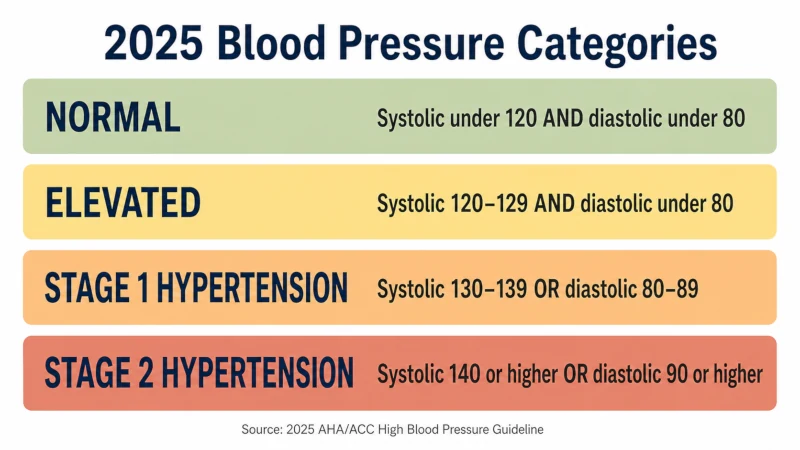
The general treatment target in that guideline is below 130/80 mm Hg, with exceptions your doctor will weigh for pregnancy, advanced age, and limited life expectancy.
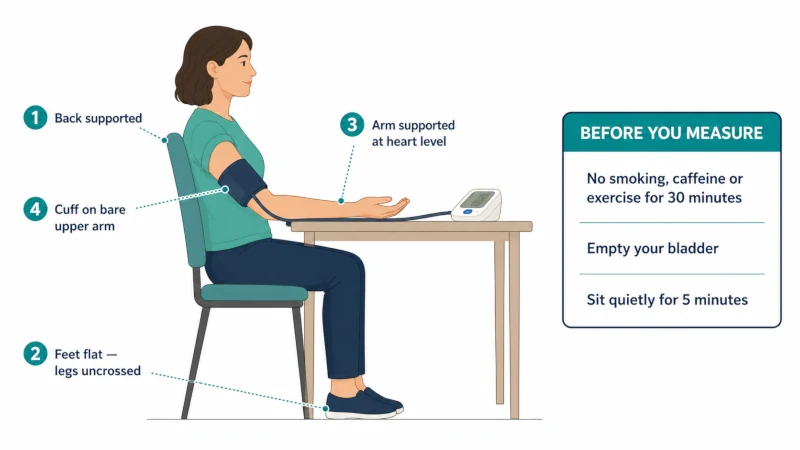
A cuff at home tells you more than one reading a year at a clinic. The AHA recommends an automatic, cuff-style, upper-arm monitor — not a wrist or finger device. Skip smoking, caffeine, and exercise for 30 minutes beforehand, empty your bladder, then sit quietly for five minutes with your back supported, feet flat, and your arm resting at heart level. Take two readings a minute apart, at the same time each day, and write them down [AHA guidance on home blood pressure monitoring, 2025]. A week of logged readings is far more useful to your doctor than a single number you remember.
The natural home remedies for high blood pressure with the strongest evidence
These are the changes with the largest and most consistent effects in human trials. Mayo Clinic puts approximate numbers on them:
| Change | Typical systolic reduction |
| A heart-healthy eating pattern such as DASH | up to 11 mm Hg |
| Regular aerobic exercise | 5–8 mm Hg |
| Cutting dietary sodium | 5–6 mm Hg |
| Losing weight | about 1 mm Hg per kilogram (2.2 lb) lost |
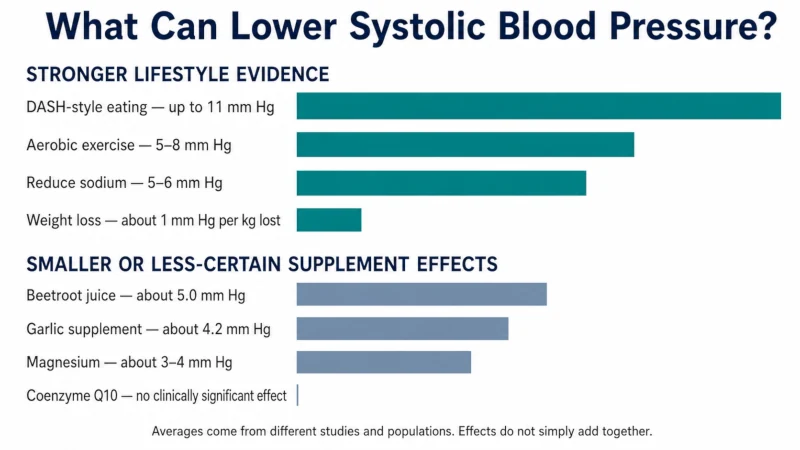
Source: Mayo Clinic, 10 ways to manage high blood pressure without medicine, 2026
One caution about that table: the effects don’t simply add up. Doing all four won’t drop you 25 points. But two or three done consistently can be the difference between stage 1 hypertension and a normal reading, and for people already on medication they often make the medication work better.
Eat like the DASH plan, even if you never call it that
DASH — Dietary Approaches to Stop Hypertension — was built specifically to lower blood pressure, and it’s the eating pattern the 2025 guideline names. It emphasizes vegetables, fruits, and whole grains, with fat-free or low-fat dairy, fish, poultry, beans, nuts, and vegetable oils, while limiting saturated fat and sugar-sweetened drinks. On a 2,000-calorie day that’s roughly 4–5 servings of vegetables and 4–5 of fruit [NHLBI DASH Eating Plan].
You don’t need to adopt it as a program. Most of the benefit comes from the shift itself — more plants, less processed food. If you want specifics, our guide to foods that lower blood pressure breaks down which ones have human data behind them.
Cut sodium, and expect the fight to be in packaged food
The standard target is 2,300 mg of sodium a day, and NHLBI notes that “1,500 milligrams (mg) sodium lowers blood pressure even further than 2,300 mg sodium daily” [NHLBI DASH Eating Plan]. The salt shaker is rarely the problem. Bread, deli meat, canned soup, sauces, and restaurant meals carry most of it, so label reading beats willpower here.
Get more potassium — with one important exception
Potassium blunts sodium’s effect and eases tension in blood vessel walls. The AHA suggests 3,500–5,000 mg daily, ideally from food: sweet potatoes, spinach, beans, bananas, yogurt, fish [AHA, How Potassium Can Help Control High Blood Pressure, 2025]. A list of potassium-rich foods makes the targets easier to hit.
Potassium-based salt substitutes are one of the more interesting findings in this area. In the Salt Substitute and Stroke Study, nearly 21,000 people in rural China who switched to a potassium-enriched substitute had fewer strokes, fewer major cardiovascular events, and fewer deaths than those using regular salt [SSaSS, New England Journal of Medicine, 2021, via ACC].
| The exception matters. That trial excluded people with kidney disease, people taking potassium-sparing diuretics, and people already on potassium supplements — and the AHA warns that extra potassium can be harmful for anyone with kidney disease or a condition affecting how the body handles potassium. If you take an ACE inhibitor, an ARB, or a potassium-sparing diuretic, or if your kidneys are not fully healthy, ask your doctor before you start salting food with a substitute or taking a potassium supplement. |
Move most days, and lose a little weight if you carry extra
Aim for 150 minutes of moderate activity a week, or 75 minutes of vigorous activity, plus strength training twice a week. Weight loss pays out at roughly a point of systolic pressure per kilogram, which means even 10 or 15 pounds is worth something measurable [Mayo Clinic, 2026].
Alcohol, sleep, and stress
The 2025 guideline recommends reducing or eliminating alcohol. Mayo’s practical version: one drink a day or fewer, and not every day. Sleep gets less attention than it deserves — aim for 7 to 9 hours, and if someone tells you that you snore loudly or gasp for air at night, mention it to your doctor, because sleep apnea is on NHLBI’s list of medical conditions that can cause high blood pressure [NHLBI, High Blood Pressure Causes and Risk Factors, 2024]. Stress management is in the guideline too, though the size of its blood-pressure effect is less well quantified than diet or exercise.
Supplements and foods with smaller — or shakier — evidence
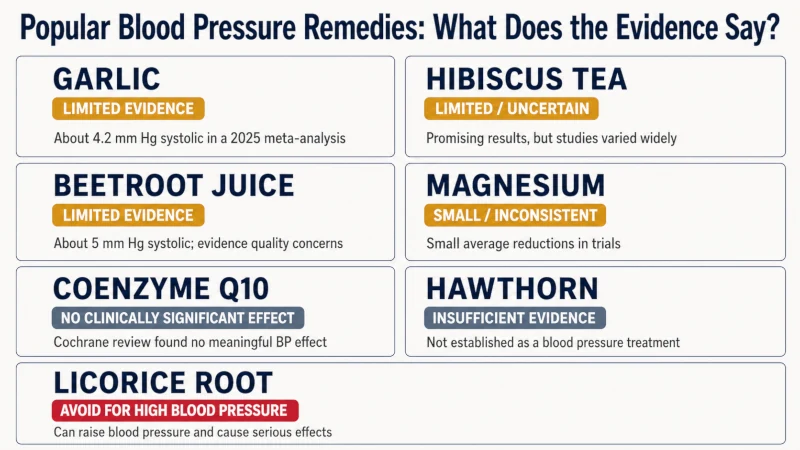
Garlic. A 2025 meta-analysis of 10 randomized trials found garlic supplementation lowered systolic pressure by about 4.21 mm Hg (95% CI −5.74 to −2.69) and diastolic by 3.13 mm Hg, mostly over 8–12 weeks. The authors flagged real limits: few studies, inconsistent formulations, and no long-term data [Tang et al., Frontiers in Nutrition, 2025]. NCCIH’s read is more conservative — “limited evidence suggests that garlic supplements may reduce blood pressure to a small extent” [NCCIH, Garlic, 2025]. Both can be true: a small real effect, weakly established.
Hibiscus tea. A meta-analysis of 17 trials found a systolic reduction of 7.10 mm Hg, but with a wide confidence interval (−13.00 to −1.20), a nonsignificant diastolic effect, and very high heterogeneity between studies [Ellis et al., Nutrition Reviews, 2022]. Promising, not settled. Doses above 1 g/day for more than four weeks showed the larger effects.
Beetroot juice. Seven trials in people with hypertension showed a systolic drop of about 4.95 mm Hg, with no significant change in diastolic pressure — and the reviewers themselves graded the evidence as having serious risk of bias, inconsistency, and imprecision [Benjamim et al., Frontiers in Nutrition, 2022]. If you want the comparison with other nitric-oxide options, we cover beetroot versus citrulline and arginine separately.
Magnesium. NIH’s Office of Dietary Supplements summarizes the trial data as small: a Cochrane review found roughly a 2.2 mm Hg drop in diastolic pressure, and a 22-study meta-analysis found 3–4 mm Hg systolic and 2–3 mm Hg diastolic, with larger effects above 370 mg/day. The FDA allows a qualified health claim here but explicitly notes the evidence is inconsistent [NIH ODS, Magnesium, 2026].
Coenzyme Q10 — no. A Cochrane review concluded there is “moderate-quality evidence that coenzyme Q10 does not have a clinically significant effect on blood pressure” [Ho, Li & Wright, Cochrane CD007435, 2016]. It’s widely sold for this purpose anyway.
Hawthorn — not enough evidence, and a safety flag. NCCIH reports conflicting evidence in heart failure and says there isn’t enough evidence to know whether hawthorn affects heart disease or related conditions. In January 2024 the FDA published a list of products labeled as hawthorn that actually contained yellow oleander, a toxic plant [NCCIH, Hawthorn, 2025].
Celery, cayenne, and other traditional remedies. These show up on every list. They’re fine as food, and celery has a long traditional use for blood pressure, but the human trial evidence is thin compared with the changes above. We’ve sorted through which herbs for high blood pressure have evidence and which don’t, and the nutritional case for celery stands on its own without the blood pressure claim doing the work.
What to leave alone
Licorice. Real licorice root contains glycyrrhizin, which NCCIH says can cause serious adverse effects including irregular heartbeat and cardiac arrest, with problems reported even at small amounts in people with hypertension or heart or kidney conditions [NCCIH, Licorice Root, 2025]. Mayo Clinic lists it among supplements that raise blood pressure, alongside arnica, ephedra (ma-huang), ginseng, and guarana [Mayo Clinic, Medications and supplements that can raise your blood pressure, 2025].
Everyday medicines that push readings up. NSAIDs such as ibuprofen and naproxen, decongestants containing pseudoephedrine or phenylephrine, hormonal birth control, some antidepressants, and caffeine pills all appear on that same Mayo list. If your numbers jumped without explanation, your medicine cabinet is worth a look before your diet is.
Drinking extra water. Hydration is good; it isn’t a blood pressure treatment. Water intake appears nowhere in the lifestyle recommendations of the 2025 guideline, which name weight, DASH-style eating, sodium reduction, potassium, physical activity, stress management, and alcohol.
Assuming a supplement is safe because it’s sold. The FDA “is not authorized to review dietary supplements for safety and effectiveness before they are marketed,” and what’s on the label may not be what’s in the bottle [NCCIH, Using Dietary Supplements Wisely, 2019].
Safety, interactions, and who should be careful
If you take blood thinners, be careful with garlic supplements: NCCIH warns they may increase bleeding risk, which matters with warfarin, direct oral anticoagulants, and daily aspirin [NCCIH, Garlic, 2025].
If you have kidney disease or take an ACE inhibitor, ARB, or potassium-sparing diuretic, don’t add potassium supplements or potassium salt substitutes without medical advice.
Magnesium supplements have an upper limit of 350 mg a day for adults from supplements alone; above that, diarrhea, nausea, and cramping are common, and magnesium interacts with bisphosphonates, tetracycline and quinolone antibiotics, diuretics, and proton pump inhibitors [NIH ODS, Magnesium, 2026].
If you’re pregnant or breastfeeding, treat herbal remedies as off the table until your doctor clears them. NCCIH says garlic may not be safe in pregnancy or breastfeeding in amounts greater than those found in food, and licorice consumption in pregnancy carries specific warnings. High blood pressure in pregnancy is managed differently and needs obstetric care, not home remedies.
Common side effects worth knowing: garlic causes breath and body odor, abdominal pain, gas, and nausea; hawthorn can cause dizziness, nausea, vomiting, diarrhea, and muscle pain; magnesium’s main one is loose stools.
Do not stop or reduce blood pressure medication on your own. Lifestyle changes and medication are not competing options — the changes above are what make lower doses possible, and that’s a conversation to have with your doctor with a month of home readings in hand.
When to call your doctor — and when to call 911
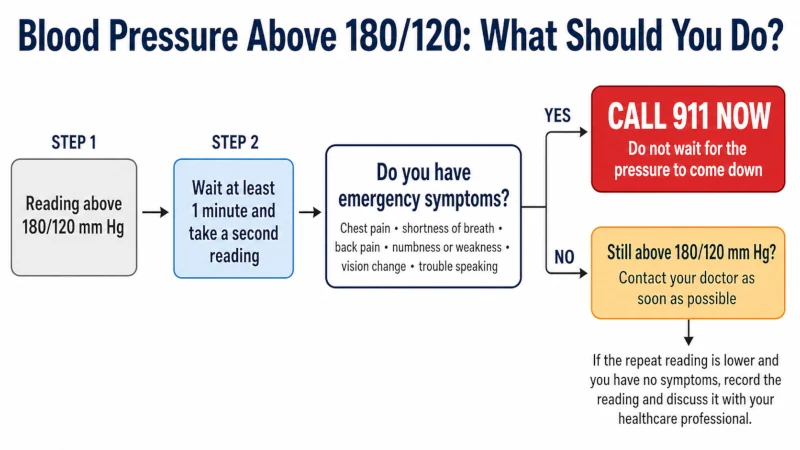
| Above 180/120 mm Hg: wait at least one minute and take a second reading. If it’s still above 180/120 and you feel fine, contact your doctor as soon as possible. If it’s above 180/120 and you have chest pain, shortness of breath, back pain, numbness or weakness, a change in vision, or difficulty speaking, call 911 — that’s an emergency, and you shouldn’t wait to see whether the number comes down. Source: AHA, When To Call 911 About High Blood Pressure, 2025 |
In pregnancy, call your obstetric provider right away for a headache that won’t go away, changes in vision including blurriness or seeing spots, pain in the upper stomach area, nausea or vomiting, swelling of the face or hands, sudden weight gain, or trouble breathing. These can signal preeclampsia [CDC, High Blood Pressure During Pregnancy, 2024].
Call your doctor, without urgency, if your home readings sit at 130/80 or above for a week or two, if they climb after you start a new medication or supplement, or if a change you’ve been making for three months hasn’t moved the number. Self-care is not enough on its own for stage 2 hypertension, and it isn’t a substitute for treatment if you already have heart disease, diabetes, or kidney disease.
| HEALTH DISCLAIMER: This article is for general education and is not medical advice, diagnosis, or treatment. High blood pressure is a serious condition, and the right plan depends on your readings, your other conditions, and your medications. Talk to your doctor — or a registered dietitian or pharmacist for diet and supplement questions — before starting any supplement or herbal remedy, especially if you are pregnant or breastfeeding, have kidney disease, or take prescription medication. Never stop or change a prescribed blood pressure medication on your own. If you have a reading above 180/120 mm Hg with symptoms, call 911. |
Frequently Asked Questions
How long before these changes show up in my readings?
Sooner than most people expect for sodium and alcohol, slower for weight and fitness. The supplement trials give a rough sense of timing: garlic studies mostly ran 8 to 12 weeks, hibiscus effects were larger past four weeks, and beetroot trials ran anywhere from three to 60 days. Give any single change four to twelve weeks of logged home readings before you decide it isn’t working.
Can I manage high blood pressure without medication?
Sometimes — it depends on your stage and your overall cardiovascular risk, which is exactly the judgment your doctor is trained to make. The 2025 guideline’s target is below 130/80 mm Hg for most adults, and lifestyle change is the foundation of every treatment plan at every stage. What you should not do is stop a prescribed medication to “try natural first.” Bring a few weeks of home readings to your next appointment and ask the question directly.
Are potassium salt substitutes safe for everyone?
No. They were a clear win in a large trial, but that trial deliberately excluded people with kidney disease, people on potassium-sparing diuretics, and people already taking potassium supplements. If you have reduced kidney function or take an ACE inhibitor, an ARB, or a potassium-sparing diuretic, check with your doctor or pharmacist first.
Do garlic supplements work better than just eating garlic?
The trials were done on supplements — standardized preparations, taken daily for two to three months — so that’s where the numbers come from. Cooking with garlic is good for you and worth doing, but it hasn’t been tested the same way, and NCCIH’s assessment of even the supplement evidence is that it’s limited.
Does stress really raise blood pressure?
Stress management is in the 2025 guideline’s list of recommended lifestyle changes, so it’s taken seriously. What’s less clear is how many millimeters of mercury it’s worth compared with diet, exercise, or sodium reduction — that has not been quantified as cleanly. Treat it as a real but supporting change rather than the main lever.
References
- Centers for Disease Control and Prevention. About High Blood Pressure. CDC, last reviewed January 28, 2026. View source
- Centers for Disease Control and Prevention. High Blood Pressure Facts. CDC, last reviewed June 2, 2026. View source
- Centers for Disease Control and Prevention. High Blood Pressure During Pregnancy. CDC, last reviewed December 13, 2024. View source
- American Heart Association / American College of Cardiology. 2025 High Blood Pressure Guideline: Top Things to Know. Professional Heart Daily, 2025. View source
- American Heart Association. Home Blood Pressure Monitoring. AHA, last reviewed August 14, 2025. View source
- American Heart Association. How Potassium Can Help Prevent or Treat High Blood Pressure. AHA, last reviewed August 14, 2025. View source
- American Heart Association. When To Call 911 About High Blood Pressure. AHA, last reviewed August 14, 2025. View source
- Mayo Clinic. 10 ways to manage high blood pressure without medicine. Mayo Foundation for Medical Education and Research, July 26, 2026. View source
- Mayo Clinic. Medications and supplements that can raise your blood pressure. Mayo Foundation for Medical Education and Research, February 21, 2025. View source
- National Heart, Lung, and Blood Institute. DASH Eating Plan. NHLBI, NIH. View source
- National Heart, Lung, and Blood Institute. High Blood Pressure — Causes and Risk Factors. NHLBI, NIH, April 30, 2024. View source
- American College of Cardiology. Salt Substitute and Stroke Study (SSaSS) trial summary. ACC, 2021 (primary publication: N Engl J Med, 2021). View source
- Tang Y, et al. Meta-analysis on the safety and efficacy of long-term garlic consumption as an adjunctive treatment for hypertension. Frontiers in Nutrition, 2025. DOI 10.3389/fnut.2025.1656809. View source
- National Center for Complementary and Integrative Health. Garlic: Usefulness and Safety. NCCIH, February 2025. View source
- Ellis LR, Zulfiqar S, Holmes M, Marshall L, Dye L, Boesch C. A systematic review and meta-analysis of the effects of Hibiscus sabdariffa on blood pressure and cardiometabolic markers. Nutrition Reviews. 2022;80(6):1723–1737. DOI 10.1093/nutrit/nuab104. PMID 34927694. View source
- Benjamim CJR, et al. Nitrate Derived From Beetroot Juice Lowers Blood Pressure in Patients With Arterial Hypertension: A Systematic Review and Meta-Analysis. Frontiers in Nutrition, 2022. DOI 10.3389/fnut.2022.823039. View source
- NIH Office of Dietary Supplements. Magnesium — Health Professional Fact Sheet. ODS, NIH, January 6, 2026. View source
- Ho MJ, Li ECK, Wright JM. Blood pressure lowering efficacy of coenzyme Q10 for primary hypertension. Cochrane Database of Systematic Reviews, 2016, CD007435. DOI 10.1002/14651858.CD007435.pub3. View source
- National Center for Complementary and Integrative Health. Hawthorn: Usefulness and Safety. NCCIH, April 2025. View source
- National Center for Complementary and Integrative Health. Licorice Root: Usefulness and Safety. NCCIH, April 2025. View source
- National Center for Complementary and Integrative Health. Using Dietary Supplements Wisely. NCCIH, January 2019. View source
