
Contents
- 1 Medical disclaimer
- 2 Quick answer
- 3 What is L‑citrulline?
- 4 Citrulline vs arginine
- 5 Typical dosage ranges used in studies
- 6 Timing: morning vs night vs pre‑workout
- 7 What results are realistic (so you don’t get disappointed)
- 8 BP safety: who should be cautious
- 9 How to run a clean 2‑week trial (so you know what helped)
- 10 What to track
- 11 Frequently Asked Questions
- 12 Next reads
- 13 References
Medical disclaimer
This article about l-citrulline dosage is for educational purposes only and is not medical advice. If you have high blood pressure, heart disease, kidney disease, are pregnant, or take prescription medications, talk with a qualified clinician before changing treatment or starting supplements. Do not stop or adjust blood pressure medication without your prescriber.[5]
Quick answer
L‑citrulline is an amino acid supplement that can raise arginine levels in the body, which may support nitric oxide (NO) signaling and blood vessel relaxation.[4] A 2025 meta‑analysis in middle‑aged/older adults found modest average reductions in both systolic and diastolic blood pressure with L‑citrulline or watermelon interventions (about −4 mmHg systolic and −2.5 mmHg diastolic on average).[1] But results are mixed across studies, and not every trial finds a clear benefit.[3]
If you want a safe, beginner approach, think in three steps:
1) Food-first NO support + movement first.
2) If you add L‑citrulline, start low and keep the dose steady for 1–2 weeks.
3) Track blood pressure trends (weekly averages), not single readings.[5]
What is L‑citrulline?
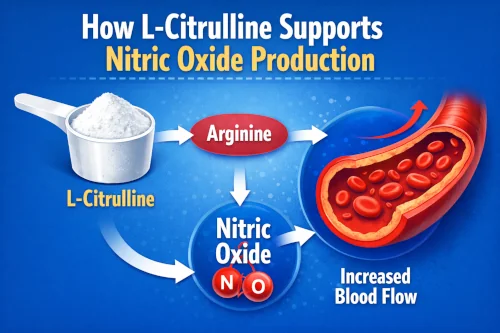
L‑citrulline is a non‑essential amino acid. Your body can convert it into L‑arginine, and arginine is one of the building blocks used to produce nitric oxide (NO) in the blood vessel lining (endothelium).[4]
People commonly try L‑citrulline for:
• Blood flow / “pump” feelings during workouts
• Blood pressure support (modest average changes in some studies)[1][2]
• Support for vascular function markers (research setting)[4]
Citrulline vs arginine
Both relate to nitric oxide, but they’re not the same supplement. L‑citrulline can be converted into arginine in your body. For beginners, the practical takeaway is: don’t stack multiple NO supplements at once—it makes results and side effects harder to interpret.
Typical dosage ranges used in studies
There isn’t one official “perfect” dose. Studies use a range. Two helpful summaries:
• A 2019 meta‑analysis suggested reductions in systolic blood pressure overall, and it noted that diastolic reductions were more apparent in studies using ≥ 6 g/day.[2]
• A 2025 meta‑analysis in middle‑aged/older adults found modest average BP reductions across 15 RCTs (varied designs).[1]
A cautious titration approach
| Step | Example daily dose (L‑citrulline) | How long | Why |
| Start low | 1.5–3 g/day | 3–7 days | Check tolerance (GI upset, headache, dizziness) |
| Hold steady | 3 g/day (or your starting dose) | 7–14 days | Look at BP trend vs day‑to‑day noise[5] |
| Consider adjusting | Up to ~6 g/day (if tolerated) | 2–4 more weeks | Some analyses show stronger signals at higher doses[2] |
| Stop & reassess | — | Anytime | If you feel faint, BP runs low, or side effects persist[5] |
Note: If your product is citrulline malate, check the label—some products list the blend dose rather than the pure L‑citrulline amount. When comparing to research, aim to match the L‑citrulline amount as closely as possible.
Timing: morning vs night vs pre‑workout
For blood pressure support, consistency usually matters more than the exact time of day. For workout-related blood flow, many people take it before exercise (because that’s when they care about blood flow).
Timing options (choose what you’ll actually stick to)
| Timing option | Who it fits best | Beginner tip |
| Morning | You want a simple daily routine | Take with breakfast; keep dose consistent |
| Evening | Morning dosing upsets your stomach | Take with dinner; keep other BP habits steady |
| Split dose (AM/PM) | Higher doses bother your stomach | Split into two smaller doses |
| Pre‑workout | Your main goal is exercise blood flow | Take 30–60 min before training; don’t add other new boosters |
What results are realistic (so you don’t get disappointed)
Average changes in research are modest. In the 2025 meta‑analysis, the average effect was only a few mmHg.[1] That can still matter, but your individual result may be smaller, larger, or zero.
Some trials do not find improvements in BP or arterial stiffness over short time periods.[3] That’s why a structured trial + tracking is the best approach.
BP safety: who should be cautious
Be extra cautious (and talk to your clinician first) if:
• You take blood pressure medication[5]
• You have a history of fainting, very low BP, or dehydration
• You have kidney disease or are on fluid/electrolyte restrictions
• You’re pregnant or breastfeeding
• You use nitrates (for chest pain) or potent vasodilators—L‑citrulline may add to BP‑lowering effects and should be monitored.[6]
When to stop and reassess
| Sign | Possible meaning | What to do |
| Dizziness / lightheadedness | BP may be dropping too low or you’re dehydrated | Stop; check BP; contact clinician if persistent[5] |
| Very low readings vs baseline | Additive BP effects with meds/habits | Do not continue without guidance[5] |
| Headache / flushing | Vasodilation or dose intolerance | Reduce dose or stop |
| Stomach upset | Dose too high or empty-stomach sensitivity | Take with food or split dose; if persistent, stop |
How to run a clean 2‑week trial (so you know what helped)
The biggest mistake: changing five things at once. Do this instead:
- Track BP for 7 days before starting (same time, seated, rested).
- Start low and keep the same dose for 14 days.
- Don’t add other new BP-lowering supplements during this trial.
- Compare weekly averages (Week 0 vs Week 2), not single readings.[5]
What to track
- Home BP trend (weekly average).
- Symptoms (dizziness, weakness, headaches).
- Dose + timing (write it down).
- Exercise minutes + sleep score (quick 1–5).
Frequently Asked Questions
- Is L‑citrulline safe long term? Safety depends on your health and medications. Many studies are short‑ to medium‑term. If you take BP meds, use clinician-guided monitoring.[5]
- Should I choose L‑citrulline or watermelon? Watermelon provides L‑citrulline plus fluids and other nutrients. Supplements are more concentrated. The 2025 meta‑analysis grouped both and found modest average BP reductions.[1]
- What’s better: citrulline or citrulline malate? They’re different forms. Many workout studies use citrulline malate, while BP discussions often reference L‑citrulline amounts. Match the L‑citrulline amount when comparing to research.
- Can I take it with blood pressure medication? Sometimes, but involve your prescriber. Don’t adjust meds on your own.[5]
Next reads
- The Complete Guide for Blood Pressure & Heart Health
- Nitric Oxide Supplements for Blood Pressure: What Helps, What’s Safe
- Nitric Oxide and Blood Pressure: What It Does and What to Track
- Nitrate‑Rich Vegetables + Easy Meal Ideas
- 12 Natural Ways to Support Nitric Oxide for Healthier Blood Pressure
References
- [1] Luo P, et al. Does L‑citrulline supplementation and watermelon intake reduce blood pressure in middle‑aged and older adults? Systematic review and meta‑analysis of randomized controlled trials. 2025. https://pubmed.ncbi.nlm.nih.gov/40789388/
- [2] Barkhidarian B, et al. Effects of L‑citrulline supplementation on blood pressure: systematic review and meta‑analysis of randomized controlled trials. 2019. (Open access via PMC) https://pmc.ncbi.nlm.nih.gov/articles/PMC6369322/
- [3] Tryfonos A, et al. Short‑Term L‑Citrulline Supplementation Does Not Affect Blood Pressure, Pulse Wave Reflection, or Arterial Stiffness in Older Males. Sports. 2023. https://www.mdpi.com/2075-4663/11/9/177
- [4] Rodionov RN, et al. Nitric Oxide in Hypertension. Int J Mol Sci. 2021. (Open access via PMC) https://pmc.ncbi.nlm.nih.gov/articles/PMC8109558/
- [5] 2025 AHA/ACC/AANP/AAPA/ABC/ACCP/ACPM/AGS/AMA/… Guideline for the Prevention, Detection, Evaluation, and Management of High Blood Pressure in Adults. Hypertension. 2025. https://www.ahajournals.org/doi/10.1161/HYP.0000000000000249
- [6] Drugs.com (professional). Drug interaction note: L‑arginine/L‑citrulline may potentiate hypotensive effects of nitrates/vasodilators (monitor). https://www.drugs.com/drug-interactions/cialis-with-citrulline-2144-1395-3771-0.html?professional=1
Last updated: 2026-01-01