Hemp nettle has one benefit with real institutional backing: Germany’s drug regulator lists it as a traditional remedy for mild airway congestion. Most of the other hemp nettle benefits repeated online — treating anemia, healing tuberculosis, reversing osteoporosis — turn out to be either outdated folklore, evidence borrowed from a different plant, or in at least one widely copied case, a citation that points to the wrong study entirely. Here’s what the plant is, what actually holds up, and how to use it if you decide to try it.
What Hemp Nettle Actually Is
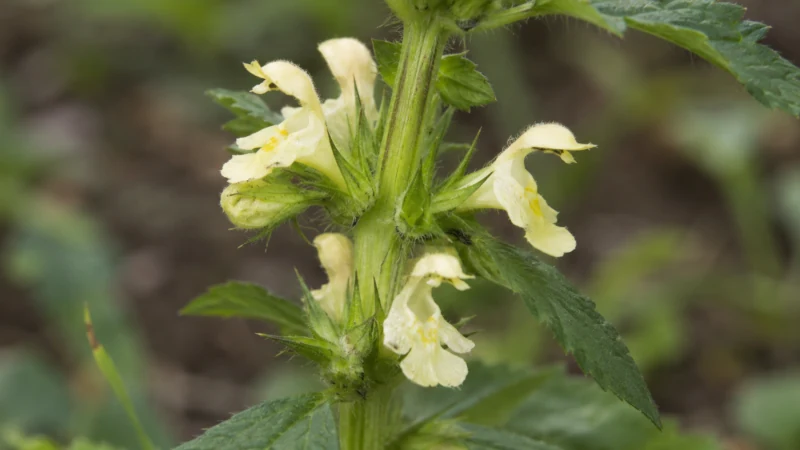
Hemp nettle is the common name for several plants in the genus Galeopsis, part of the mint family (Lamiaceae), native to Europe and parts of Asia. The species most often used medicinally is Galeopsis segetum — also called yellow hemp nettle or corn hemp nettle — though older herbal texts sometimes also reference the more common Galeopsis tetrahit. Both are small, square-stemmed annual plants with hairy leaves and two-lipped flowers.
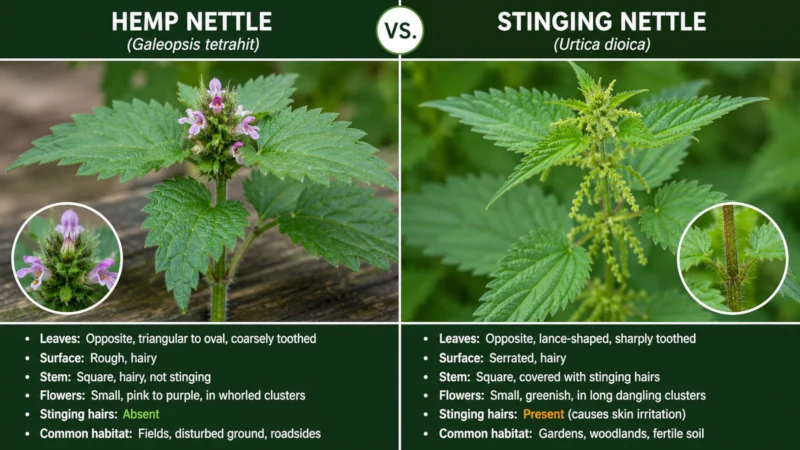
Despite the name, hemp nettle isn’t related to hemp (Cannabis) or to true nettles. “Hemp” refers to a loose resemblance between the leaf shape and hemp leaves; “nettle” refers to a resemblance to stinging nettle, even though hemp nettle doesn’t sting [Galeopsis tetrahit, Wikipedia]. If you’ve seen hemp nettle recommended alongside stinging nettle tea for the same conditions, that’s worth pausing on — they’re different genera entirely, and the research base for one doesn’t transfer to the other. Our guide to stinging nettle tea covers what’s actually been studied for that plant, separately.
Hemp nettle’s other historical claim to fame is tuberculosis. In the 18th and 19th centuries, when tuberculosis (then called “consumption”) killed enormous numbers of people in European cities, hemp nettle blends were marketed as consumption cures and sold at high prices. They didn’t work, and the practice was eventually banned once the plant’s real (and much more modest) effects became clear.
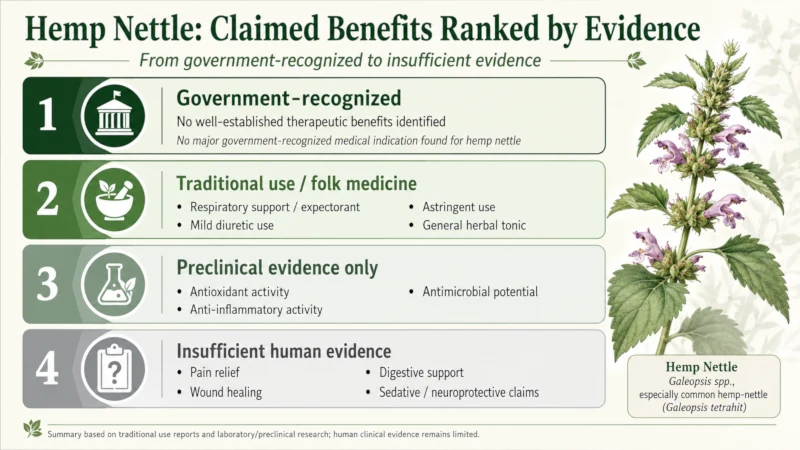
Hemp Nettle Benefits, Ranked by Evidence
| Possible benefit | Evidence level | How it may work | Main caveat |
| Mild airway/bronchial congestion | Traditional use, government-recognized (Germany) | Saponins act as a mild mucolytic/expectorant; tannins and iridoids contribute mild anti-inflammatory action | Backed by a traditional-use monograph, not modern randomized trials |
| Joint and connective-tissue support | Traditional, weak | Silicic acid is proposed to support connective tissue | No clinical trials specific to hemp nettle for arthrosis or osteoporosis |
| Skin, hair, and nail support | Traditional, weak (mostly promotional sources) | Same silica rationale as above | Not part of the official respiratory-use monograph; largely anecdotal |
| Anemia / iron support | Insufficient evidence | Unclear — no defined mechanism specific to hemp nettle | No dedicated studies found; likely carried over from stinging nettle, a different plant |
Mild airway congestion (traditional, government-recognized)
This is the one hemp nettle benefit with a real regulatory paper trail. Germany’s Commission E — the expert panel that has evaluated herbal medicines for the country’s drug regulator since the 1980s — issued a positive monograph for Galeopsidis herba (hemp nettle) specifically for mild catarrh of the airways [BfArM Commission E monograph list], first published in the Bundesanzeiger in 1987 [PTAheute, 2021]. The rationale rests on the plant’s chemistry: tannins (astringent, mildly anti-inflammatory), iridoid compounds, and saponins that act as a gentle expectorant, helping loosen thick bronchial mucus so it can be cleared [PTAheute, 2021].
It’s worth being precise about what kind of evidence this is. A Commission E monograph is built from long-standing traditional use, plausible mechanism, and safety data — not from placebo-controlled clinical trials. That’s a real difference. When the Natural Medicines Comprehensive Database — the source behind RxList’s and WebMD’s supplement monographs — reviewed hemp nettle for cough, bronchitis, and mild airway swelling, it rated the evidence “insufficient to rate effectiveness” for all of them, because it grades specifically against controlled human trials, which don’t exist for this plant.
Both things are true at once: a German regulatory body recognizes hemp nettle as a traditional remedy for mild catarrh, and a clinical-evidence database says there isn’t yet a trial that proves it works. That’s a genuine disagreement in how different bodies weigh traditional-use evidence, not a case where one source is simply wrong.
Joint and connective-tissue support (traditional, weak)
Hemp nettle contains silicic acid, and some traditional and commercial sources extend this into claims about joint health, bone density, skin elasticity, and connective tissue generally [PTAheute, 2021]. This is the same reasoning applied to other silica-rich plants like horsetail. It’s biologically plausible — silicon is involved in connective-tissue chemistry — but plausibility isn’t evidence. No clinical trials specific to hemp nettle and arthrosis, osteoporosis, or skin aging turned up in this review. Treat this as a traditional, folk-level claim rather than something you can expect a measurable result from.
Anemia and iron (insufficient evidence)
Some older plant encyclopedias describe hemp nettle as helpful for anemia, framed around boosting iron absorption and red blood cell production. This review didn’t turn up any dedicated research — human, animal, or lab — connecting hemp nettle specifically to anemia or iron metabolism.
The most likely explanation is that this claim has been carried over from stinging nettle (Urtica dioica), a genuinely different plant that does contain measurable iron and is a much more commonly studied “nettle” for that purpose — though even there, the clinical evidence for treating anemia is thin. If iron intake is your actual goal, a food-based approach has far better evidence behind it; see our list of foods rich in iron for options with known iron content and absorption data.
Where the Evidence Is Weakest
- “Hemp nettle cures tuberculosis.” This is a 200-year-old marketing claim, not a medical fact. It has no support in modern or historical clinical evidence, and the German regulatory monograph covers mild airway catarrh only — nothing close to active tuberculosis, which requires antibiotic treatment.
- “Silica-rich herbs like hemp nettle reverse osteoporosis or wrinkles.” Plausible mechanism, no clinical trials. Don’t substitute this for bone-density screening or medical treatment of osteoporosis.
- “Hemp nettle is antianemic.” No dedicated evidence found. If you suspect you’re anemic, that needs a blood test and a doctor’s evaluation, not an herbal tea.
How to Prepare Hemp Nettle Tea
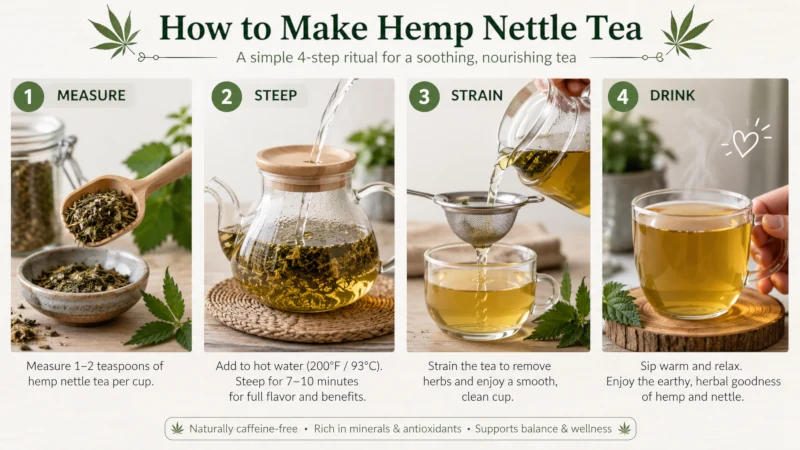
Traditional preparation uses about 2 grams of dried hemp nettle herb per cup of just-boiled water, steeped as an infusion, with a typical daily amount of roughly 6 grams of dried herb (about 2 to 3 cups) [PTAheute, 2021]. There is no formally established modern clinical dose — this figure comes from traditional herbal practice, not a dose-response trial, so treat it as a starting point rather than a precise target.
- Steep 2 g (roughly 1 teaspoon) of dried hemp nettle herb in one cup of just-boiled water for 10 to 15 minutes, then strain.
- A traditional daily total is 1 to 2 cups, up to about 6 g of dried herb per day.
- Buy from a supplier that can positively identify the species. Hemp nettle raw material has historically sometimes been adulterated with other Galeopsis species that were used medicinally in the past but aren’t the plant behind the modern monograph.
Side Effects and Safety
Formal safety data on hemp nettle is thin. The Natural Medicines Comprehensive Database states plainly that there isn’t enough reliable information to know what side effects hemp nettle might cause when taken by mouth, though it’s generally considered to be tolerated by most people at traditional tea doses [RxList]. Saponins, one of the plant’s active compounds, are bitter-tasting and can be irritating or toxic in concentrated form, which is a reason not to exceed traditional tea-strength preparations [Saponin, Wikipedia].
Who should avoid hemp nettle
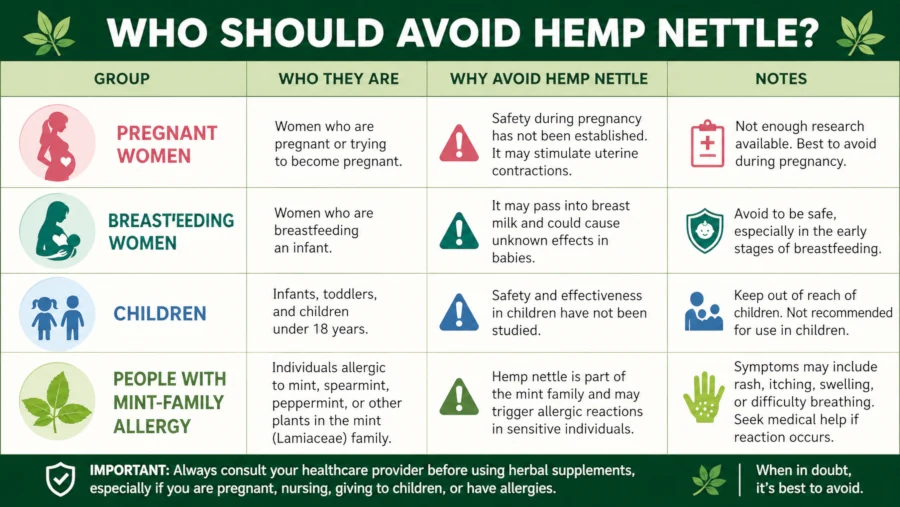
- Anyone who is pregnant or breastfeeding — see below.
- Children — there’s no established pediatric dose or safety data.
- Anyone with a known allergy to plants in the mint family (Lamiaceae).
Drug and supplement interactions
No specific drug interactions for hemp nettle have been documented in the sources reviewed here [RxList]. That’s a gap in the research, not a clean bill of safety — absence of documented interactions with a poorly studied herb isn’t the same as proof there are none. As a general precaution, take hemp nettle tea separately from iron supplements or other medications by a couple of hours, since tannins in many herbal teas can reduce mineral absorption when taken together.
Pregnancy and breastfeeding
Avoid hemp nettle if you are pregnant or breastfeeding. There isn’t enough reliable safety information to know whether it’s safe in either situation, and the standard guidance from the Natural Medicines Comprehensive Database is to stay on the safe side and avoid it [RxList] [WebMD].
Realistic Expectations
If you try hemp nettle tea for mild chest congestion or a cold-related cough, the most honest framing is that it’s a traditional remedy with a plausible mechanism and a positive regulatory opinion in one country, but no controlled human trials proving it works. It is not a treatment for tuberculosis, anemia, osteoporosis, or any diagnosed disease. If your symptoms are more than mild, or don’t improve within a week or two, that’s a signal to see a doctor rather than increase the dose.
When to Talk to Your Doctor
- Shortness of breath, wheezing, or chest tightness
- Coughing up blood
- A cough that lasts more than two to three weeks
- High fever with a productive cough
- Any symptoms suggestive of anemia (fatigue, pale skin, shortness of breath on exertion) — these need blood testing, not an herbal tea
| HEALTH DISCLAIMER: This article is for educational purposes only and is not a substitute for professional medical advice, diagnosis, or treatment. Hemp nettle is not a cure for tuberculosis, anemia, osteoporosis, or any other diagnosed disease, and it is not a substitute for prescribed medication. Talk to your doctor or pharmacist before using hemp nettle if you are pregnant, breastfeeding, giving it to a child, or taking other medications. Seek prompt medical care for severe breathing difficulty, coughing up blood, or symptoms that suggest a serious illness. |
Frequently Asked Questions
No. Hemp nettle (Galeopsis species) is in the mint family and is completely unrelated to Cannabis. The name comes from a resemblance between the leaves, not any chemical or botanical relationship.
Is hemp nettle the same as stinging nettle?
No. Stinging nettle (Urtica dioica) is a different plant in a different genus. They’re both loosely called “nettle,” which causes a lot of the confusion around hemp nettle’s claimed benefits, since much of what’s written about “nettle and anemia” or “nettle and iron” actually refers to stinging nettle. See our stinging nettle tea guide for that plant specifically.
Does hemp nettle tea actually help with coughs?
It may provide mild relief for simple chest congestion — Germany’s Commission E recognizes it as a traditional remedy for mild airway catarrh — but there are no modern controlled trials proving it works, and a major evidence database rates it “insufficient evidence.” It’s not a substitute for treating a persistent or severe cough medically.
Is hemp nettle safe during pregnancy?
No — avoid it. Safety data for pregnancy and breastfeeding is insufficient, and the standard guidance is to stay on the safe side and not use it.
Does hemp nettle help with anemia?
There’s no good evidence for this. It appears to be a claim carried over from confusion with stinging nettle, a different plant. If you’re managing anemia, that needs a doctor’s evaluation and blood work — see our foods rich in iron list for dietary options with real supporting data.
How do I brew hemp nettle tea?
Steep about 2 g of dried hemp nettle herb in one cup of just-boiled water for 10 to 15 minutes, then strain. A traditional daily amount is 1 to 2 cups.
References
- Bundesinstitut für Arzneimittel und Medizinprodukte (BfArM). Liste der Monographien der Kommission E (Phytotherapie), die im Bundesanzeiger veröffentlicht sind. → View source
- Weber-Fina, U. Hohlzahn – bei leichten Atemwegskatarrhen. PTAheute (pharmacy-trade publication), 2021. → View source
- RxList / Natural Medicines Comprehensive Database. Hempnettle: Health Benefits, Side Effects, Uses, Dose & Precautions. → View source
- WebMD / Natural Medicines Comprehensive Database. Hempnettle: Overview, Uses, Side Effects, Precautions, Interactions, Dosing. → View source
- Olennikov, D.N. Synanthropic Plants as an Underestimated Source of Bioactive Phytochemicals: A Case of Galeopsis bifida (Lamiaceae). Plants, 9(11):1555, 2020. DOI: 10.3390/plants9111555. → View source
- Wikipedia. Galeopsis tetrahit. → View source
- Wikipedia. Saponin. → View source
- Ewalia. Downy hemp-nettle (historical/traditional-use narrative only). → View source
