
A nicotine patch goes on clean, dry, hair-free skin on your upper body. The usual spots are the upper chest, the upper or inner arm, the shoulder, and the upper back [CDC, How to Use Nicotine Patches, 2024]. Some product directions also include the hip [MedlinePlus drug information, 2024], so the box your patches came in is the final word on which sites are approved for that particular product.
Where exactly you land within that zone matters less than two other things: the condition of the skin underneath, and whether you move to a different spot every single day. A patch is designed to release nicotine slowly through skin that is intact. If the skin is broken or irritated, more of the drug can get through than the product intends [National Capital Poison Center]. That single fact is the reason the instructions are so specific about surface, not just location.
Where to put nicotine patch
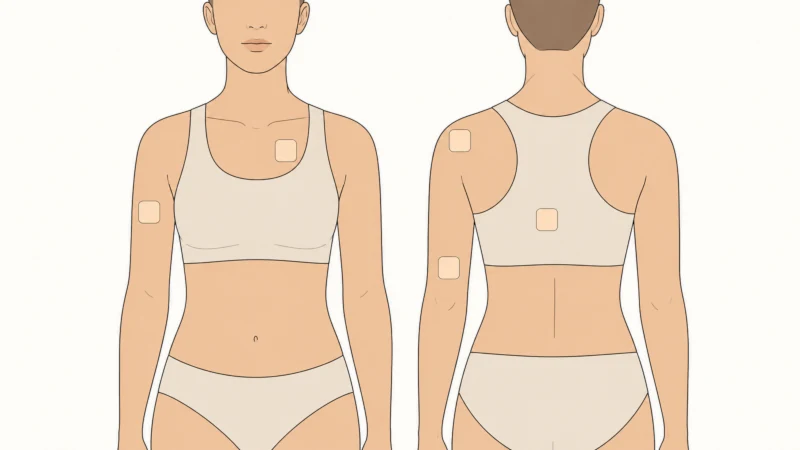
Any of these will do the job, provided the skin there is clean, dry, and free of hair.
| Site | Why it works | Watch out for |
| Upper outer arm | Flat, easy to reach with your other hand, rarely creased. | Short shirt sleeves that catch the edge as you pull them on. |
| Upper chest | Broad and flat, and hidden under most clothing. | Chest hair, and necklace chains that sit across the patch. |
| Shoulder | Stays put during most daily movement. | Backpack and bag straps rubbing the edges loose. |
| Upper back | Out of the way and hard to knock off accidentally. | You will probably need a mirror or a second pair of hands. |
| Inner arm | Usually the least hairy skin available. | Skin here is thinner and can be more reaction-prone, so rotate away at the first sign of redness. |
| Hip | Listed in some product directions. | Only use it if your own package says so, and keep it clear of the waistband. |
The practical test is simple. Press your palm flat against the area. If it lies smooth without a fold, is not being rubbed by a strap or a waistband, and has little or no hair, it will hold a patch for the day.
Where not to put a nicotine patch
Skip any skin that is irritated, oily, scarred, or broken [MedlinePlus drug information, 2024]. That includes cuts, sunburn, a rash, a healing scrape, and the patch of skin you used yesterday. A specialist tobacco treatment clinic also advises staying off the neck, the breast, tattooed skin, and scar tissue [Michigan Medicine patient guidance, 2021].
A few more things worth knowing before you open the pouch:
- Do not put moisturizer or oil on the area first. Oily skin is one of the surfaces the instructions tell you to avoid, and lotion will also stop the adhesive from gripping.
- Never cut a patch. Cutting changes how the nicotine is released [FDA-approved OTC Drug Facts label, 2024]. If the dose feels wrong, that is a conversation to have with a pharmacist or clinician, not something to solve with scissors.
- Never wear two at once unless a healthcare provider has specifically told you to [CDC, How to Use Nicotine Patches, 2024]. Wearing more than one patch is a recognized route to nicotine overdose [National Capital Poison Center].
How to apply it so it actually stays on
- Choose your spot and make sure it is clean and completely dry. Damp skin and adhesive do not mix.
- Open the foil pouch, peel off the protective backing, and put the patch on straight away [FDA-approved OTC Drug Facts label, 2024]. Do not leave it sitting on the counter.
- Press it down with the palm of your hand for about ten seconds, and pay particular attention to the edges [MedlinePlus drug information, 2024]. Some adhesives need twenty or thirty seconds to bond fully [National Capital Poison Center], so a longer press does no harm.
- Wash your hands afterwards to get any nicotine off your fingers. Instructions differ slightly here: the drug label and CDC both say to wash your hands [FDA-approved OTC Drug Facts label, 2024], with CDC specifying soap and water [CDC, How to Use Nicotine Patches, 2024], while the national drug monograph says water alone [MedlinePlus drug information, 2024]. Follow whichever appears in your own package insert.
You can shower or bathe with it on. That is expected, and the patch is built for it. If it does loosen or fall off, do not try to re-stick it; put a fresh one on a new spot instead.
Rotating sites, and why it is not optional
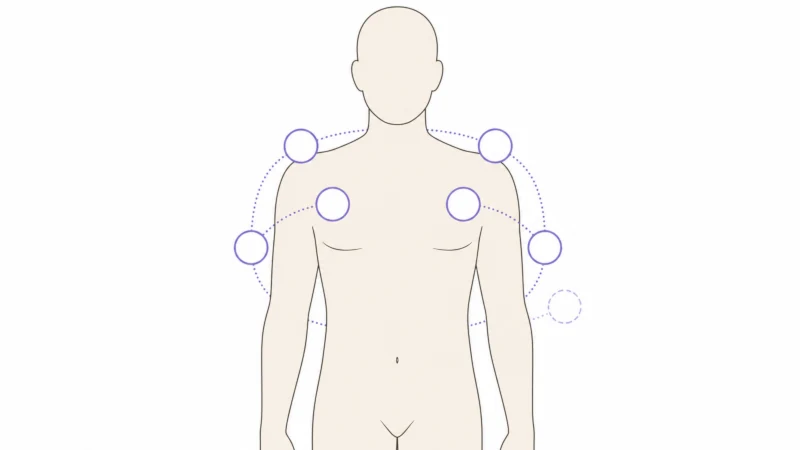
Use a new area of your upper body every day, and try not to come back to the same square of skin more than once a week [CDC, How to Use Nicotine Patches, 2024]. This is not a fussy detail. Skin irritation is the most common complaint people have about nicotine patches [Cochrane systematic review, 2018], and it is largely a problem of the same adhesive sitting on the same skin day after day.
A rotation that actually works looks like a loop rather than a rule you have to remember. Move around your body in the same direction each day: right upper arm, right chest, right shoulder blade, left shoulder blade, left chest, left upper arm, then start again. Seven positions, one week, and you never have to think about it. If you do lose track, the old patch site is usually still slightly pink, which tells you where not to go next.
Redness, itching, and when a skin reaction means stop
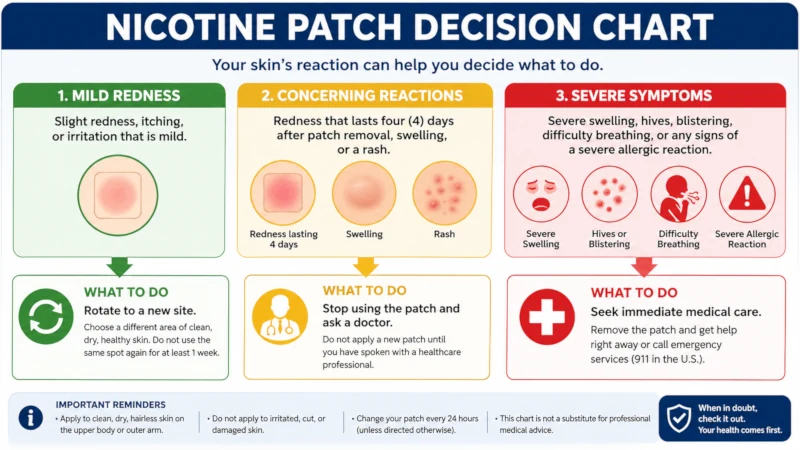
Mild redness, itching, or a burning feeling where the patch sits is common, and moving to a fresh site the next day usually handles it [CDC, How to Use Nicotine Patches, 2024].
Stop using the patch and check with a doctor if redness from the patch has not cleared four days after you took it off, if the skin swells, or if you develop a rash [FDA-approved OTC Drug Facts label, 2024]. Those are the thresholds printed on the product itself, and they are worth taking at face value rather than waiting to see whether it settles.
Call your doctor right away for a severe rash or swelling, an abnormal heartbeat, seizures, or difficulty breathing [MedlinePlus drug information, 2024]. If breathing is genuinely affected, or if someone collapses or cannot be woken, that is a 911 call rather than a phone call to a clinic.
Two groups should talk to a clinician before starting rather than after a reaction appears: anyone who reacts to adhesive tape, and anyone with an existing skin condition such as eczema or psoriasis [FDA-approved OTC Drug Facts label, 2024] [CDC, How to Use Nicotine Patches, 2024]. And never put a new patch over skin that is still irritated from the last one.
16-hour and 24-hour patches, and what to do about sleep
Patches are not all built the same way. Some are designed to be worn for a full 24 hours, others for 16 [Cochrane systematic review, 2023]. Check the box, because it changes what you do at bedtime.
With a 24-hour patch you keep it on overnight. If that gives you vivid dreams or leaves you unable to sleep, the standard fix is to take it off at bedtime and put a fresh one on when you wake up [FDA-approved OTC Drug Facts label, 2024] [CDC, How to Use Nicotine Patches, 2024]. You lose some overnight coverage, which can mean stronger morning cravings, and you gain a night of sleep. For most people that is a reasonable trade.
It is worth being honest about how thin the evidence is on this specific question. Only one small trial has ever directly compared wearing a patch for 16 hours against wearing it for 24, and with 106 participants it could not tell the two approaches apart [Cochrane systematic review, 2023]. So treat overnight wear as a comfort decision rather than something that will make or break your quit attempt.
Two rules do not bend. Do not leave a 24-hour patch on for longer than a day, because it can irritate your skin and it loses strength anyway. And do not smoke during a patch-free stretch overnight: nicotine already in your skin keeps entering your bloodstream for hours after the patch comes off [FDA-approved OTC Drug Facts label, 2024].
Keeping patches away from children and pets
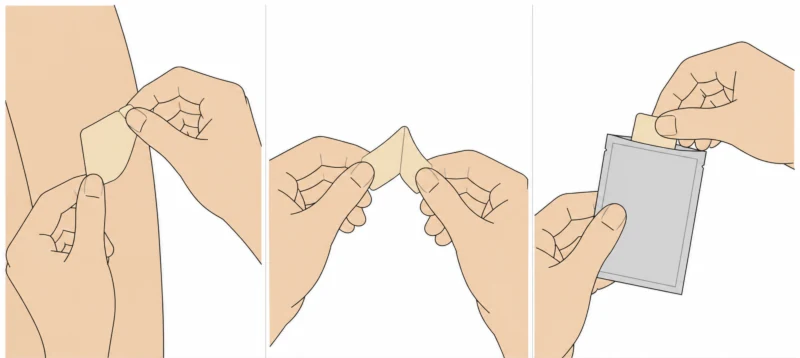
A used patch is not empty. It still holds enough nicotine to poison a small child or a pet [FDA-approved OTC Drug Facts label, 2024] [CDC, How to Use Nicotine Patches, 2024]. When you take one off, fold it in half so the sticky sides meet, put it back in the pouch the new one came out of, and throw it away where nobody small can reach it [FDA-approved OTC Drug Facts label, 2024].
The risk is not theoretical. Poison control specialists describe an 11-year-old who put on two of his mother’s patches out of curiosity and ended up in an emergency room with nicotine poisoning, weak and unable to stand [National Capital Poison Center]. Children have also been exposed by patches that came loose in an adult’s bed overnight [National Capital Poison Center].
That last point is the one place where where you put the patch really does matter for safety. If you share a bed with a young child, put the patch somewhere it is not being rubbed by bedding, and run a hand over it before you turn in to check it is still firmly attached.
If a child or pet gets hold of a patch
- Take the patch off and wash the skin with soap and water [National Capital Poison Center].
- Call Poison Help at 1-800-222-1222, or use the online tool at poison.org, straight away [National Capital Poison Center]. Guidance is free and available around the clock.
- Call 911 instead if the person has collapsed, had a seizure, is having trouble breathing, or cannot be woken [MedlinePlus drug information, 2024].
- For a pet, call your veterinarian or an animal poison control service right away rather than waiting for symptoms.
When placement is not the problem
If you are following the instructions and still fighting hard cravings, moving the patch to a different spot will not fix it. The issue is usually the dose or the product mix. CDC’s guidance is to consider stepping up to a stronger patch, or adding a fast-acting product such as gum or a lozenge, and to talk to a healthcare provider if you are already on the highest dose [CDC, How to Use Nicotine Patches, 2024].
That combination approach has good evidence behind it. Pooling 16 trials with 12,169 participants, adding a fast-acting form of nicotine replacement to the patch raised long-term quit rates compared with using one product alone – roughly 174 people quitting per 1,000 instead of 137 [Cochrane systematic review, 2023]. The patch on its own is also well established: across 51 trials and 25,754 people, it improved the odds of quitting by a little over 60 percent compared with placebo or nothing [Cochrane systematic review, 2018]. Those are meaningful improvements on a hard task, not guarantees.
One more thing that trips people up: smoking a cigarette while wearing a patch is not a reason to abandon the whole attempt. Throw the cigarettes out and carry on with the patch as directed [CDC, How to Use Nicotine Patches, 2024]. What you should not do is smoke or use other nicotine products routinely while wearing it, because that can push you into nicotine overdose [FDA-approved OTC Drug Facts label, 2024]. Nausea, vomiting, dizziness, weakness, and a racing heartbeat are the signs to watch for; if they appear, take the patch off and get medical advice [FDA-approved OTC Drug Facts label, 2024].
Free coaching roughly doubles what a patch can do on its own for most people, and in the US it costs nothing: 1-800-QUIT-NOW connects you to your state quitline [CDC, How to Use Nicotine Patches, 2024].
Who should talk to a clinician first
Get advice before you start the patch if any of the following apply to you:
- Heart disease, a heart attack in the last two weeks, an irregular heartbeat, or high blood pressure that is not controlled with medication [FDA-approved OTC Drug Facts label, 2024] [CDC, How to Use Nicotine Patches, 2024].
- An allergy to adhesive tape, or a skin condition such as eczema or psoriasis [FDA-approved OTC Drug Facts label, 2024].
- You take a prescription medicine for depression or asthma, or another stop-smoking medicine – the dose may need adjusting [FDA-approved OTC Drug Facts label, 2024].
- You are pregnant or breastfeeding. Patches should be used only on a provider’s advice in that situation [FDA-approved OTC Drug Facts label, 2024].
- You are under 18 [FDA-approved OTC Drug Facts label, 2024].
- You have an MRI scan coming up. Take the patch off before the scan, because it can cause burns [FDA-approved OTC Drug Facts label, 2024]
| Health Disclaimer: This article is general health information, not medical advice, and it cannot account for your health history, your other medications, or how much you smoke. The directions printed on your own package take priority over anything written here, because nicotine patch products differ in wear time, dose, and approved application sites. Do not start, stop, or change any prescription medicine because of something you read on this page – talk to your prescriber first. If you think you or someone else has been exposed to too much nicotine, call Poison Help at 1-800-222-1222. Call 911 for collapse, seizures, trouble breathing, or someone who cannot be woken. For personal guidance on quitting, speak with a doctor, pharmacist, or your state quitline at 1-800-QUIT-NOW. |
Frequently Asked Questions
Can I put a nicotine patch on my leg or stomach?
Those are not among the sites the instructions name. Guidance points to the upper body – upper chest, upper arm, shoulder, back, inner arm – with the hip appearing in some product directions [CDC, How to Use Nicotine Patches, 2024] [MedlinePlus drug information, 2024]. Stay within what your own package lists.
Does it matter which side of my body I use?
No side is better than the other. What the instructions actually ask for is a different area each day and no repeat within a week [CDC, How to Use Nicotine Patches, 2024], which is easiest to manage if you alternate sides as part of a set rotation.
Can I shower or swim with a nicotine patch on?
Showering and bathing are fine, and both CDC and the national drug monograph say so directly [CDC, How to Use Nicotine Patches, 2024] [MedlinePlus drug information, 2024]. Swimming is not addressed by either source, so check your package and be ready to replace a patch that loosens in water.
What if the patch falls off partway through the day?
Replace it with a new one on a different, clean spot [CDC, How to Use Nicotine Patches, 2024]. Do not try to re-stick the old one, and do not add a second patch alongside a partly attached one – only one patch should be on at a time [FDA-approved OTC Drug Facts label, 2024].
How long should I wait before using the same spot again?
About a week. CDC advises against putting the patch in the same place more than once every seven days, specifically to keep the skin from becoming irritated [CDC, How to Use Nicotine Patches, 2024].
References
- Centers for Disease Control and Prevention. “How to Use Nicotine Patches.” Tips From Former Smokers, Office on Smoking and Health. Last reviewed October 4, 2024. View source
- American Society of Health-System Pharmacists. “Nicotine Transdermal Patch.” AHFS Patient Medication Information, via MedlinePlus, US National Library of Medicine. Last revised June 20, 2024. View source
- Dr. Reddy’s Laboratories Inc. “Nicotine Transdermal System – nicotine kit.” OTC Drug Facts label, NDA020076, SPL set id e2391b29-9bac-fc09-f2a5-a3370bc4e2c3, hosted by DailyMed, US National Library of Medicine. Label updated July 25, 2024. View source
- Theodoulou A, Chepkin SC, Ye W, Fanshawe TR, Bullen C, Hartmann-Boyce J, Livingstone-Banks J, Hajizadeh A, Lindson N. “Different doses, durations and modes of delivery of nicotine replacement therapy for smoking cessation.” Cochrane Database of Systematic Reviews. 2023;6:CD013308. DOI 10.1002/14651858.CD013308.pub2. PMID 37335995. PMCID PMC10278922. View source
- Hartmann-Boyce J, Chepkin SC, Ye W, Bullen C, Lancaster T. “Nicotine replacement therapy versus control for smoking cessation.” Cochrane Database of Systematic Reviews. 2018;5:CD000146. DOI 10.1002/14651858.CD000146.pub5. Published May 31, 2018. View source
- Soloway RAG. “Using skin patch medicines safely.” National Capital Poison Center (poison.org). Undated; accessed July 27, 2026. View source
- Nix AD. “Nicotine Replacement Products: How to Use?” Michigan Medicine Tobacco Consultation Service, University of Michigan. Last revised March 2021. View source
