Ashwagandha has become one of the most popular herbal supplements in recent years, and it’s easy to see why new mothers are curious. It’s widely marketed for stress relief, better sleep, and improved energy — three things that feel desperately needed in those early postpartum months. But before you add it to your routine while nursing, there’s a clear and important answer from health authorities that deserves to lead this conversation.

Ashwagandha and Breastfeeding: The Short Answer
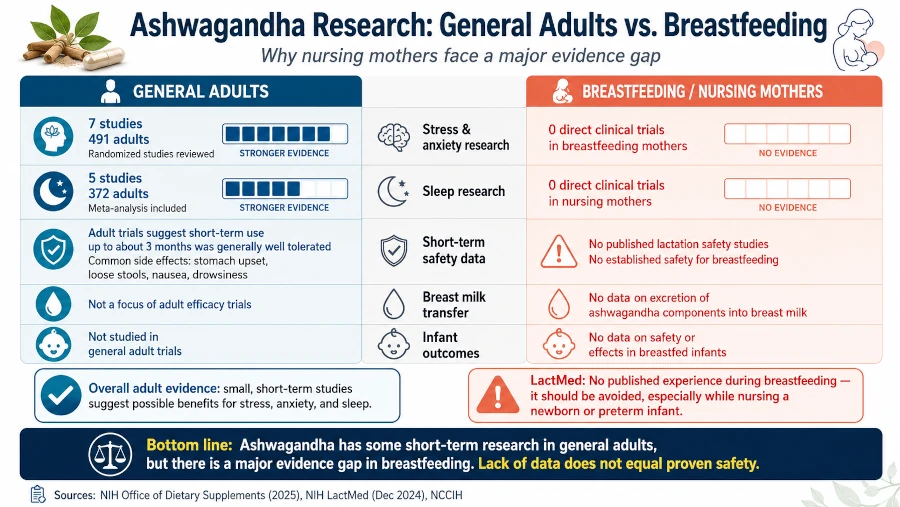
Health authorities advise against taking ashwagandha while breastfeeding. The National Center for Complementary and Integrative Health (NCCIH), a division of the National Institutes of Health, states explicitly that ashwagandha should not be used while breastfeeding [NCCIH, 2023]. The reason is not that it has been proven harmful to nursing infants — it’s that no one actually knows what it does, because the research simply doesn’t exist.
That absence of data is itself the problem. LactMed, the U.S. National Library of Medicine’s authoritative drug and lactation database, reports that no studies have measured whether any component of ashwagandha passes into breast milk, and no safety or efficacy data exist for nursing mothers or their infants [LactMed, 2024]. When we don’t know, the standard of care — especially where an infant’s developing system is involved — is to err on the side of caution.
What Ashwagandha Is (and Why New Mothers Are Interested)
Ashwagandha (Withania somnifera) is a small evergreen shrub with a long history in Ayurvedic medicine. Its root is the part most commonly used in supplements. For a fuller look at what the evidence supports in healthy, non-pregnant adults, see our in-depth review of ashwagandha benefits.
The appeal for new mothers is understandable. Sleep deprivation is real, postpartum stress is real, and the physical demands of nursing are real. Ashwagandha is classified as an adaptogenic herb — a category of plants thought to help the body manage the effects of physical and psychological stress. In adults who are not pregnant or nursing, short-term use appears generally well-tolerated, and there is modest evidence it may reduce perceived stress and improve sleep quality.
What’s actually in it
Ashwagandha root contains compounds called withanolides, along with alkaloids and saponins. Products vary significantly in their preparation — some use root extract, some use leaf or root/leaf combinations, and different branded extracts (KSM-66, Sensoril, and others) use different parts and concentrations. That variability makes it even harder to generalize any safety assumption from one product to another, which matters when you’re asking whether something could reach a nursing infant through breast milk.
Why Health Authorities Say to Avoid It While Breastfeeding
No data on transfer into breast milk
The central issue is not that ashwagandha is known to be dangerous for nursing infants. It’s that we have no idea whether its compounds pass into breast milk, and if so, at what levels, with what effects. LactMed notes that no data exist on the excretion of any ashwagandha components into human breast milk [LactMed, 2024]. The compounds in ashwagandha — including withanolides, alkaloids, and steroidal lactones — have not been studied in this context at all.
This matters because infants, particularly newborns, metabolize substances differently than adults do. Something that a healthy adult clears efficiently might accumulate in an infant’s system or have unpredictable effects on their developing organ function.
The newborn and preterm risk
LactMed’s guidance is specific: ashwagandha should be avoided especially while nursing a newborn or preterm infant [LactMed, 2024]. Preterm infants have even less mature metabolic and detoxification capacity than full-term newborns, making them more vulnerable to any compound that might transfer through milk. If you are nursing a premature baby, this caution is particularly important.
The Galactogogue Question: Can Ashwagandha Boost Milk Supply?
In Ayurvedic tradition, ashwagandha is sometimes used as a galactogogue — an agent believed to support or increase breast milk production. This is one reason some mothers consider it. But the scientific picture here is equally incomplete.
LactMed examined the only known study in this area: a 1986 trial using a combination herbal product called Lactare, which included ashwagandha alongside wild asparagus, fenugreek, licorice, and garlic. The results appeared encouraging in that fewer infants required supplementary feeding after treatment. However, LactMed notes that this study cannot be considered valid evidence of a galactogogue effect because it lacked randomization, blinding, a placebo control, and adequate breastfeeding instruction [LactMed, 2024]. Since ashwagandha was one ingredient among several, no conclusion about its individual contribution is possible.
The broader guidance from the Academy of Breastfeeding Medicine is also worth understanding here: galactogogues should never replace assessment and counseling on the underlying factors that affect milk supply [LactMed, 2024]. Low milk production most often has identifiable causes — latch issues, insufficient feeding frequency, early supplementation, maternal health conditions — and those root causes need to be addressed directly. An herbal supplement is not a substitute for that evaluation.
In short: there is no scientifically valid evidence that ashwagandha boosts milk supply, and the combination product it was tested in has not been studied in a controlled way.
Known Side Effects — Even in Healthy Adults
It’s worth understanding the side-effect profile of ashwagandha in adults, because some of these could matter for a nursing mother independently of infant safety. Even in people who are not breastfeeding, ashwagandha can cause:
- Gastrointestinal upset, including diarrhea, nausea, and vomiting
- Drowsiness and sedation
- Skin reactions in some individuals
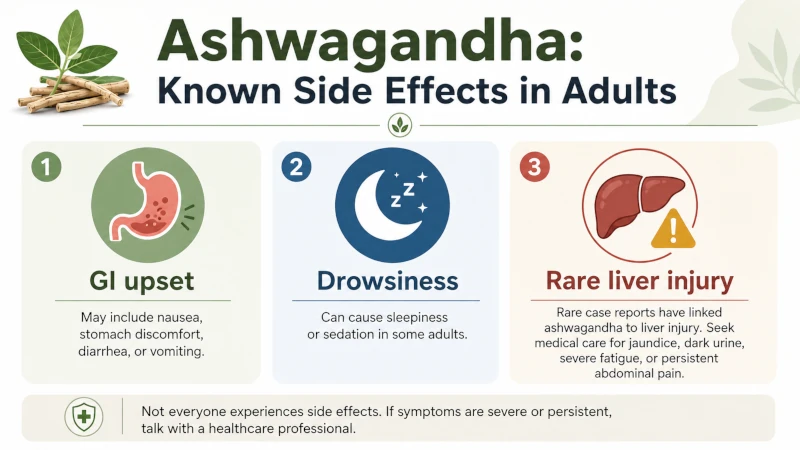
There are also rare but documented cases of liver injury associated with ashwagandha supplements. LactMed notes that severe diarrhea, skin burning, sedation, skin discoloration, and allergic skin reactions have been reported [LactMed, 2024]. NCCIH notes that some cases of liver injury have been reported, though they appear uncommon [NCCIH, 2023]. A breastfeeding mother who develops jaundice, dark urine, upper-right abdominal pain, or unusual fatigue while taking ashwagandha should stop use immediately and contact a healthcare provider.
Medication Interactions Worth Knowing About
Postpartum care often involves medications — for pain management, blood pressure, mood, or other conditions. Ashwagandha has documented interactions that are relevant to this picture.
According to NCCIH, ashwagandha may interact with medications for diabetes and high blood pressure, immunosuppressants, sedatives, anti-seizure medications, and thyroid hormone medications [NCCIH, 2023]. For more context on the interaction profile, our article on ashwagandha and magnesium covers these in detail.
Additionally, ashwagandha may raise thyroid hormone levels, which is relevant for anyone with postpartum thyroiditis — a condition that affects some women in the months after delivery and is often not yet diagnosed when symptoms begin.
People with autoimmune conditions, diabetes, or hypertension should use ashwagandha with particular caution, even outside of breastfeeding [LactMed, 2024].
Safer Alternatives for Common Postpartum Concerns
For stress and sleep
Non-pharmacological strategies — prioritizing rest when the baby sleeps, accepting help, maintaining basic nutrition and hydration, and where possible getting some daily movement — are the foundation and carry no risk for the nursing infant. If you want to read more broadly about adaptogenic herbs and how the category works, see our guide to adaptogenic herbs for stress and anxiety.
For persistent postpartum mood disturbance, anxiety, or sleep disruption that is affecting your functioning, a conversation with your midwife, OB, or primary care provider is the right first step. Postpartum depression and anxiety are common and treatable, and both the mother and infant benefit when the mother gets proper care.
For milk supply support
If you’re concerned about milk supply, the most evidence-supported first step is a consultation with an International Board Certified Lactation Consultant (IBCLC). They can identify whether a true supply issue exists (many perceived low-supply situations reflect a different underlying cause) and recommend appropriate interventions.
Among traditional herbal galactogogues with longer-established use histories, fenugreek and blessed thistle are sometimes discussed in the context of lactation support, though the evidence for these is also limited. If you’re considering any herbal supplement while breastfeeding, this should always be discussed with a healthcare provider first.
When to Talk to Your Healthcare Provider
Seek medical advice before taking any supplement while breastfeeding. That includes ashwagandha, even if someone has recommended it to you, even if it is labeled ‘natural,’ and even if you took it safely before pregnancy. The postpartum period involves different physiology, and your baby’s safety depends on that conversation happening.
Contact your provider promptly if you:
- Experience signs of liver stress — yellowing skin or eyes, dark urine, persistent abdominal pain, or unusual fatigue — while taking any supplement
- Notice your baby seems unusually drowsy, feeds poorly, or shows changes in behavior after you’ve started a new supplement
- Have postpartum thyroiditis, autoimmune conditions, blood pressure issues, or mood changes that need attention
You do not have to navigate the postpartum supplement question alone. A midwife, OB-GYN, family physician, or pharmacist can all help you weigh options that are actually appropriate for your situation.
| HEALTH DISCLAIMER This article is for educational and informational purposes only. It is not medical advice and does not replace guidance from a qualified healthcare professional. Ashwagandha is a dietary supplement — it is not approved by the FDA as a treatment for any condition, and supplements are not required to be proven safe before they go to market. If you are breastfeeding, pregnant, or trying to conceive, do not take ashwagandha or any herbal supplement without first speaking with your midwife, OB-GYN, physician, or another licensed clinician. If you develop jaundice, dark urine, abdominal pain, or unusual fatigue while using a supplement, stop use and seek medical care promptly. |
Frequently Asked Questions
Is ashwagandha safe while breastfeeding?
No — current guidance from NCCIH (a division of the NIH) advises against using ashwagandha while breastfeeding. The core reason is that no research exists on whether its compounds transfer into breast milk or what effects they may have on a nursing infant. When safety data are absent, health authorities advise avoidance, particularly for vulnerable populations like newborns.
Can ashwagandha help boost my milk supply?
There is no scientifically valid evidence that it does. The only study that included ashwagandha for milk production used a multi-herb combination without a control group or randomization, so no conclusions about ashwagandha’s individual effect are possible. The Academy of Breastfeeding Medicine also emphasizes that galactogogues should never substitute for addressing the actual factors affecting milk supply.
What about Ayurvedic traditions of using ashwagandha for lactation?
Traditional use in Ayurveda does not equal safety evidence in the modern clinical sense. Traditional systems were developed without knowledge of how compounds transfer through breast milk or how they affect infant development. Those who practice Ayurveda today also generally recommend individual consultation before using herbs postpartum, and they are not a uniform group that endorses routine ashwagandha use in nursing mothers.
Are there safer herbal options for postpartum stress?
The safest approach to postpartum stress is non-herbal: rest, nutrition, social support, and professional care when mood disturbance goes beyond ordinary adjustment. If persistent anxiety, depression, or exhaustion is affecting you, speak with your provider about options that have established postpartum safety profiles. No supplement should be your first line of defense against a genuine mental health concern.
Will ashwagandha hurt my baby?
We genuinely do not know — and that’s the point. The question has not been studied. LactMed specifically flags greater caution for mothers nursing newborns or preterm infants because of how differently their systems metabolize substances. In the absence of evidence, avoiding unknown risks to your infant is the prudent course.
References
- LactMed® (Drugs and Lactation Database). Withania. National Institute of Child Health and Human Development, National Institutes of Health. Last revised December 15, 2024. PMID: 30000965. View source →
- National Center for Complementary and Integrative Health (NCCIH). Ashwagandha: Usefulness and Safety. National Institutes of Health. Last updated March 2023. View source →
