
The most useful home remedies for mosquito repellent are the ones that make it harder for mosquitoes to find you, land on you, or breed near you. Some natural options can help for short periods. Others sound good online but do very little once you are sitting outside at dusk. If mosquitoes in your area may carry West Nile, dengue, Zika, malaria, or another infection, use these home strategies alongside a proven repellent rather than in place of one [CDC mosquito bite prevention, 2024].
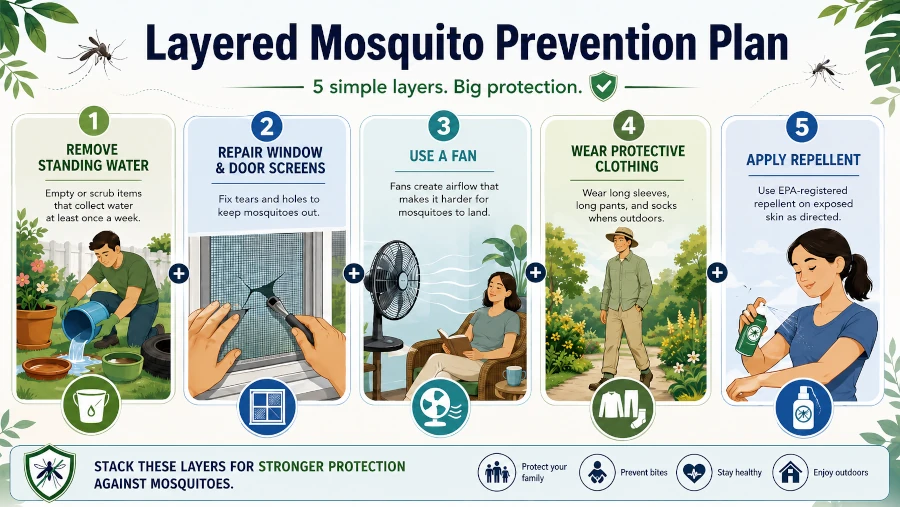
That does not mean every natural method is useless. Oil of lemon eucalyptus products that contain PMD are recognized by the CDC as one of the EPA-registered repellent options. Fans, screens, loose clothing, and weekly water removal are simple, low-risk steps that can sharply reduce bites around the home [CDC mosquito bite prevention, 2024]. Essential oils such as citronella, peppermint, lemongrass, clove, cinnamon, and geraniol have research behind them, but their protection tends to depend on concentration, formulation, and frequent reapplication [Maia & Moore plant-based repellent review, 2011].
The useful truth about natural mosquito protection
Mosquitoes use several signals to find people, including body odor, carbon dioxide, heat, movement, and visual cues. Repellents interfere with those senses so the insect has a harder time finding a host [NPIC insect repellents fact sheet]. Home remedies work best when they interrupt more than one part of that process: remove breeding sites, block entry, move air, cover skin, and use a repellent when bites are likely.
The CDC recommends EPA-registered repellents containing DEET, picaridin, IR3535, oil of lemon eucalyptus, PMD, or 2-undecanone. When used as directed, the CDC describes these repellents as safe and effective, including for people who are pregnant or breastfeeding [CDC mosquito bite prevention, 2024]. That guidance matters. A homemade spray may be fine for a short evening on a low-risk patio, but it should not be your only protection during travel, outbreaks, heavy mosquito pressure, or outdoor work in a high-risk area.
Best home remedies for mosquito repellent to use first
These are the home measures with the best mix of practicality, safety, and evidence. They also work well with natural repellent options instead of competing with them.
Empty standing water once a week
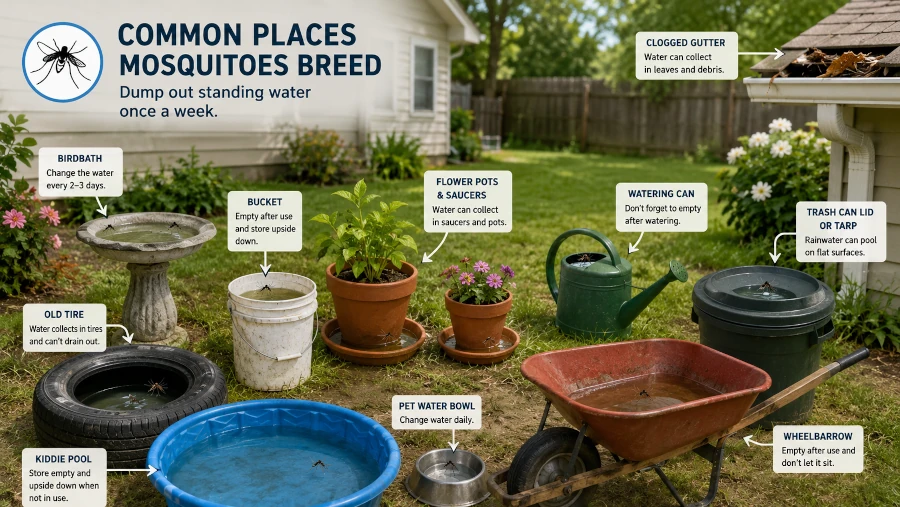
Mosquito control starts before the bite. The CDC advises emptying, scrubbing, turning over, covering, or throwing out items that hold water at least once a week, including buckets, toys, birdbaths, pool covers, flowerpot saucers, old tires, and trash containers [CDC mosquito bite prevention, 2024]. This is one of the most important home remedies because it reduces the next wave of mosquitoes instead of only chasing away the ones already flying.
Put a physical barrier between you and mosquitoes
Repair window and door screens, use air conditioning when available, and use mosquito netting over strollers, baby carriers, beds, or porch seating when needed [CDC mosquito bite prevention, 2024]. Barriers are especially useful for babies, people with sensitive skin, and anyone who cannot tolerate topical products.
Use a fan where people sit
A fan is not a medical-grade repellent, but moving air can make a patio table or porch less comfortable for mosquitoes. Aim the airflow at legs and ankles, where mosquitoes often bite. This works best when people are staying in one place, such as during dinner outside, and it pairs well with long clothing and a repellent product.
Cover skin with loose, light clothing
Loose long sleeves, long pants, socks, and closed shoes reduce exposed skin. The CDC also recommends permethrin-treated clothing and gear, but permethrin should not be used directly on skin [CDC mosquito bite prevention, 2024]. If you treat clothing yourself, follow the product label and let fabric dry completely before wearing it.
Choose oil of lemon eucalyptus or PMD when you want a plant-derived option
Oil of lemon eucalyptus (OLE) and para-menthane-diol (PMD) are the best plant-derived options for readers who want something closer to a natural mosquito repellent but still want stronger evidence than a homemade essential-oil mist. Look for an EPA-registered product with OLE or PMD listed as the active ingredient, then choose a protection time that fits your activity [EPA repellent search tool, 2025].
Do not confuse these products with plain lemon eucalyptus essential oil. The plant-based repellent review by Maia and Moore notes that PMD from lemon eucalyptus extract is different from the essential oil and has stronger evidence for longer protection [Maia & Moore plant-based repellent review, 2011]. CDC guidance also says not to use products containing OLE or PMD on children under 3 years old [CDC mosquito bite prevention, 2024].
Essential oils for mosquitoes: promising, but easy to overstate
Essential oils are the part of this topic most likely to be oversold. Many plant oils contain volatile compounds that mosquitoes dislike, and some have performed well in laboratory or small human-exposure tests. The catch is that many evaporate quickly, vary by plant species and manufacturer, and can irritate skin [Maia & Moore plant-based repellent review, 2011]; [Luker et al., Scientific Reports, 2023].
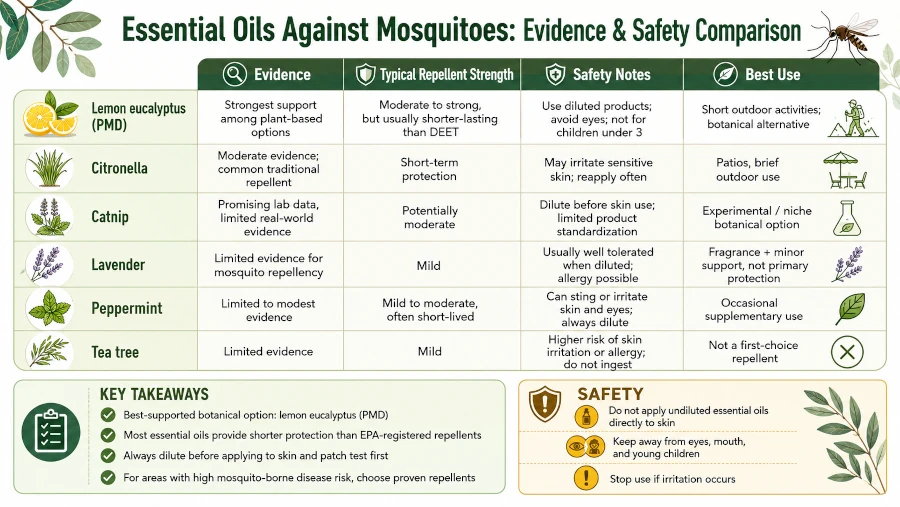
| Option | Evidence grade | Practical use |
| OLE/PMD product | Best plant-derived option when EPA-registered. | Good fit for adults and children 3+ when label directions are followed. Not for children under 3. |
| Citronella oil | Traditional repellent; evidence suggests short-lived protection. | May irritate skin or trigger allergy. Better for short exposure or spatial use than high-risk bite prevention. |
| Peppermint, lemongrass, cinnamon, clove, geraniol | Promising but variable; some lab/contact studies show protection for limited periods. | Use cautiously. Cinnamon and clove are more irritating and are not good casual skin ingredients. |
| Lavender, basil, rosemary, catnip plants | Pleasant garden plants; crushed leaves or oils may contain repellent compounds, but plants sitting nearby are not reliable personal protection. | Fine as part of landscaping, not a substitute for repellent on skin or clothing. |
Citronella oil
Citronella is a real repellent ingredient, not a myth. NPIC describes oil of citronella as a naturally occurring insect and animal repellent that works by masking scents attractive to insects [NPIC oil of citronella fact sheet]. The problem is duration. The plant-based repellent review found that citronella products often protect for a relatively short time because the oil evaporates quickly, and citronella candles may reduce biting somewhat without giving dependable personal protection [Maia & Moore plant-based repellent review, 2011].
Lavender, basil, rosemary, peppermint, and catnip
These herbs are reasonable additions to a patio garden, especially if you already enjoy growing them. Lavender, for example, fits naturally with a herb-focused internal resource on lavender benefits. Still, a potted plant by the door should not be treated as a shield. The repellent effect usually comes from volatile compounds released from crushed plant material, extracts, or formulated oils, not from a plant quietly sitting in a container.
Catnip is a good example of why evidence needs careful wording. Catnip compounds have shown repellent activity in research settings, but that does not mean scattering dried catnip around a deck will protect a person from bites. If you have cats, catnip may also attract the exact household chaos you were trying to avoid.
Clove, cinnamon, geraniol, lemongrass, and peppermint oil
A 2023 Scientific Reports study tested 20 minimum-risk active ingredients using mosquito arm-in-cage and tick contact assays. In 10 percent lotion emulsions, clove oil and cinnamon oil provided the longest protection among the ingredients tested, and the authors concluded that some ingredients can protect for longer than one hour under test conditions [Luker et al., Scientific Reports, 2023]. That does not make cinnamon or clove oil ideal for homemade skin use. Both can irritate skin, and essential-oil performance changes with concentration, formulation, and chemical composition.
Safer DIY mosquito repellent recipes
Use these recipes as low-risk experiments for short outdoor time, not as disease-prevention tools. Do not apply essential oils undiluted. Keep sprays away from eyes, lips, nostrils, broken skin, infants, pets, and anyone with asthma or fragrance sensitivity.
Adult patch-test oil for short outdoor time
- Add 1 ounce of carrier oil, such as jojoba, coconut, or sweet almond oil, to a clean glass bottle.
- Add 3 to 6 total drops of essential oil. This creates roughly a 0.5 to 1 percent dilution, which is a conservative adult starting point.
- Shake well, then patch test a small area of skin for 24 hours before wider use.
- Apply only to small exposed areas, such as ankles or wrists, and reapply cautiously if needed.
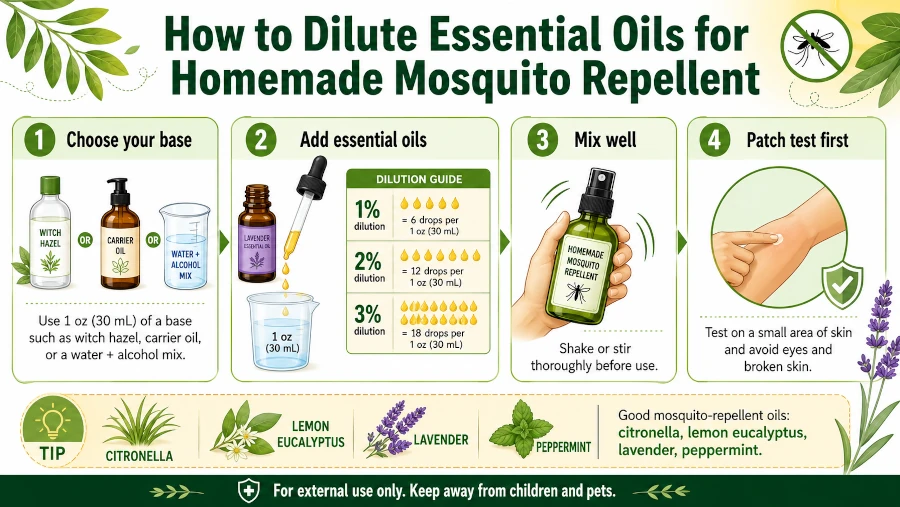
NAHA notes that many aromatherapy blends fall between 1 and 5 percent dilution, but skin reactions become more likely depending on the oil, the person, and the application area. Children generally require lower dilutions and more caution [NAHA aromatherapy safety]. For a mosquito article, the safer editorial choice is to start low.
Clothing or patio spray
- Mix 2 tablespoons distilled water with 2 tablespoons witch hazel in a small spray bottle.
- Add 6 to 10 total drops of citronella, peppermint, lemongrass, lavender, or geraniol essential oil.
- Shake before each use and mist outer clothing, patio cushions, or table linens lightly. Spot test fabric first.
- Do not spray near flames, pets, food, eyes, or a child’s hands.
This type of spray is more appropriate for fabric or a seating area than for bare skin. It will not perform like an EPA-registered repellent, and its effect may fade quickly outdoors.
Diffuser plus fan setup
For a porch or patio, a diffuser can add scent, but it should not be the main line of defense. Use it in an open area, follow the device directions, and pair it with a fan that blows across the seating area. Skip diffusing around pets, babies, people with asthma, or anyone who gets headaches or nausea from fragrance.
Home remedies to skip or use cautiously
| Remedy | Verdict | Why |
| Eating garlic | Not recommended as a mosquito strategy. | A plant-based repellent review notes that garlic consumption has not been shown to repel mosquitoes. |
| Garlic rubbed on skin | Possible but unpleasant and inferior to better options. | May have moderate repellent effects, but odor and irritation make it a poor practical choice. |
| Apple cider vinegar traps | Skip as a mosquito repellent. | These are not reliable personal protection and may attract other insects. |
| Citronella candles alone | Use only as a small add-on. | They may reduce bites somewhat in a small area but do not provide dependable personal protection. |
| Undiluted essential oils | Avoid. | Higher irritation and sensitization risk; no need to put concentrated oils directly on skin. |
| DIY spray during outbreaks or travel | Do not rely on it alone. | Use an EPA-registered repellent and follow local public-health advice. |
Safety: children, pregnancy, pets, allergies, and skin irritation
Natural does not automatically mean gentle. NAHA lists several safety issues with essential oils, including skin irritation, sensitization, photosensitivity from some citrus oils, mucous membrane irritation, and special caution for infants, toddlers, young children, older adults, and pregnancy [NAHA aromatherapy safety]. NPIC also notes that people can react to insect repellents and that label directions matter [NPIC insect repellents fact sheet].
- For children: follow label directions. Do not use OLE or PMD products on children under 3 years old [CDC mosquito bite prevention, 2024]. Do not apply any repellent to a child’s hands, eyes, mouth, cuts, or irritated skin.
- For pregnancy or breastfeeding: CDC states that EPA-registered repellents are safe and effective when used as directed, including for pregnant and breastfeeding women [CDC mosquito bite prevention, 2024]. Essential-oil use in pregnancy is more complicated; use professional guidance rather than homemade blends.
- For pets: many essential oils can bother or harm pets, especially cats and birds. Do not spray pet bedding, collars, fur, food bowls, or enclosed rooms unless a veterinarian has approved the product.
- For sensitive skin: patch test first, dilute well, and stop immediately if burning, redness, swelling, itching, or rash occurs.
- For sunscreen: apply sunscreen first and insect repellent second [CDC mosquito bite prevention, 2024].
When mosquito bites need medical attention
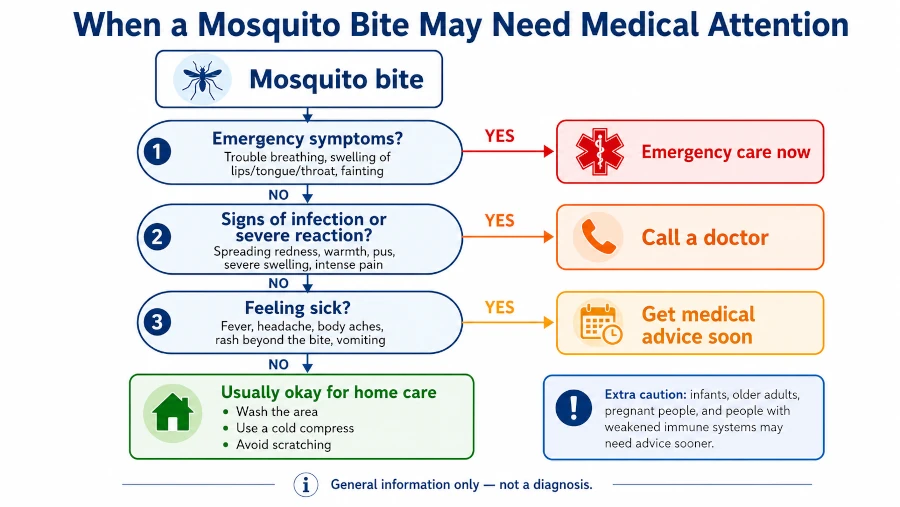
Most mosquito bites cause short-lived itching, swelling, and redness. Self-care is not enough if symptoms suggest infection, severe allergy, or a mosquito-borne illness.
- Seek urgent care for trouble breathing, swelling of the lips or face, faintness, or widespread hives after a bite.
- Call a healthcare professional if a bite becomes increasingly painful, hot, red, swollen, drains pus, or forms red streaks.
- Get medical advice promptly if you develop fever, severe headache, body aches, rash, stiff neck, confusion, unusual weakness, or eye pain after mosquito exposure.
- Be more cautious after travel, during local mosquito-borne disease alerts, or if you are pregnant, immunocompromised, caring for a young child, or caring for an older adult.
| Health Disclaimer: This article is for educational purposes only and is not a substitute for medical advice, diagnosis, treatment, or public-health guidance. Mosquito bites can spread disease in some regions. If you are pregnant, breastfeeding, using medication, caring for a child, have asthma or skin disease, or live in an area with mosquito-borne illness risk, ask a qualified healthcare professional or local public-health authority before relying on home remedies. Use all repellents, essential oils, and permethrin products only as directed on the label. |
Frequently Asked Questions
What is the best home remedy for mosquito repellent?
The best home approach is not one single remedy. Empty standing water weekly, repair screens, use fans where people sit, cover skin with loose clothing, and use a proven repellent when bites are likely. If you want a plant-derived product, EPA-registered oil of lemon eucalyptus or PMD is a stronger choice than a homemade essential-oil spray.
Do essential oils really repel mosquitoes?
Some can. Citronella, peppermint, lemongrass, clove, cinnamon, and geraniol have evidence of repellent effects in certain formulations or tests. The problem is that many essential oils evaporate quickly, vary by source, and can irritate skin. They are better viewed as short-duration add-ons than dependable disease-prevention tools.
Is oil of lemon eucalyptus the same as lemon eucalyptus essential oil?
No. Oil of lemon eucalyptus or PMD repellent products are not the same as plain lemon eucalyptus essential oil. EPA-registered OLE/PMD products have stronger support and should be used according to the label. Do not use OLE or PMD products on children under 3 years old.
Can I use vinegar as mosquito repellent?
Vinegar is not a dependable mosquito repellent for skin. Apple cider vinegar traps are also not reliable personal protection. If you use vinegar in a homemade spray, treat it as a scent or carrier experiment, not as the active ingredient that keeps mosquitoes from biting.
Are mosquito-repelling plants enough for a patio?
No. Lavender, basil, rosemary, mint, and catnip can be pleasant patio plants, and some contain compounds mosquitoes dislike. But plants sitting nearby usually do not release enough active compounds to protect you from bites. Use them as landscaping, not your main repellent.
What should I use during high mosquito disease risk?
Use an EPA-registered repellent with an active ingredient recommended by the CDC, follow the product label, wear protective clothing, and remove standing water. Home remedies can support that plan, but they should not replace proven protection during outbreaks, travel, or heavy exposure.
References
- Centers for Disease Control and Prevention (CDC). “Preventing Mosquito Bites.” Updated August 28, 2024. View source
- U.S. Environmental Protection Agency (EPA). “Find the Repellent that is Right for You.” Last updated September 11, 2025. View source
- U.S. Environmental Protection Agency (EPA). “Repellents: Protection against Mosquitoes, Ticks and Other Arthropods.” Last updated June 10, 2026. View source
- National Pesticide Information Center (NPIC). “Insect Repellents Fact Sheet.” Oregon State University / U.S. EPA cooperative project. View source
- National Pesticide Information Center (NPIC). “Oil of Citronella Fact Sheet.” Oregon State University / U.S. EPA cooperative project. View source
- National Pesticide Information Center (NPIC). “Choosing and Using Insect Repellents.” View source
- National Association for Holistic Aromatherapy (NAHA). “Exploring Aromatherapy: Safety.” View source
- Maia, Marta Ferreira, and Sarah J. Moore. “Plant-based insect repellents: a review of their efficacy, development and testing.” Malaria Journal, 2011. DOI path confirmed in live article URL: 10.1186/1475-2875-10-S1-S11. View source
- Luker, Hailey A., et al.. “Repellent efficacy of 20 essential oils on Aedes aegypti mosquitoes and Ixodes scapularis ticks in contact-repellency assays.” Scientific Reports, 2023. View source
