
NAD plus injections are sold by wellness clinics and online programs as a fast route to more energy, sharper focus, and slower aging — but the human evidence behind those promises is still thin. The biology underneath is real: NAD+ is a coenzyme your cells genuinely depend on. What is far less settled is whether putting it into a vein or under your skin does what the marketing says. This guide lays out what is actually known, what is not, how the shots are given, what they can cost you in side effects, and who should skip them.
The short version
- NAD+ helps turn food into energy and is needed to repair DNA. That part is settled science.
- Whether injected NAD+ reliably improves energy, mood, focus, or longevity in healthy people has not been shown in good human trials.
- Most marketing claims rest on lab dishes, animal studies, oral-precursor research, or personal stories — not on randomized trials of the injections themselves.
- The shots are not FDA-approved. They are compounded and require a prescription [FDA, 2025].
- Nausea, cramping, chest tightness, and flushing are common when an IV runs too fast.
If you want a careful, proactive way to support your cells, that is a reasonable goal. Go in with clear eyes about how preliminary the evidence is, and treat anyone promising a cure as a warning sign. For the basics that actually move your energy — sleep, exercise, treating any underlying condition — the evidence is far stronger than for any infusion.
What NAD+ actually does in your body
Nicotinamide adenine dinucleotide — NAD+ for short — is a coenzyme found in every living cell. It does two main jobs. First, it carries electrons during the reactions that convert food into ATP, the molecule your cells burn for energy. Second, it is a required partner for several enzyme families, including sirtuins, the DNA-repair enzymes called PARPs, and an enzyme called CD38 [Nat Rev Mol Cell Biol, 2021].
Put plainly: when NAD+ runs low inside a cell, the machinery that makes energy and fixes DNA works less efficiently. That single fact is the entire rationale for trying to raise it — and it is worth keeping separate from the much bigger claim that an injection can reverse how you feel or how you age.
Does NAD+ really drop as you age?
Probably, in some tissues — but the human picture is messier than clinic websites suggest. In rodents, several tissues show clear NAD+ declines with age, and that animal data is what kicked off the whole field [PubMed, 2020].
In humans the data are thinner and less consistent. A 2021 review in Nutrients looked across species and concluded that the evidence for a universal, whole-body NAD+ decline is very limited and often rests on a single tissue or cell type [Nutrients, 2021]. So the line you will see on sales pages — that your NAD+ falls 50% by age 50 — is not well supported. The honest version is: NAD+ likely declines in certain tissues with age and disease, but the size and meaning of that drop in healthy people is still being worked out. Some of the antioxidant and repair systems NAD+ supports can also be nudged by everyday nutrients like selenium through ordinary diet.
How NAD+ injections are given
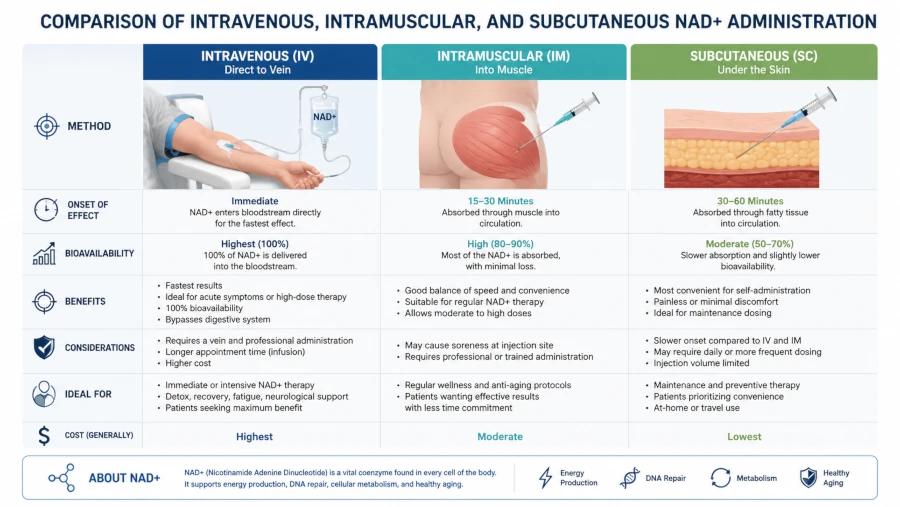
Clinics use three main routes. The route changes how long it takes and where you have to be, not whether it works.
| Route | How it is given | Typical time | Setting |
| IV infusion | A slow drip into a vein, usually mixed with saline. | 1–4 hours | In-clinic |
| IM shot | Injected into a muscle. | Minutes | In-clinic |
| Subcutaneous (SC) | Injected into the fat just under the skin. Sometimes done at home after training and with a prescription. | Minutes | Clinic or home |
The slower the delivery, the easier it tends to be on your stomach and chest — more on that below.
Do NAD+ injections actually work?
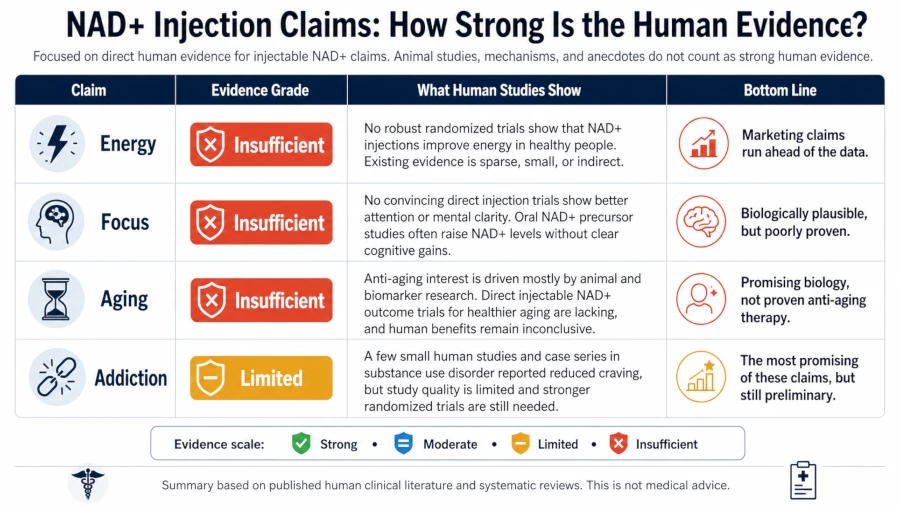
This is where to slow down, because the answer differs sharply by claim. Here is the evidence, graded honestly.
Energy and fatigue
This is the headline promise. It rests almost entirely on personal reports and a handful of small, uncontrolled pilot studies. No randomized trial has shown that injected NAD+ beats a placebo for energy in healthy adults. People do sometimes feel a lift — which could be real, could be the saline and B-vitamins often added to the bag, or could be expectation.
Brain fog, focus, and mood
Same story, weaker still. The cellular logic is plausible, but human trials testing injected NAD+ against placebo for cognition or mood are essentially absent. Treat strong claims here as marketing, not medicine.
Healthy aging and longevity
The exciting results come from worms, mice, and cell cultures. There is no human study showing that NAD+ injections slow aging or extend life. Even the broader, better-studied approach — raising NAD+ with oral precursors — has been underwhelming in people. A 2025 review in Nature Metabolism found that while precursor supplements can raise blood NAD+, human trials have shown limited clinical benefit [Nature Metabolism, 2025].
Addiction and withdrawal
IV NAD+ has been used in addiction recovery since the 1960s, which is where much of today’s clinic use traces back. But that long history is not the same as good evidence: the studies are old, small, and uncontrolled. It remains experimental.
The “it floods your cells” claim, examined
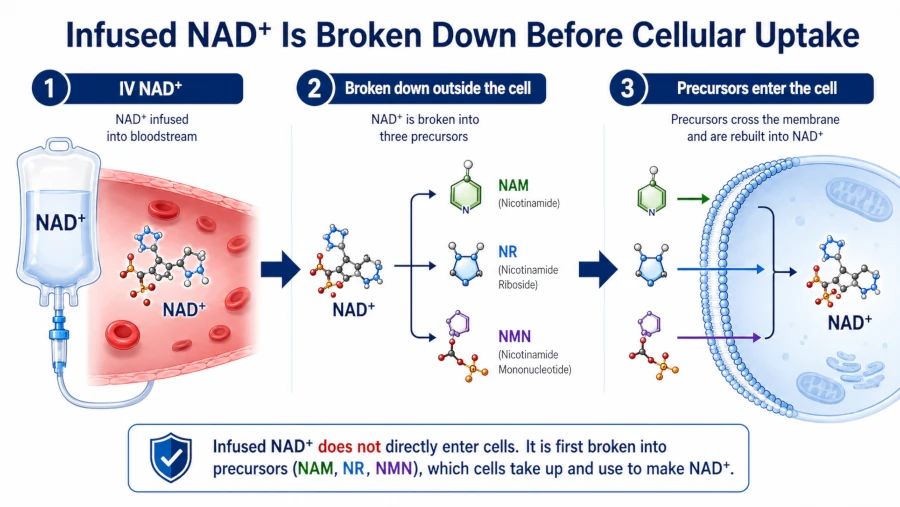
The usual pitch is that injecting NAD+ delivers it straight to your cells, bypassing the gut for high bioavailability. The biology is less tidy than that.
NAD+ is a large molecule, and cells mostly cannot take it up whole. Instead they import smaller building blocks and rebuild NAD+ inside. In a 2019 pilot study, researchers infused NAD+ into volunteers for six hours and found that blood NAD+ did not rise for the first two hours; what they measured instead were breakdown products, consistent with NAD+ being taken apart outside the cells before anything got in [Grant et al., 2019]. So “high bioavailability, straight to the cell” oversimplifies what actually happens after the needle.
Injections vs. oral NR and NMN
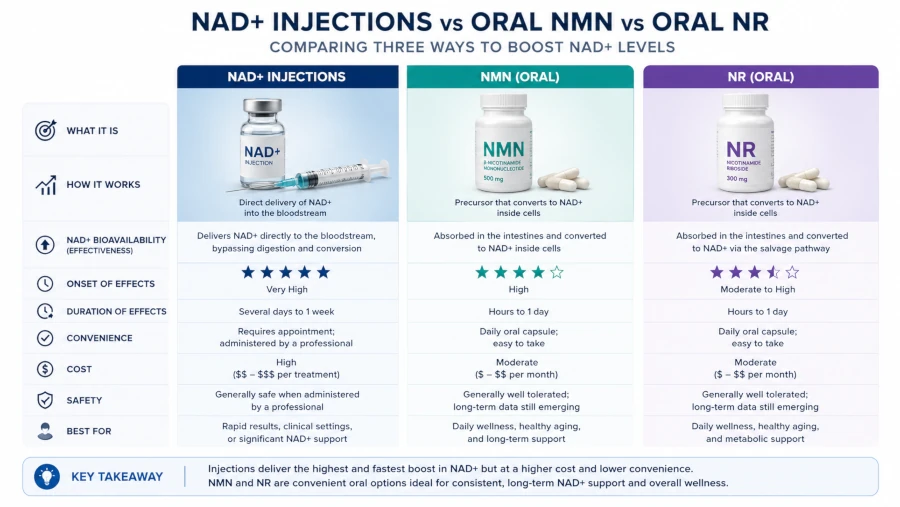
Swallowing NAD+ itself is pointless — it is broken down in the gut and cannot be absorbed intact [Frontiers in Aging, 2026]. That is why oral supplements use precursors instead, usually nicotinamide riboside (NR) or nicotinamide mononucleotide (NMN). Those reliably raise blood NAD+; for example, 1,000 mg of NR a day has been shown to lift NAD+ in blood cells by roughly 60% over six weeks.
| Injected NAD+ | Oral NR / NMN | |
| Speed into blood | Fast, but rapidly broken down | Slower, builds over weeks |
| Human evidence | Very limited; mostly pilot and tolerability studies | More human data, but clinical benefits still modest |
| Convenience | Clinic visits or supervised home injections | A daily capsule |
| Regulation | Compounded, prescription-only, not FDA-approved | Sold as dietary supplements |
| Typical cost | High per session | Lower monthly |
Neither has been proven to make healthy people feel or age better. The honest takeaway: injections get NAD+ precursors into your blood faster, but “faster” is not the same as “better outcome.”
Side effects and safety
The most common problems happen during or right after an infusion: nausea, flushing, a tight feeling in the chest or abdomen, cramping, sweating, lightheadedness, and headache. These are tied to how fast the NAD+ goes in — slowing the drip usually reduces them, and they tend to fade once the infusion ends [Frontiers in Aging, 2026].
What is not well established is the long-term safety of repeated, high-dose injections in otherwise healthy people. There simply is not much data. And because these products are compounded rather than FDA-approved, the sterility and quality depend on the specific pharmacy and clinic — which makes who you go to matter as much as what you get.
Who should be cautious or avoid NAD+ injections
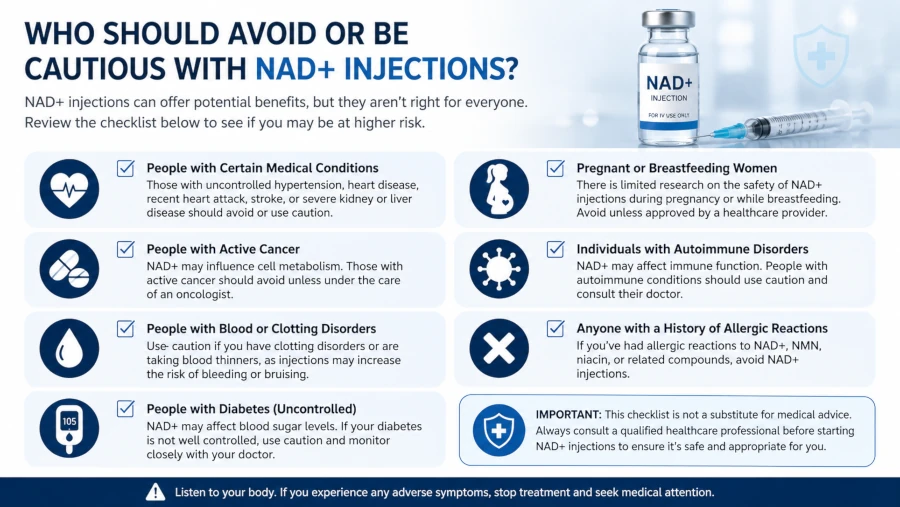
- Pregnant or breastfeeding: safety has not been studied. Avoid it.
- Serious heart, liver, or kidney disease: talk to your own physician before considering it.
- People on multiple medications: interaction data are thin; review your full list with a clinician.
- Anyone promised a disease cure: NAD+ injections are not a treatment for any specific disease, and a clinic that says otherwise is a red flag.
On the regulatory side, NAD+ injections are not FDA-approved. They are made by compounding pharmacies under a prescription, and in 2019 the FDA proposed not to add NAD to the cleared list of bulk substances for compounding [FDA, 2019]. Legitimate use is prescription-only and medically supervised.
What to ask before you book
- Which compounding pharmacy makes the NAD+, and can the clinic share quality documentation?
- What dose and infusion time do you use, and who supervises the session?
- What happens if I feel unwell partway through?
- What is the full cost? Sessions often run from roughly $150 to well over $1,000, packages cost more, and insurance does not cover it.
Realistic expectations
If you try NAD+ injections, the honest expectation is uncertainty. Some people report feeling more alert afterward; that may be a genuine effect, a placebo response, or the other ingredients in the IV bag. None of it has been pinned down in controlled trials. Meanwhile, the boring fundamentals — consistent sleep, regular movement, and finding the cause of your fatigue — have much stronger evidence behind them. Skin changes are also marketed heavily, but if your main goal is your complexion, targeted options for aging skin are better studied than an NAD+ drip.
When to talk to a healthcare professional
Persistent fatigue, brain fog, or low mood are worth a real medical workup rather than a wellness drip. They can point to thyroid problems, anemia, sleep apnea, depression, and other treatable conditions that an infusion will not fix.
Seek urgent care for red flags such as chest pain, fainting, trouble breathing, or a severe reaction during an infusion. And do not use NAD+ injections to self-treat a condition that needs a diagnosis — get the diagnosis first.
| HEALTH DISCLAIMER: This article is for general education only and is not medical advice, diagnosis, or treatment. NAD+ injections are not FDA-approved, and the evidence for most marketed benefits is preliminary. Always speak with a licensed healthcare provider before starting NAD+ therapy or any supplement, especially if you are pregnant or breastfeeding, have a medical condition, or take medication. Nothing here is a substitute for professional care, and you rely on it at your own risk. |
Frequently Asked Questions
Are NAD+ injections FDA-approved?
No. They are compounded by licensed pharmacies and require a prescription. The FDA has not approved NAD+ injections for energy, aging, or any other use.
How fast will I feel something?
It varies, and there is no reliable timeline. Some people describe a same-day lift; others feel nothing. Because controlled studies are lacking, any reported timeline is anecdotal.
Are injections better than NMN or NR pills?
Injections get into the blood faster, but they have not been proven to produce better outcomes, and oral precursors have more human data behind them. Faster is not the same as more effective.
Is it safe to use long-term?
Unknown. Short-term side effects are usually mild and infusion-related, but the long-term safety of repeated high-dose injections in healthy people has not been well studied.
Can I do NAD+ shots at home?
Sometimes, as a subcutaneous injection, with a prescription and after training from a provider. It should still be set up and overseen by a clinician.
Who should not get NAD+ injections?
Anyone pregnant or breastfeeding, people with serious heart, liver, or kidney disease, and anyone being sold it as a cure for a specific disease. Check with your own clinician first.
References
- Covarrubias AJ, Perrone R, Grozio A, Verdin E. NAD+ metabolism and its roles in cellular processes during ageing. Nature Reviews Molecular Cell Biology. 2021. → View source
- NAD+ precursor supplementation in human ageing: clinical evidence and challenges. Nature Metabolism. 2025. → View source
- Age-Dependent Decline of NAD+ — Universal Truth or Confounded Consensus? Nutrients. 2021;14(1):101. → View source
- Age-related NAD+ decline. Experimental Gerontology. 2020. (PubMed) → View source
- Grant R, et al. A Pilot Study Investigating Changes in the Human Plasma and Urine NAD+ Metabolome During a 6 Hour Intravenous Infusion of NAD+. 2019. (PMC) → View source
- Intravenous infusion of NAD+ versus nicotinamide riboside (NR): a retrospective tolerability pilot study. Frontiers in Aging. 2026. → View source
- U.S. Food and Drug Administration. Bulk Drug Substances Used in Compounding. → View source
- U.S. Food and Drug Administration / Federal Register. Amendments to the List of Bulk Drug Substances (NAD proposed for non-inclusion). 2019. → View source
