
If you’re hoping a few drops of oil will quiet your aching joints, here’s the honest answer. Some essential oils, massaged in properly diluted, have eased knee pain a little in small studies, and the relief tended to fade within a few weeks. They won’t slow arthritis down or replace your treatment. Used carefully, they can be a pleasant extra.

That’s the overall picture for essential oils for arthritis. A 2023 review of 12 randomized trials in people with osteoarthritis, rheumatoid arthritis, and other muscle and joint conditions found that topical oils lowered pain scores slightly more than placebo right after treatment. The authors rated the certainty of that evidence as very low. [Bakó et al., 2023] Below: which oils have actually been tested, how to use them without irritating your skin, and who should skip them.
What the research on essential oils for arthritis shows
Most human studies follow the same pattern. People with knee osteoarthritis get a series of massages with an essential oil blended into a carrier oil, and their pain is compared with people who got a plain-oil massage or no massage at all. In the 2023 review, pain scores in the oil groups were 0.87 points lower than placebo immediately after treatment and 0.52 points lower at four weeks. At one week, the difference wasn’t statistically significant. [Bakó et al., 2023]
Two things make those numbers shaky. Every trial in the review was judged to have a high risk of bias or “some concerns,” partly because you can’t hide the smell of lavender from the person being massaged with it. [Bakó et al., 2023] And massage is a treatment in its own right, so only a comparison against plain-oil massage tells you whether the oil adds anything. Not every trial made that comparison.

Health authorities are cautious. The National Center for Complementary and Integrative Health notes that aromatherapy is sometimes part of massage for knee osteoarthritis pain but draws no conclusion that it works. [NCCIH, 2020] The Arthritis Foundation says aromatherapy won’t cure arthritis, though it may help with pain and overall well-being. [Arthritis Foundation, n.d.]
The 10 oils people ask about, graded
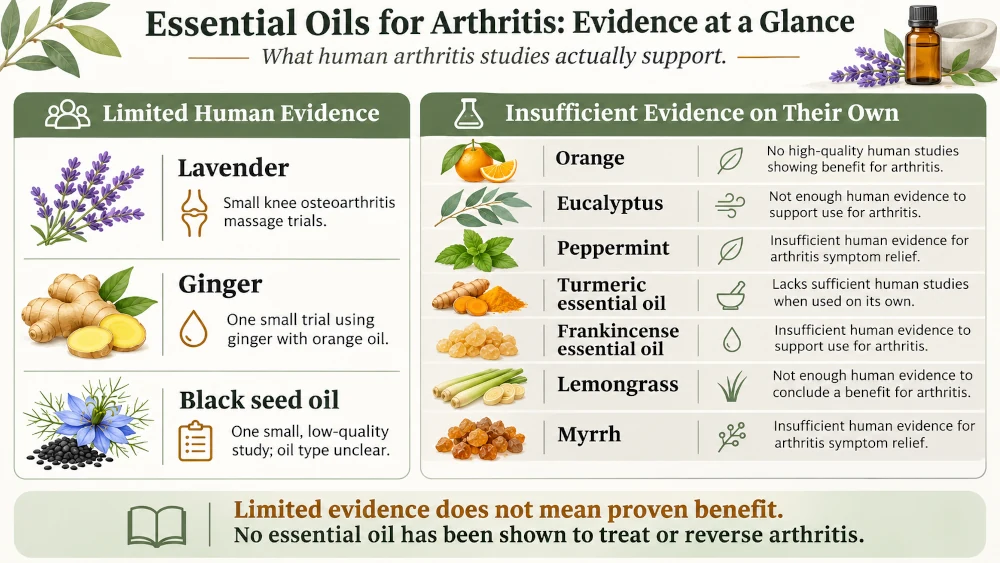
“Limited” means at least one small human trial in arthritis. “Insufficient” means our review found no controlled trial of that oil on its own in people with arthritis.
| Oil | Best human evidence in arthritis | Evidence grade |
| Lavender | Massage trials in knee osteoarthritis; the most-studied oil | Limited |
| Ginger | One ginger-and-orange massage trial in older adults with knee pain | Limited |
| Black seed (Nigella sativa) | One small crossover trial against acetaminophen, with reporting flaws | Limited, low quality |
| Orange | Only as part of the ginger blend | Insufficient on its own |
| Eucalyptus | Inhaled as part of a three-oil blend | Insufficient on its own |
| Peppermint | No arthritis trials found | Insufficient |
| Turmeric oil | None; the oil contains no curcumin | Insufficient |
| Frankincense oil | None; the oil lacks boswellic acids | Insufficient |
| Lemongrass | None found | Insufficient |
| Myrrh | None found | Insufficient |
Lavender
Lavender has the most research behind it, appearing in seven of the 12 trials in the 2023 review. [Bakó et al., 2023] In a trial of 90 people with knee osteoarthritis in Iran, lavender oil massage reduced pain immediately afterward and one week later compared with no massage. By four weeks, the difference had disappeared. [Nasiri et al., 2016] Some people also find the scent helps them wind down; the Arthritis Foundation links smelling lavender before bed with more restful sleep. [Arthritis Foundation, n.d.] Our guide to lavender benefits sorts its other claimed uses by strength of evidence.
Ginger (and orange)
In a Hong Kong study of older adults with moderate-to-severe knee pain, six massages over three weeks with ginger and orange oils improved pain and physical function more than plain olive-oil massage or no massage when measured one week later. The advantage didn’t last to four weeks. [Yip & Tam, 2008] That single trial is also the main evidence for orange oil in arthritis. Eating ginger or taking it as a supplement is a different question, covered in our ginger guide.
Black seed oil (Nigella sativa)
In a crossover trial of 40 older adults with knee osteoarthritis, rubbing about 1 mL of Nigella sativa oil on the knee three times a day produced slightly lower average pain scores than a 325 mg acetaminophen tablet three times a day (4.23 vs. 4.76). [Kooshki et al., 2016] Read that cautiously. The paper contradicts itself on how long treatment lasted, reports no safety data, and doesn’t say whether the product was pressed seed oil or a distilled essential oil.
Eucalyptus and peppermint
Eucalyptus shows up in arthritis research mostly as one ingredient in an inhaled blend. In a Korean study described by the Arthritis Foundation, people with arthritis who smelled a mix of lavender, eucalyptus, and rosemary reported less pain and better mood than those who didn’t. [Arthritis Foundation, n.d.] Peppermint’s menthol gives a cooling feel that many people like on sore joints, but we found no arthritis trials of peppermint oil alone.
Both need extra care around children. Oils high in 1,8-cineole (eucalyptus) or menthol (peppermint) call for special caution with young kids, [NAHA, n.d.] and swallowed eucalyptus oil can cause seizures. [Poison Control, n.d.]
Turmeric and frankincense: the oil isn’t the spice
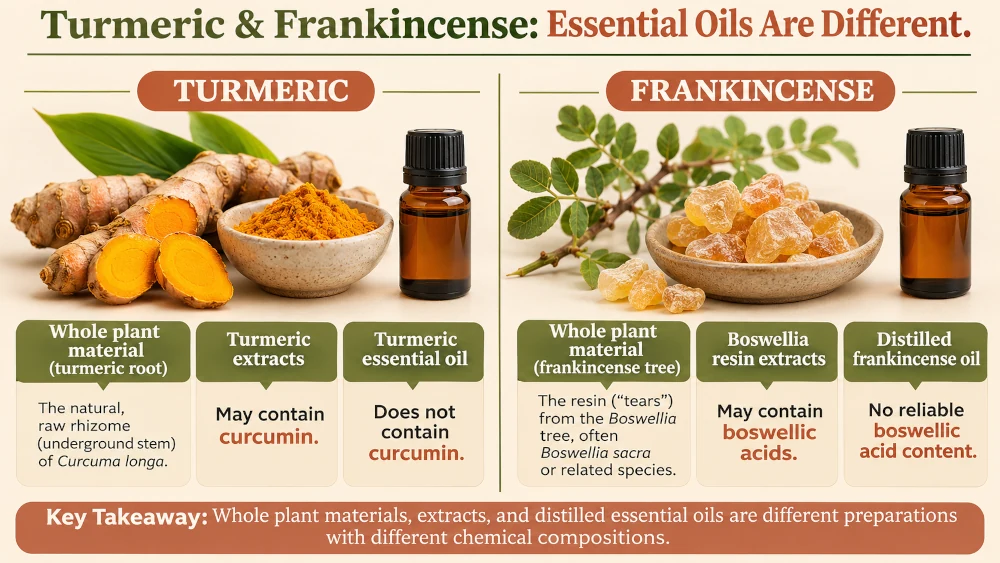
This is where many essential oil lists go wrong. Turmeric’s research reputation rests on curcumin, but turmeric essential oil doesn’t contain curcuminoids. [Orellana-Paucar & Machado-Orellana, 2022] Even curcumin taken by mouth has only promising early evidence for osteoarthritis, and it’s unclear whether curcumin on the skin helps knee pain. [NCCIH, 2025]
Frankincense works the same way. The compounds studied in frankincense resin, boswellic acids, are heavy molecules, and there’s no reliable report of them in frankincense oil made by normal distillation. [Tisserand Institute, 2022] So research on boswellic acids tells you little about what the oil will do for a knee, and we found no human evidence that frankincense oil repairs cartilage.
If you’re weighing turmeric or curcumin supplements instead, our review of anti-inflammatory supplements and what the evidence supports covers the osteoarthritis research and the liver-injury reports tied to high-absorption products.
Lemongrass and myrrh
Both appear on “best oils for arthritis” lists on the strength of lab work and traditional use. We found no controlled trials in people with arthritis for either, so any joint benefit is speculative.
How to use essential oils for arthritis pain safely
Massage has the most research, so it’s the sensible place to start.
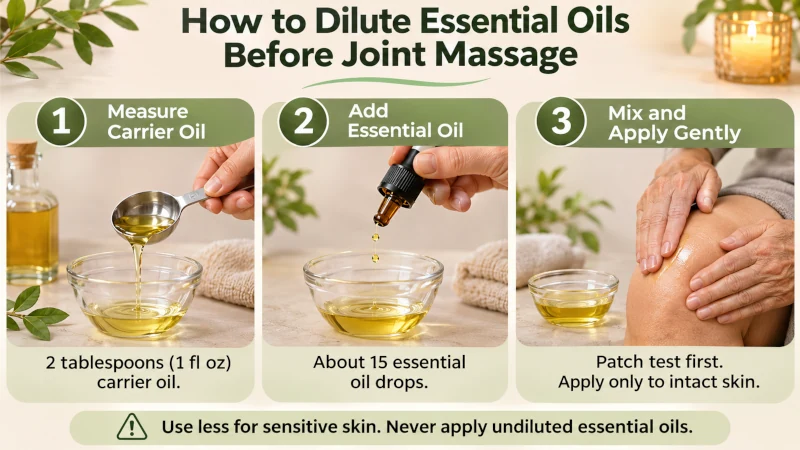
- Always dilute. Most blends fall between 1% and 5%, and stronger mixes raise the risk of a skin reaction. [NAHA, n.d.] One practical recipe from the Arthritis Foundation is about 15 drops in 1 ounce (2 tablespoons) of a carrier such as almond, avocado, or jojoba oil; it also stresses that more is not better. [Arthritis Foundation, n.d.] Use fewer drops if your skin is thin or sensitive.
- Patch test first. Rub a little of the diluted blend on a small patch of skin and watch for redness or itching before using it on a larger area.
- Keep it off broken or inflamed skin. Damaged skin absorbs more oil and reacts more easily. [NAHA, n.d.; Poison Control, n.d.]
- Never swallow essential oils. [Arthritis Foundation, n.d.; Poison Control, n.d.]
- Check citrus oils before sun exposure. The Arthritis Foundation warns that citrus oils can increase sun sensitivity. [Arthritis Foundation, n.d.] NAHA is more specific: expressed lemon, lime, bitter orange, and regular bergamot are photosensitizing, while sweet orange is not. If you use a phototoxic oil, keep that skin out of the sun for at least 24 hours. [NAHA, n.d.]
- Store bottles out of reach. Lock them away from children and pets. [Poison Control, n.d.]
Breathing in oil from a diffuser avoids skin contact entirely, though the research behind inhalation is about mood and perceived pain rather than the joint itself. And skip the “therapeutic grade” upsell: the Arthritis Foundation calls it a marketing term with no clinical meaning. [Arthritis Foundation, n.d.] The same dilution habits apply to sore muscles; our guide to essential oils for muscle cramps covers that use.
Who should avoid essential oils or check first
- Pregnant or breastfeeding. The Arthritis Foundation advises avoiding essential oils during pregnancy. [Arthritis Foundation, n.d.] NAHA notes the evidence is limited and lists oils to avoid during pregnancy and breastfeeding, including wintergreen and birch. [NAHA, n.d.] Check with your midwife or doctor first. [Tisserand Institute, n.d.]
- Babies and young children. Their thin skin and immature livers make them more vulnerable to toxic effects. [Poison Control, n.d.]
- Anyone on warfarin or another blood thinner. Wintergreen and birch oils are rich in methyl salicylate, a relative of aspirin. In one case report, a woman on warfarin developed a dangerously high INR of 12.2 after rubbing a methyl salicylate gel on her knees daily for eight days. [Joss & LeBlond, 2000] Check the label of any joint rub for methyl salicylate, and remember that essential oils in general may interact with medicines. [Poison Control, n.d.]
- People with eczema, allergies, or sensitive skin. Patch test, and keep irritating oils off inflamed or damaged skin. [NAHA, n.d.]
- Anyone adding turmeric or curcumin supplements. High-absorption curcumin products have been linked to liver injury; stop and call your provider if you notice fatigue, nausea, dark urine, or yellowing skin. Turmeric supplements may also be unsafe in pregnancy. [NCCIH, 2025]
What eases arthritis pain more reliably

Essential oils make the most sense as an add-on to treatments with stronger evidence. For osteoarthritis of the hand, hip, and knee, the American College of Rheumatology and Arthritis Foundation guideline strongly recommends self-management programs, tai chi for knee and hip osteoarthritis, and topical NSAID gels for the knee and hand. It conditionally recommends topical capsaicin for knee osteoarthritis, and it notes that exercise is backed by a strong body of research for almost everyone with the condition. [ACR/Arthritis Foundation, 2020]
Rheumatoid arthritis is an autoimmune disease, and oils don’t stand in for the medication your rheumatologist prescribes. Our rheumatoid arthritis diet guide covers what food can and can’t do, and caregivers will find practical options in our guide to chronic pain management for seniors.
When to see a doctor

Familiar, stable aches are fine to manage at home. See your doctor if joint pain is new, getting worse, or stopping you from doing everyday things. Get urgent care the same day for:
- sudden, severe pain in one joint
- a joint that is swollen, warm, or changing color
- being unable to move the joint or put weight on it
- joint pain with a fever, chills, or feeling generally unwell
These can be signs of septic arthritis, a joint infection that needs prompt treatment. [NHS, n.d.] If a rash appears after using an oil, stop and wash the area with soap and water; any reaction with trouble breathing is an emergency. If someone swallows an essential oil, call Poison Control at 1-800-222-1222 or use webPOISONCONTROL online. [Poison Control, n.d.]
HEALTH DISCLAIMER: This article is for general information and isn’t medical advice. Essential oils are not a treatment for arthritis and shouldn’t replace care from your doctor, rheumatologist, or physical therapist. Talk with a healthcare professional or pharmacist before using essential oils if you’re pregnant or breastfeeding, take blood thinners or other medicines, have a skin condition, or plan to use them on a child.
Frequently Asked Questions
What is the best essential oil for arthritis?
Lavender has the most research, and ginger (blended with orange) has one positive trial. In both cases the benefit showed up within about a week of treatment and had faded by four weeks. [Nasiri et al., 2016; Yip & Tam, 2008]
Can essential oils reduce joint inflammation?
The human trials measured pain and stiffness, not inflammation inside the joint. [Bakó et al., 2023] Claims that an oil “reduces inflammation” in arthritis usually come from lab or animal studies and go beyond what has been shown in people.
Is frankincense oil the same as a Boswellia supplement?
No. Boswellia supplements are made from the resin and contain boswellic acids; distilled frankincense oil has no reliable boswellic-acid content. [Tisserand Institute, 2022]
How often can I use a diluted oil on my joints?
There’s no established schedule. Trials used anything from several massages a week for three weeks to applications three times a day. [Yip & Tam, 2008; Kooshki et al., 2016] Stop if your skin gets red, itchy, or sore.
Do essential oils help rheumatoid arthritis?
Rheumatoid arthritis was among the conditions in the 2023 review, but trials are few and small. [Bakó et al., 2023] Oils may help you relax; they don’t treat the disease.
Can I use essential oils with my arthritis medicines?
Usually, but tell your pharmacist. Essential oils may interact with medications, and wintergreen or birch oils are a particular concern if you take a blood thinner. [Poison Control, n.d.; Joss & LeBlond, 2000]
References
- American College of Rheumatology. American College of Rheumatology/Arthritis Foundation release updated treatment guideline for osteoarthritis. View source
- Chappell MM, Davis J. Aromatherapy for arthritis relief. Arthritis Foundation. View source
- Bakó E, Fehérvári P, Garami A, Dembrovszky F, Gunther EE, Hegyi P, Csupor D, Böszörményi A. View source
- Joss JD, LeBlond RF. Potentiation of warfarin anticoagulation associated with topical methyl salicylate. View source
- Kooshki A, Forouzan R, Rakhshani MH, Mohammadi M. Effect of topical application of Nigella sativa oil and oral acetaminophen on pain in elderly with knee osteoarthritis: a crossover clinical trial. View source
- National Association for Holistic Aromatherapy. Safety information. View source
- Nasiri A, Mahmodi MA, Nobakht Z. Effect of aromatherapy massage with lavender essential oil on pain in patients with osteoarthritis of the knee: View source
- National Center for Complementary and Integrative Health. Aromatherapy. View source
- National Center for Complementary and Integrative Health. Turmeric. View source
- NHS. Septic arthritis. View source
- Orellana-Paucar AM, Machado-Orellana MG. Pharmacological profile, bioactivities, and safety of turmeric oil. View source
- National Capital Poison Center. Essential oils: poisonous when misused. View source
- Tisserand R. Does frankincense oil contain boswellic acid? Tisserand Institute. View source
- Tisserand Institute. Safety guidelines. View source
- Yip YB, Tam ACY. An experimental study on the effectiveness of massage with aromatic ginger and orange essential oil for moderate-to-severe knee pain among the elderly in Hong Kong. View source


