
The best CBD gummies for sleep and anxiety aren’t the ones with the boldest promises — they’re the ones that tell you exactly what’s inside, back it with a current third-party lab report, and stop short of claiming to cure anything. This guide covers what the research actually shows, what to check on a label before you buy, and how ten widely sold gummies compare. It also covers the safety questions — drug interactions, liver effects, pregnancy — that most product roundups skip.
One reality check first. In the United States, the FDA has approved only a single CBD product: a prescription seizure medicine called Epidiolex. Every gummy below is sold as a dietary supplement, which means no agency has verified that it works, that the dose on the label is accurate, or that it’s right for you [FDA]. That doesn’t make CBD useless. It means the burden of choosing carefully sits with you, and this guide is built around that.
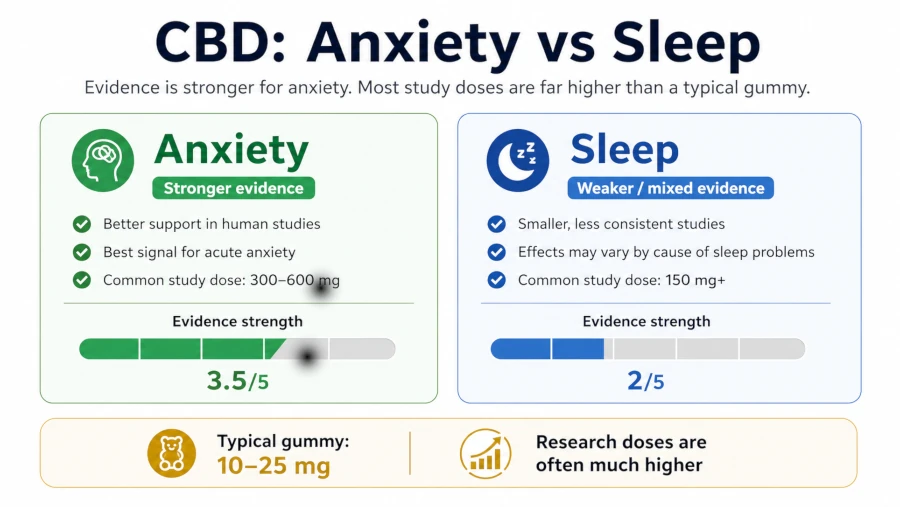
What CBD does for sleep and anxiety — and what it doesn’t
CBD, short for cannabidiol, is one of the main compounds in the cannabis plant. Unlike THC, it doesn’t get you high [NCCIH, 2024]. It acts on the endocannabinoid system, a signaling network tied to mood, stress, and the sleep-wake cycle — though exactly how it might ease anxiety or improve sleep is still being worked out.
The evidence is uneven, and it helps to be specific about it.
For anxiety, the most-cited human data is a 2019 retrospective case series of 72 adults at a psychiatric clinic. Anxiety scores fell within the first month in about 79% of patients and stayed down; sleep scores improved in roughly 67% at first but fluctuated after that [Shannon, 2019]. Encouraging — but it was a chart review with no placebo group, and doses ran from about 25 to 175 mg a day, often far above the 10 to 30 mg in a typical gummy.
For sleep on its own, the support is thinner. A 2024 randomized pilot trial gave adults with moderate-to-severe insomnia 150 mg of CBD each night and found it worked about the same as placebo on most sleep measures, while modestly improving how people felt during the day [Narayan et al., 2024]. A 2020 review of 12 studies covering 250 people concluded there wasn’t enough solid evidence to recommend cannabinoids for any sleep disorder, and flagged that most of those studies carried a meaningful risk of bias [NCCIH, sleep]. Harvard Health lands in a similar spot: CBD may help some people fall or stay asleep, often by easing the anxiety or pain that’s keeping them up, rather than by acting as a sedative itself [Harvard Health].
The honest read: there’s reasonable early support for CBD and anxiety at higher doses, weaker and more mixed support for CBD as a standalone sleep aid, and a real gap between the doses studied and the doses in most gummies. Plenty of “sleep” gummies get their punch from added melatonin or CBN, not from CBD.
The part most roundups skip: quality and regulation
Because these gummies are supplements, they skip premarket review. Independent testing has repeatedly turned up products with more or less CBD than the label claims, and some that contain THC while advertising none. That’s not a reason to panic, but it is the single biggest reason to buy only from brands that publish a batch-specific Certificate of Analysis (how to read one is below).
Safety has its own asterisk. In a 2025 FDA-run randomized trial, about 5.6% of healthy adults developed liver-enzyme elevations more than three times the normal upper limit after four weeks of CBD at doses people commonly take [FDA, 2025]. The changes reversed after stopping and most people had no symptoms — but it’s a genuine signal, especially if you take other medicines or drink regularly.
Why people reach for gummies
Gummies are popular for boring, practical reasons: a fixed dose per piece, an easy format to carry, and a taste most people prefer to an earthy oil. Compared with the alternatives, oils and tinctures let you fine-tune the dose but taste strongly of hemp; capsules are simple to swallow but feel clinical; and vapes act fast but carry the lung risks of any inhaled product. For anyone already winding down with tea, herbs, or a steady bedtime routine, a gummy slots in without much fuss.
Full-spectrum vs broad-spectrum vs isolate
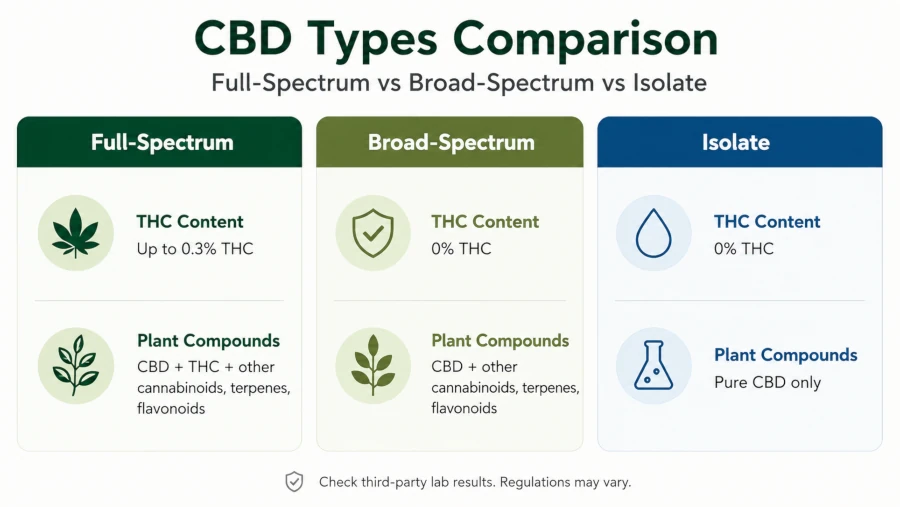
Almost every gummy falls into one of three categories, and the difference matters mostly for THC and for anyone who gets drug tested.
- Full-spectrum keeps the whole hemp profile, including up to 0.3% THC. Some people prefer it for the so-called entourage effect, the idea that plant compounds work better together — a plausible but not firmly proven theory.
- Broad-spectrum keeps other cannabinoids and terpenes but strips THC to non-detectable levels. A common middle ground for people who want plant compounds without THC.
- Isolate is pure CBD and nothing else — THC-free, but without the supporting compounds.
No spectrum is “best” for everyone. If you’re subject to workplace drug testing, broad-spectrum or isolate is the safer bet, since even legal trace THC can occasionally show up on a test.
What’s often added besides CBD
Most sleep and stress gummies aren’t CBD alone. The common add-ins each have their own (separate) evidence, and a few deserve a plain-English note:
- Melatonin — a hormone that signals “night” to your body. It’s better at shifting sleep timing than at keeping you asleep, and a low dose (around 0.5 to 1 mg) usually works as well as the higher amounts in many gummies. It can cause grogginess and vivid dreams.
- CBN (cannabinol) — marketed as the “sleepy” cannabinoid, but human evidence for that reputation is still thin.
- L-theanine — an amino acid from tea linked to a calmer, more focused state without sedation.
- Ashwagandha and other adaptogens — studied mainly for stress, with modest results.
- Chamomile, valerian, passionflower — traditional calming herbs with long histories and limited modern trial data.
If you’d rather skip CBD entirely, botanical-only formulas are an option — for example, the passionflower-based blend in LifeSeasons Rest-ZZZ’s, which leans on herbs alone.
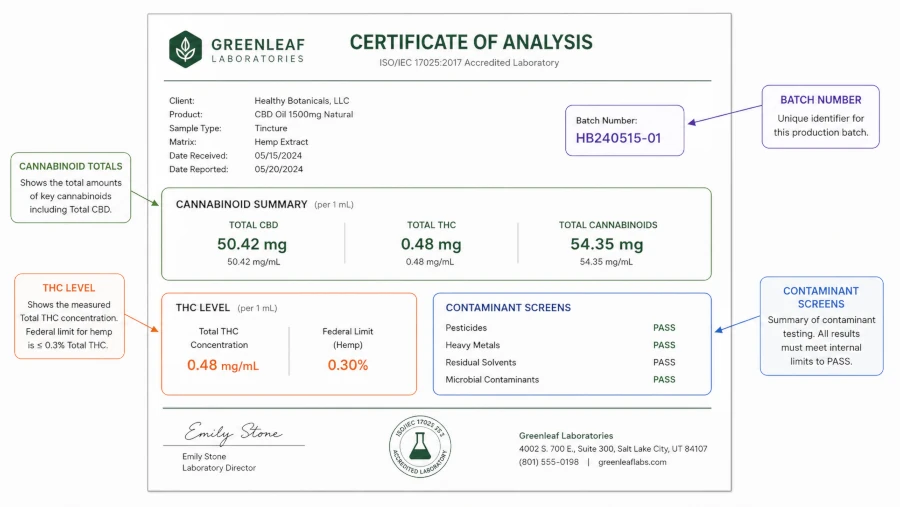
How to read a Certificate of Analysis (COA)
A COA is a batch-specific lab report, and learning to skim one is the most useful skill for buying CBD. A trustworthy report shows four things:
- Cannabinoid totals — the actual CBD (and CBN) per batch, which should match the label.
- THC content — confirming whether it’s full-spectrum or truly THC-free.
- Contaminant screens — for heavy metals, pesticides, and residual solvents.
- A batch number that matches the code on the bottle, so you know the report is for the product in your hand.
If a brand won’t show a current, matching COA, treat that as a reason to walk away.
How these picks were chosen
The shortlist below favors brands that publish third-party lab results, label their CBD type and strength clearly, and have a steady track record — the same traits that tested roundups from Healthline, Forbes Health, and Medical News Today tend to reward. One caveat worth stating plainly: product details here reflect what each brand published at the time of writing, and these specifics aren’t independently verified. Potencies, formulas, and prices change, so confirm the current COA before buying.
Ten CBD gummies worth comparing
1. Cornbread Hemp Full-Spectrum Gummies
Organic, Kentucky-grown full-spectrum gummies that the brand positions for nighttime calm, with up to legal-limit THC in some versions. The clean ingredient list (no artificial colors or corn syrup) appeals to people already watching what they eat. View the product page.
Best for: a clean full-spectrum option for both stress and sleep, if trace THC is fine for you.
2. CBDfx Mixed Berry Gummies
A widely reviewed, THC-free broad-spectrum line sold in several potencies, which is why it shows up on lists for both daytime stress and evening wind-down. View the product page.
Best for: one THC-free gummy to cover daytime calm and bedtime.
3. NuLeaf Naturals Gummies
A no-frills full-spectrum gummy (around 15 mg each, often a 30 mg serving) for people who want cannabinoid content over candy flavoring. View the product page.
Best for: experienced users who want a simple, potent full-spectrum option.
4. Aspen Green Bliss Organic Gummies
A higher-potency organic full-spectrum gummy that appears on several expert lists for heavier stress loads. Fewer gummies for the same effect can matter if you watch sugar. View the product page.
Best for: stronger needs, paired with some CBD experience.
5. R&R Full-Spectrum Gummies
A melatonin-free, organic full-spectrum option for anyone who wants evening calm without a hormone-based sleep aid, and the flexibility to use it during the day. View the product page.
Best for: people who specifically want to avoid melatonin.
6. Slumber Deep Zzzs (CBD + CBN + THC)
A multi-cannabinoid night formula (listed around 25 mg CBD, 8 mg CBN, and 3 mg THC per piece) aimed at heavier sedation. The THC makes it a poor fit for anyone who is drug-tested or THC-sensitive. View the product page.
Best for: experienced users wanting a stronger, night-only blend.
7. Medterra Max Relief Gummies
A full-spectrum gummy (about 25 mg) positioned more for all-around relaxation and physical comfort than sleep specifically, which can still help rest by easing aches that keep you up. View the product page.
Best for: when sleep trouble is tied to soreness or tension.
8. CBDfx Sleep Gummies (CBN or Melatonin)
The sleep-specific version of CBDfx’s line, pairing broad-spectrum CBD with CBN or melatonin for a more pronounced, predictable bedtime effect. View the product page.
Best for: CBD plus a dedicated sleep compound in a night-only gummy.
9. Broad-Spectrum, THC-Free Calm Gummies
A category rather than one product: several brands sell THC-free “calm” or “stress” gummies (often 10 to 25 mg, sometimes with L-theanine or botanicals) aimed at daytime use without strong drowsiness. Verify the THC-free claim on the COA.
Best for: steady daytime calm without THC, especially for drug-tested workplaces.
10. Mixed Day/Night Packs from Major Brands
Bundles that combine a daytime calm formula with a nighttime sleep formula let you compare how one brand handles each, often at better value than buying bottles separately.
Best for: trying several formulas before committing to one.
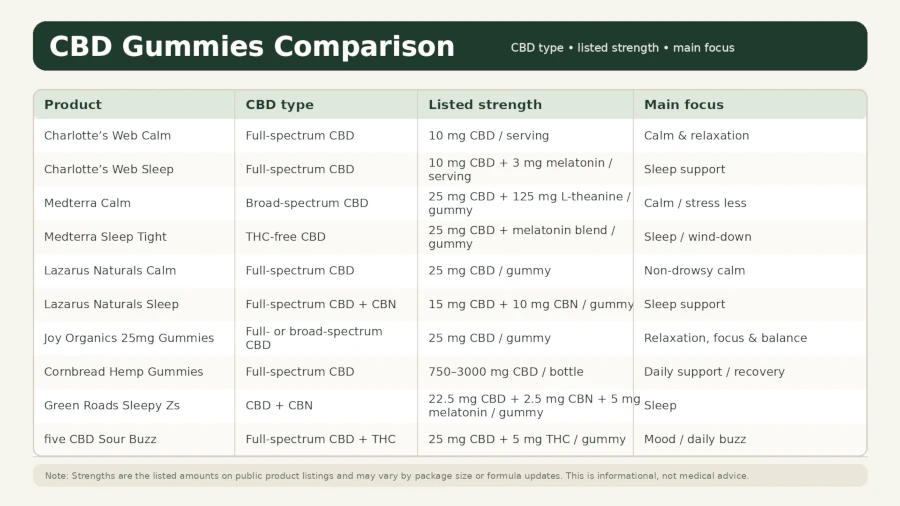
Quick comparison
| Product | CBD type | Listed strength | Main focus |
| Cornbread Hemp | Full-spectrum | ~20 mg+ | Sleep and calm |
| CBDfx Mixed Berry | Broad-spectrum | 25 mg+ | Anxiety + sleep |
| NuLeaf Naturals | Full-spectrum | ~15 mg each | Simple, potent calm |
| Aspen Green Bliss | Full-spectrum | High potency | Heavier stress/sleep |
| R&R | Full-spectrum | Moderate–strong | Melatonin-free calm |
| Slumber Deep Zzzs | Full-spectrum + CBN/THC | 25 mg CBD + CBN + THC | Deep night sleep |
| Medterra Max Relief | Full-spectrum | ~25 mg | Relaxation + comfort |
| CBDfx Sleep | Broad-spectrum | + CBN/melatonin | Sleep-specific |
| THC-free calm gummies | Broad-spectrum | 10–25 mg | Daytime calm |
| Mixed day/night packs | Mixed | Varies | Sampling both |
Strengths reflect figures published by each brand at the time of writing; confirm the current COA before buying.
Side effects, drug interactions, and who should avoid CBD
CBD is usually well tolerated at modest doses, but it isn’t side-effect-free. Reported effects include dry mouth, diarrhea or other digestive upset, drowsiness, reduced appetite, and mood or alertness changes [NCCIH, 2024]. As noted above, liver-enzyme changes can also occur, mostly at higher or sustained doses.
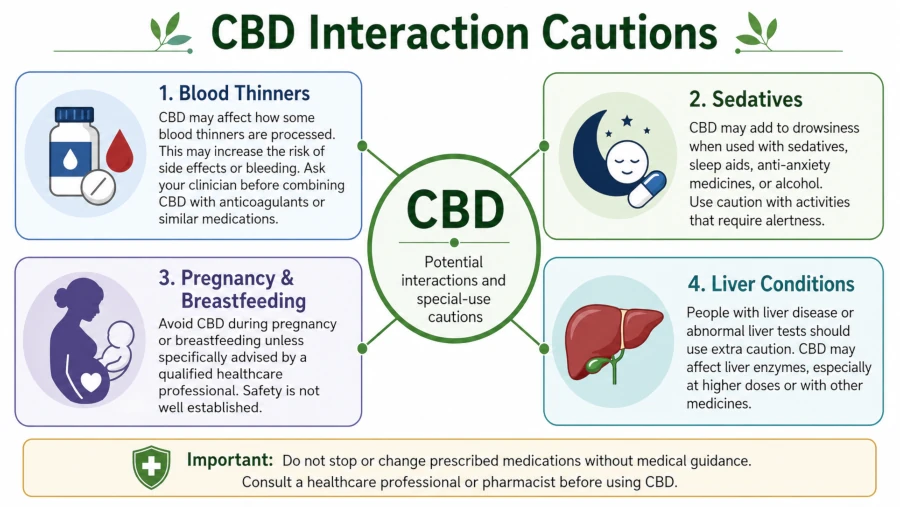
Drug interactions are the most important issue, and the one people most often overlook. CBD is processed by the same liver enzymes (the cytochrome P450 system) that handle many prescription drugs, so it can raise or lower their levels. A useful rule of thumb: if your medicine carries a grapefruit warning, CBD may interact too. Take extra care with blood thinners such as warfarin, some seizure medicines, and sedatives, and don’t combine CBD with alcohol or other sleep aids without medical advice.
Some people should be especially cautious or avoid CBD gummies altogether:
- Anyone pregnant or breastfeeding — the FDA strongly advises against CBD during pregnancy and nursing because of possible harm and unknowns [FDA].
- People with liver conditions, given the liver-enzyme signal.
- Anyone on interacting medications without a clinician’s sign-off.
- People who are drug tested — full-spectrum products can trigger a positive THC result.
- Anyone who needs to drive or operate machinery soon after a dose, since drowsiness is common.
If your sleep or anxiety ties into a broader pattern, it’s worth reading up on natural approaches to nervous-system balance and discussing options with a professional rather than relying on a gummy alone.
Realistic expectations and getting the most from them
Set the bar honestly. CBD is not a sedative that switches you off, and effects are usually subtle — a slightly easier wind-down rather than a knockout. People who get the most from gummies tend to start at a low dose, give it a couple of weeks, and take a sleep gummy about 30 to 60 minutes before bed. They also pair it with the basics that move the needle more reliably: a consistent bedtime, less late screen time, and a calm routine. Simple changes like an earlier, lighter dinner or foods that support sleep often do more than any supplement.
When to talk to a healthcare professional
A gummy is fine for the occasional restless night. Some signs mean it’s time to involve a clinician instead:
- Insomnia that lasts more than three months, or anxiety that interferes with work, relationships, or daily life.
- Panic attacks, or anxiety with chest pain, shortness of breath, or a racing heart that’s new or severe — seek prompt care.
- Daytime impairment: nodding off, trouble concentrating, or needing a gummy every night to function.
- Any plan to combine CBD with prescription medication, alcohol, or other sleep aids.
For chronic insomnia, the first-line treatment recommended by sleep specialists is cognitive behavioral therapy for insomnia (CBT-I), not a supplement [Sleep Foundation]. CBD may have a place alongside good care, but it isn’t a substitute for it.
| HEALTH DISCLAIMER This article is for general education only and is not a substitute for professional medical advice, diagnosis, or treatment. CBD products are not FDA-approved to prevent, treat, or cure any disease. Always talk with a qualified healthcare provider before starting CBD, especially if you are pregnant or breastfeeding, take prescription medication, or have a liver condition. Use of any information here is at your own risk. |
Frequently Asked Questions
How long do CBD gummy effects last?
Most people notice something within 30 to 90 minutes, with effects lasting roughly 2 to 6 hours depending on the dose, your body weight, and your metabolism. Eating the gummy with food can slow onset but extend the effect.
Can CBD gummies leave me groggy the next day?
They can, especially at higher doses or in formulas with added melatonin or THC. Lowering the dose and taking it earlier in the evening usually reduces the morning heaviness.
Are CBD gummies addictive?
Current evidence doesn’t show CBD itself to be habit-forming the way some prescription sleep medicines can be. You can still build a psychological routine around them, and tolerance to sleep effects may develop with nightly use.
Will a CBD gummy make me fail a drug test?
Isolate and verified broad-spectrum (THC-free) gummies are the safer choice if you’re tested, since full-spectrum products contain trace THC that can occasionally show up. Confirm the THC content on the COA.
Is more CBD always better for sleep?
No. The 2024 insomnia pilot used 150 mg nightly and still found CBD performed similarly to placebo on most sleep measures, so a higher number on the label doesn’t guarantee better sleep. Start low and judge by how you actually feel.
References
- U.S. Food and Drug Administration. What You Need to Know About Products Containing Cannabis or Cannabis-Derived Compounds, Including CBD. → View source
- U.S. Food and Drug Administration (CDER). Investigators Address the Safety of CBD in a Randomized Trial, 2025. → View source
- National Center for Complementary and Integrative Health. Cannabis (Marijuana) and Cannabinoids: What You Need To Know. → View source
- National Center for Complementary and Integrative Health. Sleep Disorders and Complementary Health Approaches. → View source
- Shannon S, Lewis N, Lee H, Hughes S. Cannabidiol in Anxiety and Sleep: A Large Case Series. Perm J, 2019;23:18-041. → View source
- Narayan AJ, et al. Cannabidiol for moderate–severe insomnia: a randomized controlled pilot trial of 150 mg of nightly dosing. J Clin Sleep Med, 2024;20(5):753–763. → View source
- Harvard Health Publishing. Cannabidiol (CBD): What we know and what we don’t. → View source
- Sleep Foundation. Cannabis for Sleep: Benefits and Risks. → View source
- Healthline. Best CBD Gummies (tested picks). → View source
- Forbes Health. Best CBD Gummies. → View source
- Medical News Today. Best CBD Gummies for Sleep. → View source
