
If you came here looking for ways to use the oleander plant for your health, here is the straight answer: there aren’t any you can safely use at home. Every part of oleander — flowers, leaves, stems, sap — contains poisons that act on the heart [MedlinePlus, 2025]. A purified oleander extract has been tested in cancer trials, and that research is real. It hasn’t produced a treatment, though, and it tells you nothing about what a leaf, a tea or a flower cream would do.
Below: what oleander contains, why the old healing claims don’t hold up, how to recognize poisoning, and how to keep a yard full of oleander safe for kids and pets.
| If someone has swallowed any part of an oleander plant Call Poison Help at 1-800-222-1222 now, even if they feel fine. Call 911 if they collapse, have trouble breathing, or have a very slow or irregular pulse. Don’t make them throw up unless poison control tells you to [MedlinePlus, 2025]. For a pet, call your vet or the ASPCA Animal Poison Control Center at (888) 426-4435 [ASPCA]. |
What the oleander plant is
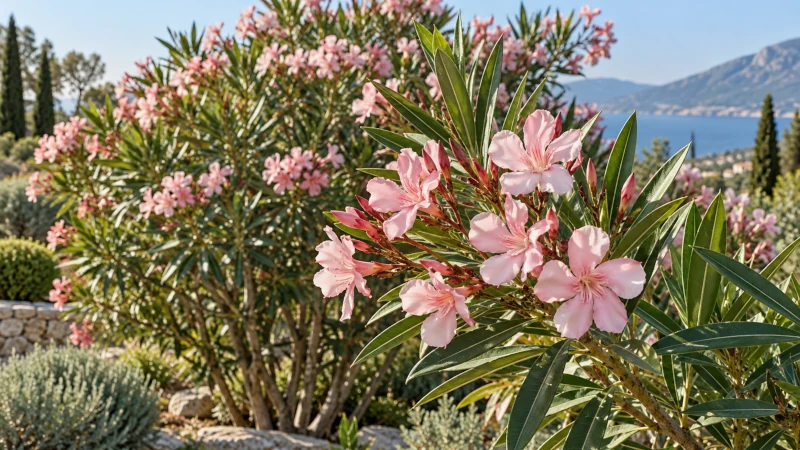
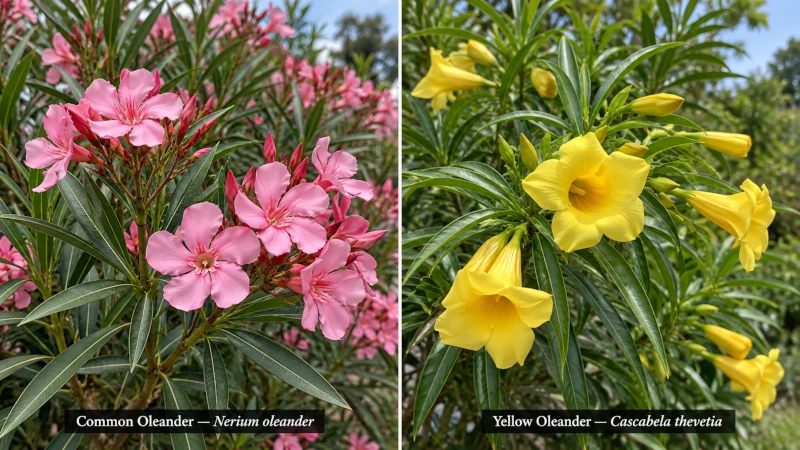
Oleander (Nerium oleander) is an evergreen shrub in the dogbane family, Apocynaceae. The French call it laurier rose; in Spanish it’s adelfa. It’s native to Europe and Asia, grows roughly 5 to 20 feet tall, and flowers from late spring through late summer in shades running from white and pink to peach [NC State Extension]. It shrugs off heat, drought and poor soil, which is why it lines highway medians in warm states such as California [MedlinePlus, 2025].
It has a cousin worth knowing about: yellow oleander (Cascabela thevetia, formerly Thevetia peruviana). It’s a different plant carrying the same family of poisons [MedlinePlus, 2025]. That matters here because almost all the controlled clinical research on oleander poisoning comes from yellow oleander self-poisoning in South Asia, not from the common oleander in American yards [CalPoison, 2017].
Why the oleander plant is poisonous
Oleander contains cardiac glycosides, including oleandrin, neriin and digitoxigenin [MedlinePlus, 2025]. They’re chemical relatives of digoxin, the heart drug descended from foxglove — our guide to the foxglove plant covers that side of the family.
These compounds jam the sodium-potassium pump in heart muscle cells. A little of that makes each beat more forceful. More of it makes the heart’s electrical system irritable: the rate slows, signals between the upper and lower chambers can block, potassium in the blood climbs, and deaths come from rhythms the heart can’t recover from [CalPoison, 2017].
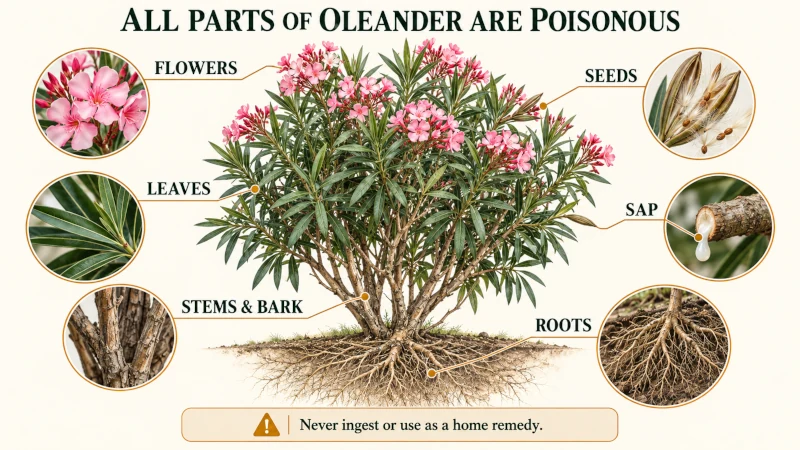
The poison isn’t confined to one part. Flowers, leaves, stems, twigs, bark, roots, seeds and sap are all listed as toxic [MedlinePlus, 2025; NC State Extension], and the plant stays poisonous when dried [NC State Extension]. The Missouri Poison Center adds nectar, smoke from burning clippings, and even the water from a vase of cut oleander flowers to the ways people can be poisoned [Missouri Poison Center, 2020].
How much is dangerous?
The sources don’t agree on a number, and you’re better off knowing that than trusting a falsely precise one. MedlinePlus says a single leaf may kill an adult [MedlinePlus, 2025]. The California Poison Control System reports fatal poisonings after 5 to 15 leaves, notes a suggestion that one leaf could be toxic to a child, and describes nonfatal cases after varying amounts of leaves, flowers and extracts [CalPoison, 2017].
Part of the reason for the spread is that the amount swallowed predicts the outcome poorly. Toxin content varies, absorption from the gut is limited and uneven, and many people vomit early [CalPoison, 2017]. So treat it simply: there is no known safe amount to swallow, and any swallow is worth a call to poison control.
Do oleander plant health benefits hold up?
Oleander has a long history as a folk medicine and a short, specific history in modern research. They need to be judged separately.
| Claim | What the evidence shows | Evidence grade |
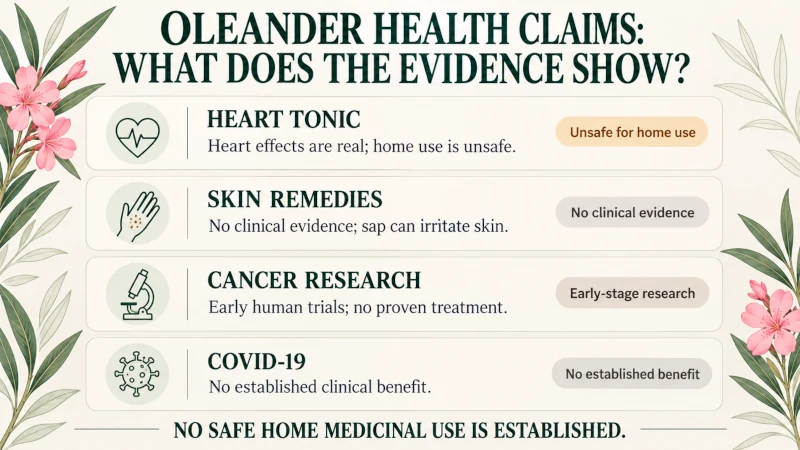
| Heart tonic (“stronger than foxglove”) | The heart action is real — it’s the same action that poisons. Digoxin is useful as a purified drug with decades of established use; no oleander preparation has that [ACMT et al., 2020]. | Mechanism real; no safe home use |
| Scabies creams, flower poultices | No clinical studies found. The sap itself can cause contact dermatitis [NC State Extension]. | No evidence; possible harm |
| Other traditional uses (heart failure, leprosy, malaria, ringworm, indigestion, ending pregnancies) | Recorded historically [CalPoison, 2017]; not supported by modern trials. | Traditional use only |
| Cancer (PBI-05204 extract) | Phase I: tolerated in advanced cancer. Phase II: missed its survival goal [Hong et al., 2014; Roth et al., 2020]. | Early-stage; unproven |
| COVID-19 (oleandrin) | Lab-dish data only; toxicology groups advise against use outside supervised trials [ACMT et al., 2020]. | No human evidence |
The heart claim
The earlier version of this page called oleander’s main glycoside a powerful cardiotonic, stronger than foxglove’s, and then added that taking it by mouth wasn’t recommended because the useful dose sits too close to the toxic one. That second half is what counts. The pump-blocking action that once made oleander look promising for a failing heart is the same action that kills in poisoning [CalPoison, 2017]. Digoxin earns its place in medicine as a purified compound whose use has been worked out over decades [ACMT et al., 2020]. A homemade oleander preparation has none of that, and the dose in any given leaf or flower is unknowable.
Scabies creams and poultices
The old article gave a recipe for an oleander-flower butter cream to treat scabies and suggested flower poultices on the skin. Both are gone. We found no clinical study supporting oleander for scabies or any other skin condition, and extension services warn that the sap can irritate skin and cause contact dermatitis [NC State Extension; Bricker, Univ. of Arizona]. Our guide to herbs for skin issues puts oleander on its list of plants to keep off your skin entirely.
If you think you have scabies, see a doctor or pharmacist rather than experimenting with a poisonous plant.
Cancer research on an oleander extract
This is where the genuine science sits. PBI-05204 is a company-developed extract of oleander leaves that contains oleandrin, and it has been tested in people with advanced cancer.
- In a first-in-human phase I trial, 46 patients with advanced solid tumors took it by mouth. Researchers judged it well tolerated in this heavily pretreated group; dose-limiting side effects — fatigue and protein in the urine — appeared at the top dose tested [Hong et al., 2014].
- A phase II trial in metastatic pancreatic cancer enrolled 42 people and analyzed 38. It did not meet its primary goal for overall survival, though the authors saw signals they felt deserved more study. Vomiting, nausea, loss of appetite and diarrhea were the most common side effects [Roth et al., 2020].
Keep two things in view. These trials used a measured pharmaceutical extract under close medical monitoring, not plant material. And neither trial showed that the extract treats cancer.
Oleandrin and COVID-19
In 2020, oleandrin was promoted as a possible COVID-19 treatment on the strength of a preprint lab study in cells. The American College of Medical Toxicology, the American Academy of Clinical Toxicology and the American Association of Poison Control Centers answered together: plenty of chemicals block a virus in a dish, that says nothing about safety or benefit in people, and they recommended in the strongest terms against using oleandrin outside rigorous, medically supervised research [ACMT et al., 2020]. Poison centers apply the same warning to oleandrin sold as a supplement [Missouri Poison Center, 2020].
Symptoms of oleander poisoning
Symptoms can begin within a few hours of swallowing the plant. Nausea, vomiting and stomach pain usually come first and are very common [CalPoison, 2017]. MedlinePlus groups the signs like this [MedlinePlus, 2025]:
| Body system | Signs to watch for |
| Heart and circulation | Slow or irregular heartbeat, low blood pressure, weakness |
| Stomach and gut | Nausea, vomiting, stomach pain, diarrhea, loss of appetite |
| Brain and nerves | Confusion, disorientation, drowsiness, lethargy, dizziness, fainting, headache |
| Eyes | Blurred vision; halos around objects |
| Skin | Rash, hives |
Halos, low mood and loss of appetite show up mainly with longer-term exposure rather than a single swallow [MedlinePlus, 2025].
Heart rhythm trouble can arrive late. In yellow oleander poisoning, serious rhythm problems have appeared up to 72 hours after ingestion, which is why hospitals may keep people on a heart monitor for days [CalPoison, 2017].
How badly things go varies a great deal. MedlinePlus describes symptoms lasting one to three days, calls death unlikely, and stresses that faster care improves the odds [MedlinePlus, 2025]. Deliberate self-poisoning with yellow oleander seeds in South Asia is a different picture, with a reported case fatality rate of 4 to 10% [CalPoison, 2017].
Skin and eye contact
The sap can irritate skin and cause contact dermatitis [NC State Extension; Bricker, Univ. of Arizona]. Wash it off with soap and water. If sap gets in an eye or a rash spreads, call Poison Help for advice.
What to do if someone swallows oleander
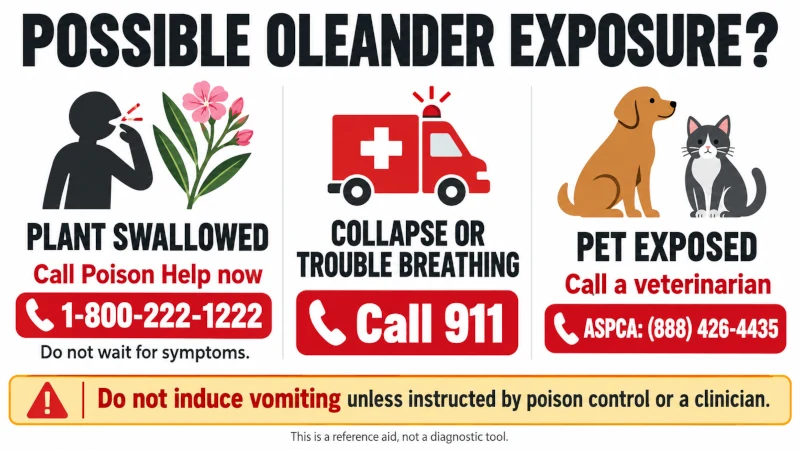
- Call Poison Help at 1-800-222-1222 right away. It’s free, confidential and open 24 hours a day, and you don’t need to wait for symptoms [MedlinePlus, 2025]. Call 911 instead if the person has collapsed, is struggling to breathe, or seems seriously unwell.
- Don’t make them vomit unless poison control or a clinician tells you to [MedlinePlus, 2025].
- Have these details ready: the person’s age, weight and condition; which plant and which part; when it was swallowed; and roughly how much [MedlinePlus, 2025]. If you have a heart condition or take heart or water-pill (diuretic) medicines, say so.
- For a dog, cat or horse, call your veterinarian or the ASPCA Animal Poison Control Center at (888) 426-4435; a consultation fee may apply [ASPCA].
What happens at the hospital
Expect vital-sign monitoring, blood and urine tests, and an electrocardiogram (ECG) [MedlinePlus, 2025]. Potassium matters: a high level reflects how severe the poisoning is, and a low one makes the heart more vulnerable [CalPoison, 2017].
Treatment may include activated charcoal, IV fluids and medicine for symptoms [MedlinePlus, 2025], atropine for a slow heart rate, and digoxin-specific antibody fragments — an antidote that binds cardiac glycosides. Plant poisonings usually need larger antidote doses than a digoxin overdose because the antibodies grip plant toxins less tightly [CalPoison, 2017].
The treatment evidence is mixed
Activated charcoal is the best-studied treatment for oleander poisoning, and the two big trials point in different directions.
- In a 2003 trial of 401 people poisoned with yellow oleander in Sri Lanka, repeated doses of charcoal cut deaths from 8% (16 people) to 2.5% (5 people) compared with placebo [de Silva et al., 2003].
- A 2008 trial of 4,632 self-poisoned patients — 1,647 of whom had eaten yellow oleander seeds — found no difference in deaths between multiple-dose charcoal and no charcoal across the whole trial: 6.3% versus 6.8% [Eddleston et al., 2008]. Those figures cover every poison in the trial, not oleander alone.
A 2006 Cochrane review, written before the larger trial, concluded there was some evidence that repeated-dose charcoal and anti-digoxin antibody fragments may help in yellow oleander poisoning, and pointed out that cost keeps the antibodies out of reach where these poisonings are most common [Roberts & Buckley, 2006]. The California Poison Control System calls the literature conflicting and suggests charcoal when it can be given safely, never as a substitute for other treatment [CalPoison, 2017]. None of this is something to attempt at home.
Who is most at risk
- Young children. One leaf has been suggested as potentially toxic to a child [CalPoison, 2017]. The leaves are bitter and stiff, which makes swallowing them uncommon [Bricker, Univ. of Arizona] — uncommon, not impossible.
- People with heart conditions or on diuretics. Low potassium makes cardiac glycoside poisoning more dangerous, and diuretics or heavy diarrhea can lower it [CalPoison, 2017]. Mention your medicines when you call poison control.
- Pregnancy and breastfeeding. Oleander was historically used to end pregnancies [CalPoison, 2017]. We found no research supporting any safe use during pregnancy or breastfeeding.
- Pets and livestock. Oleander is toxic to dogs, cats and horses; signs include drooling, belly pain, diarrhea, colic, depression and death [ASPCA]. Cattle, sheep, goats and llamas can be poisoned too [Bricker, Univ. of Arizona].
- Anyone tempted by a home remedy. Teas, creams, tinctures and oleandrin supplements all carry the same unpredictable dose of a heart poison.
Living with oleander in your yard
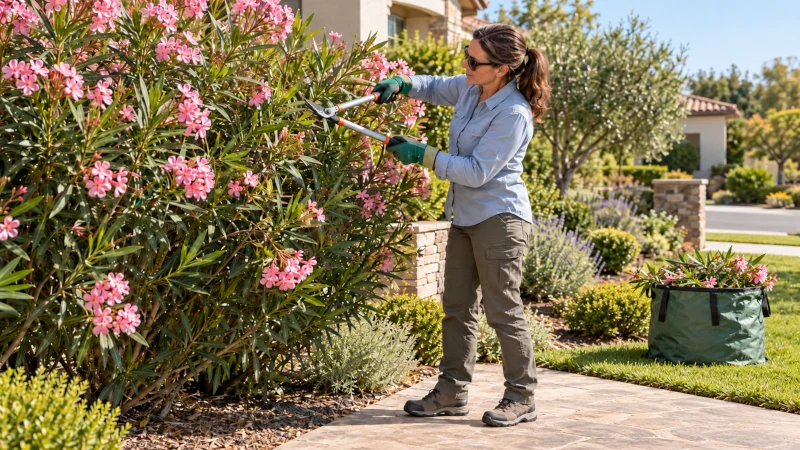
Plenty of people keep oleander without trouble. A few habits cover most of the risk:
- Wear gloves and long sleeves when you prune, and wash afterward — the sap is a skin irritant [NC State Extension].
- Never burn clippings. Extension guidance says the smoke is injurious [NC State Extension], and the Missouri Poison Center lists smoke as a route of poisoning [Missouri Poison Center, 2020].
- Bag trimmings and keep them away from horses, livestock and pets. Dried leaves are still poisonous [NC State Extension].
- Skip oleander in flower arrangements where a child or pet could drink the vase water [Missouri Poison Center, 2020].
- Teach children not to put leaves or flowers in their mouths.
If you have toddlers or grazing animals and are planting fresh, NC State Extension lists native alternatives that fill a similar role, including yaupon holly (Ilex vomitoria) and wax myrtle (Myrica cerifera) [NC State Extension]. For two more garden plants worth knowing, see our guides to the poisonberry plant (black nightshade) and bittersweet nightshade.
When to get emergency help
| Call 911 or go to the emergency room after a possible oleander exposure if there is: Fainting or collapseA very slow, racing or irregular heartbeatTrouble breathingConfusion, disorientation or unusual drowsinessRepeated vomiting or diarrheaBlurred vision or halos around lights These are among the recognized signs of oleander poisoning [MedlinePlus, 2025]. With no symptoms at all, still call Poison Help at 1-800-222-1222 — rhythm problems can be delayed [CalPoison, 2017]. |
Health disclaimer
| HEALTH DISCLAIMER: This article is for general information and education. It is not medical advice and does not replace diagnosis or treatment from a qualified healthcare professional. Oleander is a poisonous plant; do not use any part of it, or any oleandrin product, as a remedy. If you are pregnant or breastfeeding, caring for a child, taking prescription medicines (especially heart medicines or diuretics), or living with a heart condition, talk to your doctor or pharmacist before using any herbal product. In a poisoning emergency, call Poison Help at 1-800-222-1222. For a medical emergency, call 911. |
Frequently Asked Questions
Is oleander poisonous to touch?
The serious heart effects come from swallowing the plant, but the sap can irritate skin and cause contact dermatitis [NC State Extension]. Wear gloves when pruning and wash any sap off with soap and water.
Is it safe to burn oleander clippings?
No. Extension guidance warns that the smoke is injurious [NC State Extension], and poison centers list smoke as a way people get poisoned [Missouri Poison Center, 2020]. Bag clippings for disposal instead.
Is dried oleander still poisonous?
Yes. Oleander is poisonous fresh or dry [NC State Extension], so fallen leaves and old trimmings still need care around children and animals.
Is yellow oleander the same plant?
No. Yellow oleander (Cascabela thevetia) is a separate species with the same type of heart poison [MedlinePlus, 2025]. Its seeds are a common means of self-poisoning in parts of South Asia [CalPoison, 2017].
Are oleandrin supplements safe?
No supplement has shown safety or benefit, and medical toxicology groups recommend against oleandrin outside supervised clinical research [ACMT et al., 2020]. If you or someone you know has taken one, call Poison Help at 1-800-222-1222.
References
- MedlinePlus Medical Encyclopedia. “Oleander poisoning.” U.S. National Library of Medicine; View source
- MedlinePlus Medical Encyclopedia. “Oleander (Nerium oleander)” image page. U.S. National Library of Medicine; View source
- Minns A. “Naturally Occurring Cardiac Glycoside Poisoning.” California Poison Control System, UCSF; View source
- Missouri Poison Center. “Oleander and Oleandrin: Not a Safe Plant or Supplement.” View source
- American College of Medical Toxicology, American Academy of Clinical Toxicology, American Association of Poison Control Centers. “Joint Statement on the Dangers of Oleandrin Toxicity.” View source
- Roberts DM, Buckley N. “Antidotes for acute cardenolide (cardiac glycoside) poisoning.” View source
- de Silva HA, Fonseka MM, Pathmeswaran A, et al. “Multiple-dose activated charcoal for treatment of yellow oleander poisoning: a single-blind, randomised, placebo-controlled trial.” View source
- Eddleston M, Juszczak E, Buckley NA, et al. “Multiple-dose activated charcoal in acute self-poisoning: a randomised controlled trial.” View source
- Hong DS, Henary H, Falchook GS, et al. “First-in-human study of PBI-05204, an oleander-derived inhibitor of akt, fgf-2, nf-κB and p70s6k, in patients with advanced solid tumors.” View source
- Roth MT, Cardin DB, Borazanci EH, et al. “A Phase II, Single-Arm, Open-Label, Bayesian Adaptive Efficacy and Safety Study of PBI-05204 in Patients with Stage IV Metastatic Pancreatic Adenocarcinoma.” View source
- North Carolina Extension Gardener Plant Toolbox. “Nerium oleander.” NC State Extension. View source
- Bricker R. “A Love-Hate Relationship with Oleanders.” University of Arizona Cooperative Extension (PDF), undated. View source
- ASPCA Animal Poison Control Center. “Oleander.” Toxic and Non-Toxic Plants list. View source


