
If you’re looking into hawthorn berry benefits, here’s the honest short version. Hawthorn’s best evidence is for easing symptoms of mild-to-moderate chronic heart failure when it’s added to standard treatment — and even there, the largest long-term trials didn’t show that it prevents heart attacks, hospital stays, or deaths. For high blood pressure the signal is encouraging but built on small studies. For anxiety, weight loss, and most other uses, the research is thin or missing [NCCIH, 2025].
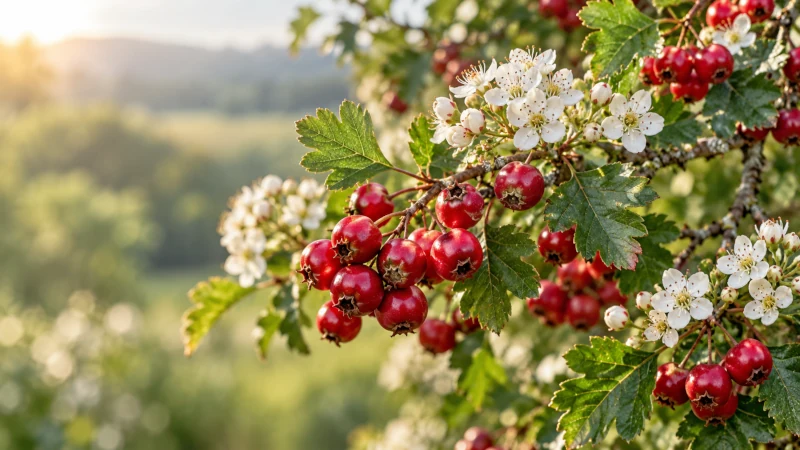
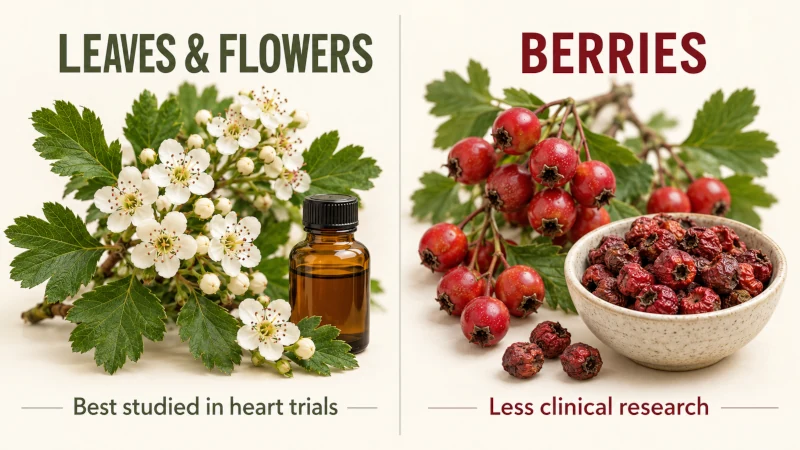
One detail changes how you should read nearly everything else. The hawthorn tested in most clinical trials isn’t the berry. The best-studied extracts, WS 1442 and LI 132, are made from the leaves and flowers, and far fewer clinical studies have looked at berry extract alone [Dahmer & Scott, 2010]. If the bottle in your cabinet says “hawthorn berry,” the results below may not transfer neatly to it.
What hawthorn is — and which part you’re taking
Hawthorn (Crataegus) is a flowering shrub or small tree in the rose family that grows in temperate regions around the world. Supplements usually come from C. monogyna or C. laevigata [NCCIH, 2025]. Its use as a heart remedy in Europe goes back at least to the first-century Greek physician Dioscorides [Dahmer & Scott, 2010].
Leaves, flowers, and berries all contain flavonoids and oligomeric procyanidins (OPCs), the compounds thought to drive hawthorn’s effects on the heart and blood vessels. Standardized extracts are measured by them: WS 1442 is standardized to 18.75% OPCs, and LI 132 to 2.2% flavonoids. Germany’s Commission E recommends the leaf and flower for therapeutic use. The dried berries are a traditional digestive aid in Chinese medicine and are often made into jam, candy, or wine [Dahmer & Scott, 2010].
Hawthorn is sometimes compared with the foxglove plant, the source of the heart drug digoxin. They are not interchangeable. Hawthorn contains no cardioactive glycosides, the compounds that make foxglove both useful and dangerous [Walker et al., 2006] — and that’s exactly why it can’t stand in for a prescribed heart medicine.
Hawthorn for heart failure: modest symptom relief, no proof it saves lives
This is where hawthorn has been studied most. A Cochrane systematic review found 14 double-blind, placebo-controlled trials of hawthorn leaf-and-flower extract; 10 of them, covering 855 people with chronic heart failure (New York Heart Association classes I–III), could be pooled. Compared with placebo, hawthorn improved maximal workload and exercise tolerance, lowered the pressure–heart rate product (a marker of how hard the heart is working), and eased shortness of breath and fatigue. Reported side effects were infrequent, mild, and short-lived [Guo et al., 2008].
Those trials were short — mostly six to eight weeks [Dahmer & Scott, 2010] — and they measured how people felt and performed, not whether they lived longer. Two larger, longer trials took on that harder question:
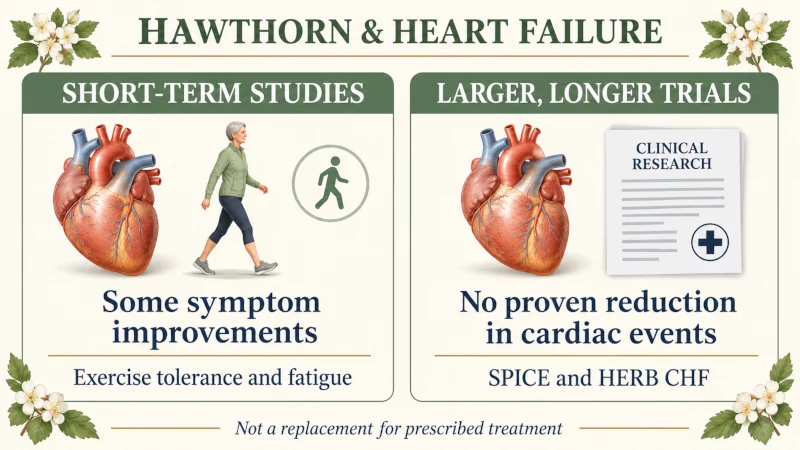
- SPICE (2008). 2,681 people with class II–III heart failure and a reduced ejection fraction took 900 mg a day of WS 1442 or placebo for 24 months on top of their usual medication. Hawthorn did not significantly delay the first cardiac event, the trial’s main outcome. It was safe alongside standard therapy, and a subgroup analysis hinted at fewer sudden cardiac deaths — a lead to test, not a finding [Holubarsch et al., 2008].
- HERB CHF (2009). In 120 people with class II–III heart failure on standard therapy, hawthorn gave no symptomatic or functional benefit [Zick et al., 2009]. A secondary analysis of the same trial suggested an increased early risk of heart failure getting worse [Zick et al., 2008]. NCCIH says the reason is unclear; an interaction with patients’ medicines is one possibility [NCCIH, 2025].
Taken together, the evidence is conflicting [NCCIH, 2025]. A clinical review in American Family Physician concluded that a standardized extract can be used alongside standard therapy to relieve symptoms of mild heart failure, found no evidence that it lowers mortality, and advised sticking with proven treatments until long-term safety and effectiveness are established [Dahmer & Scott, 2010].
So if you have heart failure, hawthorn is a question to bring to your cardiologist. It is not a swap for anything you’re prescribed.
Hawthorn and blood pressure: an encouraging but early signal
A 2025 meta-analysis pooled six randomized, placebo-controlled trials with 428 adults who had high blood pressure. Doses ran from 250 to 1,200 mg a day for 10 weeks to 6 months. Hawthorn lowered systolic pressure by an average of 6.65 mmHg more than placebo (95% CI −11.72 to −1.59). The drop in diastolic pressure (−7.19 mmHg) wasn’t statistically significant overall. Most trials raised some concerns about bias, the products and doses varied widely, and the authors concluded hawthorn isn’t effective enough to treat hypertension on its own [Szikora et al., 2025].
The best-designed single trial in that group enrolled 79 people with type 2 diabetes, most of them already on blood pressure medicine. After 16 weeks on 1,200 mg a day of hawthorn extract, diastolic pressure fell slightly more than with placebo, while systolic pressure didn’t differ. Researchers saw no herb–drug interactions [Walker et al., 2006].

You’ll sometimes see hawthorn described as “balancing” blood pressure — lowering it when it’s high and raising it when it’s low. The pressure-raising effect in research comes from a fixed combination of hawthorn and camphor, not hawthorn alone [Szikora et al., 2025]. Memorial Sloan Kettering rates the blood pressure data as conflicting [MSKCC, 2022].
If your numbers run high, diet, activity, and — when needed — medication still do the heavy lifting. Our guides to lowering blood pressure naturally and how sodium, potassium, and magnesium affect blood pressure cover the options with the most evidence. Don’t stop or cut back a blood pressure medicine to try hawthorn. If you add it, tell your prescriber so they can watch for readings that drop too low.
Anxiety, palpitations, and hawthorn’s calming reputation
Hawthorn has a long folk reputation as a calming herb, but NCCIH says it’s unclear whether it affects anxiety [NCCIH, 2025]. In the European Union, hawthorn leaf and flower is registered as a traditional herbal medicine for temporary nervous heart complaints, such as palpitations from mild anxiety — and only after a doctor has ruled out serious causes [Szikora et al., 2025]. “Traditional use” means long, apparently safe use. It doesn’t mean the effect has been proven.
That condition matters. A racing or fluttering heart can come from anxiety, but it can also come from an arrhythmia, a thyroid problem, or heart disease. Get it checked before you treat it as nerves. For gentler options for everyday tension, see our guides to a calming nervine tea and supplements for anxiety and stress.
Other claimed hawthorn berry benefits: where the evidence runs out
Hawthorn is sold for far more than the heart. Here’s how the main claims line up against what’s actually been studied.
| Use | What the research shows | Evidence |
| Chronic heart failure symptoms (add-on) | Better exercise tolerance and symptoms in short trials; no proven effect on cardiac events or deaths in long trials [Guo, 2008]; [Holubarsch, 2008]; [Zick, 2009] | Moderate, mixed |
| High blood pressure | Modest systolic drop in a small meta-analysis; trials varied and had bias concerns [Szikora, 2025] | Limited but promising |
| Anxiety | Unclear in humans [NCCIH, 2025] | Insufficient |
| Angina, abnormal heart rhythm, artery plaque | Not enough evidence to know [NCCIH, 2025] | Insufficient |
| Weight loss | No evidence of an effect [NCCIH, 2025] | None |
| Digestion | Traditional use in Chinese medicine; clinical studies lacking [MSKCC, 2022] | Traditional only |
How hawthorn is taken, and the doses studied
In heart studies, daily doses of standardized extract ranged from 160 to 1,800 mg, usually split into two or three doses. Nobody knows the most effective dose, and the AFP review suggests a trial of at least four to eight weeks before judging whether it’s helping [Dahmer & Scott, 2010]. SPICE and HERB CHF both used 900 mg a day of WS 1442 [Holubarsch et al., 2008]; [Zick et al., 2009]. The blood pressure trials used 250 to 1,200 mg a day [Szikora et al., 2025].
Teas, tinctures, and whole berries haven’t been tested in comparable trials, so there’s no evidence-based dose for them. Hawthorn jam or jelly is food, not treatment.
Sources disagree about how long it’s safe to take. NCCIH says no research has tested hawthorn’s safety beyond 16 weeks [NCCIH, 2025], yet SPICE followed people on WS 1442 for two years and reported it safe alongside heart-failure medicine [Holubarsch et al., 2008]. One likely explanation: a single standardized extract was studied long-term, and it’s unknown whether other products behave the same way.
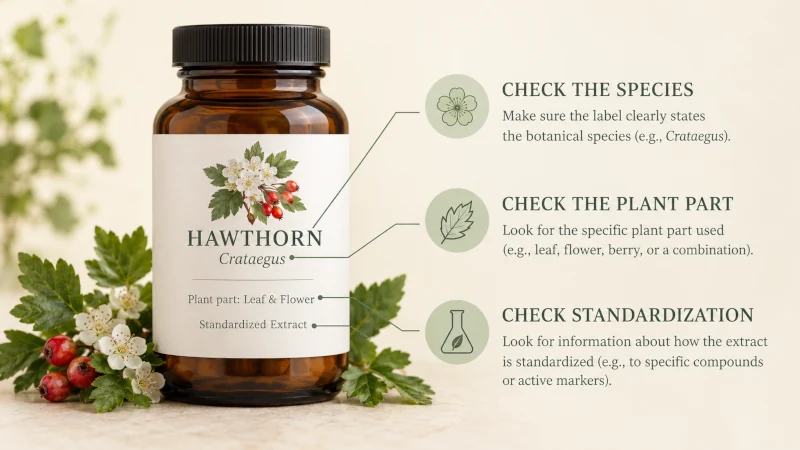
Product quality matters, too. Supplements in the U.S. aren’t approved by the FDA before they’re sold [NCCIH, 2025]. Choose a label that names the species, the plant part (leaf and flower, or berry), and how it’s standardized.
A warning about tejocote root (Mexican hawthorn)
The FDA has found that products labeled “tejocote root” (Crataegus mexicana, also sold as Mexican hawthorn or raíz de tejocote), many marketed for weight loss, actually contain yellow oleander — a poisonous plant that can cause severe or even fatal heart, nervous system, and digestive effects. The agency advises people to stop using these products and to contact a health care provider if they’ve taken them, even in the past [FDA, 2026]. These are not the hawthorn extracts studied for heart health. Avoid them.
Side effects, interactions, and who should avoid hawthorn
Common side effects
Most people tolerate hawthorn well. Dizziness and vertigo are the most common complaints. Less common effects include nausea, fatigue, sweating, palpitations, headache, shortness of breath, trouble sleeping, agitation, and nosebleeds [Dahmer & Scott, 2010]. NCCIH also lists vomiting, diarrhea, and muscle pain [NCCIH, 2025]. Taking too much can cause low blood pressure and an irregular heartbeat [MSKCC, 2022].
Medication interactions
Because hawthorn acts on the heart and blood vessels, the main risk is adding its effects on top of heart drugs. Reviews flag possible interactions with [Dahmer & Scott, 2010]:
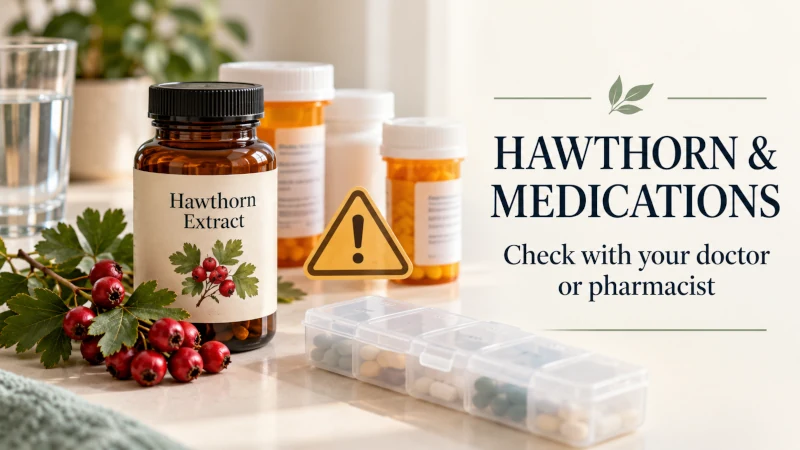
- Blood pressure medicines, including ACE inhibitors, angiotensin receptor blockers, calcium channel blockers, and other vasodilators
- Antiarrhythmic drugs
- Digoxin and other cardiac glycosides
- PDE5 inhibitors (erectile dysfunction drugs such as sildenafil)
- Cholesterol-lowering drugs
- Other heart-active herbs and supplements, such as danshen, ginger, Panax ginseng, turmeric, and valerian
The digoxin question is genuinely mixed. The AFP review reports data suggesting no notable interaction with digitalis drugs but still advises caution [Dahmer & Scott, 2010], while LactMed notes that hawthorn can possibly increase the effects of digoxin, anticoagulants, and blood pressure medicines [LactMed, 2021]. Memorial Sloan Kettering adds that a lab study suggests hawthorn may increase the side effects of antiplatelet and anticoagulant drugs, though whether that matters in people isn’t known [MSKCC, 2022]. Until the data settle, start any of these combinations only with your prescriber’s okay.
Who should avoid hawthorn or check first
- Pregnancy. Not recommended because of possible uterine stimulation [Dahmer & Scott, 2010], and Memorial Sloan Kettering advises against it [MSKCC, 2022]. NCCIH notes that little is known about safety in pregnancy [NCCIH, 2025].
- Breastfeeding. There are no data on hawthorn in breast milk or nursing infants. Germany’s Commission E sees no reason to avoid the leaf and flower but says the fruit should be avoided; other sources advise avoiding hawthorn altogether while nursing [LactMed, 2021].
- Children. There’s no reliable safety evidence, so it isn’t recommended [Dahmer & Scott, 2010].
- Allergy to Crataegus. The only absolute contraindication [Dahmer & Scott, 2010].
- Heart conditions or heart and blood pressure medicines. Use hawthorn only under the direction and monitoring of the doctor treating you [MSKCC, 2022].
When to get medical help

Hawthorn shouldn’t be used to manage symptoms that need a diagnosis. Call 911 for possible heart attack signs: chest discomfort; pain or discomfort in the arms, back, neck, jaw, or stomach; shortness of breath; a cold sweat; nausea; a rapid or irregular heartbeat; unusual tiredness; or lightheadedness [AHA, Heart attack warning signs].
If you have heart failure, the American Heart Association advises calling your doctor or 911 for shortness of breath at rest, a sudden weight gain of more than 2–3 pounds in 24 hours (or 5 pounds in a week), more swelling in the lower body, a frequent dry, hacking cough, trouble lying flat to sleep, or new or worsening dizziness or confusion [AHA, HF symptom tracker].
Make a regular appointment — soon, not someday — for palpitations that keep coming back, home blood pressure readings that stay high, or new tiredness or breathlessness when you’re active.
| HEALTH DISCLAIMER: This article is for education only and isn’t a substitute for medical advice, diagnosis, or treatment. Hawthorn is pharmacologically active and can interact with heart and blood pressure medicines. Talk with your doctor or pharmacist before using it — especially if you have a heart condition, take any prescription medicine, or are pregnant or breastfeeding. Never stop or change a prescribed heart or blood pressure medicine on your own. If you have chest pain, severe shortness of breath, or fainting, call 911. |
Frequently Asked Questions
Are hawthorn berry supplements the same as the extracts used in studies?
Usually not. Most trials used standardized leaf-and-flower extracts (WS 1442 or LI 132), and far fewer studies have tested berry extract alone [Dahmer & Scott, 2010]. Check the label for the plant part and standardization.
Can hawthorn replace my blood pressure medication?
No. The authors of the most recent meta-analysis concluded that hawthorn isn’t effective enough to treat high blood pressure on its own [Szikora et al., 2025]. Keep taking your medicine, and talk with your prescriber before adding hawthorn.
How long does hawthorn take to work?
Heart failure reviews suggest giving a standardized extract at least four to eight weeks [Dahmer & Scott, 2010]. Blood pressure trials ran from 10 weeks to 6 months [Szikora et al., 2025]. A home blood pressure monitor will tell you more than how you feel.
Is it safe to take hawthorn with digoxin or other heart medicines?
Only with your prescriber’s supervision. The data on digoxin are mixed, and hawthorn may add to the effects of blood pressure and blood-thinning drugs [Dahmer & Scott, 2010]; [LactMed, 2021].
Is hawthorn safe during pregnancy or breastfeeding?
It isn’t recommended in pregnancy because of possible uterine stimulation [Dahmer & Scott, 2010], and there are no data on breastfeeding safety [LactMed, 2021]. Ask your obstetric provider first.
Is tejocote root the same as hawthorn?
Tejocote is a Mexican hawthorn species, but the FDA has found many tejocote root weight-loss products actually contain toxic yellow oleander [FDA, 2026]. Don’t use them.
References
- National Center for Complementary and Integrative Health (NCCIH). Hawthorn: Usefulness and Safety. View source
- Guo R, Pittler MH, Ernst E. Hawthorn extract for treating chronic heart failure. View source
- Dahmer S, Scott E. Health effects of hawthorn. American Family Physician. View source
- Holubarsch CJF, Colucci WS, Meinertz T, Gaus W, Tendera M; SPICE trial study group. The efficacy and safety of Crataegus extract WS 1442 in patients with heart failure: the SPICE trial. European Journal of Heart Failure. View source
- Zick SM, Vautaw BM, Gillespie B, Aaronson KD. Hawthorn Extract Randomized Blinded Chronic Heart Failure (HERB CHF) trial. View source
- Zick SM, Gillespie B, Aaronson KD. The effect of Crataegus oxycantha Special Extract WS 1442 on clinical progression in patients with mild to moderate symptoms of heart failure. European Journal of Heart Failure. View source
- Walker AF, Marakis G, Simpson E, et al. Hypotensive effects of hawthorn for patients with diabetes taking prescription drugs: a randomised controlled trial. British Journal of General Practice. View source
- Szikora Z, Mátyus RO, Vargáné Szabó B, Csupor D, Tóth B. Hawthorn (Crataegus spp.) clinically significantly reduces blood pressure in hypertension: a meta-analysis of randomized placebo-controlled clinical trials. Pharmaceuticals (Basel). View source
- Memorial Sloan Kettering Cancer Center. Hawthorn — About Herbs. View source
- Drugs and Lactation Database (LactMed). Hawthorn. National Institute of Child Health and Human Development. View source
- U.S. Food and Drug Administration. FDA Issues Warning About Certain Products Containing Toxic Yellow Oleander. View source
- American Heart Association. Warning Signs of a Heart Attack. View source
- American Heart Association. HF Symptom Tracker: Self-Check Plan for HF Management. View source


