
Blepharitis is inflammation along the edges of your eyelids, where the lashes grow. It is one of the most common reasons eyelids look red and crusty, burn or itch, and feel gritty, as if there is sand in your eye [National Eye Institute, 2024]. It isn’t contagious and usually doesn’t cause lasting damage to the eyes, but it tends to come and go for years [NEI, 2024].
For many people, warm compresses and gentle lid cleaning keep symptoms under control. When they don’t, an optometrist or ophthalmologist has prescription options, including a newer eye drop aimed at eyelash mites. Knowing which home remedies to skip matters just as much.
What is blepharitis?
Blepharitis is a chronic inflammation that mainly affects the eyelid margin, and eye doctors consider it a common cause of ongoing eye irritation [American Academy of Ophthalmology guideline, 2023]. It can begin in childhood but usually starts in middle age, and it typically cycles between flare-ups and calmer stretches [AAO, 2023].
Anterior vs. posterior blepharitis
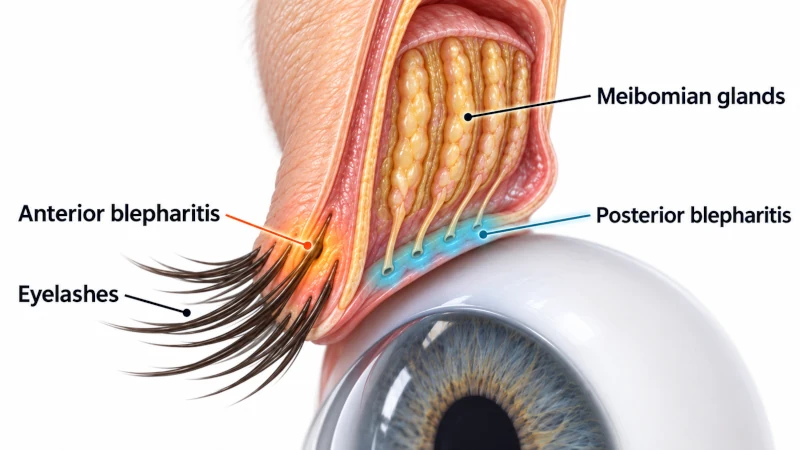
Doctors sort blepharitis by where on the lid margin the inflammation sits [AAO, 2023] [NEI, 2024].
| Anterior blepharitis | Posterior blepharitis | |
| Where | Outer front edge of the lid: the skin, lash base, and lash follicles | Inner edge that touches the eye, where the meibomian (oil) glands open |
| Usual drivers | Skin bacteria (staphylococcal type) or dandruff-like scaling (seborrheic type) | Clogged or poorly working oil glands, often alongside rosacea or seborrheic dermatitis |
| What you may see | Hard, matted crusts or collars around lash bases, or greasy flakes | Foamy tears, thickened lid edges, plugged gland openings |
| Linked problems | Styes; lash loss or misdirected lashes in severe staphylococcal cases | Chalazia (sometimes several), dry eye |
Sources: AAO Blepharitis Preferred Practice Pattern, 2023; NEI, 2024; American Optometric Association.
The categories overlap. You can have one type or both at the same time, and the symptoms are nearly identical, which is one reason an exam is useful [NEI, 2024] [AAO, 2023].
Where meibomian gland dysfunction fits in
Each eyelid holds a row of tiny meibomian glands whose oil slows tear evaporation. In meibomian gland dysfunction (MGD), the gland openings become blocked or the oil changes in amount or quality, ranging from cloudy fluid to a thick, paste-like material [AAO, 2023]. When less normal oil reaches the eye, the tear film can become unstable and evaporate faster, and MGD is considered the most common cause of evaporative dry eye [AAO, 2023].
Blepharitis symptoms
Symptoms range from a mild itch to daily discomfort. The most common include [NEI, 2024] [MedlinePlus, 2024]:
- Crusting and scales at the base of the lashes, often described as dandruff-like flakes
- Crusty lashes or lids stuck together when you wake up
- Burning or stinging
- Itching of the lids or eyes
- A foreign-body sensation, the feeling of sand or dust in the eye when you blink
- Red, swollen lid edges and redness of the eye
- Watery eyes, or tears that look foamy or bubbly
- Sensitivity to light and dry-eye discomfort
Long-standing or severe blepharitis can make lashes fall out or grow in the wrong direction, and in severe cases it can harm the cornea, the clear front surface of the eye [NEI, 2024].
Why mornings are often worst
Symptoms that are worse when you wake up are typical of blepharitis, whereas symptoms that build later in the day point more toward dry eye from low tear production [AAO, 2023].
Blurry vision that comes and goes
Blurred or fluctuating vision is a recognized blepharitis symptom [AAO, 2023], often because oil and flakes build up in the tear film [NEI, 2024]. Blur that doesn’t clear, or any sudden change in vision, needs prompt medical attention rather than home care [MedlinePlus, 2025].
What causes blepharitis?
The exact cause isn’t fully known; several factors usually combine [MedlinePlus, 2024].
Bacteria. Bacteria normally live on eyelid skin. In blepharitis, there tend to be too many at the base of the lashes [NEI, 2024]. Staphylococcus species, including S. aureus, are linked with the crusting, staphylococcal form, although exactly how they drive inflammation is still poorly understood [AAO, 2023].
Seborrheic dermatitis. This condition, which causes greasy, flaky skin on the scalp and face, is closely tied to the seborrheic form of blepharitis: in one study of people with chronic blepharitis, 95% of those with seborrheic blepharitis also had seborrheic dermatitis [AAO, 2023]. Dandruff and oily skin raise your risk [NEI, 2024].
Rosacea. Rosacea causes facial flushing, redness, bumps, and small visible blood vessels, and it is frequently found in people with MGD [AAO, 2023]. It is often overlooked, especially when signs are mild or on darker skin tones [AAO, 2023].
Demodex mites. Demodex are microscopic mites that live in hair follicles, including eyelash follicles. They have been found in 30% to 68% of people with chronic blepharitis, but also in many people without it, so finding mites doesn’t automatically make them the cause [AAO, 2023]. A telltale sign is cylindrical dandruff, waxy sleeves wrapped around the base of the lashes, and eye discomfort tends to be worse when more mites are present on each lash [AAO, 2023].
Other contributors. Allergies that affect the lashes can play a part [NEI, 2024]. Some medicines are linked to blepharitis, including isotretinoin, an oral acne medicine [AAO, 2023]. If you suspect a medicine, talk with the prescriber instead of stopping it on your own.
How blepharitis connects to dry eye and styes
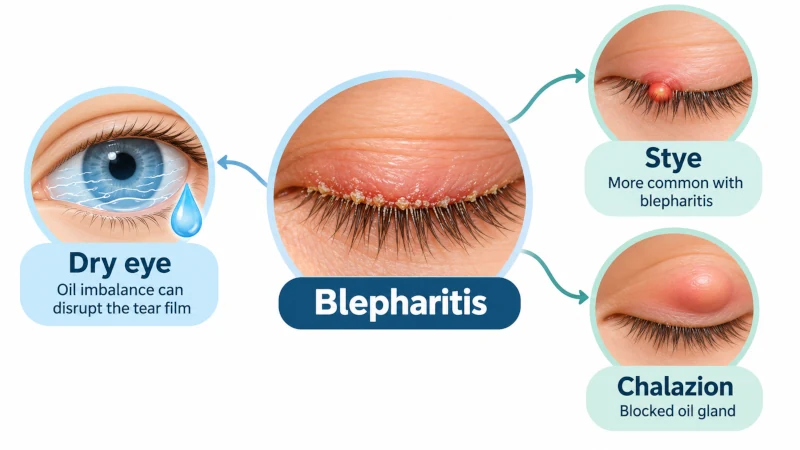
Blepharitis and dry eye often travel together, and a poorly working tear film can leave eyes feeling dry or oddly watery [NEI, 2024]. Dry eye has been reported in about half of people with staphylococcal blepharitis, and 25% to 40% of people with seborrheic blepharitis or MGD also make too little watery tear fluid [AAO, 2023]. If dryness is a large part of your symptoms, our guide to dry eye syndrome causes, symptoms, and relief covers the tear side of the problem.
Styes and chalazia are also more common in people with blepharitis [MedlinePlus, 2024]. A stye is a red, painful bump on the lid, while a chalazion is a hard, usually painless lump from a blocked oil gland, often left behind by a stye that doesn’t go away [NEI, 2024]. A history of repeated styes or chalazia is common in posterior blepharitis [AAO, 2023]. Our guide to telling a stye from a chalazion covers home care for those bumps.
How blepharitis is diagnosed
There is no single lab test for blepharitis. An optometrist or ophthalmologist diagnoses it with an eye exam, looking closely at your lids, lashes, and gland openings under bright light and magnification [NEI, 2024] [American Optometric Association]. Expect questions about timing of symptoms, one or both eyes, skin conditions, contact lenses, and medicines [AAO, 2023].
Your eye doctor may press gently on the lids to check the gland oil or examine a removed lash for Demodex under a microscope [AAO, 2023]. The exam also separates blepharitis from conditions that can look similar, including allergic and infectious eyelid problems and, rarely, eyelid cancers [AAO, 2023]. Our eye and vision health guides cover several other causes of red, irritated eyes.
Blepharitis eyelid care at home: a safe daily routine
Lid hygiene is the foundation of treatment. A Cochrane review of clinical trials found that lid hygiene, including warm compresses and lid scrubs, can relieve symptoms of both anterior and posterior blepharitis [Cochrane review, 2012]. Consistency matters more than force, because symptoms often return when people stop [AAO, 2023].
Step 1: Warm compresses
Warmth softens crusts and scales and warms thickened gland oil so it flows more easily. Compresses are especially helpful for posterior blepharitis and MGD [AAO, 2023].
- Wash your hands.
- Soak a clean washcloth in warm water and wring it out, or use an over-the-counter heat pack [AAO, 2023].
- Close your eyes and hold the warm cloth over your lids for several minutes, rewarming it as it cools.
- Repeat once or twice a day, at whatever time is easiest to stick with [AAO, 2023].
MedlinePlus suggests about 5 minutes at least twice a day [MedlinePlus, 2024]. Whatever schedule you choose, the compress should feel comfortably warm, never hot enough to burn the thin eyelid skin [AAO, 2023].
Step 2: Clean the lid margins gently
Right after the compress, clean along the lash line to remove crusts and excess oil. The National Eye Institute recommends this routine [NEI, 2024]:
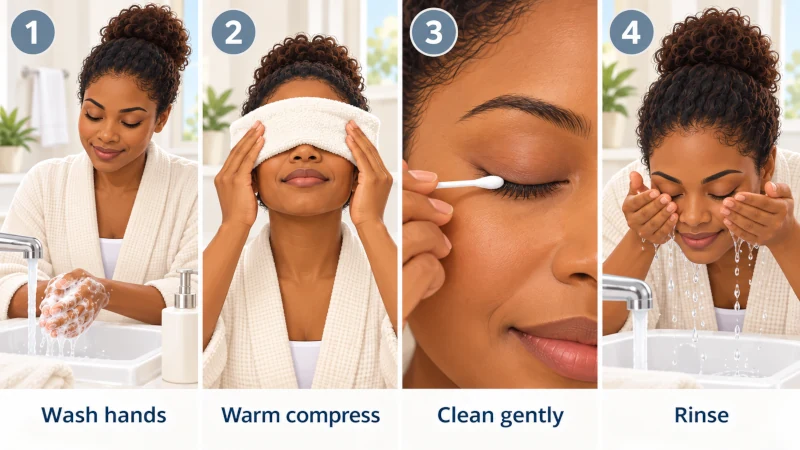
- Wash your hands with soap and water.
- Mix warm water with a small amount of a gentle cleanser, such as baby shampoo.
- Dip a clean, soft cloth or cotton swab into the mixture.
- With your eye closed, gently rub back and forth where the lashes meet the lid.
- Rinse with clean water.
- Repeat on the other eye with a fresh cloth or swab.
Over-the-counter eyelid cleansers and wipes are an alternative to diluted baby shampoo, including cleansers with 0.01% hypochlorous acid, which has antimicrobial activity [AAO, 2023]. No option has proven better than the others [AAO, 2023].
Gentle means gentle. Frequent manipulation of the eyelids can irritate them [AAO, 2023]. If you have posterior blepharitis, your eye doctor may show you a light massage to help express oil from the glands. People with advanced glaucoma, or who have had glaucoma surgery, should avoid pressing hard on the lids because it can raise eye pressure [AAO, 2023]
Step 3: Artificial tears, when they help
Lubricating eye drops (artificial tears) can ease grittiness alongside lid care, because many people with blepharitis have an unstable tear film. Oil- or lipid-based drops can be helpful for posterior blepharitis. If you use drops more than four times a day, choose a preservative-free formula [AAO, 2023].
Use only sterile products made for the eye, keep the bottle tip from touching your eye, fingers, or any surface, and stop using drops if you develop pain, discharge, or vision changes. Several over-the-counter eye drops have been recalled for contamination [FDA, 2026].
Everyday habits that help
- Use an anti-dandruff shampoo on your scalp if you have dandruff [AOA].
- Limit or skip eye makeup during treatment, since it makes lid cleaning harder [AOA].
- Consider pausing contact lenses while you’re being treated [AOA].
- Get rosacea or seborrheic dermatitis treated; controlling the skin condition helps the eyelids [NEI, 2024].
- Try not to rub your eyes. Rubbing irritated lids can lead to a secondary infection [AOA].
What not to put on your eyelids
Anything applied to the lid margin can end up in the eye, and the FDA notes that anything used in the eye must be sterile because the eye bypasses some of the body’s natural defenses [FDA, 2026]. Skip these:
- Essential oils, including tea tree oil you dilute yourself. Eye doctors sometimes use tea tree oil products for Demodex, but a Cochrane review found the benefit uncertain and reported eye irritation in some users [Cochrane review, 2020]. A strong 50% solution caused a corneal injury in one reported case [AAO, 2023].
- Homemade eye drops or eyewashes, including salt water, herbal teas, and honey, which can cause burning [FDA, 2026].
- Hydrogen peroxide, rubbing alcohol, or household antiseptics. These are not made for use on the eyelid margin.
- Aggressive scrubbing, rough cloths, or picking off crusts. Soften crusts with warmth and wipe gently.
- Leftover prescription drops, especially steroid or antibiotic drops prescribed for a past problem or for someone else.
What about omega-3 supplements?
The evidence conflicts. One year-long blepharitis study reported benefits, while a large NIH-funded dry eye trial found 3,000 mg of omega-3s daily worked no better than an olive oil placebo [AAO, 2023]. Ask your eye doctor or pharmacist before adding a supplement. For other low-risk comfort measures, see our overview of natural remedies for eye problems.
Medical treatment for blepharitis
If symptoms get worse or don’t improve after several days of careful lid cleaning, see an eye care professional [MedlinePlus, 2024]. Prescription treatments are usually combined with continued lid care [AAO, 2023].
Antibiotics
For anterior blepharitis, an eye doctor may prescribe an antibiotic ointment such as bacitracin or erythromycin to apply to the lid margins for a few weeks [AAO, 2023]. In clinical trials, topical antibiotics provided some symptom relief and cleared bacteria from the lid margins [Cochrane review, 2012].
For posterior blepharitis that lid care doesn’t control, oral antibiotics in the tetracycline family, such as doxycycline, may be used, partly for their anti-inflammatory effects [AAO, 2023]. The evidence is thin. A Cochrane review found only two trials, with 220 adults, and concluded there wasn’t enough evidence to draw meaningful conclusions; doxycycline may improve some clinical signs but caused more side effects than placebo [Cochrane review, 2021].
Tetracyclines are not used during pregnancy, while breastfeeding, or in children under 8. They can increase sunburn risk, make birth control pills less effective, and strengthen the effect of the blood thinner warfarin [AAO, 2023]. Oral azithromycin is an alternative, but it may cause dangerous heart-rhythm problems in people with cardiovascular disease [AAO, 2023]. Tell your doctor about heart conditions and all your medicines.
Anti-inflammatory treatments
A brief course of corticosteroid (steroid) eye drops or ointment can calm significant lid or eye-surface inflammation. Steroids can raise eye pressure and contribute to cataracts, so eye doctors use the lowest effective dose, avoid long-term use when possible, and typically recheck you within a few weeks [AAO, 2023]. Cyclosporine drops, which modulate the immune response, may help some people with posterior blepharitis [AAO, 2023].
Treatment for Demodex blepharitis
In 2023 the FDA approved lotilaner ophthalmic solution 0.25% (Xdemvy) for Demodex blepharitis. It targets a mite-selective nerve channel and is used as one drop in each eye twice a day for six weeks [FDA prescribing information, 2023]. It was evaluated in two six-week trials with 833 adults [FDA, 2023]:
| Result at day 43 | Saturn-1: lotilaner vs. inactive drop | Saturn-2: lotilaner vs. inactive drop |
| Upper-lid collarettes reduced to 2 or fewer | 44% vs. 7% | 55% vs. 12% |
| Mites eradicated from lashes | 68% vs. 17% | 50% vs. 14% |
| Eyelid redness fully cleared | 19% vs. 7% | 30% vs. 9% |
Source: FDA prescribing information for Xdemvy (lotilaner ophthalmic solution) 0.25%, 2023.
Stinging or burning when the drop goes in affected about 10% of users. Contact lenses should come out before each dose and can go back in after 15 minutes. Safety and effectiveness haven’t been established for people under 18, and there are no data on use during pregnancy [FDA, 2023].
Other approaches an eye doctor may consider for mites include clinician-directed tea tree oil treatment and ivermectin, though the evidence behind these is weaker [AAO, 2023] [Cochrane review, 2020].
In-office procedures
Some clinics offer thermal pulsation (devices that heat and press the lids), intense pulsed light (IPL), or microblepharoexfoliation (lid-margin cleaning with a spinning sponge). Some studies show benefit, but much of the research is industry-sponsored, and independent randomized trials are lacking [AAO, 2023]. These treatments are often not covered by insurance, and IPL needs extra caution on darker skin because of the risk of burns and pigment changes [AAO, 2023].
Does blepharitis go away?
Usually not completely. Blepharitis is typically a chronic condition that can’t be permanently cured, but steady daily care can improve symptoms considerably [AAO, 2023]. A Cochrane review of 34 trials with 2,169 participants found no strong evidence that any treatment cures chronic blepharitis [Cochrane review, 2012].
Treat it like dandruff: something you manage rather than finish. Once things settle, regular lid cleaning, daily or several times a week, often keeps symptoms muted [AAO, 2023].
When to see an eye doctor
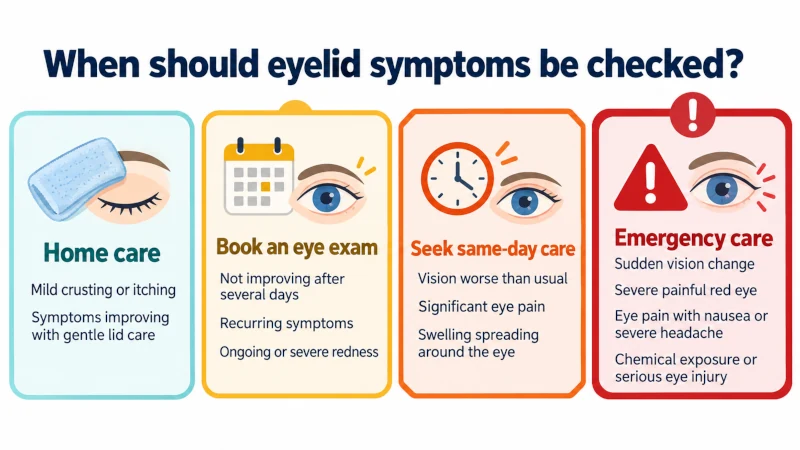
Make an appointment with an optometrist or ophthalmologist, or start with your primary care clinician, if:
- Symptoms get worse or don’t improve after several days of careful lid cleaning [MedlinePlus, 2024].
- Redness is severe or never fully clears [AAO, 2023].
- You have moderate or severe eye pain [AAO, 2023].
- Flare-ups keep coming back, or home care isn’t working [AAO, 2023].
Call your eye doctor the same day, or go to urgent care if you can’t reach them, if your vision is worse than usual or swelling spreads into the tissue around the eye [AAO, 2023].
Red flags that suggest something other than routine blepharitis
Rarely, eyelid cancer or an immune-related disease mimics blepharitis. A closer look, sometimes including a biopsy, is warranted when [AAO, 2023]:
- Symptoms affect only one eye and don’t respond to treatment, especially in an older adult
- Lashes fall out in one spot
- A chalazion keeps returning in the same place
- You notice a lump, an open sore, scarring, or a change in the normal shape of the lid edge
- Inflammation of the eye’s lining persists despite treatment
These signs are uncommon, but early diagnosis matters: it can prevent vision loss and disfigurement and may be lifesaving [AAO, 2023]. See an ophthalmologist promptly.
When to get emergency care
Go to the ER, or call 911 if you can’t get there safely, for any of the following [MedlinePlus, 2025]:
- A painful red eye
- Any sudden change in vision, such as blurred or double vision
- Eye pain with nausea or headache
- A chemical in the eye. Flush it with a gentle stream of cool tap water for 15 minutes, then get help right away.
- A scratch, cut, or object that has entered the eye
| Health Disclaimer: This article is for general education and is not a substitute for medical advice, diagnosis, or treatment. Only an eye examination can confirm blepharitis or rule out something more serious. Do not start, stop, or change any prescription medicine or eye drop based on this article, and never put homemade preparations, essential oils, or non-sterile products in or around your eyes. Seek urgent care for eye pain, a sudden change in vision, an eye injury, or chemical exposure. |
Frequently Asked Questions
What causes blepharitis?
Usually a combination of factors: too many bacteria at the base of the lashes, clogged or poorly working eyelid oil glands, and skin conditions such as seborrheic dermatitis (dandruff) and rosacea [NEI, 2024]. Demodex eyelash mites play a role in some people [MedlinePlus, 2024].
Is blepharitis contagious?
No. Blepharitis isn’t contagious [NEI, 2024]. It reflects how your own eyelids, skin, and oil glands are behaving, not an infection you caught from someone else.
Can blepharitis cause dry eyes?
Yes. Oil and flakes from inflamed lids can build up in the tear film and make your eyes feel dry or watery [NEI, 2024]. Meibomian gland dysfunction, which underlies posterior blepharitis, is considered the most common cause of evaporative dry eye [AAO, 2023].
How should eyelids be cleaned with blepharitis?
Apply a warm compress for a few minutes, then gently rub along the lash line with a clean cloth or cotton swab dipped in warm water mixed with a little baby shampoo, rinse, and use a fresh cloth for the other eye [NEI, 2024]. A commercial eyelid cleanser is a reasonable alternative. Skip essential oils, hydrogen peroxide, homemade drops, and hard scrubbing.
Does blepharitis go away?
It usually doesn’t go away completely. It is typically a chronic condition that can’t be permanently cured, but regular lid care can keep symptoms under good control [AAO, 2023]. It may come back even after successful treatment [AOA].
Can blepharitis cause styes?
Styes and chalazia are more common in people with blepharitis [MedlinePlus, 2024], and repeated ones are especially common with posterior blepharitis [AAO, 2023]. Keeping the lid margins clean is part of managing both.
References
- Lin A, Ahmad S, Amescua G, Cheung AY, Choi DS, Jhanji V, Mian SI, Rhee MK, Viriya ET, Mah FS, Varu DM; American Academy of Ophthalmology Preferred Practice Pattern Cornea/External Disease Committee. Blepharitis Preferred Practice Pattern® (Blepharitis PPP 2023). View full PDF
- National Eye Institute, National Institutes of Health. Blepharitis. View source
- MedlinePlus Medical Encyclopedia (National Library of Medicine; A.D.A.M.). Blepharitis. View source
- MedlinePlus Medical Encyclopedia (National Library of Medicine; A.D.A.M.). Eye emergencies. View source
- American Optometric Association. Blepharitis. Healthy Eyes: Eye and Vision Conditions. View source
- U.S. Food and Drug Administration / Tarsus Pharmaceuticals. XDEMVY (lotilaner ophthalmic solution) 0.25% Prescribing Information. NDA 217603; initial U.S. View source
- U.S. Food and Drug Administration, Center for Drug Evaluation and Research. What You Should Know about Eye Drops. View source
- Lindsley K, Matsumura S, Hatef E, Akpek EK. Interventions for chronic blepharitis. Cochrane Database of Systematic Reviews. CD005556; DOI 10.1002/14651858.CD005556.pub2. View source
- Onghanseng N, Ng SM, Halim MS, Nguyen QD. Oral antibiotics for chronic blepharitis. Cochrane Database of Systematic Reviews. 2021, Issue 6. Art. No. CD013697; DOI 10.1002/14651858.CD013697.pub2. View source
- Savla K, Le JT, Pucker AD. Tea tree oil for Demodex blepharitis. Cochrane Database of Systematic Reviews. 2020;6(6):CD013333. DOI 10.1002/14651858.CD013333.pub2; PMID 32589270; PMCID PMC7388771. View source


