
The germander plant is a low, purple-flowered member of the mint family that European herbalists used for centuries as a bitter digestive tonic. Here’s what most articles about it leave out: wall germander (Teucrium chamaedrys) is a well-established cause of liver injury, including cases of liver failure and death [LiverTox, 2018]. It makes a handsome garden plant. As an herbal remedy, it isn’t safe, and you shouldn’t take it as a tea, tincture, or capsule.
That’s a real change from how germander used to be described, including in an earlier version of this page. Below you’ll find what the plant is, what it was traditionally used for, how the evidence stacks up, and what to watch for if you’ve already been taking it.
| Germander at a glance Botanical name: Teucrium chamaedrys (wall germander)Family: mint family (Lamiaceae); the genus has about 250 species [LiverTox, 2018]Other names: germandrée (French), camedrio (Spanish)Traditional uses: digestion, fever, gout, arthritis [LiverTox, 2018]Proven benefits in people: noneMain risk: liver injury, rated by NIH’s LiverTox as a well-established cause [LiverTox, 2018]Our advice: enjoy it in the garden; don’t take it as a tea, tincture, capsule, or powder |
What Is the Germander Plant?
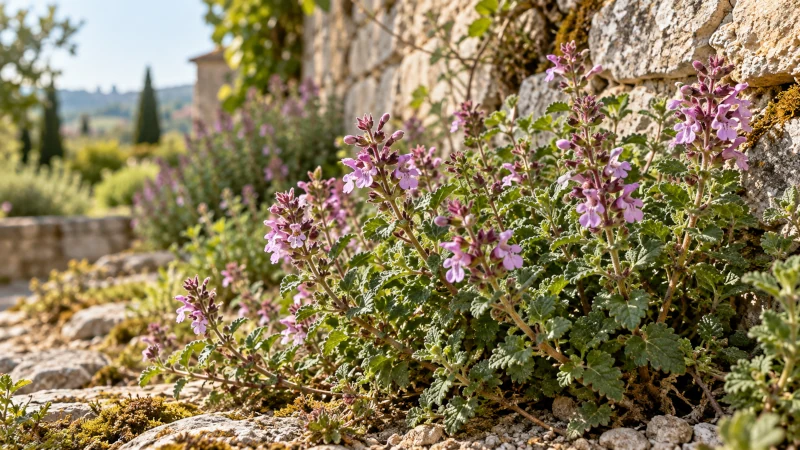
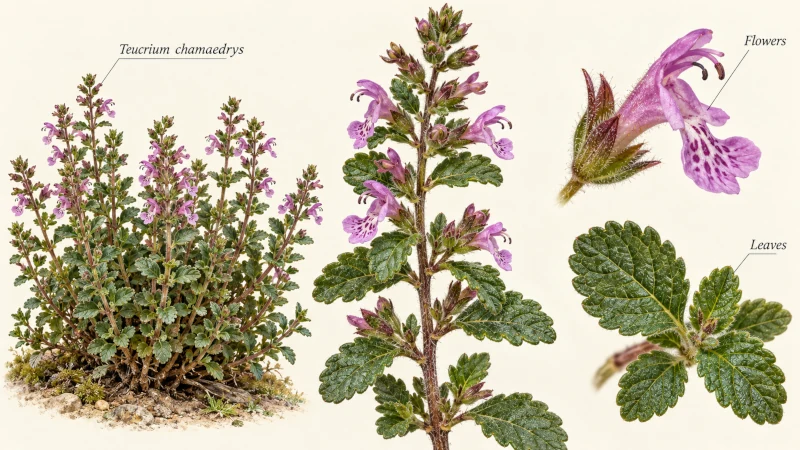
Wall germander is a small, shrubby perennial from Europe that likes dry, rocky, chalky ground, which is how it ended up growing out of old stone walls and earned its common name. It’s still widely planted in gardens for its flowers and its neat, compact shape [LiverTox, 2018].
The genus name, Teucrium, comes from teucrion, the classical name the Roman writer Pliny used for this plant [Lewis & Short]. Tradition links it to Teucer, a legendary king of Troy. Germander is one of roughly 250 Teucrium species [LiverTox, 2018], and a few relatives, such as golden or felty germander (T. polium) and cat thyme (T. marum), have medicinal histories of their own. They come up again below, because they share some of the same problems.
Traditional Uses of Germander
In European folk medicine, germander was taken for fever, arthritis, gout, and digestive complaints [LiverTox, 2018]. Its flowering tops were also used for indigestion, poor appetite, bronchitis, and wound healing [Nencini et al., 2014]. Herbalists classed it as one of the bitters, plants whose bitter taste was thought to wake up appetite and digestion, and as a cholagogue, something believed to help the gallbladder release bile.
Then the plant got a modern makeover. In the late 1980s, germander extract was packed into 600 mg capsules and sold in Europe as a weight-loss and cholesterol-lowering aid [LiverTox, 2018]. More people took more germander, more consistently, than ever before. That’s when the trouble started.
What the Evidence Actually Shows
Here’s how each claim holds up.
| Claim | What the evidence is | Grade |
| Aids digestion (bitter tonic) | Centuries of folk use. No clinical trials found. | Traditional only |
| Helps the gallbladder release bile | A traditional herbalist classification. No human studies located. | Traditional only |
| Weight loss | Sold for it in the 1980s. LiverTox notes little evidence it causes weight loss [LiverTox, 2018]. | Insufficient |
| Diabetes, inflammation, antioxidant effects | Lab and animal studies across the Teucrium genus; reviewers say clinical trials are still needed [Sadeghi et al., 2022]. | Lab / animal only |
| Liver injury | Dozens of human case reports, repeated relapse on re-exposure, and a mechanism shown in animals [LiverTox, 2018]. | Well established (harm) |
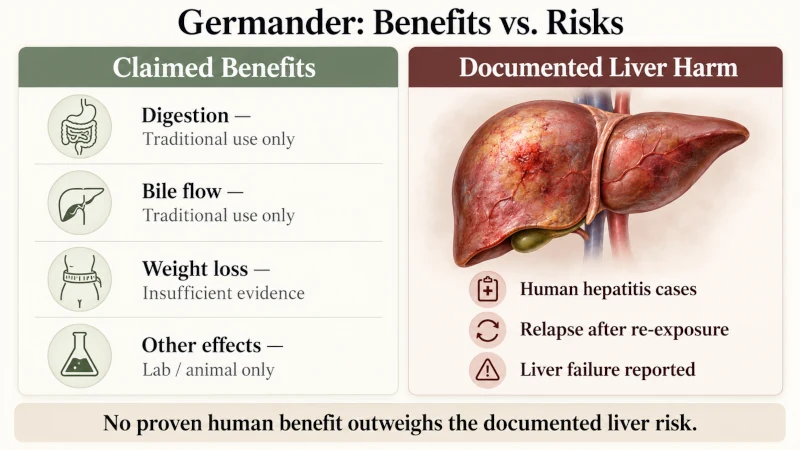
Notice the imbalance. Every claimed benefit rests on tradition or test tubes. The harm rests on real patients, repeated case series, and a clear biological explanation. LiverTox even points out the irony that Teucrium extracts have shown antioxidant, liver-protective effects in some animal models [LiverTox, 2018]. None of that has turned into a safe, proven use in people.
Germander Plant and Liver Damage: What Happened in France
Germander weight-loss products went on sale in France around 1986 [LiverTox, 2018]. By 1992, French doctors were publishing a run of hepatitis cases in people taking them. A national pharmacovigilance review gathered 26 patients, 25 of them women, who developed acute hepatitis while using germander capsules or tea, mostly for weight loss [LiverTox, 2018]. A separate report of seven carefully investigated patients found jaundice and steep rises in liver enzymes 3 to 18 weeks after they started germander [Larrey et al., 1992].
Most people recovered once they stopped. In that seven-patient series, jaundice cleared within eight weeks and full recovery took 1.5 to 6 months [Larrey et al., 1992]. Not everyone was so lucky. LiverTox documents acute liver failure, liver transplantation, and deaths, along with a slower pattern of chronic hepatitis and cirrhosis in people who kept taking germander for many months [LiverTox, 2018].
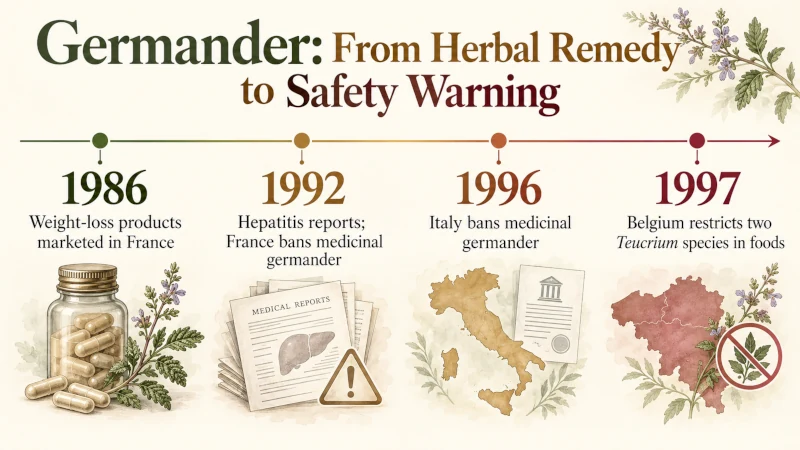
What convinced doctors the herb was responsible was what happened on re-exposure. In the French registry, 12 of the 26 patients had hepatitis return after taking germander again [LiverTox, 2018]. France banned germander as an herbal medicine in 1992. Italy followed in 1996, and Belgium banned T. chamaedrys and T. polium in foods in 1997 [EU Scientific Committee on Food, 2003]. Doctors in Canada soon reported the same pattern, including a patient whose hepatitis came back after restarting [Laliberté & Villeneuve, 1996].
What germander liver injury typically looks like
| Feature | What was reported |
| Time to symptoms | Usually 2 to 18 weeks after starting (about 9 on average) [LiverTox, 2018] |
| Typical symptoms | Fatigue, nausea, then jaundice, resembling viral hepatitis [LiverTox, 2018] |
| Recovery after stopping | Usually weeks to a few months; full recovery in 1.5 to 6 months in one series [Larrey et al., 1992] |
| Serious outcomes | Acute liver failure, liver transplant, and death in a minority; chronic hepatitis and cirrhosis with long-term use [LiverTox, 2018] |
| Restarting germander | Hepatitis often returned, and faster [LiverTox, 2018] |
Why germander damages the liver
The problem compounds are furan-containing neo-clerodane diterpenoids, the most abundant of which is teucrin A. On their own, they’re not the issue. Your liver’s cytochrome P450 enzymes, especially one called CYP3A, convert them into reactive metabolites (probably epoxides) that latch onto liver-cell proteins and use up glutathione, one of the liver’s main protective molecules [EU Scientific Committee on Food, 2003].
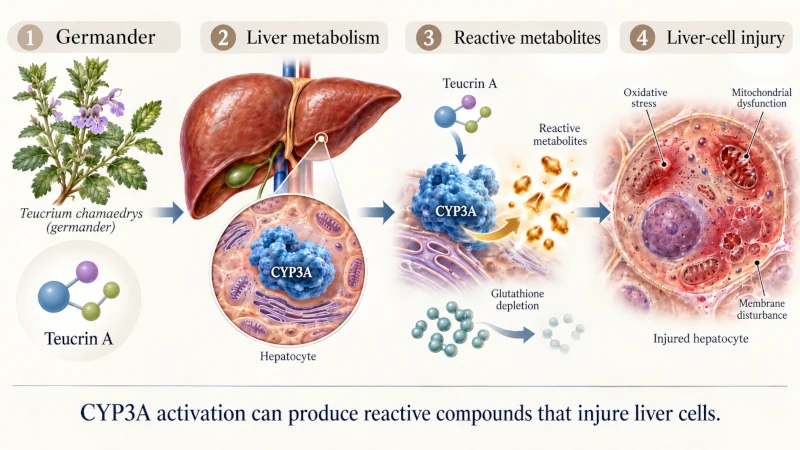
Animal experiments back this up. In mice, blocking CYP3A prevented germander’s liver damage, while drugs that ramp up CYP3A made it worse [EU Scientific Committee on Food, 2003]. The immune system may pile on, too. Some patients developed antibodies against a liver enzyme altered by teucrin A, which may explain why a second exposure can trigger such a fast relapse [EU Scientific Committee on Food, 2003].
Is germander tea safer than capsules?
No. Since commercial extracts were banned, LiverTox reports that most recent cases have come from tea brewed with locally gathered germander [LiverTox, 2018]. In Italy, a couple developed hepatitis from a homemade decoction of wild germander, recovered, and then relapsed when they started drinking it again [Nencini et al., 2014].
The amounts involved weren’t extreme, either. European food-safety scientists calculated that capsules supplying about 2 mg of teucrin A a day, roughly 0.03 mg per kilogram of body weight, were enough to cause hepatitis within nine weeks [EU Scientific Committee on Food, 2003]. Teucrin A levels also vary a lot from one preparation to the next [EU Scientific Committee on Food, 2003], so there’s no way to brew a cup at home and know you’re below a risky amount.
Golden Germander, Cat Thyme, and Skullcap Mix-Ups
Wall germander isn’t the only Teucrium with this problem. LiverTox lists golden germander (T. polium), T. capitatum, and T. viscidum as causes of similar liver injury, including a woman who needed a liver transplant after drinking T. polium tea [LiverTox, 2018]. T. polium is still a popular folk remedy around the Mediterranean and Middle East. In one Turkish case series, three women developed severe hepatitis after taking it in late pregnancy or after giving birth, to boost breast milk and ease indigestion. All three recovered within about three months of stopping [Dağ et al., 2014].
Cat thyme (T. marum), sometimes sold as marum germander, is another Teucrium species with a history of medicinal use [USDA Dr. Duke’s Databases]. An earlier version of this article recommended it as a tonic for low blood pressure and fainting, at up to five cups a day. We’ve taken that advice down. We couldn’t find clinical evidence for it, we found no published safety data on drinking it regularly, and it belongs to a genus with a documented liver-toxicity record. Low blood pressure or fainting spells deserve a medical evaluation, not an herbal tea.
Germander can also turn up where you don’t expect it. American skullcap (Scutellaria lateriflora), a popular calming herb, has at times been adulterated with germander species, and researchers have developed chemical tests specifically to tell the two apart [Lin et al., 2009]. Mayo Clinic lists skullcap among herbal products linked to acute liver failure [Mayo Clinic, 2024]. If you buy skullcap, choose a brand that names the botanical species on the label and uses third-party identity testing.
Germander in Liqueurs and Vermouth
If germander is this risky, why is it legal anywhere? In the United States, federal food rules allow wall germander and golden germander as natural flavorings in alcoholic beverages only [21 CFR 172.510]. In Europe, alcohol-based germander extracts have been used to flavor vermouths, bitters, and liqueurs.
European regulators weren’t entirely comfortable with that. The EU’s Scientific Committee on Food estimated that heavy drinkers of these beverages could take in teucrin A at levels only about six times lower than the dose that caused hepatitis in capsules. It concluded that germander use shouldn’t spread beyond flavored alcoholic drinks [EU Scientific Committee on Food, 2003]. And alcohol is one of the clearest drivers of liver damage in its own right, so a germander-flavored liqueur is no route to any health benefit.
Safer Ways to Get What People Wanted From Germander
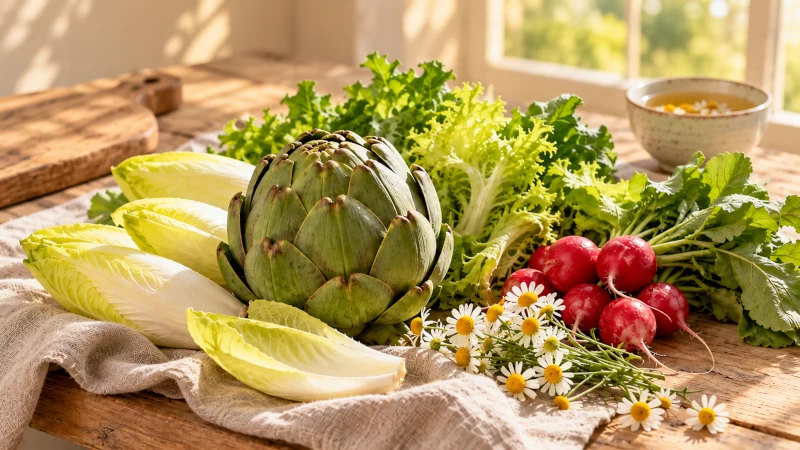
Most people reached for germander for one of three reasons: easier digestion, weight loss, or general liver and gallbladder support. Each has a safer path.
- For sluggish digestion: bitter foods such as endive, escarole, artichoke, and radishes have long been used to encourage bile flow. The evidence for them is mostly traditional too, but they’re foods, not hepatotoxins. Our guide to gallbladder-friendly foods covers several.
- For bloating and mild stomach upset: European regulators recognize chamomile flower tea for minor digestive complaints such as bloating, as we explain in our nervine tea guide.
- For weight: germander’s own history is the cautionary tale. It was sold for weight loss, there’s little evidence it worked, and it hurt people’s livers [LiverTox, 2018]. Talk with your doctor about approaches with real evidence behind them.
- For liver health: everyday eating patterns have far better support than any herbal cleanse. See our evidence-graded list of the best foods for the liver.
If you’re drawn to other traditional bitter herbs, check each one’s cautions before you brew. Mugwort tea, for example, comes with its own pregnancy and allergy warnings.
Germander Safety: Side Effects, Interactions, and Who Should Avoid It
Side effects
The main side effect is the serious one: liver injury. It tends to look like viral hepatitis, with fatigue, nausea, and loss of appetite, followed by yellowing of the skin and eyes [LiverTox, 2018]. Because it can surface weeks or months after starting, the connection to an herbal tea is easy to miss. Longer-term use has also been linked to a chronic hepatitis pattern, sometimes with fever and joint pain, and in some people to cirrhosis [LiverTox, 2018].
Medication interactions
No clinical studies have tested germander alongside specific medicines, so any interaction risk is inferred from how it harms the liver. Two theoretical concerns come out of the animal research. Medicines or supplements that strongly speed up CYP3A enzymes could, in principle, increase production of germander’s toxic metabolites. Anything that depletes the liver’s glutathione could, in principle, make the injury worse [EU Scientific Committee on Food, 2003]. These are mechanism-based cautions, not documented human interactions. Your pharmacist can tell you whether any of your medicines affect CYP3A or the liver. The practical advice is simpler: if you take prescription medicine, don’t add germander.
Pregnancy and breastfeeding
Avoid germander and every other Teucrium species if you’re pregnant or breastfeeding. There’s no safety data to support using them, and the T. polium cases above involved women in late pregnancy and the weeks after birth, a time when normal liver changes may make injury more severe [Dağ et al., 2014]. The babies in that series were reported healthy, but their mothers had serious hepatitis.
Who should avoid germander
As an oral remedy, everyone. That goes double for:
- People with liver disease or abnormal liver tests
- Anyone pregnant, trying to conceive, or breastfeeding
- Children and teenagers
- People who drink alcohol heavily
- Anyone taking medicines that can affect the liver
- Anyone who has had a reaction to germander before, since re-exposure often brings hepatitis back faster [LiverTox, 2018]
When to get medical help
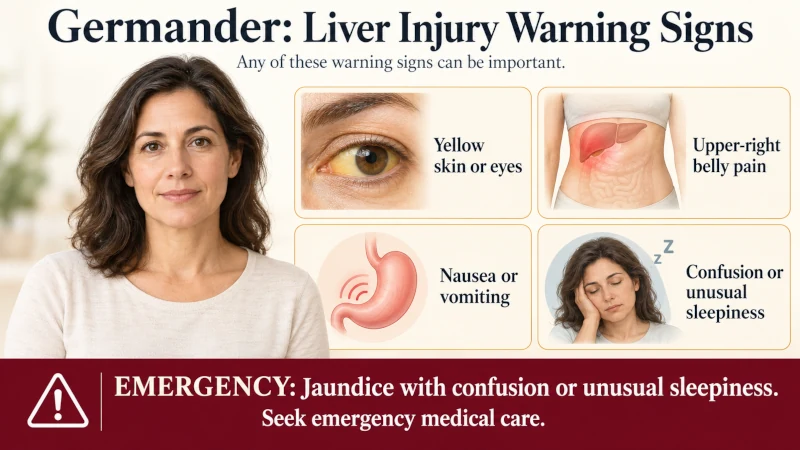
If you’ve been drinking germander tea or taking a product that might contain it, stop. Then contact a doctor promptly if you notice yellowing of your skin or eyes, pain or tenderness in the upper right belly, nausea or vomiting, or an unusual, lingering sense of feeling unwell [Mayo Clinic, 2024].
Get emergency care right away if jaundice comes with confusion, disorientation, unusual sleepiness, or any sudden change in behavior. These can be signs of acute liver failure, which is life-threatening [Mayo Clinic, 2024].
Whatever you do, tell your doctor about the herb. In the first published germander case, the patient didn’t mention it to her doctors, and she later restarted it and got sick again [LiverTox, 2018]. A blood test for liver enzymes is quick, and stopping germander for good is the most important part of recovery.
| HEALTH DISCLAIMER: This article is for general education only. It is not medical advice and doesn’t replace diagnosis or treatment from a qualified healthcare professional. Germander and related Teucrium species have been linked to serious liver injury, and nothing here should be read as guidance on how to use them safely. If you have taken germander or a blend that may contain it, or you’re pregnant, breastfeeding, taking medication, or living with a liver condition, talk to your doctor or pharmacist. If you have yellowing skin or eyes, confusion, or unusual sleepiness, seek medical care right away. See our full medical advice disclaimer. |
Frequently Asked Questions
Is germander tea safe to drink?
No. Germander tea by itself has caused hepatitis; the problem was never limited to concentrated capsules. Since commercial extracts were banned, most new cases have come from tea brewed with wild-gathered germander [LiverTox, 2018].
What is the germander plant used for?
Traditionally, it was used for digestion, fever, gout, and arthritis, and in the 1980s for weight loss [LiverTox, 2018]. None of those uses is supported by clinical trials. Today, its safest use is as an ornamental garden plant.
Is germander banned?
France banned it as an herbal medicine in 1992, Italy in 1996, and Belgium banned two Teucrium species in foods in 1997 [EU Scientific Committee on Food, 2003]. In the U.S., it’s permitted only as a flavoring in alcoholic beverages [21 CFR 172.510].
Is wall germander the same as cat thyme or skullcap?
No. Cat thyme (T. marum) is a different species in the same genus [USDA Dr. Duke’s Databases]. Skullcap is an unrelated plant, but some skullcap products have been adulterated with germander [Lin et al., 2009].
Can I grow germander in my garden?
Yes. It’s widely grown as an ornamental [LiverTox, 2018]. Just keep it out of the teapot, and don’t harvest wild plants to brew.
I’ve been taking germander. What should I do?
Stop taking it and call your doctor, who may check your liver enzymes. Get emergency care for jaundice with confusion or unusual sleepiness [Mayo Clinic, 2024]. Don’t restart it, even if you feel fine, because hepatitis often returns faster on re-exposure [LiverTox, 2018].
References
- LiverTox: Clinical and Research Information on Drug-Induced Liver Injury. Germander. Bethesda (MD): National Institute of Diabetes and Digestive and Kidney Diseases; View source
- Larrey D, Vial T, Pauwels A, et al. Hepatitis after germander (Teucrium chamaedrys) administration: another instance of herbal medicine hepatotoxicity. Ann Intern Med. View source
- Laliberté L, Villeneuve JP. Hepatitis after the use of germander, a herbal remedy. View source
- European Commission, Scientific Committee on Food. Opinion on Teucrin A, major component of hydroalcoholic extracts of Teucrium chamaedrys (wild germander). View source
- Nencini C, Galluzzi P, Pippi F, Menchiari A, Micheli L. Hepatotoxicity of Teucrium chamaedrys L. decoction: role of difference in the harvesting area and preparation method. Indian J Pharmacol. View source
- Dağ M, Özturk Z, Aydınlı M, Koruk I, Kadayıfçı A. Postpartum hepatotoxicity due to herbal medicine Teucrium polium. Ann Saudi Med. View source
- Lin LZ, Harnly JM, Upton R. Comparison of the phenolic component profiles of skullcap (Scutellaria lateriflora) and germander (Teucrium canadense and T. chamaedrys), a potentially hepatotoxic adulterant. View source
- Sadeghi Z, Yang JL, Venditti A, Moridi Farimani M. A review of the phytochemistry, ethnopharmacology and biological activities of Teucrium genus (Germander). View source
- U.S. Code of Federal Regulations. 21 CFR 172.510 — Natural flavoring substances and natural substances used in conjunction with flavors. View source
- U.S. Department of Agriculture, Agricultural Research Service. Dr. Duke’s Phytochemical and Ethnobotanical Databases: Teucrium marum (Lamiaceae). View source
- Lewis CT, Short C. A Latin Dictionary (entries: Teucer; teucrion). Online edition, alatius.com. View source
- Mayo Clinic Staff. Acute liver failure: symptoms and causes. Mayo Clinic; View source


