
The benefits of mugwort tea are talked about far more often than they are tested. Search for this bitter, sage-scented herb and you will find confident promises about vivid dreams, smoother periods, and calmer digestion. Most of those claims rest on centuries of folk use and a handful of laboratory studies, not on solid human trials. That does not make mugwort useless. It means the honest answer to “what does mugwort tea do?” is narrower, and the safety warnings sharper, than the wellness internet suggests.
Here is the short version. Mugwort (Artemisia vulgaris) has a long traditional record as a digestive bitter, a menstrual stimulant, and a sleep-and-dream herb. Major drug-information references agree there is no good clinical evidence that it treats any of those conditions [WebMD, 2024]. The clearer facts sit on the safety side: it can stimulate the uterus and is considered likely unsafe in pregnancy, it cross-reacts with ragweed and related allergies, and it contains thujone, a compound that is toxic in large amounts. The rest of this guide covers what is reasonable to expect, and who should skip it entirely.
What Is Mugwort?

Mugwort is a tall, hardy perennial in the daisy family (Asteraceae), the same family as sunflowers and dandelion. It grows wild across Europe, Asia, and North America, and you can usually recognize it by the silvery-white, slightly furry underside of its leaves and a scent somewhere between sage and chrysanthemum.
The plant has many cultural homes. In Korea it is ssuk; in Japan, yomogi — both used in rice cakes, soups, and teas. In traditional Chinese medicine the dried, aged leaf is processed into “moxa” and burned near the skin in a practice called moxibustion. In medieval Europe it flavored beer before hops took over, and it was carried as a protective charm.
Chemically, the leaf carries flavonoids, phenolic acids, and bitter sesquiterpene lactones, plus a volatile oil that contains thujone. Thujone is a neurotoxin at high doses but sits at very low levels in a properly brewed cup. Keep it in mind — it shapes the safety advice later on.
What the Evidence Says About the Benefits of Mugwort Tea

Strip away the folklore and here is where things stand. Most mugwort research is preclinical — test tubes and animals — or purely traditional. Human trials on the tea itself are close to nonexistent [Drugs.com, 2025]. So read the table below as “plausible and traditional,” not “proven.”
| What people claim | What the research actually is | How strong |
| Eases bloating and slow digestion | Traditional use as a bitter; bitter compounds can trigger saliva, stomach acid and bile. No human trials on the tea itself. | Traditional + plausible |
| Brings on or regulates periods | Long folk use as an emmenagogue (a substance that promotes menstrual flow). Consistent enough that the pregnancy warning is taken seriously. | Traditional; safety-relevant |
| Vivid dreams and better sleep | Personal reports plus mild sedative activity in animal studies. No controlled human trials. | Weak / anecdotal |
| Antioxidant and antimicrobial | Extracts and essential oil show activity in test tubes. Not shown to do the same from a cup of tea. | Lab only |
| Turning breech babies (via moxibustion, not tea) | A 2023 Cochrane review found moderate-certainty evidence that moxibustion plus usual care probably reduces breech presentations at birth. | Moderate (that use only) |
Digestion
The best-grounded traditional use is as a digestive bitter. Bitter herbs are thought to prompt saliva, stomach acid, and bile, which is why mugwort has long been taken before heavy or fatty meals [RxList, 2021]. Drug references list digestive complaints among its folk uses but rate the actual evidence as insufficient [WebMD, 2024]. If a small cup of something bitter settles your stomach, mugwort fits that pattern. It is not a treatment for a diagnosed digestive disorder.
Periods and Cramps
Mugwort is classified as an emmenagogue, a substance that promotes menstrual flow, and animal tissue studies point to a mild antispasmodic (muscle-relaxing) effect. Herbalists have used it for late or painful periods for a very long time. Here is the part most marketing skips: the property valued for menstrual support is the same one that makes mugwort dangerous in pregnancy. You cannot separate the two.
Sleep and Vivid Dreams
This is the claim driving most of mugwort’s current popularity, and it is the weakest. There are no controlled human trials showing that mugwort tea changes dreams. Animal studies suggest the essential oil has mild sedative activity, and plenty of people report strange, vivid dreams after a cup before bed — but expectation alone strongly shapes how we remember dreams. Mugwort is not a hallucinogen, and the effect, if any, varies a lot from person to person.
Antioxidant and Antimicrobial Activity
In the lab, Artemisia vulgaris extracts show antioxidant activity, and its essential oil can slow the growth of some bacteria and fungi. That is real, and it is interesting to researchers [Ekiert et al., 2021]. It also tells you almost nothing about a cup of tea. A compound that inhibits a microbe in a petri dish has not been shown to do anything similar once diluted, brewed, swallowed, and digested.
Beyond the Cup: Moxibustion and Smoking
Tea is only one way people use mugwort. Two others come up constantly, and they deserve straight answers. For a wider look at the plant’s traditional applications, see our overview of the broader uses of mugwort.
Moxibustion
In moxibustion, dried mugwort is burned near specific points on the body — not consumed. Its most studied use is encouraging a breech baby to turn before birth, by warming a point near the little toe. A 2023 Cochrane review found moderate-certainty evidence that moxibustion combined with usual care probably reduces the number of breech presentations at birth, while noting the trials are still limited [Cochrane, 2023]. If this interests you during pregnancy, it should be done with a trained practitioner and your maternity team, not as a DIY project.
Smoking Mugwort
Some people smoke dried mugwort for a faster calming or dream effect. The benefits here do not outweigh a basic fact: inhaling smoke from any burning plant pulls tar, fine particles, and carbon monoxide into your lungs, where it irritates tissue and, over time, causes damage. There is no nicotine, but “herbal” smoke is still smoke. We cover this in more detail in our piece on smoking mugwort.
Mugwort Tea Side Effects and Who Should Avoid It
No honest write-up of an herb stops at the upside. Mugwort is generally fine for most healthy adults in small amounts for short periods, but there are firm exceptions.
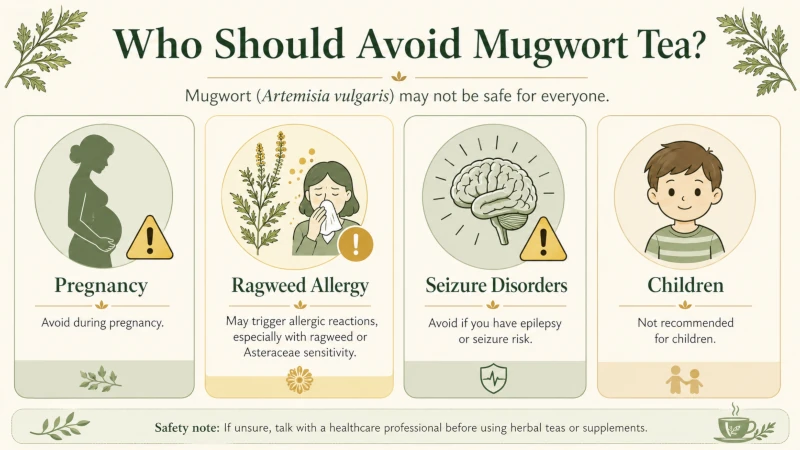
Pregnancy and Breastfeeding — the Most Important Warning
Do not use mugwort if you are pregnant, trying to conceive, or breastfeeding. Its uterus-stimulating, period-promoting action is considered likely unsafe in pregnancy and may raise the risk of miscarriage or early labor [WebMD, 2024]. Safety while breastfeeding has not been established, so the standard advice is to avoid it entirely [Drugs.com, 2025].
Allergic Reactions

Because mugwort is in the daisy family, people allergic to related plants react to it more often. It cross-reacts strongly with ragweed pollen, and it sits at the center of “celery–mugwort–spice syndrome,” which in some people can trigger reactions as severe as anaphylaxis [JACI, 2024]. Reactions can follow either skin contact or drinking the tea [Medical News Today, 2024]. Be cautious if you react to any of these:
- Ragweed, chrysanthemums, marigolds, or daisies
- Celery, carrot, or fennel
- Birch or other pollens that already bother you
Symptoms range from mild (itchy mouth, hives, sneezing) to severe (swelling, trouble breathing). Spice and pollen cross-reactions are common enough that allergy specialists treat them as a recognized pattern [AAAAI].
Thujone
Thujone is the compound once blamed for the myths around absinthe. It can cause seizures at high doses, shown in animal studies and a few human poisoning cases. The reassuring part: European regulators reviewed the evidence and concluded that everyday thujone exposure in the range of roughly 3 to 7 mg per day does not pose special concern, and a normal cup of mugwort tea sits well below problem levels [EMA/HMPC, 2012]. The real risk comes from concentrated mugwort essential oil, which should never be swallowed, and from heavy, prolonged use.
Medication Interactions and Other Cautions
Mugwort may add to the effect of sedatives and could matter for people taking anticonvulsants or with a seizure disorder, given thujone’s link to seizures [Drugs.com, 2025]. Reliable dosing data simply do not exist, so “start low” is more than a platitude here. If you take prescription medicine, clear it with a pharmacist first.
Who Should Avoid Mugwort
- Anyone pregnant, breastfeeding, or trying to conceive
- People allergic to ragweed or other daisy-family plants (chrysanthemum, marigold), or with celery/carrot/spice allergies
- People with a seizure disorder, or taking anticonvulsant or sedative medication
- Children, unless a clinician advises otherwise
- Anyone scheduled for surgery soon, or taking prescription medication — check with a clinician first
How to Make Mugwort Tea (and What to Realistically Expect)
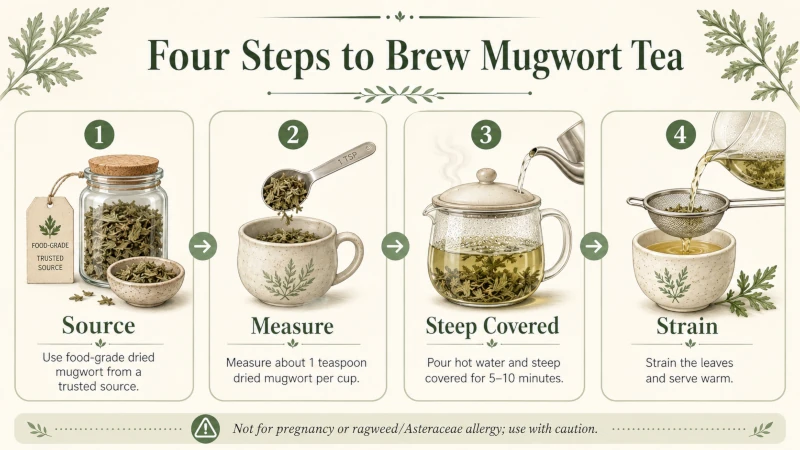
If you have checked that mugwort is safe for you, the tea is simple to make:
- Source it well. Buy organic dried mugwort leaf from a reputable supplier so you are not also drinking pesticide residue.
- Measure. Use about 1 to 2 teaspoons of dried leaf per 8 ounces (1 cup) of just-boiled water.
- Steep covered. Cover and steep 5 to 10 minutes — covering traps the volatile oils. Longer steeping turns it sharply bitter.
- Strain and adjust. Strain, then add a little honey or lemon if you want to soften the earthy, bitter taste.
Start with a small cup to see how you react. For dream use, people often drink it 30 to 60 minutes before bed. It is not meant for daily, long-term drinking. Realistic expectations matter: at best, mugwort is a gentle traditional aid that may take the edge off mild digestive discomfort or shift the texture of your dreams. It will not regulate a medical condition, and if a benefit shows up at all, expect it to be subtle.
When to Talk to a Healthcare Professional
Skip the tea and get medical help in these situations:
- Signs of a serious allergic reaction — swelling of the lips, tongue, or throat, or any trouble breathing. This is an emergency; call your local emergency number.
- You are pregnant or breastfeeding and have already taken mugwort — contact your provider.
- You are using mugwort to self-treat a real condition, or to replace a prescribed medicine — talk to your clinician before changing anything.
- Your symptoms (digestive, menstrual, or sleep) are new, worsening, or persistent — these deserve a proper diagnosis, not a home remedy.
A doctor, pharmacist, registered dietitian, or certified clinical herbalist can weigh mugwort against your history and current medications and tell you whether it is a reasonable fit.
| Health Disclaimer This article is for general education only and is not medical advice, diagnosis, or treatment. Mugwort is a dietary supplement, not a regulated medicine, and the information here does not cover every possible use, interaction, or risk. Nothing here is intended to diagnose, treat, cure, or prevent any disease. Talk with a doctor, pharmacist, registered dietitian, or qualified herbalist before using mugwort, especially if you are pregnant, breastfeeding, trying to conceive, taking prescription medication, or managing a health condition. If you have signs of a serious allergic reaction, stop and seek emergency care. You use any information here at your own risk. |
Frequently Asked Questions
Is mugwort tea safe to drink every day?
There is no good long-term safety data, and the thujone content argues against heavy, ongoing use. Occasional cups for most healthy, non-pregnant adults are generally considered low risk, but daily long-term use is not recommended.
Does mugwort tea really cause vivid dreams?
Some people report more vivid or memorable dreams; many notice nothing. The evidence is anecdotal, expectation plays a large role, and there are no controlled human trials. It is not a hallucinogen.
Can mugwort tea bring on a late period?
Mugwort has a traditional reputation as an emmenagogue, but its reliability is unproven. Critically, it must never be used to try to end a pregnancy — that is unsafe and ineffective. If your period is late, a clinician can help you understand why.
Who should not drink mugwort tea?
Anyone pregnant, breastfeeding, or trying to conceive; people allergic to ragweed or other daisy-family plants; people with seizure disorders or on sedative or anticonvulsant medication; and children unless advised by a clinician.
Is mugwort the same as wormwood?
They are relatives. Wormwood is Artemisia absinthium and contains much more thujone; mugwort is Artemisia vulgaris. Do not treat the two as interchangeable.
References
- WebMD (Therapeutic Research Center). Mugwort — Uses, Side Effects, and More. → View source
- Drugs.com (NatMed). Chinese Mugwort: Uses, Benefits & Dosage. 2025. → View source
- Medical News Today. Mugwort: Uses, benefits, and risks. 2024. → View source
- RxList. Mugwort Supplement. → View source
- American Academy of Allergy, Asthma & Immunology. Spice Allergy. → View source
- European Medicines Agency, HMPC. Public statement on the use of herbal medicinal products containing thujone (Revision 1). → View source
- Coyle ME, Smith CA, Peat B. Cephalic version by moxibustion for breech presentation. Cochrane Database of Systematic Reviews, 2023. → View source
- Journal of Allergy and Clinical Immunology. Role of Api g 7 in mugwort pollen–related celery allergy. 2024. → View source
- Ekiert H, et al. Artemisia vulgaris L.: phytochemistry and pharmacology (review). Plants, 2021. → View source
