
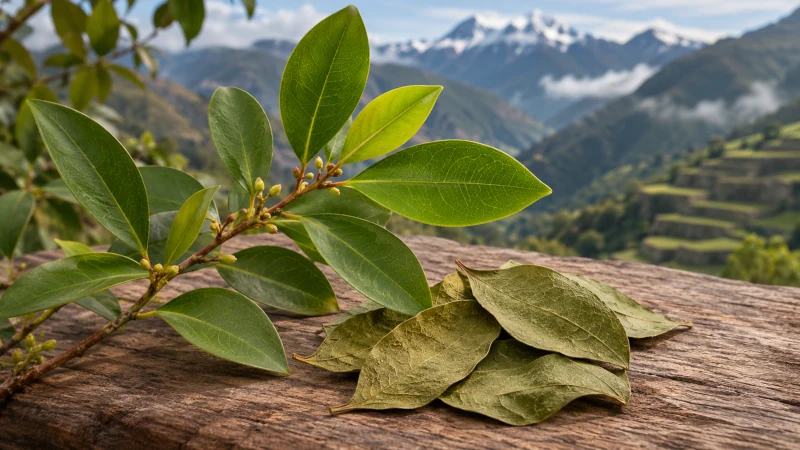
People in the Andes have chewed and brewed coca leaves for thousands of years, mostly to take the edge off fatigue, hunger and thin mountain air [Weil, 1978; Biondich & Joslin, 2016]. The same leaves are the raw material for cocaine. Both facts are true, and the useful answer sits between them. Coca plant leaves hold only a small amount of cocaine, about 0.6% of the dried leaf on average [Biondich & Joslin, 2016], so chewing them or sipping coca tea is a very different exposure from using the purified drug.
Different is not the same as harmless. Coca leaf products contain real cocaine, they can make a drug test come back positive, and in the United States they are a controlled substance. If you’re reading this before a trip to Cusco or La Paz, the short version is this: coca tea is part of daily life there, the evidence that it prevents altitude sickness is thin, and the strategy that works is a slow ascent.
Coca Leaves vs. Cocaine: Same Plant, Very Different Doses
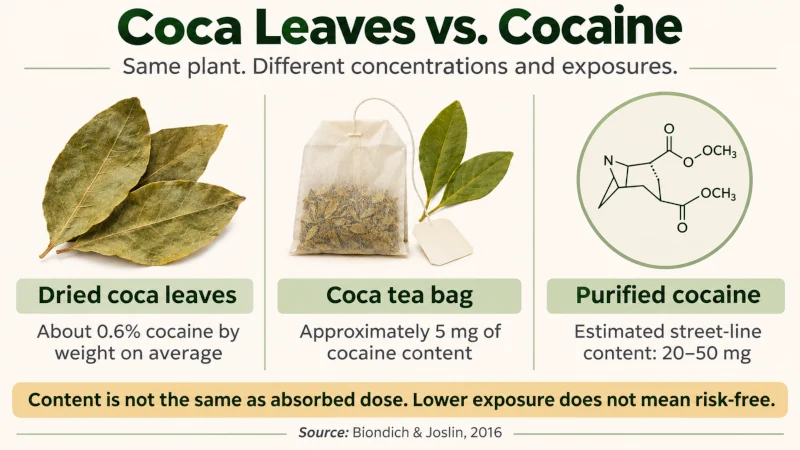
Cocaine is one of 18 alkaloids found across the cultivated coca varieties [Biondich & Joslin, 2016]. What separates a leaf from a line of powder is concentration and speed. A street “line” is estimated to hold 20–50 mg of cocaine hydrochloride. A coca tea bag holds roughly 5 mg when the leaf is fully extracted, and blood cocaine levels run almost 50 times higher after the purified drug than after chewing whole leaves [Biondich & Joslin, 2016].
That gap explains a recent official finding. After its first full review of coca leaf in more than 30 years, the World Health Organization’s Expert Committee on Drug Dependence concluded that traditional chewing and coca tea do not pose major public-health risks [WHO, 2025; WHO, 2026]. It still recommended keeping the leaf in Schedule I of the 1961 Single Convention on Narcotic Drugs, because cocaine can be easily and profitably extracted from it [WHO, 2025]. WHO also said evidence on dependence and long-term safety remains limited [WHO, 2025].
Purified cocaine is a different story. The National Institute on Drug Abuse describes it as an addictive stimulant; repeated use can bring tolerance, withdrawal symptoms and compulsive drug-seeking [NIDA, 2024].
How Coca Leaves Are Traditionally Used
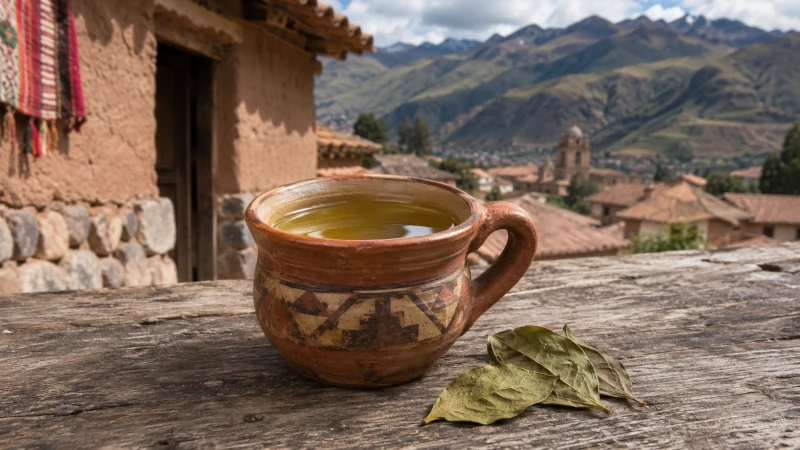
In Andean communities, dried leaves are chewed or held in the cheek, or steeped in hot water as tea, often called mate de coca. Use can be heavy: one large survey cited by Biondich and Joslin estimated that mine workers chew about 368 g of leaf a week [Biondich & Joslin, 2016]. Coca also carries deep cultural meaning, which WHO explicitly recognized for Indigenous Peoples in the Andean region [WHO, 2026].
Folk uses go well beyond energy. Coca tea is taken for stomach pain, cramping, nausea, indigestion, constipation and diarrhea, and leaves are held against toothaches and mouth sores [Biondich & Joslin, 2016]. These are long-standing practices. None of them has been tested in clinical trials.
Do Coca Plant Leaves Help With Altitude Sickness?
Nobody knows, and the evidence may never settle it.
CDC’s travel-medicine guidance says coca leaf, chewed or brewed, has been used for altitude illness, but no strong evidence shows that it works or that it causes harm [CDC, 2026a]. WebMD and RxList both list altitude sickness among the uses without enough scientific support [WebMD, n.d.; RxList, n.d.].
The most thorough review for travelers, by Irmgard Bauer of James Cook University, found no controlled studies, only traveler surveys [Bauer, 2019]. In one survey of 136 visitors to Peru and Bolivia, almost 90% had tried coca. Of those, 51% noticed no effect, 31% a desirable one and 19% an undesirable one [Bauer, 2019]. Surveys like this can’t separate coca from rest, excitement or the body adjusting on its own. Lab work is sparse and mostly done in people who already live at altitude: in 22 men at 3,800 m, chewing coca helped them sustain moderate work for an hour, while a separate study found no gain in maximal exercise capacity [Bauer, 2019].
Bauer argues coca deserves an informed hearing and accepts that scientific proof either way may never arrive [Bauer, 2019]. That is a fair position. It is not evidence that coca prevents altitude sickness. If you drink coca tea in the Andes, treat it as a local custom, not protection, and don’t let it talk you out of taking a headache seriously.
What actually prevents altitude sickness
The approach with real support is pacing your ascent. CDC advises against going from low elevation straight to a sleeping altitude of about 2,750 m (9,000 ft) in one day. Above 3,000 m (9,850 ft), raise your sleeping altitude by no more than about 500 m (1,600 ft) a day, and add a rest day for every extra 1,000 m [CDC, 2026b]. Skip alcohol and keep exercise light for the first 48 hours [CDC, 2026b].
Acetazolamide, a prescription medicine, speeds acclimatization and can prevent acute mountain sickness [CDC, 2026b]. If your itinerary forces a fast climb (flying straight into Cusco or La Paz, for example), ask a clinician before you go whether it suits you.
Warning signs that mean you should descend
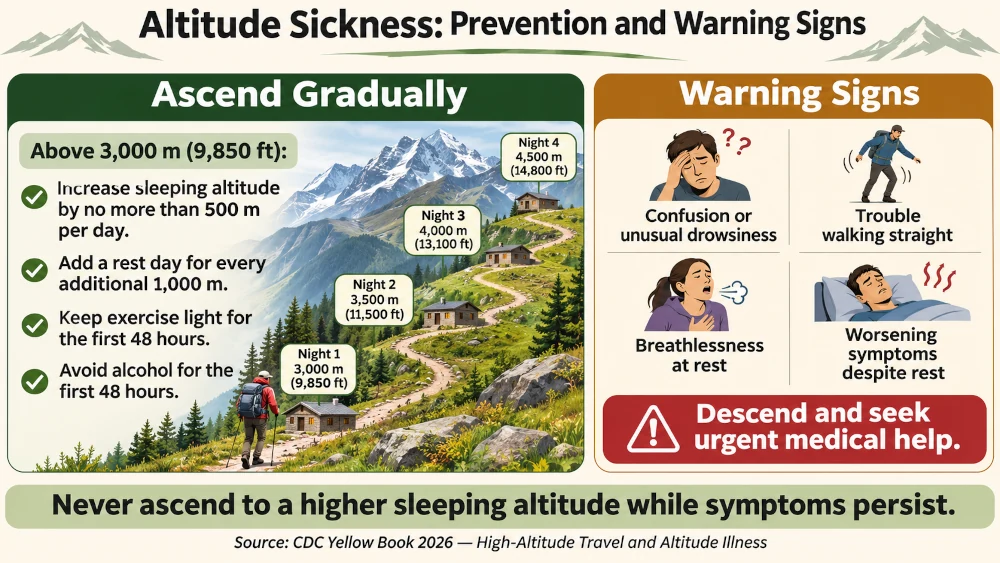
Mild acute mountain sickness feels like a hangover: headache, often with nausea, poor appetite, dizziness or fatigue, usually starting 2–12 hours after you arrive [CDC, 2026b]. Get medical help and head downhill if you notice:
- confusion, unusual drowsiness, or trouble walking in a straight line (possible high-altitude cerebral edema)
- breathlessness while resting, a persistent cough, or chest congestion (possible high-altitude pulmonary edema)
- symptoms that get worse despite rest at the same altitude
Never move to a higher sleeping altitude while you still have symptoms, however mild. Descent is the main treatment, and AMS usually improves after dropping 300 m (1,000 ft) or more [CDC, 2026b].
Other Claimed Benefits: What the Evidence Shows
| Claim | What the evidence says | Evidence grade |
| Altitude sickness | No controlled trials; traveler surveys can’t show cause and effect [CDC, 2026a; Bauer, 2019] | Insufficient |
| Fatigue and energy | Traditional use; no good scientific evidence [WebMD, n.d.] | Traditional use only |
| Athletic performance | Raises heart rate without improving exercise ability [WebMD, n.d.; RxList, n.d.] | Likely ineffective |
| Stomach complaints | Long folk use for pain, nausea, indigestion; no clinical trials found [Biondich & Joslin, 2016] | Traditional use only |
| Nutrition | Leaves contain calories, carbohydrates, minerals and vitamins; amounts and real dietary value not quantified [Biondich & Joslin, 2016] | Limited |
| Depression, motion sickness, weight loss | Proposed in 1978 as ideas worth studying [Weil, 1978]; we found no later trials supporting them | Speculative |
That last row is worth a sentence. In 1978, physician Andrew Weil suggested coca might help gastrointestinal problems, motion sickness and depression, or serve as a coffee substitute [Weil, 1978]. Those were hypotheses. Nearly 50 years on, they remain untested in good-quality human trials.
Coca and Modern Medicine: The Anesthetic Connection
Coca’s biggest gift to medicine came through cocaine’s numbing effect. In 1884, Viennese ophthalmologist Carl Koller showed cocaine could anesthetize the eye for surgery [Redman, 2011]. Its addictiveness pushed chemists to look for something safer, and in 1905 Alfred Einhorn synthesized procaine, a far less addictive local anesthetic that soon displaced cocaine for most uses [Redman, 2011]. Procaine and the anesthetics that followed are laboratory-made drugs, not extracts of the leaf. Procaine itself has since been discontinued in the U.S. [Drugs.com, n.d.].
Cocaine still has a narrow medical role. The FDA has approved a cocaine hydrochloride nasal solution (Goprelto) to numb the lining of the nose before diagnostic procedures and surgery in adults, with a boxed warning about its high potential for abuse and dependence [FDA, Goprelto label]. NIDA notes doctors may use cocaine for local anesthesia in some eye, ear and throat surgeries [NIDA, 2024].
Side Effects and Safety of Coca Plant Leaves

Decocainized coca leaf, with the cocaine removed, is used as a food flavoring and is rated likely safe in food amounts [RxList, n.d.; WebMD, n.d.]. For ordinary leaves, there isn’t enough reliable information to say whether they are safe [WebMD, n.d.]. The concern is the cocaine they contain. At higher exposures it can cause raised blood pressure, migraines, seizures, stroke, heart attack, and liver and kidney failure [WebMD, n.d.; RxList, n.d.]. No one has established a safe dose range for coca [WebMD, n.d.; RxList, n.d.], so there is no reliable way to know where a cup of tea or a cheek of leaves sits on that scale for you.
Drug interactions
WebMD and RxList flag the same four interactions but grade two of them differently. Where they disagree, assume the more cautious rating until a pharmacist tells you otherwise.
| Medicine or substance | Concern | WebMD rating | RxList rating |
| Alcohol | Combined effects on the brain; alcohol and cocaine also form cocaethylene, which may add to heart toxicity [WebMD, n.d.; NIDA, 2024] | Moderate | Major |
| Nifedipine | Higher risk of serious effects such as seizures [WebMD, n.d.; RxList, n.d.] | Moderate | Major |
| Diabetes medicines | Coca may raise blood sugar and blunt the medicine [WebMD, n.d.; RxList, n.d.] | Moderate | Moderate |
| Blood pressure medicines | Coca may raise blood pressure and blunt the medicine [WebMD, n.d.; RxList, n.d.] | Moderate | Moderate |
The nifedipine entry matters for travelers. CDC lists nifedipine as a treatment for high-altitude pulmonary edema [CDC, 2026b], so it may be in your medical kit or handed to you at a clinic in the mountains. Tell whoever treats you about any coca use.
Pregnancy and breastfeeding
Avoid coca entirely. Both monographs rate it unsafe in pregnancy, citing possible miscarriage, birth defects and a link with sudden infant death syndrome, and unsafe while breastfeeding because cocaine passes into breast milk [WebMD, n.d.; RxList, n.d.].
Who should avoid coca leaves
- Anyone who is pregnant or breastfeeding [WebMD, n.d.; RxList, n.d.]
- People with heart disease, high blood pressure, or a past stroke or high stroke risk [WebMD, n.d.; RxList, n.d.]
- People with asthma, which cocaine can worsen [RxList, n.d.]
- People with plasma pseudocholinesterase deficiency, who are more likely to have seizures or die after cocaine exposure [RxList, n.d.]
- People with diabetes, unless their clinician agrees and blood sugar is monitored [WebMD, n.d.; RxList, n.d.]
- Anyone facing a drug test (see below)
- Anyone in recovery from cocaine or other stimulant use: talk with your treatment team before any exposure
If what you want is a warm herbal cup without a controlled substance in it, our guide to brewing a calming nervine tea covers caffeine-free options.
Coca tea will show up on a drug test
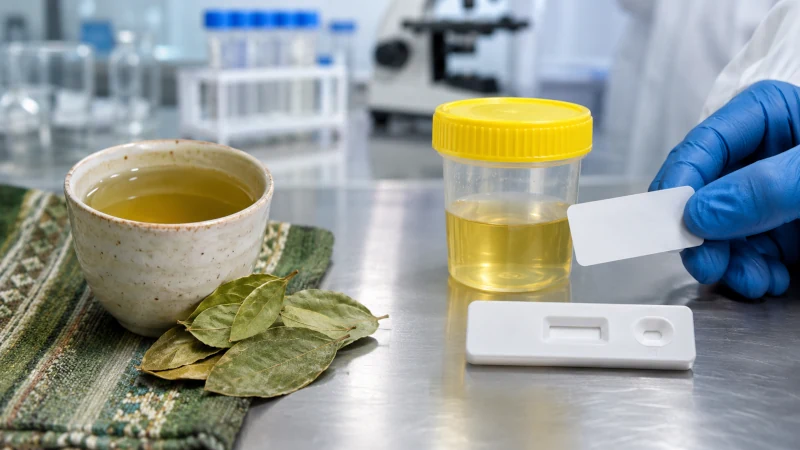
This one catches travelers off guard. In a small study, all five volunteers who drank coca tea tested positive for cocaine metabolites within 2 hours, and three were still positive at 36 hours [Mazor et al., 2006]. CDC warns that coca leaf use may produce a positive result [CDC, 2026a]. If you face workplace, sports, military or legal drug testing, skip coca tea and other coca products altogether, including in the days before a test.
Is Coca Leaf Legal?
That depends on where you are standing. Internationally, coca leaf stays in Schedule I of the 1961 Single Convention; the UN Commission on Narcotic Drugs confirmed that position in April 2026, while noting that countries can still protect traditional uses under national law [WHO, 2026]. That is why coca tea is offered openly in parts of the Andes, including at high-altitude airports and to arriving travelers [Bauer, 2019].
In the United States, coca leaves are a Schedule II controlled substance. Only decocainized leaves, and extracts that contain no cocaine or ecgonine, are excluded [eCFR, 21 CFR 1308.12]. Packing leaves or tea bags as a souvenir from Peru or Bolivia is not a harmless gift. Check the rules for every country on your route before you buy.
The Coca Plant at a Glance
| Feature | Detail |
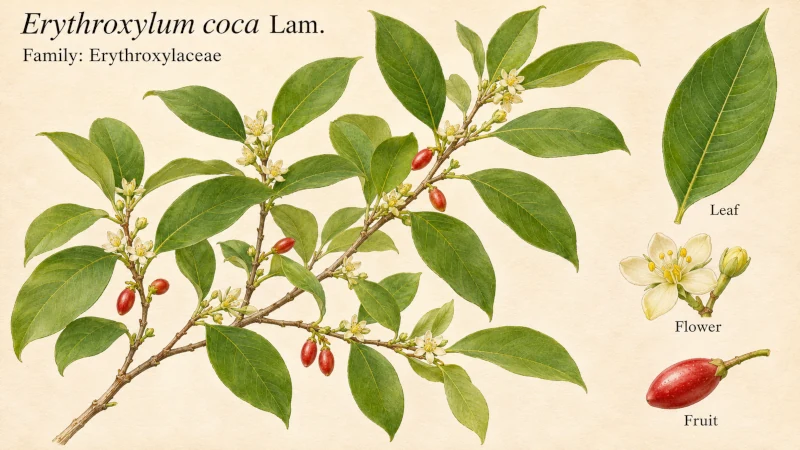
| Scientific name | Erythroxylum coca Lam. [Flora of the World, n.d.] |
| Family | Erythroxylaceae [Britannica, n.d.; Flora of the World, n.d.] |
| Native range | Bolivia, northern Brazil, Colombia, Ecuador and Peru [Flora of the World, n.d.] |
| Appearance | Shrub about 2.4 m (8 ft) tall with thin oval leaves, small yellowish-white flowers in clusters, and red berries [Britannica, n.d.] |
| Part used | Leaves |
| Main alkaloid | Cocaine, about 0.6% of the dried leaf in E. coca var. coca [Biondich & Joslin, 2016] |
| HEALTH DISCLAIMER: This article is for general education. It is not medical or legal advice, and it is not a recommendation to use coca. Coca leaf products contain cocaine and are controlled substances in many countries, including the United States. Talk with a doctor or pharmacist before using any coca product if you take medicines, have heart disease, high blood pressure, asthma or diabetes, or are pregnant or breastfeeding. At high altitude, confusion, trouble walking, or breathlessness at rest need urgent medical care and descent. Read our full medical advice disclaimer. |
Frequently Asked Questions
Does coca tea contain cocaine?
Yes. Laboratory analysis found roughly 5 mg of cocaine per tea bag when the leaf was fully extracted [Biondich & Joslin, 2016]. That is far less than a recreational dose, but it is enough to show up on a drug test.
Can you get addicted to coca leaves?
The evidence isn’t settled. A 2016 review found no evidence that habitual use of whole coca leaf causes addiction or withdrawal [Biondich & Joslin, 2016], while WHO said in 2025 that evidence on dependence remains limited [WHO, 2025]. Purified cocaine, by contrast, is clearly addictive [NIDA, 2024].
Will one cup of coca tea make me fail a drug test?
It can. In one small study, every volunteer tested positive within 2 hours of drinking coca tea, and most were still positive at 36 hours [Mazor et al., 2006]. CDC gives travelers the same warning [CDC, 2026a].
Is coca tea like drinking coffee?
Both are mild stimulants, but coca contains a controlled substance and has far less safety research behind it. If you want a familiar pick-me-up, here is what’s known about the effects of coffee on the body, including safe daily limits.
Are coca leaves legal in the United States?
No. Coca leaves are a Schedule II controlled substance under federal regulations. Only decocainized leaves and extracts that contain no cocaine or ecgonine are excluded [eCFR, 21 CFR 1308.12].
References
- Bauer I. Travel medicine, coca and cocaine: demystifying and rehabilitating Erythroxylum – a comprehensive review. Tropical Diseases, Travel Medicine and Vaccines. View source
- Biondich AS, Joslin JD. Coca: The History and Medical Significance of an Ancient Andean Tradition. Emergency Medicine International. View source
- Centers for Disease Control and Prevention. Complementary and Integrative Health Approaches to Travel Wellness. View source
- Centers for Disease Control and Prevention. High-Altitude Travel and Altitude Illness. View source
- Drugs.com. Procaine (archived consumer drug information; notes the drug is discontinued in the U.S.). View source
- Electronic Code of Federal Regulations. 21 CFR § 1308.12 – Schedule II. View source
- U.S. Food and Drug Administration. GOPRELTO (cocaine hydrochloride) nasal solution, 4% – Prescribing Information. View source
- Flora of the World. Erythroxylum coca Lam. (native-range data cited from Plants of the World Online). View source
- Encyclopaedia Britannica. Coca (Erythroxylum coca). View source
- Mazor SS, et al. Coca tea consumption causes positive urine cocaine assay. European Journal of Emergency Medicine. View source
- National Institute on Drug Abuse. Cocaine Research Report: What is cocaine? View source
- Redman M. Cocaine: What is the Crack? A Brief History of the Use of Cocaine as an Anesthetic. Anesthesiology and Pain Medicine. View source
- RxList. Coca: Health Benefits, Side Effects, Uses, Dose & Precautions. View source
- WebMD. Coca: Uses, Side Effects, and More. Ingredient monograph 748. View source
- Weil AT. Coca leaf as a therapeutic agent. American Journal of Drug and Alcohol Abuse. View source
- World Health Organization. WHO Expert Committee concludes critical review of coca leaf, recommends maintaining current controls. View source
- World Health Organization. UN drug policy body acts on WHO recommendations to control new psychoactive substances and considers coca leaf review. View source


