
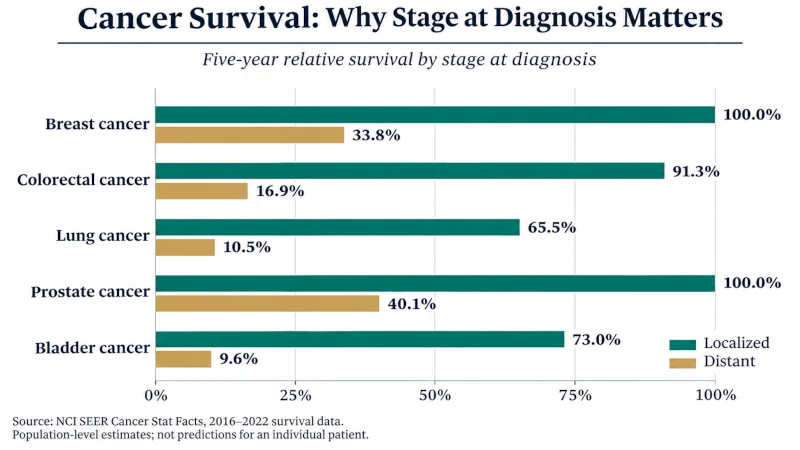
Breast, colorectal, lung, prostate, and bladder cancer — the top 5 cancers in seniors covered here — become far more common after 60, and together they account for a large share of the cancer older Americans face. Across all cancers, the median age at diagnosis in the U.S. is 67 [NCI, 2025]. The more hopeful number is what happens when these cancers are found early. While the cancer is still localized, five-year relative survival ranges from about 65% for lung cancer to essentially 100% for breast and prostate cancer [NCI SEER], [NCI SEER], [NCI SEER]. Screening, where a good test exists, and paying attention to a few specific symptoms are how most people get to that stage in time.

Why cancer risk climbs with age
Most cancer is a disease of later life. Half of people with lung cancer are 71 or older when they’re diagnosed, and the median for bladder cancer is 73 [NCI SEER], [NCI SEER].
Time is a big part of it. Over the years, cells collect damage to their DNA, and the longer you live, the longer you’ve been exposed to things that speed that up: tobacco smoke, alcohol, radiation, air pollution. One well-studied pathway is oxidative stress, where reactive oxygen molecules damage DNA, proteins, and fats faster than the body can repair them. A 2018 review in Clinical Interventions in Aging lists cancer among the age-related conditions oxidative stress contributes to. The authors also say the exact mechanisms are still being worked out [Liguori et al., 2018].
Age isn’t destiny, though. The World Health Organization estimates that about 38% of cancers could be prevented today by avoiding known risk factors and using existing prevention strategies [WHO, 2026].
The top 5 cancers in seniors at a glance
| Cancer | Median age at diagnosis | Routine screening for average-risk adults (USPSTF) | Early signs to report |
| Breast | 64 (women) | Mammogram every 2 years, ages 40–74 | New lump, skin dimpling, nipple changes |
| Colorectal | 66 | Stool test, colonoscopy, or other option, ages 45–75; individual decision 76–85 | Rectal bleeding, bowel changes lasting more than a few days, anemia |
| Lung | 71 | Yearly low-dose CT, ages 50–80, with a 20 pack-year history and currently smoking or quit within 15 years | Cough that lingers or worsens, coughing up blood |
| Prostate | 68 | PSA test: individual decision at 55–69; not recommended at 70+ | Usually none early |
| Bladder | 73 | No routine screening | Blood in the urine |
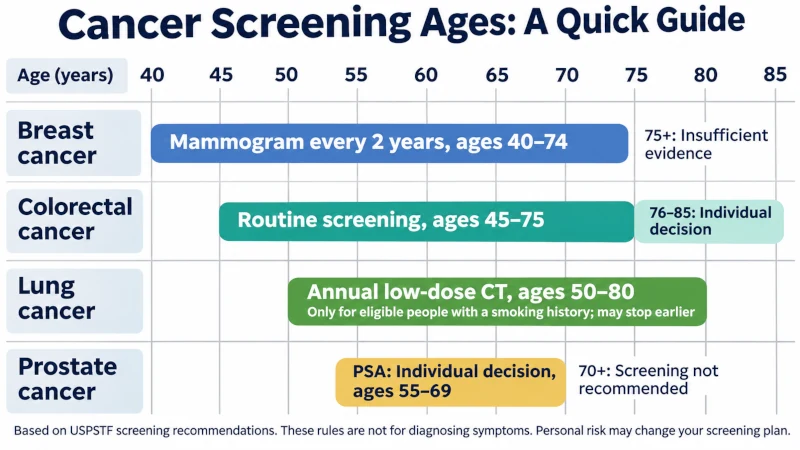
Median ages: NCI SEER Cancer Stat Facts, 2019–2023 data. Screening: U.S. Preventive Services Task Force; bladder: American Cancer Society.
Breast, prostate, lung, and colorectal cancers are the four most commonly diagnosed cancers in the U.S. Melanoma comes next overall, just ahead of bladder cancer [NCI, 2025]. Bladder cancer makes this list because it is concentrated in later life and because its main warning sign is so easy to act on. If you have a new mole, or one that’s changing, tell your doctor about it too [ACS, n.d.].
1. Breast cancer

About 1 in 8 U.S. women will be diagnosed with invasive breast cancer in her lifetime. The American Cancer Society expects roughly 321,910 new cases in 2026 [ACS, 2026]. Nearly half of new cases occur in women 65 and older, and the age group with the most diagnoses is 65 to 74 [NCI SEER].
Screening
The U.S. Preventive Services Task Force (USPSTF) recommends a mammogram every two years for women aged 40 to 74 [USPSTF, 2024]. For women 75 and older, the Task Force says the evidence isn’t strong enough to weigh benefits against harms. That doesn’t mean you should stop. It means the decision depends on your health and what matters to you, so talk it through with your clinician. The same “insufficient evidence” verdict applies to adding ultrasound or MRI for women with dense breasts.
The recommendation is not meant for you if you carry a BRCA1 or BRCA2 variant or another high-risk genetic marker, had high-dose chest radiation at a young age, or have had breast cancer or a high-risk breast lesion before [USPSTF, 2024]. Those situations need their own screening plan.
Warning signs
A new lump is the most common sign, though most breast lumps turn out not to be cancer. Tell your doctor about any of these [ACS, n.d.]:
- A new lump or mass in the breast
- Swelling of all or part of a breast, even without a lump
- Skin dimpling that can look like orange peel
- Nipple or breast skin that is red, dry, flaky, or thickened
- A nipple that turns inward, or discharge other than breast milk
- Swollen lymph nodes under the arm or near the collarbone
2. Colorectal cancer
Colorectal cancer is the second leading cause of cancer death in the U.S. when men and women are counted together, with about 55,230 deaths expected in 2026 [ACS, 2026]. The median age at diagnosis is 66 [NCI SEER]. Rates have been falling in older adults while rising about 2.9% a year in people under 50 [ACS, 2026], so this is no longer only a disease of later life. But it remains common in it.
Screening
The USPSTF recommends screening for adults 45 to 75. Between 76 and 85, it’s an individual decision based on your health and your screening history [USPSTF, 2021]. You have more options than most people realize:
- A FIT or high-sensitivity stool test every year
- A stool DNA-FIT test every 1 to 3 years
- CT colonography every 5 years
- Flexible sigmoidoscopy every 5 years (or every 10 years with a yearly FIT)
- Colonoscopy every 10 years
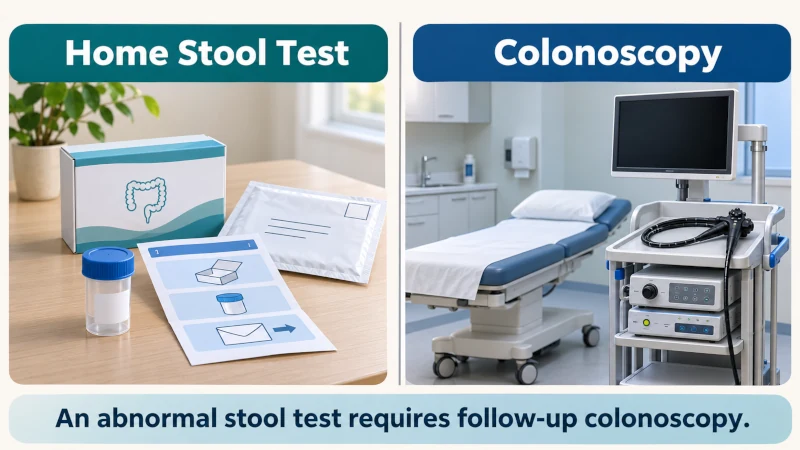
If you pick a test other than colonoscopy, an abnormal result needs a timely follow-up colonoscopy. Otherwise the screening isn’t finished. Colonoscopy also lets the doctor remove certain polyps during the same procedure [ACS, n.d.]. The best test is the one you’ll actually complete.
Warning signs
Early colorectal cancer often causes no symptoms. When it does, watch for [ACS, n.d.]:
- Diarrhea, constipation, or narrower stools lasting more than a few days
- Feeling that you need a bowel movement that going doesn’t relieve
- Bright red rectal bleeding, or stool that looks dark brown or black
- Cramping or belly pain
- Weakness, fatigue, or weight loss you can’t explain
Sometimes the first clue is anemia (a low red blood cell count) on a routine blood test. It can come from slow bleeding you can’t see in the stool [ACS, n.d.].
3. Lung cancer
Lung cancer is by far the leading cause of cancer death in the U.S., accounting for about 1 in 5 cancer deaths, and most people diagnosed are 65 or older [ACS, 2026]. It is also the most common cause of cancer death worldwide [WHO, 2026]. Cigarette smoking is linked to about 80% of U.S. lung cancer deaths. People who have never smoked can still get it: radon in the home, secondhand smoke, and workplace exposures such as asbestos, diesel exhaust, and silica all raise the risk [CDC, n.d.].
Who should get screened
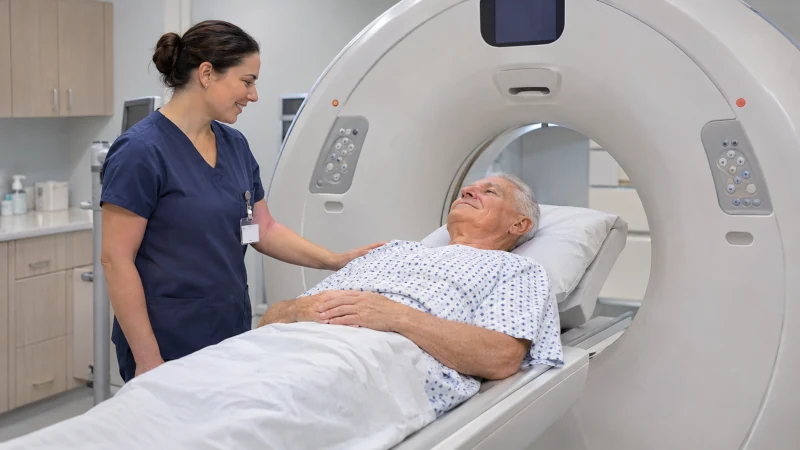
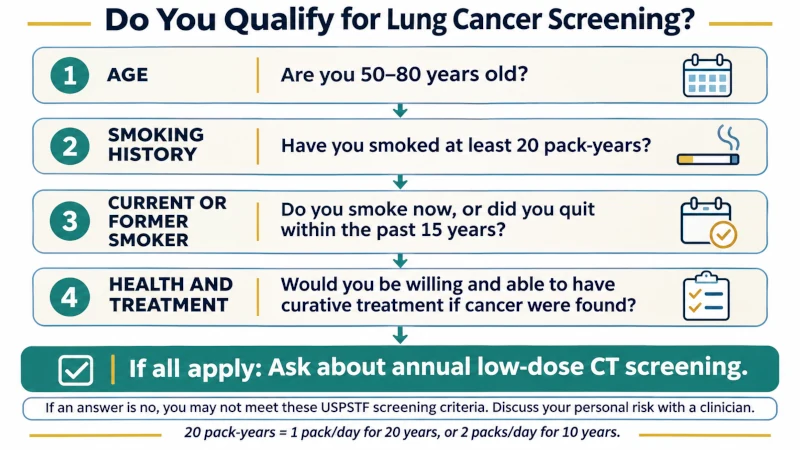
The USPSTF recommends a low-dose CT scan every year for adults 50 to 80 who have a 20 pack-year smoking history and either still smoke or quit within the past 15 years [USPSTF, 2021]. A pack-year is one pack a day for one year, so 20 pack-years could be a pack a day for 20 years or two packs a day for 10. Screening stops once you’ve gone 15 years without smoking. It also stops if another health problem means you couldn’t have, or wouldn’t want, surgery to cure a lung cancer.
If you still smoke, our step-by-step guide on how to stop smoking covers medications that help, the free 1-800-QUIT-NOW line, and handling cravings.
Warning signs
Some people do have symptoms with early lung cancer. These usually have other causes, but they deserve a prompt check [ACS, n.d.]:
- A cough that doesn’t go away or keeps getting worse
- Coughing up blood or rust-colored mucus
- Chest pain that’s worse when you breathe deeply, cough, or laugh
- Hoarseness, new wheezing, or shortness of breath
- Loss of appetite, unexplained weight loss, or tiredness that won’t lift
- Bronchitis or pneumonia that won’t clear up or keeps coming back
In older adults, a lingering cough is also often COPD or an infection. Our guide to respiratory diseases in seniors covers those.
4. Prostate cancer
Other than skin cancer, prostate cancer is the most common cancer in American men. About 1 in 8 men will be diagnosed during their lifetime, about 6 in 10 cases are found in men 65 or older, and Black men face higher risk than men of other races [ACS, 2026]. Many prostate cancers grow slowly. For localized disease, five-year relative survival is essentially 100% [NCI SEER].
Screening is a decision, not a default
For men 55 to 69, the USPSTF says whether to have a PSA blood test should be an individual decision made with your clinician. It recommends against PSA screening for men 70 and older [USPSTF, 2018]. The Task Force is working on an update, but the 2018 guidance is the current final recommendation.
The trade-off is real on both sides. For every 1,000 men aged 55 to 69 who are screened over about 13 years, screening may prevent about 1.3 prostate cancer deaths and about 3 cases of cancer that has spread. On the other side are false-positive results that lead to more tests and biopsies, and overdiagnosis: the Task Force estimates 20% to 50% of screen-detected cancers might never have caused harm. Treatment side effects can also be lasting. About 1 in 5 men who have the prostate removed develop long-term urinary incontinence, and 2 in 3 have long-term erectile dysfunction [USPSTF, 2018].
The American Cancer Society suggests starting the conversation at 50 for men at average risk who expect to live at least 10 more years. It suggests age 45 for Black men and men whose father or brother was diagnosed before 65, and age 40 for men with more than one close relative diagnosed at an early age [ACS, n.d.].
Warning signs
Early prostate cancer usually causes no symptoms. Trouble urinating is much more often caused by benign prostatic hyperplasia (BPH), a noncancerous enlargement of the prostate, but any new urinary trouble should still be checked. More advanced prostate cancer can cause erectile problems, pain in the hips, back, or ribs, weakness or numbness in the legs, loss of bladder or bowel control, weight loss, and fatigue [ACS, n.d.].
5. Bladder cancer

Bladder cancer leans heavily toward older men. About 64,730 of the 84,530 new cases expected in 2026 will be in men [ACS, 2026], and the median age at diagnosis is 73 [NCI SEER]. Smoking is the biggest risk factor. Workplace chemical exposure is another, affecting painters, metal workers, leather workers, and miners, among others [ACS, 2026]. Major medical organizations don’t recommend routine bladder cancer screening for most people [ACS, n.d.], so knowing the warning signs matters more. Caught as an early, non-invasive tumor, five-year relative survival is about 98% [NCI SEER].
Warning signs
Blood in the urine (hematuria) is most often the first sign. It may not show up every day, and it can go away for a while and then come back [ACS, n.d.]. So a single episode that clears up still deserves a call to your doctor. Blood in the urine is more often caused by an infection or kidney stones, but only a proper evaluation can tell.
Bladder cancer can also cause changes in urination [ACS, n.d.]:
- Needing to go more often, or more urgently
- Pain or burning when you urinate
- Trouble urinating, or waking at night to go
Other conditions cause these far more often than cancer does. Larger or more advanced tumors can cause an inability to urinate, lower back pain on one side, weight loss, fatigue, swollen feet, and bone pain [ACS, n.d.].
Symptoms worth a doctor’s visit, whatever the cause
These symptoms aren’t specific to any one cancer and usually have a harmless explanation. When one is new, lasts, or keeps getting worse, have it checked [ACS, n.d.]:
- Weight loss or gain of 10 pounds or more for no known reason
- Fatigue that doesn’t get better with rest
- Swelling or a lump in the breast, lymph nodes, or anywhere in the body
- Unusual bleeding or bruising you can’t explain
- A sore that won’t heal
- A cough or hoarseness that doesn’t go away
- Trouble swallowing
- A new mole, or a change in one you already have
When to get urgent care
Some symptoms shouldn’t wait for a routine appointment. Call 911 or go to an emergency department for heavy or sudden bleeding (including coughing up more than a streak of blood), severe chest pain or sudden trouble breathing, being completely unable to urinate, sudden confusion, weakness or numbness on one side, a seizure, or severe belly pain.
If you’re already living with cancer, ask about palliative care. It focuses on comfort, symptom relief, and quality of life, and it can start as early as diagnosis and run alongside treatment. Choosing it doesn’t mean giving up treatment that might cure the illness [NIA, n.d.].
What actually lowers your cancer risk
No habit can guarantee you won’t get cancer. The evidence does point consistently in the same direction, though, and none of it is exotic. The World Cancer Research Fund estimates that up to 40% of cancer cases are preventable [WCRF, n.d.].
- Don’t smoke. Smoking is linked to about 80% of lung cancer deaths [CDC, n.d.] and is also the leading risk factor for bladder cancer [ACS, 2026].
- Keep alcohol low, or skip it. The International Agency for Research on Cancer classifies alcohol as a Group 1 carcinogen. It’s linked to cancers of the mouth and throat, larynx, esophagus, liver, breast, and colon and rectum [NCI, 2025]. More in our guide: does alcohol cause cancer?
- Stay at a healthy weight. Excess body fat is linked to at least 13 types of cancer [NCI, 2025].
- Keep moving. For adults 65 and older, the CDC recommends at least 150 minutes a week of moderate activity, muscle-strengthening on at least two days, and activities that improve balance [CDC, n.d.]. Adjust to what your body allows. Some is better than none.
- Eat mostly plants. Build meals around whole grains, vegetables, fruit, and beans, and limit red and processed meat, fast food, and sugary drinks [WCRF, n.d.]. Our cancer-preventing diet guide grades the evidence food by food.
- Don’t rely on supplements. Antioxidant supplement trials haven’t shown cancer prevention, and high-dose beta-carotene raised lung cancer risk in people who smoke or used to smoke [WCRF, n.d.], [NCI, 2017]. Get your nutrients from food unless a clinician finds a deficiency.
- Get the vaccines recommended for you. HPV and hepatitis B vaccines protect against cancers those viruses cause [WHO, 2026].
- Keep up with screening. For breast, colorectal, and lung cancer, and for prostate cancer if you choose it, screening finds cancers at the stage where treatment works best.
| HEALTH DISCLAIMER: This article is for general education and does not replace medical advice, diagnosis, or treatment. Screening and treatment decisions should be made with a qualified healthcare professional who knows your personal and family medical history. The screening guidance described here applies to people without symptoms. If you have a lump, unexplained bleeding, blood in your urine, a cough that won’t go away, unintended weight loss, or any other symptom that worries you, contact a doctor promptly rather than waiting for a scheduled screening. No food, supplement, or lifestyle change can guarantee that you will not develop cancer. |
Frequently Asked Questions
What is the most common cancer in older adults?
Other than skin cancer, prostate cancer is the most common in men and breast cancer the most common in women. Lung cancer causes the most cancer deaths in the U.S. [ACS, 2026], [ACS, 2026], [ACS, 2026].
At what age can I stop cancer screening?
It depends on the cancer and your health, not just your birthday. For mammograms, the USPSTF says evidence is insufficient after 75. For colorectal screening, 76 to 85 is an individual decision. Lung screening runs through 80, or ends sooner once you’ve been smoke-free 15 years. PSA screening isn’t recommended at 70 and up [USPSTF, 2024], [USPSTF, 2021], [USPSTF, 2021], [USPSTF, 2018]. Your clinician will weigh your overall health and how long you’re likely to benefit.
Can diet or supplements prevent cancer?
A healthy weight, regular activity, and a mostly plant-based diet lower cancer risk, but no diet guarantees protection. Supplements are a different story. Apart from calcium for colorectal cancer, there’s no strong evidence they reduce cancer risk, and high-dose beta-carotene increased lung cancer risk in people who smoke or used to [WCRF, n.d.].
Are these cancers curable if they’re found early?
Often, yes. Five-year relative survival for localized cancer is about 100% for breast and prostate, 91% for colorectal, 73% for localized bladder cancer (98% when caught as an early non-invasive tumor), and 66% for lung. Once the cancer has spread to distant organs, those figures drop sharply, for example to about 17% for colorectal and 11% for lung [NCI SEER], [NCI SEER], [NCI SEER], [NCI SEER], [NCI SEER].
Does a family history mean I’ll get cancer?
No. Up to 10% of cancers are caused by inherited genetic changes [NCI, n.d.]. Family history still matters, because it can change when screening should start. For prostate cancer, the ACS suggests talking about screening at 45 if your father or brother was diagnosed before 65 [ACS, n.d.]. Women with a known BRCA variant need a separate breast-screening plan [USPSTF, 2024].
Is blood in the urine always a sign of cancer?
No. It’s more often from an infection or kidney stones. But it’s also the most common first sign of bladder cancer, and it can come and go, so even one episode should be checked [ACS, n.d.].
References
- American Cancer Society. How Common Is Breast Cancer? → View source
- American Cancer Society. Signs and Symptoms of Breast Cancer. → View source
- American Cancer Society. Key Statistics for Colorectal Cancer. → View source
- American Cancer Society. Colorectal Cancer Signs and Symptoms. → View source
- American Cancer Society. American Cancer Society Guideline for Colorectal Cancer Screening. → View source
- American Cancer Society. Key Statistics for Lung Cancer. → View source
- American Cancer Society. Signs and Symptoms of Lung Cancer. → View source
- American Cancer Society. Key Statistics for Prostate Cancer. → View source
- American Cancer Society. Prostate Cancer Signs and Symptoms. → View source
- American Cancer Society. American Cancer Society Recommendations for Prostate Cancer Early Detection. → View source
- American Cancer Society. Key Statistics for Bladder Cancer. → View source
- American Cancer Society. Bladder Cancer Signs and Symptoms. → View source
- American Cancer Society. Can Bladder Cancer Be Found Early? → View source
- American Cancer Society. Signs and Symptoms of Cancer. → View source
- Centers for Disease Control and Prevention. Lung Cancer Risk Factors. → View source
- Centers for Disease Control and Prevention. (Older Adult Activity: An Overview. → View source
- Liguori, I., Russo, G., Curcio, F., et al. Oxidative stress, aging, and diseases. Clinical Interventions in Aging, → View source
- National Cancer Institute. Cancer Statistics. → View source
- National Cancer Institute. Age and Cancer Risk. → View source
- National Cancer Institute. Alcohol and Cancer Risk. → View source
- National Cancer Institute. Obesity and Cancer. → View source
- National Cancer Institute. Antioxidants and Cancer Prevention. → View source
- National Cancer Institute. The Genetics of Cancer. → View source
- NCI SEER Program. Cancer Stat Facts: Female Breast Cancer. → View source
- NCI SEER Program. Cancer Stat Facts: Colorectal Cancer. → View source
- NCI SEER Program. Cancer Stat Facts: Lung and Bronchus Cancer. → View source
- NCI SEER Program. Cancer Stat Facts: Prostate Cancer. → View source
- NCI SEER Program. Cancer Stat Facts: Bladder Cancer. → View source
- National Institute on Aging. What Are Palliative Care and Hospice Care? → View source
- U.S. Preventive Services Task Force. Breast Cancer: Screening. → View source
- U.S. Preventive Services Task Force. Colorectal Cancer: Screening. → View source
- U.S. Preventive Services Task Force. Lung Cancer: Screening. → View source
- U.S. Preventive Services Task Force. Prostate Cancer: Screening (update in progress). → View source
- World Cancer Research Fund. Cancer Prevention Recommendations. → View source
- World Cancer Research Fund. Do not use supplements for cancer prevention: Recommendation evidence. → View source
- World Health Organization. Cancer: Fact sheet. → View source


