Vitamin A keeps your eyes working in dim light, helps your immune system hold the line against infection, and supports the skin and lining tissues that form your body’s first barrier. Those are the real, well-established vitamin A benefits — and here’s the part most articles skip: in the United States, fewer than 1% of people are actually short on it [NIH ODS, 2025].
For most readers, the useful question isn’t “how do I get more?” It’s understanding the two different forms of vitamin A, knowing which foods supply it, and recognizing where “helpful” turns into “too much” — because this is one of the few vitamins where overdoing supplements can do real harm.
What vitamin A does in your body
Vitamin A is a group of fat-soluble compounds — retinol and its relatives — that your body uses in several systems [NIH ODS, 2025].
For vision, it’s part of rhodopsin, the light-sensitive pigment in your retina that lets you see in low light. The old line about carrots helping you see in the dark is half-true: if you’re deficient, restoring vitamin A restores night vision. But topping up beyond what you need won’t sharpen a well-nourished person’s eyesight or replace glasses [Harvard T.H. Chan, 2024].
For immunity, vitamin A maintains the moist surfaces — eyes, gut, airways — that keep pathogens out, along with the immune cells behind them. That’s why deficiency makes infections more frequent and more severe, especially in children [NIH ODS, 2025].
It’s also required for growth, cell differentiation, and reproduction — normal development of the heart, lungs, eyes, and other organs depends on it — and it helps keep skin and mucous membranes healthy. That last point is different from prescription retinoid creams, which are concentrated drugs derived from vitamin A, not the nutrient on your plate [NIH ODS, 2025].
What vitamin A does not do, despite frequent claims: it doesn’t reverse aging, extend lifespan, or cure cancer. More on where those claims come from, and what the evidence really says, further down.
The two forms of vitamin A: retinol vs. carotenoids
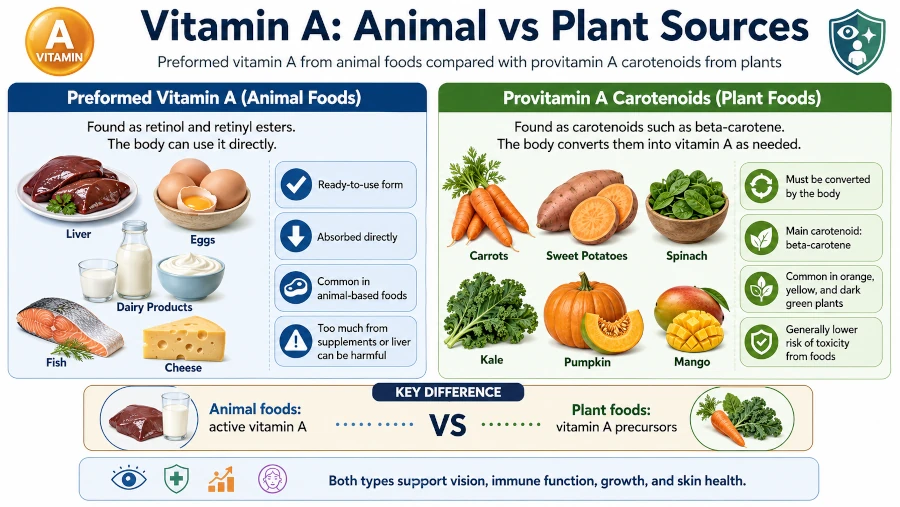
This distinction is the single most useful thing to understand about vitamin A, because the two forms behave differently in your body.
Preformed vitamin A (retinol) comes from animal foods — liver, fish, eggs, dairy — and from fortified foods and supplements. Your body absorbs it efficiently and uses it directly. It also counts directly toward the safe upper limit, which matters when supplements enter the picture [NIH ODS, 2025].
Provitamin A carotenoids — beta-carotene and its cousins — are the orange, red, and deep-green pigments in plants. Your body converts them into vitamin A only as it needs more. That regulated conversion has a reassuring consequence: you can’t give yourself vitamin A toxicity by eating carrots and sweet potatoes. The most that tends to happen with very high carotene intake is carotenodermia — a harmless yellow-orange tint to the skin that fades once you cut back [NIH ODS, 2025].
There’s an important caveat the “carotene is always safe” framing misses: beta-carotene in high-dose supplement form is a different story from beta-carotene in food, and it carries a real risk for some people. That’s covered in the safety section below.
One more note: lycopene, lutein, and zeaxanthin are also carotenoids, but your body doesn’t turn them into vitamin A. They have their own roles — lutein and zeaxanthin, for instance, concentrate in the retina [NIH ODS, 2025].
The best food sources of vitamin A
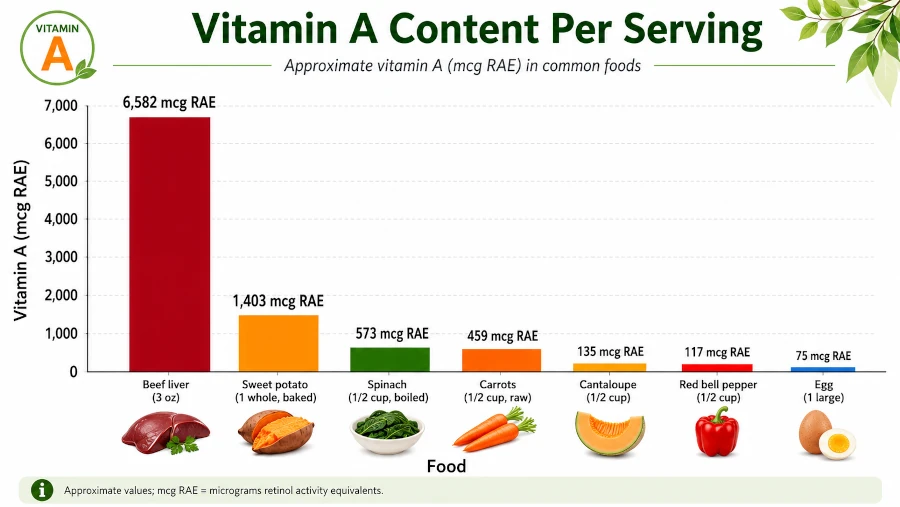
The most reliable way to cover your needs is food, and a handful of foods do most of the work. Beef liver is in a class of its own; among plants, deep-orange and dark-green produce lead.
| Food | Vitamin A per serving (mcg RAE) | % Daily Value |
| Beef liver, pan-fried, 3 oz | 6,582 | 731% |
| Sweet potato, baked in skin, 1 whole | 1,403 | 156% |
| Spinach, boiled, ½ cup | 573 | 64% |
| Carrots, raw, ½ cup | 459 | 51% |
| Cantaloupe, raw, ½ cup | 135 | 15% |
| Red bell pepper, raw, ½ cup | 117 | 13% |
| Mango, 1 whole | 112 | 12% |
| Egg, hard-boiled, 1 large | 75 | 8% |
| Dried apricots, 5 pieces | 63 | 7% |
Source: NIH Office of Dietary Supplements, 2025. DV = Daily Value (900 mcg RAE). View source
Two practical tips. Vitamin A and carotenoids are fat-soluble, so a little fat with your vegetables — olive oil on a salad, for example — improves absorption. And light cooking can actually make beta-carotene more available than eating the vegetable raw [NIH ODS, 2025]. Beyond the headliners, you’ll find useful amounts in plenty of everyday produce, including tomatoes and red and green bell peppers.
Signs of vitamin A deficiency — and who’s actually at risk
In wealthy countries, deficiency is uncommon; in the U.S., under 1% of people have low blood levels of vitamin A [NIH ODS, 2025]. Globally, it’s a different picture: vitamin A deficiency is one of the top causes of preventable blindness in children, and roughly a third of preschool-age children in some regions are affected [NIH ODS, 2025].
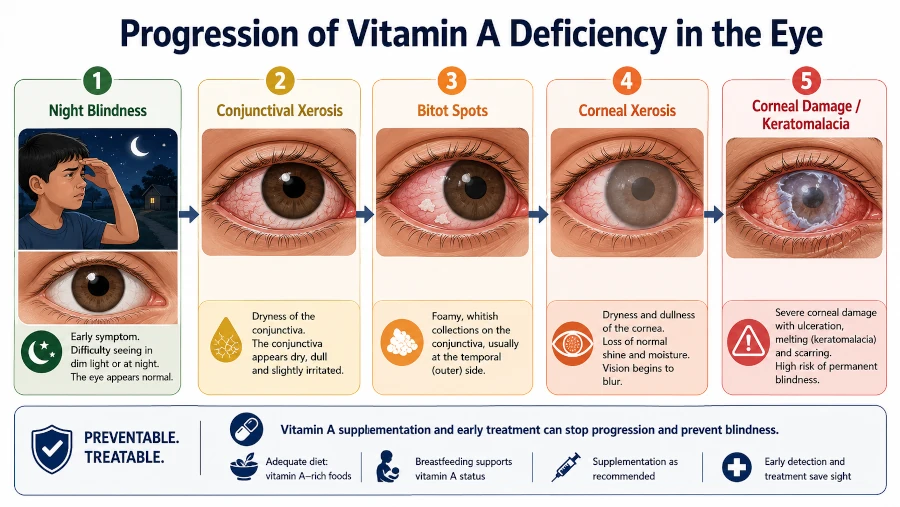
The classic early sign is night blindness — trouble seeing in dim light. If deficiency continues, it can progress to xerophthalmia, where the surface of the eye dries out and the cornea is damaged, and ultimately to permanent blindness [NIH ODS, 2025]. If you’re noticing persistent difficulty seeing in low light, it’s worth reading more on the causes of night blindness and getting checked, since several causes are treatable; the same goes for ongoing eye dryness and irritation.
Prolonged deficiency also raises the risk and severity of infections, can cause dry skin, and in children increases the danger from measles and diarrheal illness [NIH ODS, 2025].
Some people are at higher risk even in well-fed populations: premature infants, who are born with low stores; people with conditions that impair fat absorption, including cystic fibrosis, Crohn’s disease, ulcerative colitis, and celiac disease; and anyone in a low-resource setting with limited access to varied food [NIH ODS, 2025]. If you fall into one of these groups, vitamin A status is worth raising with your clinician rather than self-treating.
How much vitamin A do you need?
Needs are measured in micrograms of retinol activity equivalents (mcg RAE), a unit that accounts for the different forms.
| Group | RDA (mcg RAE/day) |
| Children 1–3 years | 300 |
| Children 4–8 years | 400 |
| Children 9–13 years | 600 |
| Men 14+ years | 900 |
| Women 14+ years | 700 |
| Pregnancy (19–50) | 770 |
| Breastfeeding (19–50) | 1,300 |
Source: NIH Office of Dietary Supplements, 2025. View source
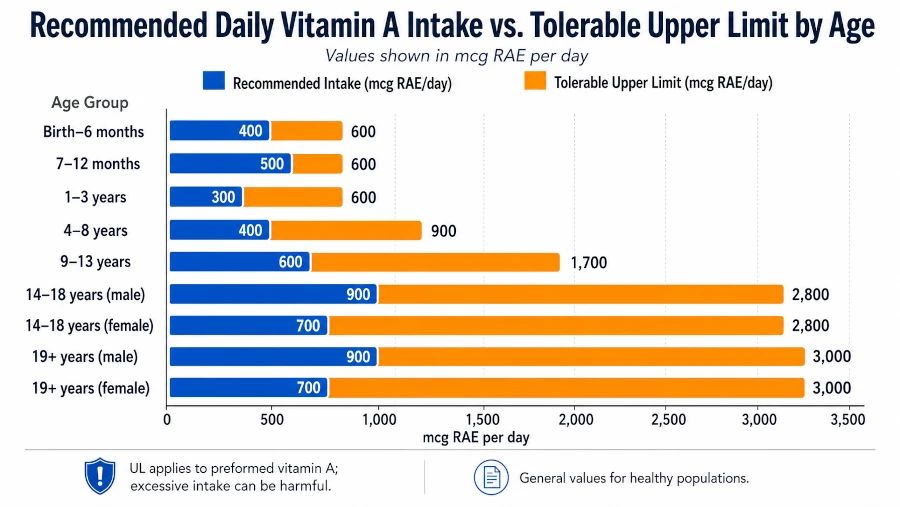
If you remember vitamin A in International Units (IU) from older labels, the rough translation is that 900 mcg RAE equals about 3,000 IU when the source is retinol or supplemental beta-carotene [NIH ODS, 2025]. The practical takeaway: average U.S. adults already take in close to these amounts from food alone — about 682 mcg RAE a day for men and 616 for women — so a standalone high-dose vitamin A supplement is usually unnecessary unless a clinician has identified a specific reason [NIH ODS, 2025].
Can you take too much? Toxicity and the safe ceiling
This is the section that matters most. Because preformed vitamin A is fat-soluble, your body stores the excess in your liver, where it accumulates [NIH ODS, 2025].
Acute toxicity — from one or a few very large doses — brings severe headache, blurred vision, nausea, dizziness, and aching muscles; in serious cases, pressure can build around the brain. Chronic toxicity from regular high doses shows up as dry skin, hair loss, painful joints and muscles, fatigue, liver abnormalities, and, over time, bone problems [NIH ODS, 2025].
The tolerable upper intake level (UL) for preformed vitamin A — the daily amount unlikely to cause harm — is well defined:
| Age | Upper limit (preformed vitamin A) |
| 0–3 years | 600 mcg/day |
| 4–8 years | 900 mcg/day |
| 9–13 years | 1,700 mcg/day |
| 14–18 years | 2,800 mcg/day |
| Adults 19+ (incl. pregnancy) | 3,000 mcg/day (≈10,000 IU) |
Source: NIH Office of Dietary Supplements, 2025. View source
A few cautions worth keeping in mind:
- These limits apply to preformed vitamin A from animal foods and supplements — not to beta-carotene from plants, which your body converts as needed.
- Cod liver oil and other fish liver oils are very concentrated in vitamins A and D. If you take one alongside a multivitamin, it’s easy to overshoot without realizing it.
- High-dose beta-carotene supplements are not automatically safe just because they’re “natural.” In two large trials — CARET and ATBC — high-dose beta-carotene, taken alone or with retinol, increased lung cancer risk in people who smoked or had asbestos exposure [Omenn et al., 1996] [ATBC Study Group, 1994]. Because of this, the Food and Nutrition Board advises against beta-carotene supplements for the general population except to correct a diagnosed deficiency [NIH ODS, 2025].
Vitamin A and pregnancy
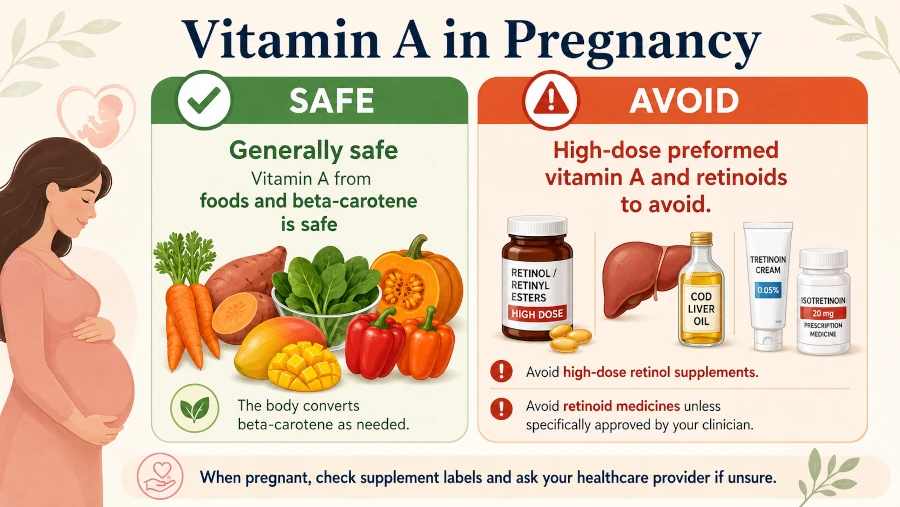
Pregnancy is the one situation where vitamin A deserves real caution. Too much preformed vitamin A early in pregnancy can cause birth defects, including malformations of the eyes, skull, heart, and lungs [NIH ODS, 2025].
The guidance is straightforward. If you’re pregnant or might be, don’t take high-dose vitamin A supplements — experts advise staying under 3,000 mcg RAE (10,000 IU) of preformed vitamin A a day — and avoid oral retinoid medications such as isotretinoin, which are strongly linked to birth defects. Beta-carotene from food isn’t known to cause these problems and is the safer way to keep your levels up [NIH ODS, 2025]. A standard prenatal vitamin is formulated with this in mind; check with your prenatal provider before adding anything beyond it.
What the evidence does — and doesn’t — support
A lot of vitamin A marketing rests on a real observation stretched past what it can hold. Here’s the honest version.
Cancer
People who eat plenty of vitamin A– and carotenoid-rich foods — meaning lots of fruits and vegetables — do tend to have lower rates of several cancers in observational studies [NIH ODS, 2025]. But that’s a property of the diet, not a pill. Vitamin A and beta-carotene supplements have not been shown to prevent cancer or reduce cancer deaths, and in smokers, high-dose beta-carotene raised lung cancer risk. So “vitamin A treats cancer” isn’t supported. (One genuine exception lives in a different category: a vitamin A–derived prescription drug, all-trans retinoic acid, is used to treat a specific leukemia — but that’s a high-dose medication under specialist care, not a supplement [NIH ODS, 2025].)
Heart disease and aging
There’s no good evidence that vitamin A or beta-carotene supplements protect your heart; in the CARET trial, the high-dose combination was associated with higher cardiovascular and overall mortality [Omenn et al., 1996]. Claims that vitamin A reverses aging or extends lifespan aren’t supported by the evidence.
Eye disease (AMD)
For age-related macular degeneration, the AREDS supplement formulas do help slow progression in people at high risk — but the current formula deliberately uses lutein and zeaxanthin instead of beta-carotene, partly because of that lung cancer signal in smokers [NIH ODS, 2025]. If you have AMD, the specific formula is a conversation to have with your eye doctor.
Measles
This is the strongest claim in older write-ups, and it holds up with the right framing. In places where vitamin A deficiency is common, the World Health Organization recommends vitamin A as part of treating children with acute measles. Given as two daily high doses, it reduces complications, and in young or deficient children it reduces deaths [WHO/Cochrane, 2022] [NEJM, 2025]. That’s a clinician-administered protocol for deficient populations — not a reason for a well-nourished person to take megadoses.
When to talk to a healthcare professional
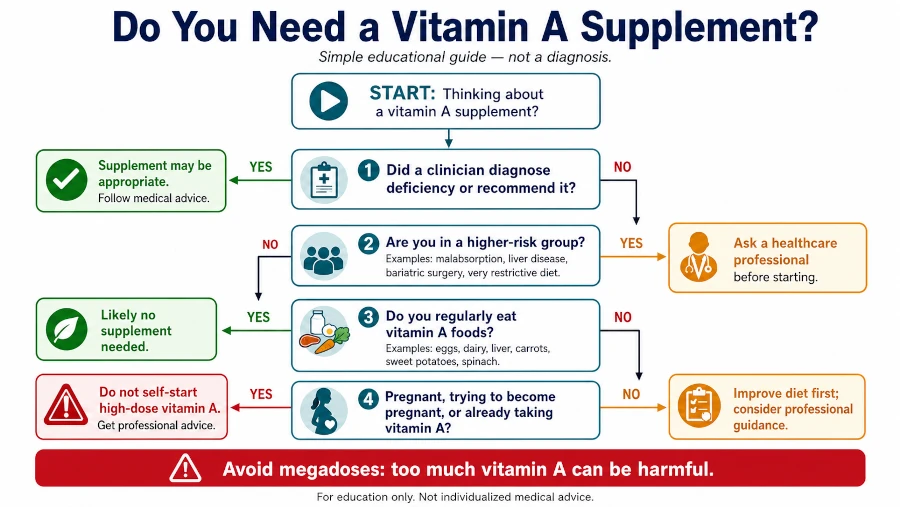
Reach out to a clinician if you notice persistent trouble seeing in low light, or dry, irritated eyes that don’t settle — night blindness has several causes, and some are treatable. If you take vitamin A–containing supplements and develop ongoing headaches, hair loss, joint pain, or nausea, stop and get checked, as these can signal toxicity. And talk to a professional before starting any high-dose vitamin A if you’re pregnant or could be, have liver disease or a fat-malabsorption condition, or take medications such as orlistat or oral retinoids [NIH ODS, 2025].
Seek care promptly for a severe headache with blurred vision, vomiting, and drowsiness after large vitamin A doses — that combination can indicate acute toxicity [NIH ODS, 2025].
| Health Disclaimer This article is for general education and is not a substitute for professional medical advice, diagnosis, or treatment. Vitamin A needs and risks vary by individual — especially during pregnancy, in childhood, and for people with liver or absorption conditions. Always consult a qualified healthcare provider before starting, stopping, or changing any supplement, and never use high-dose vitamin A to self-treat a disease. If you think you may have a medical emergency, contact your doctor or emergency services. |
Frequently Asked Questions
Is it better to get vitamin A from food or supplements?
Food, for almost everyone. Most people meet their needs through a normal diet, and food carotenoids carry no toxicity risk. Supplements are mainly for people with a diagnosed deficiency or an absorption problem, ideally guided by a clinician.
Can you overdose on vitamin A from eating carrots?
No. Your body converts plant carotenoids to vitamin A only as needed, so produce won’t cause toxicity. Overdose risk comes from preformed vitamin A — high-dose supplements, fish liver oils, and very large amounts of liver — not from vegetables.
How much vitamin A is safe per day?
Adults need about 700–900 mcg RAE daily. The safe upper limit for preformed vitamin A is 3,000 mcg/day (about 10,000 IU) for adults, and considerably lower for children. Beta-carotene from food isn’t included in that ceiling.
Is vitamin A safe during pregnancy?
At normal dietary levels and in a standard prenatal vitamin, yes. What to avoid is high-dose preformed vitamin A and oral retinoid drugs, which can cause birth defects. Beta-carotene from food is the safer way to top up — but clear any added supplement with your prenatal provider first.
Does vitamin A improve eyesight?
It corrects the night blindness caused by deficiency, but it won’t fix nearsightedness or farsightedness, and it won’t give a well-nourished person better-than-normal vision.
Are beta-carotene supplements safe?
For most non-smokers at normal doses, beta-carotene is low-risk, but health authorities don’t recommend beta-carotene supplements for the general public. People who smoke or have had asbestos exposure should avoid high-dose beta-carotene, which raised lung cancer risk in large trials.
References
- National Institutes of Health, Office of Dietary Supplements. Vitamin A and Carotenoids — Fact Sheet for Health Professionals. Updated March 10, 2025. View source
- National Institutes of Health, Office of Dietary Supplements. Vitamin A and Carotenoids — Consumer Fact Sheet. View source
- Harvard T.H. Chan School of Public Health, The Nutrition Source. Vitamin A. View source
- World Health Organization. Vitamin A supplementation for preventing morbidity and mortality in children 6–59 months (review summary). View source
- Imdad A, et al. Vitamin A supplementation for preventing morbidity and mortality in children from six months to five years of age. Cochrane Database Syst Rev. 2022. View source
- Omenn GS, et al. Effects of a combination of beta carotene and vitamin A on lung cancer and cardiovascular disease (CARET). N Engl J Med. 1996;334:1150–5. View source
- The Alpha-Tocopherol, Beta-Carotene Cancer Prevention Study Group. The effect of vitamin E and beta carotene on the incidence of lung cancer in male smokers (ATBC). N Engl J Med. 1994;330:1029–35. View source
- World Health Organization. Measles — Fact Sheet. 2024. View source
